No doubt about it: at some point we’re neither semi-retired, findependent or fully retired. We’re out there in a retirement community or retirement home, and maybe for a few years near the end of this incarnation, some time to reflect on it all in a nursing home. Our Longevity & Aging category features our own unique blog posts, as well as blog feeds from Mark Venning’s ChangeRangers.com and other experts.
Lots of media coverage this week about the (relatively) modest expansion of the Canada Pension Plan. As I noted in the print edition of Wednesday’s Financial Post (and online), this isn’t going to help almost-retired baby boomers in any material fashion but it’s certainly a welcome development for the generations that follow, including the Boomers’ own kids.
As I speculated in the headline of sister site FindependenceDay.com, you could argue that a slightly sweeter CPP package of benefits should at least marginally speed up the arrival of the Millennials’ collective Findependence Day. However, I also noted that — as in my own case — there is still an incentive to delay the receipt of CPP benefits. In a way, Boomers who don’t take “early” CPP at 60 and opt to wait until closer to 70 are choosing to almost double their ultimate benefits.
There’s still an incentive to delay receipt of benefits
Late on Monday, as reported by Canadian Press here via the National Post, it was announced that the federal Government has reached an agreement with most of the provinces to expand the Canada Pension Plan, or CPP. Manitoba and Quebec have yet to agree.
As the Globe & Mail reported here, this is the first significant increase in CPP benefits since the program was launched half a century ago. CP also reported that Ontario plans to drop its controversial new Ontario Retirement Pension Plan (ORPP). Once fully implemented, maximum annual CPP benefits would rise by about a third to $17,478.
The seven-year phase-in is expected to start on Jan. 1, 2019, and will require workers and employers to pay higher contributions. Once implemented, the upper earnings limit would rise to $82,700 by 2025. That would replace one third of income up to the new higher ceiling, compared to the 25% that the current CPP replaces. See also Rob Carrick’s Globe article: The Reality of CPP Reform: We Can’t Afford Not to Make These Changes.
What follows is a guest blog by Boomer & Echo’s Robb Engen, which ran this weekend just before the announcement. Minor edits to reflect that have been made but as you can see Robb — who is also a fee-for-service financial planner — pretty much expected this to happen and is generally positive about the prospect. I certainly concur that for the Echo generation he represents, this is a positive step, and since I have a 24-year old daughter, am happy for her as well. (By the way, she is also the Hub’s Millennial blogger: you can see her recent posts that run here Saturdays, such as this one).
Finance Ministers from across the country met Monday in Vancouver to discuss CPP expansion.
At stake is not just about whether we should expand the Canada Pension Plan, but how it should be phased in and who will benefit.
One proposal will see sweeping changes across the board both in terms of higher benefits and premiums paid by all workers. Another scenario targets specific segments of the population without employer pension plans who may not be saving enough for retirement.
Here’s why Canada Pension Plan expansion makes sense:
Canada Pension Plan Expansion
Canadians need to save for retirement and many of us are not doing a very good job of putting away money for our future.
CPP is a way for every working Canadian to have access to a defined benefit pension plan that will provide up to one-quarter of the national average wage in retirement.
In an age when employer pension plans are fading away and average Canadians are coping with the highest debt-to-income ratio in our history, it’s imperative of our government to revisit mandatory savings plans to ensure the financial well-being of our post-retirement citizens.
I work in the public sector, so I’m one of the lucky three in 10 Canadians who still have a defined benefit pension. I contribute approximately 12 per cent of my salary toward the plan, which my employer matches, and that pension will form the bedrock of my income in retirement.
But what do I hear from my co-workers and newly hired employees? It’s not gratitude that they have access to such a rich savings plan. No, instead it’s more like this:
“I wish such a big chunk of my paycheque wasn’t going into this pension plan. I could really use that money right now.”
I’m sure some of you would rather take the reins and invest that money on your own rather than being subject to the whims and restrictions of a public pension plan.
I trust that many of you would invest those funds wisely and maybe, just maybe, could even end up with more money at the end of your career.
But what happens to the 80-to-90 per cent of employees who may not be such good stewards of that extra money?
We could argue that people need to make better and more responsible financial choices but the fact is that savings rates for Canadians are very low by historical standards and the average Canadian family saves less than $1,500 per year.
Voluntary or Mandatory?
One area that CPP expansion will discuss, among other things, is whether to make the additional contributions voluntary. But Canada already has voluntary savings plans in the form of RRSPs and TFSAs, vehicles that Canadians don’t even come close to maxing out.
Imagine instead of mandatory payroll deductions, my colleagues and I had to opt-in to our workplace pension program: How many would willingly choose to contribute?
Behavioural economist Dan Ariely shared a fascinating chart that explained the psychological difference between opting-in and opting-out. He said countries in which organ donation was the default option had a nearly 100 per cent participation rate among its citizens, whereas countries that require citizens to opt-in to consent to organ donation had a remarkably lower participation rate (between 4 and 27 per cent).
We need CPP expansion, not because we need another “tax” on our income, but because we all benefit from living in a society that takes care of its citizens and doesn’t leave its old, disabled, widowed, victims, or simply unlucky in the lurch.
How should CPP expansion be rolled out?
First off, anyone without the luxury of a defined benefit pension plan should be automatically enrolled into a newly expanded CPP.
Forget government workers and public sector employees – they’ll be fine. It’s the other 70 per cent of the workforce without access to a workplace pension who needs the expanded program to help fund their retirement savings.
I’m also not worried about seniors today; the vast majority won’t be eating cat food in their old age – far from it.
Retirees today represent the last era of gold-plated pensions (for both the corporate and government worker) and saw unprecedented growth in the housing market, which translated (or will translate) into enormous, tax-free wealth.
Instead, think of today’s 30-something employees living in one of the larger cities in Canada. They’re starting to get established in their careers, maybe settling down and getting married. But their employers don’t offer a pension program, or even health benefits for that matter, they’re still paying off student loan debt, and they’re trying to save up for a down payment on a $400,000 condo.
There’s no chance they are saving for retirement unless it’s through some form of mandatory savings program.
So how will they afford these additional monthly CPP contributions when they’re struggling with so many other competing priorities?
People remarkably find ways to adapt to the money available in their chequing account. If they have $800, they’ll find a way to spend $800. But if they only have $600 (because $200 went toward expanded CPP contributions) they’ll find a way to spend $600 and be okay.
That’s the power of forced savings and paying yourself first. If it’s there, you’ll spend it. If it’s not there, you won’t miss it.
One interesting piece of research that came out of the Ontario government’s proposed Ontario Retirement Pension Plan was that, after accounting for some reduction in personal savings in response to ORPP contributions, personal household savings should increase by an average of 25 per cent thanks to the ORPP.
Interestingly enough, it’s people with pension plans that tend to save more outside of their pension than their private sector non-workplace pension counterparts. Saving begets more saving!
One added benefit of enhancing a program on a massive scale such as the CPP – lower fees.
Canadians currently have over one trillion dollars invested in mutual funds and pay the highest investment fees in the world. Your investment advisor won’t agree with more of your paycheque going towards a low-cost and well-run vehicle like the CPP, but investors might be better off with less of their money going into high MER mutual funds.
Final thoughts
We’re not all trying to keep up with the Kardashians; many Canadians are legitimately struggling to get by and that is the point of widening the safety net of CPP.
We need to recognize that it’s damn tough to save in today’s economic climate. Think of the couple that wants to start a family and diligently saves 10 per cent of their paycheque every month to put towards a down payment on a house in a year. But in a year, the cost of the house they were looking at has risen by 20 per cent. That’s a difficult situation.
Sometimes we act like there are only two types of people, ants and grasshoppers, while ignoring all the nuance in-between, such as the unlucky or ill-timed entrepreneur whose business failed.
Increase the band of CPP so that our contribution rate is a little bit higher and the yearly maximum limit is a little bit larger so that society as a whole can benefit from the increased savings, and in turn, the increased consumption in retirement.
Then design some favourable and flexible rules around the self-employed or those who are already blessed with a defined benefit pension.
The last thing I haven’t touched on is longevity risk and the very real possibility of outliving our savings in retirement. Our needs may change and healthcare costs may become a major challenge.
Wouldn’t you rather have access to a predictable monthly income that rises with inflation and is guaranteed whether you live to 70 or 120?
The summer is quickly approaching and for many Canadians that means one thing: cottage season.
While many parents envision leaving the family cottage as part of their inheritance one day, with the value of cottages often appreciating since purchase, there’s also the risk of bestowing the legacy of a large tax bill.
To help make sure you’re leaving an inheritance of cottage relaxation and not taxation, here are three strategies you can discuss with your financial advisor when planning your cottage legacy. These strategies are available to you while you are alive, and there are various other strategies that can be implemented on your death in your will.
• Co-own with your Kids
Adding your children to the deed and making them co-owners of your cottage could help defer capital gains tax and save money. For example, if your cottage value has increased over time, it would trigger a capital gain on the portion of the cottage that your children now own and you would pay the tax on that now. Down the road, your kids would only pay tax on the capital gains owing on the remaining portion of the cottage you own when you die. There is, however, a risk with this approach. Continue Reading…
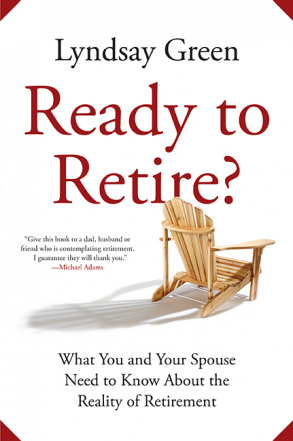
There’s no shortage of books that focus on financial readiness for retirement. But what about emotional or psychological readiness for retirement? Lyndsay Green’s just-published Ready to Retire? (Harper Collins, Toronto, 2016) puts a microscope on the less-scrutinized emotional and lifestyle issues of retirement. She interviewed 44 Canadian males and 17 of their spouses about common retirement fears (for those still working) versus the reality of retirement once it’s actually achieved.
Generally, these males either planned for retirement or – in the all-too-common case of sudden terminations – found themselves unexpectedly in the land of retirement years or even decades before they expected it.
But whether planned or not, most required a period of adjustment that can take years: not surprisingly, retirement is right up there with divorce, death and job loss in creating a traumatic new stage of life.
Mental Map depicts common emotions about Retirement
The book’s frontispiece conveys the common emotions in a graphic that I think should have been the cover. ( Continue Reading…
When it comes to navigating healthcare issues in a foreign country, lots of travelers or would-be Expats have a legitimate concern over the language barrier.
While there is a possibility that you could find yourself in the backwaters of Vietnam, in a lonely village in the mountains of China or Tibet, or spending the night in a hill tribe pueblo reachable only by rickety bridges, chances are you will be somewhere close to a civilized town or large city. In our decades of world travel through dozens of countries, our experience is that most medical professionals speak English or enough English to make the transaction go smoothly.
Service is Primary
In the hospitals of Thailand, we have discussed surgeries, received executive physicals, blood tests, colonoscopies, eye exams, sonograms, x-rays and more. But we are not fluent in Thai. How were we able to communicate about such complicated topics?
Not only do these professional medical personnel speak English, but we are issued a personal translator/assistant who takes us from office to office, procedure to procedure. She translates for us if necessary, keeps our paperwork together and wheels us around in the wheelchair if required. The fee for this service? About $2USD each visit.


 Posted By
  Lots of media coverage this week about the (relatively) modest expansion of the Canada Pension Plan. As I noted in the print edition of Wednesday’s Financial Post (and online), this isn’t going to help almost-retired baby boomers in any material fashion but it’s certainly a welcome development for the generations that follow, including the Boomers’ own kids.

 Posted By