No doubt about it: at some point we’re neither semi-retired, findependent or fully retired. We’re out there in a retirement community or retirement home, and maybe for a few years near the end of this incarnation, some time to reflect on it all in a nursing home. Our Longevity & Aging category features our own unique blog posts, as well as blog feeds from Mark Venning’s ChangeRangers.com and other experts.
Here’s my latest MoneySense blog, which it titled Is your advisor retirement ready? It came out of a conference I attended in Niagara Falls last week: the National Elder Planning Issues Conference. I had delivered the keynote address on why Longevity changes everything — a theme you’ll often see in the Hub’s Longevity & Aging section — but also sat in on a couple of sessions on which this blog is based. As you’ll see it’s also quite relevant to our Decumulation & Downsizing section.
For archival and one-stop shopping purposes, here’s the blog below, with a few photos and subheadings added: Continue Reading…
Are the Baby Boomers part of the Ageless Generation?
Many of us seem to act as if that were the case but there’s little doubt most of us feel younger than we appear. To me, the poster child for this ageless generation is Jane Fonda, whose famous workout videos appear to have held her in good stead in her personal twilight career.
(Technically, since she was born in 1937, Jane Fonda is not a post-war baby boomer but her spirit certainly seems to epitomize the zeitgeist of the generation that came soon after her).
If you get Netflix check out the recently released series Grace & Frankie, where Fonda plays a 70-year old recent divorcee: even though she herself is actually 77! Equally vibrant are her aging costars: Lilly Tomlin, Martin Sheen and Sam Waterston (best known as the prosecutor on Law & Order). Tomlin is 75 and the two male co-stars are 74.
Medical advances will transform the global economy
Amazon.com
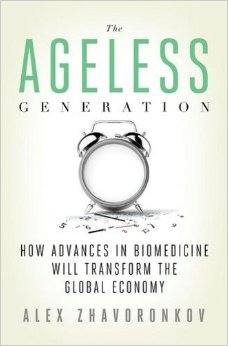
The Ageless Generationalso happens to be the title of a recent (2013) book by Dr. Alex Zhavornonkov, director of the Biogerontology Research Foundation and founder of the International Aging Research Portfolio. It’s one of about a dozen books I read in recent months in preparation for a talk on Longevity that I gave on Monday to the National Elder Planning Issues Conference in Niagara Falls.
The book’s subtitle summarizes the gist of it: How advances in biomedicine will transform the global economy. Since the focus is on the United States, it will come as no surprise that Zhavornonkov believes breakthroughs in extending Longevity can only make a shaky Social Security and Medicare system that much more fragile in the United States, and by extension their equivalent programs in other advanced nations.
On Wednesday, the Financial Post ran the first of seven articles by me that we’re calling The 7 Eternal Truths of Personal Finance: Eternal Truth #1: Live Within Your Means.
Some of the background and rationale for the series ran earlier this week here at the Hub. I believe the series will run online and in the paper once or twice a week over the summer. Each episode is accompanied by a one-minute video.
Note that this is being housed under the Post’s “Young Money” category, which makes sense because the need to live within your means is especially apt for millennials and younger folk.
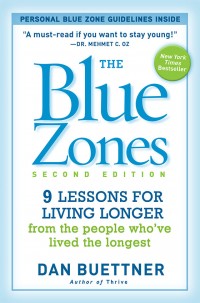
The front-cover blurb on this 2008 NYT bestseller by Dan Buettner is “A must-read if you want to stay young!” Based on that, you’d wonder why every person on the planet hasn’t bought or read The Blue Zones: 9 Lessons for Living Longer, since who doesn’t want to stay young?
The next best thing is to live to a ripe old age and in vibrant health right up until the end. Buettner travelled five “Blue Zones” around the world to study locations that have statistical proof of the extended longevity of many of its residents. They include Sardinia (Italy), Okinawa (Japan), Loma Linda (California), Nikoya (Costa Rica) and Ikaria (Greece.)
In the United States, there is only one centenarian (someone 100 years old or more) per 5,000 people. In the Sardinian “Blue Zone” they found seven centenarians in a single village of 2,500 people.
Fortunately, these Blue Zones often share common lifestyles that North Americans can emulate. Buettner — who originally visited the Blue Zones courtesy of National Geographic magazine — concludes with a chapter he titles Your Personal Blue Zone, providing nine major ways affluent and stressed out North Americans can emulate the lessons learned by the centenarians in the Blue Zones.
Create a pro-longevity environment in your own home: your personal Blue Zone
Here’s my latest blog for MoneySense, titled Longevity & Your Money. Naturally, we’ll house this here in the Hub’s Longevity & Aging section.
I’ve been researching this topic since last summer, when I met Mark Venning and his blog on longevity at ChangeRangers.com. He has since contributed some blogs to the Hub.
All this has culminated in a keynote address I’ll be giving next Monday in Niagara Falls, for the National Elder Planning Issues Conference in Niagara Falls, entitled Longevity Changes Everything.
Researching the topic was a bit daunting: I counted more than 5,500 titles at Amazon.com containing the word Longevity. We’ve reviewed some of them in the past in the Reviews section of the Hub and will run more in the coming weeks, usually on Fridays.
The bottom-line conclusion I make in the blog, and which MoneySense focused on in the dek (the line below the headline) is that you might want to add ten years in your mind as to how long you live. So if you’ve been mentally figuring on 85, make it 95, and if you’re 90, make it 100, then see how that affects your financial planning projections and the date you think you’d like to retire or achieve “Findependence.” Continue Reading…


 Posted By