For the first 30 or so years of working, saving and investing, you’ll be first in the mode of getting out of the hole (paying down debt), and then building your net worth (that’s wealth accumulation.). But don’t forget, wealth accumulation isn’t the ultimate goal. Decumulation is! (a separate category here at the Hub).
If you are like most Canadians, you may answer your investment portfolio or your home. What if I said it was your time?
If you can imagine your life as a timeline, consider three milestones that are up ahead:
1.) Your healthy life expectancy
2.) Your estimated life expectancy
3.) Your 100th birthday
With diet and exercise, you are able to push out the first two, and give yourself a healthier and longer life. In the near future, it is possible that with medical advances both one and two may exceed your 100th birthday. These adjustments are already being considered for pension portfolios.
Now what if I said each of those future years on your timeline are not of equal value?
How should you compare your 40s to your 60s? How do you value those years differently, and how do you weigh your spending in each year for an optimal result?
Next, I want you to think about a stacked timeline, with a separate line for each of your family members.
Certain years are more pivotal than others
You will quickly see that certain years are more pivotal than others. The years your children leave the nest, or the years after the first partner hits retirement. What about when your parents need help, and your role shifts and becomes that of the caretaker? Predicting health outcomes is a science, and a probability can be assigned to each year of your future. It is helpful for planning purposes to be aware of these milestones, and also to understand how you differ from the average person. Continue Reading…
The other day I had a lovely exchange with some friends on Twitter about advisor behaviour considering current market valuations. Every time I write about this, I need to begin with the caveat: this is NOT about forecasting or market timing. I can’t do it. You can’t. No one can do that if reliability is properly considered. What follows is not about predictions.
It is about what, if anything, can be done – either proactively or reactively – considering high market levels and what that might mean for investors. To be clear, I will admit that “what that might mean” is my code for “if markets take a really big tumble.”
By now, you’ll know that I have been concerned about the frothy levels of market valuation south of the border for over a year. The fact is that the Shiller CAPE for the S&P 500 has been above 30 for about four years now. In early February, it hit 35 for the first time since the dot.com bubble at the turn of the millennium. Based on valuation alone, markets are much higher today than they were at the start of the GFC [Great Financial Crisis], for instance. I think we should be worried, but most of my colleagues don’t seem to be.
At these levels, returns next decade could be poor
The thing about CAPE is that although it is a poor tool for short term market timing (i.e., it is essentially useless in picking ‘tops’), it has, over the years, proven to be a highly reliable predictor of returns over the next decade or so. When valuations are this high, the ensuing decade is pretty much always ugly.
Despite this, all I ever seem to hear about is how the good times are rolling and it would be folly to ‘fight the fed’, that ‘the trend is your friend’ and that investors seem to be more confident than ever before. Like they say in the movies… “it’s pretty quiet out there … a little TOO quiet.”
People like Jeremy Grantham at GMO have taken to suggesting the coming returns for North American stocks and bonds are likely to be negative (!) over the next seven years at least. Who has THAT in their financial plans? Perhaps more to the point, what if there’s not a single, monumental point where markets fall off a cliff? If markets drop by 1% or 2% every year for the better part of the coming decade, how will people react … and who will be genuinely prepared?
It does not matter if you have $1,000 or $100,000 in your account: you probably want to make the most of the cash you have. But how, exactly, is this accomplished?
There are many strategies. The Financial Independence Hub details some of the easiest and most effective below.
Get Help
If money management is your weakest link, look for an accountant or financial consultant to help you get a better grip on your financial future. You can find experienced financial professionals through different online job boards and platforms.
Manage your Debt
There is nothing wrong with having a house or car payment. These are debts that most people expect to take on. However, credit-card debt is something that eats away at your bank account more than you might imagine. According to Business Insider, average credit card interest rates in 2020 are more than 15 per cent. And these only compound, meaning that you pay interest on interest accrued each month as your balance continues to rise. Look at it this way: For every $100 you are in debt each month, you pay an extra $15. To keep more of your money, eliminate debt as soon as possible. Pay down your lowest balances first and then add that payment each month to your high-balance cards.
Check your Bank Accounts
When it comes to bank accounts, there are two primary types of accounts you might think about: chequing and savings. What you may not realize is that each of these has different subcategories, and some pay higher interest rates than others, and you may only be getting a small interest payment each month. Consider switching to a money market, which has a higher interest rate. Continue Reading…
How can small business owners be more frugal and spend smarter?
To help you and your small business to be more frugal and spend smarter, we asked small business owners and financial experts this question for their best advice. From polyphasic sleep to developing your IT skills, there are several tips to help your small business to be more frugal and to spend smarter.
Here are ten ways your small business can be more frugal and spend smarter:
Google my Business
Unsecured Loan or Line of Credit
Outsource to Experts
Free Trials
Check annual discounts for Services
Reevaluate your Digital Marketing Strategy
Budgeting ahead to Avoid Impulsive Spending
Use Free Software
Automate and Delegate
Only Spend if it adds more Value than it Costs
Google my Business
Google Ads offers small businesses a great opportunity to develop visibility in search result pages. By expressing a willingness to bid on keywords relevant to a business, small business owners can pay per click to attract potential customers to their website. However, as competition amongst advertisers increases, so does the cost per click. In our industry, keyword costs can be $50 – $100 per click. With rising advertising costs, small businesses have less and less margin for profits. To spend smarter, small businesses can invest in an organic search presence to increase their visibility for keywords without paying for each click. One simple step for small businesses is to start a Google My Business page to increase visibility on the local level. Alternatively, businesses can blog about topics similar to keywords in a Google Ads account to reduce paid ad costs and increase organic traffic. — Dan Reck, MATClinics
Unsecured Loan or Line of Credit
Pre-revenue businesses still need to spend in order to launch a new venture. Sometimes the best time to be frugal is when a small business owner is seeking financing and needs to pay extra attention to the interest rate that comes with an unsecured loan or line of credit. Many funding sources tout simple application processes and short pre-approval turnaround times. Be careful not to move too fast on a loan that carries a higher interest rate. Instead, take the time to do your due diligence because some upfront work can save on long-term frugality. — Craig Johnson, Unsecured Funding Source
Outsource to Experts
Let’s say that you’re a small business owner who wants to invest in something like SEO (search engine optimization). You can pay an SEO agency like us $2,500 per month, or $30,000 per year to perform SEO at an expert level. Or, you can hire an SEO manager internally for $65,000 to $85,000 annually to perform SEO for a company. Sometimes, it saves to outsource certain services to experts instead of hiring internally for a business need. Consider the alternatives before posting a job description to a career page. –– Brett Farmiloe, Markitors
Free Trials
Sending secure communications typically comes with a cost to ensure security and compliance. However, some communications companies offer free trials to test their service. For example, our company offers small businesses the ability to send a free fax. If a small business owner is looking to be frugal when it comes to communications, seek out these free trials as a way to save money and discover services that can truly support your business. — Eli Patashnik, iFax
Check Annual Discounts for Services
If you know that you are going to be using a service for an entire year, see if you can pay the entire year in advance for a discount. This often netted us 10-20% discounts on services that we were already paying for. Even if a service doesn’t appear to offer this type of discount, you should inquire as some companies will offer quarterly or semi-yearly discounts as well. I also recommend a quarterly review of your small expenses and ensure that everything is being used. There were many times, we were able to cut costs by simply realizing that we no longer properly utilized a specific service. — Matt Blake, Entrepreneur, Investor and Partner
Reevaluate your Digital Marketing Strategy
Look at your digital marketing ad spend, analytics and metrics. Are you meeting goals and objectives? There is a lot that can be done organically (non-paid) with content marketing — blogging, videos, podcasts — in conjunction with social media marketing, that will help with Search Engine Optimization (SEO) and drive traffic to your website without spending money. Continue Reading…
As fund managers with the Franklin U.S. Rising Dividends team, we believe that a company increasing its dividends is evidence of three key characteristics: growth, strong capital allocation, and resilience.
Firms that show substantial and sustainable dividend growth also tend to experience greater long-term stock price appreciation. Being able to consistently increase dividend payouts, even during periods of wider economic malaise (the past year being a perfect example) points to a company that is well managed and with a resilient business model. Investors can therefore participate in market growth, while still protecting their capital against downside risk.
Dividend-paying companies can be found across all sectors, and diversification is an important element of the Rising Dividends portfolio. Currently, Industrials, Information Technology and Health Care have the largest allocations in the fund, while there is no exposure to Communication Services, Utilities and Real Estate: the latter two sectors’ growth prospects make them generally less attractive at the moment.
In Health Care, current holding Medtronic PLC is a good example of the type of company we seek out for the portfolio. With consistent dividend increases for 43 years, the world’s largest medical device manufacturer has a diversified and resilient product shelf. Medtronic is a leading provider of cardiovascular and surgical products, and the development of surgical robots and a suite of cardiac rhythm products position it for potential sales growth and efficiency gains in the coming years.
The largest position in the fund is Microsoft, which has accounted for 8–9% of the portfolio over the past year. In our view, Microsoft has a number of different growth drivers among its cloud, enterprise productivity and gaming offerings. Microsoft Teams has also become a vital tool for many companies that had employees switch to working from home over the past year, which is further evidence of Microsoft’s resilience and ability to thrive through different market cycles.
Dividend cuts were less severe than expected during the pandemic
Resilience, on a variety of fronts, has certainly been required over the past year as the COVID-19 pandemic has hammered the global economy. At the outset of the crisis, dividend reductions were widely predicted, but these cuts weren’t as far reaching as expected: in our portfolio, approximately 3% of holdings reduced dividends in 2020.
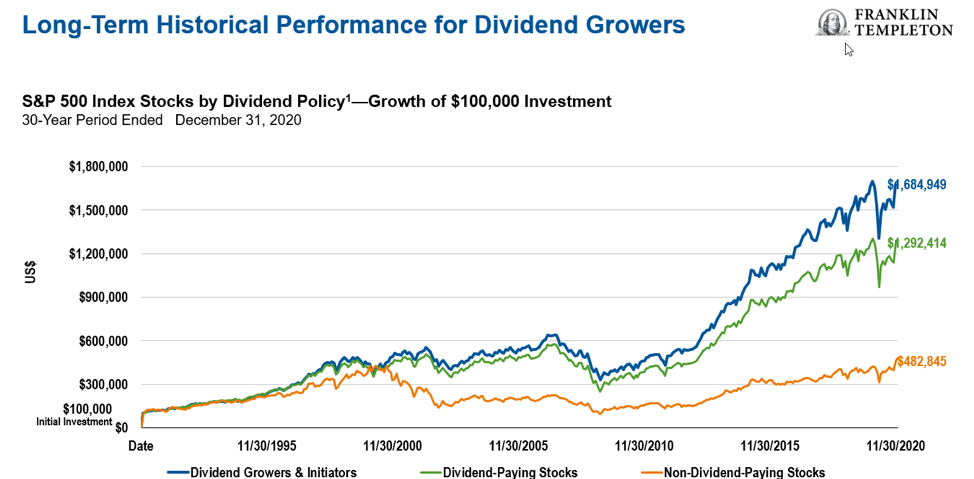
Historically, the evidence shows that dividend-growing stocks have tended to perform better than stocks that don’t provide dividends, and they have done so with less risk. The chart below shows dividend growers against the S&P 500 Index over the 30-year period ending December 31, 2020. This time frame includes multiple market cycles and downturns, including the Dot-Com collapse; the Global Financial Crisis; “The Lost Decade”, the 10-year period up to 2009 when U.S. equities (represented by the S&P 500 Index) had a near-zero return; as well as the correction of last February/March.
Taking a long-term view, corrections and drawdowns are inevitable, so it’s crucial to build portfolios of high-quality companies that can navigate different economic cycles. Continue Reading…


 Posted By
  By Michael Meyer