Building Wealth

For the first 30 or so years of working, saving and investing, you’ll be first in the mode of getting out of the hole (paying down debt), and then building your net worth (that’s wealth accumulation.). But don’t forget, wealth accumulation isn’t the ultimate goal. Decumulation is! (a separate category here at the Hub).

Q&A with John De Goey

John De Goey, courtesy MoneyShow

The following is a question-and-answer session conducted via email with advisor John De Goey following his recent talk at the MoneyShow in Toronto, which we reported here.  Some of the questions and answers also appeared in my recent MoneySense Retired Money column here.

Jon Chevreau, Findependence Hub:  How defensive do you think low-volatility ETFs (i.e., BMO’s, iShares, Harvest) are?

John De Goey: Let’s say the market pulls back by 25%. If you can handle that, then you don’t need a low-volatility ETF. In short, low-volatility products are more defensive than market  (cap)-weighted products, but it all depends on how investors react and behave when things go south.

Chevreau Q2.) Most of those are overweight utilities, consumer staples and healthcare stocks. Do you advocate that investors do this themselves with sector ETFs?

De Goey – I generally don’t recommend buying utilities as a stand-alone product/strategy. That said, if you already own cap-weighted products and want to be more conservative, it would likely be more tax effective to simply add utilities rather than sell cap-weighted products in order to buy low-vol products. Same net result, but less tax on the way.

Jon Chevreau, courtesy MoneySense

Chevreau Q3.)  If U.S. stocks are so richly priced, do you advocate owning a Value U.S. ETF to compensate, or simply sell down some U.S. or and add more International/Canada? Or other factor funds?

De Goey – I recommend getting out of the U.S. entirely. If you cannot do that then, at the very least, I’m worried that there’s an AI bubble much like what we saw with .com a quarter-century ago.

Chevreau Q4.) What range of asset allocation do you recommend for retirees, especially those who are middle-of-the-road and risk-averse?

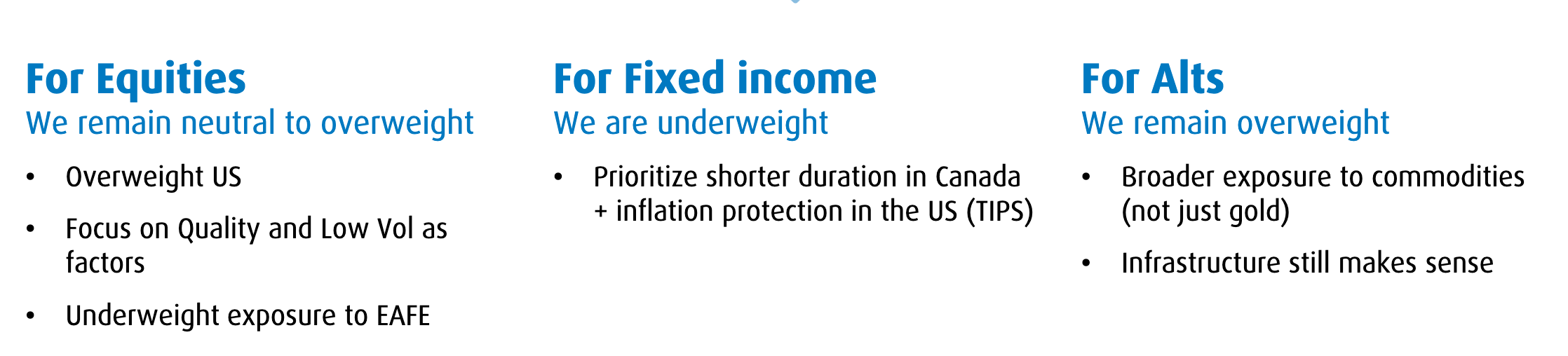
De Goey: I think all portfolios should have alternatives. Pension plans like CPP, OMERS and HOOP all have over 33% in alternatives. But for MOR retail investors, I’d opt for something like 20% alternatives, 30% income, and 50% equity.

Chevreau Q5.)  Can investors and especially retirees rely on global Asset Allocation ETFs to keep them out of too many over-valued U.S. stocks?

De Goey: I wouldn’t use the word ‘rely.’ Such products will soften the blow, but right now the U.S. represents almost 2/3 of global stock market capitalization. So, if all your stocks were in a single global ETF or mutual fund with a cap-weighted mandate, you’d have massive exposure to a massively over-valued market.

Chevreau Q6.)  What about annuitizing a portion of an RRSP/RRIF? Continue Reading…

Mark Seed on the 2% Retirement Rule

By Mark Seed, myownadvisor

Special to Financial Independence Hub

Well hello!

Welcome to some new Weekend Reading related to an article I read on not 4% rules, not 3% rules but the 2% retirement rule.

The 2% Retirement Rule

“The best retirement withdrawal strategy requires flexibility and course corrections depending on the market environment, inflation and your personal spending levels. No one actually follows through with this stuff like it shows on a spreadsheet.”

These are statements that really reasonated with me from Ben Carlson’s post entitled Why the 4% Rule is More Like the 2% Rule.

  • I desire flexibility related to our retirement income spending needs.
  • I want to use an approach that enables course corrections to happen easily.
  • I have never lived my life in a spreadsheet yet some tracking is necessary.

The 2% rule occurs when many retirees who even worry about the 4% rule constantly underspend from their portfolio from fear of outliving their money.

As Ben writes:

“There is a psychological hurdle that exists with some people because you worry about outliving your money, inflation, high healthcare costs, sequence of return risk or something coming out of left field.”

This also speaks to me.

It will be interesting to see how I combat these fears as my wife enters retirement next month and I consider retirement myself from current part-time work in 2026. Lack of a steady paycheque will be new territory to us.

Things we are considering for our retirement income spending as early retirees at least:

  1. Be flexible with our spending. If markets are good/positive, we’ll consider spending more. If markets are unfavourable, then we’ll spend a bit less. Spending a bit less means cutting back on travel plans.
  2. Keep a cash wedge at all times. Any money needed for spending in the next 1-2 years will be maintained in cash/cash equivalents. This way, when market corrections happen that I can’t see coming, we are ready to cover spending in advance.
  3. While we don’t budget (I recently wrote about that) we do track our spending and we’ll continue to do so. This will ensure we are spending money on things we value and/or are aligned to our values.

Retirement will be uncharted waters for us. My wife begins her journey next month. Our psychological and emotional hurdles when it comes to spending money without two steady paycheques will begin very soon: it will interesting to see and feel how we manage that.

I’ll keep you posted.

Other than 1, 2, 3 above, what other advice do you have for me? Words of wisdom from folks that have been there, done that?

More Weekend Reading – Related to the The 2% Retirement Rule

Ben’s post and my reflections of it remind me of this older but goodie post from Mr. Money Mustache about retirement income planning with a fixed chunk of money. Continue Reading…

Unlocking Overnight Returns for Covered Call ETFs with DayMAX™ ETFs


Image courtesy Hamilton ETFs

By Hamilton ETFs

(Sponsor Blog)

Overnight returns refer to the change in an asset’s price between the market’s closing level and its opening level the following morning. Even though stock exchanges are closed during these hours, the global financial system never truly sleeps.

Equity markets continue to move after the closing bell because of activity in futures markets, which trade almost 24 hours a day. These futures contracts track major indexes like the S&P 500 and Nasdaq 100 and respond instantly to news around the world as well as movements in global financial markets in Asia and Europe. When the North American markets open the next day, these changes are reflected in stock prices.

Why Overnight Returns matter

Overnight returns are an important source of long-term stock price appreciation that is often overlooked. In fact, studies including research from the Federal Reserve Bank of New York[1] show that over time, the majority  of stock market gains occurred overnight, not during the trading day. These moves are often driven by factors such as:

  • Company-specific news: Material information (read: “market moving”) such as earnings results, merger activity, and regulatory action is typically released after the close or before the open
  • Economic data: Reports like inflation and jobs numbers are often published before U.S. markets open
  • Global events: Political, policy, or economic news can move markets outside of trading hours

Importantly, these moves can be significant, and investors who are not invested or exposed overnight can miss out on a meaningful part of total returns.

Don’t Sleep on Overnight Returns

Overnight returns can be triggered by a single news announcement, creating sharp changes as trading begins. For example, on Sunday, May 11, 2025, the White House announced major progress on trade negotiations with China, including a 90-day truce. By the time U.S. markets opened the next morning, the S&P 500 had already jumped over +3%[2] vs. the previous night’s close. That entire move happened before investors could trade stocks during normal hours, and anyone not exposed/invested overnight missed it.

Looking at the bigger picture, overnight returns accounted for the majority of long-term market performance. Since 2000, the S&P 500 has delivered far stronger returns overnight than during the trading day. On average, annualized overnight returns were +7.67%, compared to just +1.41% during standard trading hours[3]. Put another way, a $100 investment in the S&P 500 held only during the day would have grown to about $127, while the same investment held only overnight would have grown to about $548 (Figure 1, 2).

Intraday vs. Overnight Returns[4]

As noted, overnight returns have historically accounted for the majority of positive market gains in the S&P 500. For vanilla equity investors, if they stayed invested overnight, they maintain that exposure. For a covered call ETF investor, the upside capture overnight can be limited by the call option. By selling call options each morning that expire at the same-day market’s close, DayMAX™ ETFs  only limit upside during regular trading hours, when the upside has historically been more limited, and they are fully exposed overnight, when there has historically been more money to be made (see charts below).

Figure 1: S&P 500 Intraday vs. Overnight Returns[5]

Source: Bloomberg, S&P Global, Hamilton ETFs
Past performance is not indicative of future results. Overnight vs. intraday returns may differ materially in future periods. 

Source: Bloomberg, S&P Global, Hamilton ETFs
Past performance is not indicative of future results. Overnight vs. intraday returns may differ materially in future periods.

DayMAX™ ETFs: Daily Options + Overnight Returns

DayMAX™ ETFs are built to generate frequent income while maintaining exposure to overnight returns. Unlike traditional covered call strategies that write options for weeks or months, DayMAX™ ETFs sell daily (specifically, zero-days-to expiration, or 0DTE) index call options each morning that expire at the market’s close. This structure means: Continue Reading…

Retired Money: Are pricey U.S. stock valuations a threat to new Retirees? Plus David Chilton on retiree market timing

My latest MoneySense Retired Money column looks at the currently near record high valuations of U.S. stocks and the risks that may pose to those in the Retirement Risk Zone. Full column can be accessed by clicking on the highlighted headline: Why retirement planners are getting defensive

Retirement Club co-founder Dale Roberts recently posted a typical anxious link to a Globe & Mail column by Dr. Norman Rothery, (CFA) which suggested the current environment of Trump-inspired Tariffs and global Trade Wars, are causing plenty of anxiety for this group.

In the piece posted under Managing Risk in Retirement – and headlined With today’s market, investors close to retirement face precarious times – Rothery said investors on the cusp of retirement are “facing peril from a combination of the unusually lofty U.S. stock market and political uncertainty that’s disrupting world trade.”

U.S. stocks trading at “worrying levels”

The U.S. stock market is “trading at worrying levels,” based on several Value factors, Rothery said: the S&P 500 Index is “trading at a cyclically adjusted price-to-earnings ratio (developed by Robert Shiller) near 39, which is above its peak of 33 in 1929 and it is approaching its top of 44 in late 1999, based on monthly data. Similarly the index’s price-to-sales ratio is approaching its 1999 high. A broader composite measure that includes many different market factors indicates that the U.S. market’s valuation is at record levels. “

Rothery, who also publishes StingyInvestor.com, concluded that it’s “likely that the U.S. stock market will generate unusually poor average real returns over the next decade or so.” Unfortunately, the U.S. stock market now represents about 65% of the world’s market by market capitalization based on its weight in the MSCI All-Country World Index at the end of August. So if the U.S. market flops, “It’ll likely take the rest of the world with it – at least temporarily,” Rothery cautioned.

This could impact recent retirees just beginning to draw down portfolios, due to “sequence of returns risk.” That means that those in the so-called Retirement Risk Zone  who suffer early losses could down the road be in danger of outliving their savings. Rothery also reference the famous 4% Rule of financial planner and author William Bengen: the theory that investors in a 55/40/5 portfolio should be able to sustain retirement savings for 30 years provided the annual “SafeMax” withdrawal not exceed 4% a year (actually 4.7%) after adjusting for inflation. Bengen just released a new book titled A Richer Retirement: Supercharging the 4% Rule to Spend More and Enjoy More, which the Retired Money column plans to  review next month.

What recent Retirees can do to lower their risk

Retirement Club members anxiously posed questions on the related chat room about whether they should be moving to cash and bonds, gold or other alternatives to U.S. stocks. To this, Dale Roberts – who also runs his own Cutthecrapinvesting blog – warned against getting too defensive but agreed a move to a 70% fixed income/30% stocks allocation might work for some nervous early retirees. Personally, he has trimmed back on his US growth stock exposure and added to defensive ETF sectors like consumer staples, healthcare and utilities. He also mentioned a US equity ETF trading in Canadian dollars: XDU.T

Advisors and their clients suffer from Optimist bias

Advisor John De Goey came to a similar cautious stance in a recent (Sept 12) speech at the MoneyShow in Toronto, archived here on YouTube. Titled Bullshift and Misguided beliefs (see this recent Hub blog) De Goey expanded on his usual themes of advisor bullishness and complacent investors, also articulated in his book Bullshift. Continue Reading…

Federal Reserve Changes 2025: How could they impact your Portfolio?

Image courtesy Harvest ETFs

By Ambrose O’Callaghan, Harvest ETFs

(Sponsor Blog)

The Federal Reserve (the “Fed”) was founded on December 23, 1913, as the central banking system of the United States.

At the time, the U.S. had contended with a series of financial crises that had rattled the domestic economy. This included the panic of 1907: a financial crisis that was triggered by the failed attempt in October 1907 to corner the market on the stock of the United Copper Company. These panics led to bank runs, reaffirming the desire of policy makers to have central control of the monetary system.

In this piece, we review the role of the Fed and how this U.S. central bank chooses its chairperson, presidents, and determines voting power. After that, we review how these factors could impact rate decisions through 2025 and beyond, and what Harvest ETFs may be impacted by these developments and policy shifts.

The role of the Fed

Upon its founding, the U.S. Congress established three key goals for monetary policy in the Federal Reserve Act. The Fed’s statutory mandate is as follows:

  1. Maximum Employment
  2. Stable Prices
  3. Moderate Long-Term Interest Rates

The Fed has many tools at its disposal to achieve these goals. More traditional monetary policy involves the utilization of open market operations, reserve requirements, and discount window lending.

Traditional monetary policy

Open market operations (OMOs)

Open market operations involve influencing the supply of balances in the federal funds market. In other words, this empowers the central bank to control the supply of money and credit in the economy.

Before the 2007-2008 housing crisis, and the global financial crisis that followed, OMOs were used to adjust the supply of reserve balances. This was done to keep the federal funds rate, which is the interest rate at which depository institutions lend reserve balances to other depository institutions overnight, at or around the target established by the Federal Open Market Committee (FOMC).

This approach evolved significantly in the wake of the 2007-2008 financial crisis and the Great Recession. In 2008, the FOMC established a near-zero target range for the federal funds rate. That move, paired with large-scale asset purchases – which we will cover later – made the Fed a target of scrutiny to a degree not seen since its founding in the early 20th century.

Reserve requirements

The Federal Reserve Act authorizes the Fed board to establish reserve requirements within a specific range. That allows the Fed to effectively implement monetary policy on certain types of deposits and other liabilities of depository institutions. In order to reach the dollar amount of a depository institutions reserve requirement, the Fed applies the reserve requirement ratios to an institutions’ reservable liabilities. After that, the Fed board is authorized to impose reserve requirements on transaction accounts, nonpersonal time of deposits, and Eurocurrency liabilities.

Discount window lending

Another important role of the Fed is discount window lending. The Fed is authorized to lend to depository institutions. Through this, the central bank can support the liquidity and stability of the domestic banking system as well as the effective implementation of monetary policy. The discount window aids depository institutions in the managing of their liquidity risks. This, in turn, helps to avoid actions that could have negative consequences for their customers. Essentially, the discount window supports the flow of credit to households and businesses.

Nontraditional monetary policy

Forward guidance

Central banks around the world use forward guidance to tell the public about the future course of monetary policy. When the Fed provides forward guidance, it allows individuals and businesses to make decisions based on that information. Because of its impact on spending and investment decision making, forward guidance influences financial and economic conditions.

The FOMC began providing forward guidance statements following its meetings in the early 2000s.

Large-scale asset purchases

Historically, outright purchases or sales of Treasury securities were used as a tool to manage the supply of bank reserves. This was done to maintain conditions in line with the federal funds target rate.

However, the global financial crisis in 2007-2008 led to dramatic changes in how the Fed approaches large-scale asset purchases. From 2008 to 2014, the FOMC authorized three rounds of large-scale asset purchase programs – also referred to as quantitative easing – as well as a maturity extension program.

The COVID-19 pandemic also presented a significant challenge for policymakers. In March 2020, the Fed launched large-scale asset purchases of U.S. Treasury securities to address the market disruptions at the beginning of the pandemic. Other steps including the launch of market functioning purchases of Treasuries and other securities. These purchases were without precedent. Asset purchases reached nearly $2 trillion of notes and bonds purchased just in 2020.

Fed presidents and voting power

The Fed is run by seven governors that are nominated by the President and confirmed by the Senate. All seven of the governors vote at every FOMC meeting.  A full term for Fed governors is 14 years, and one term begins every two years. This occurs on February 1 of even-numbered years. After serving a full term, a member cannot be reappointed, whereas a member who completes an unexpired portion of a term may be reappointed.

However, if a member retires earlier, the President may appoint another governor in the interim.  For example, Adriana Kugler recently resigned in August of 2025, as her term was expiring in February 2026. This seat was recently filled by the appointment and senate confirmation of Stephen Miran on September 15, 2025.  It is expected he will be re-appointed this February when that term is up for renewal.

There are 12 regional bank presidents. Five of these presidents vote at a time on rotation. All 12 presidents have terms that expire at the same time with the next term expiring this coming February. The process for selecting the regional Presidents is complicated.  It includes rolling terms for B and C directors of the regional bank that are intended to represent the public. The class B directors are chosen by the regional banks, and the class C directors are appointed by the Federal Reserve Board of Governors.  Then, the regional banks’ Presidential nominee must be approved by the Fed’s board of seven in Washington.  Chair Jerome Powell’s term as Chair is up in May of 2026 however, he has until 2028 as a board governor, although not unprecedented to serve their full terms on the board, Chairs have historically resigned from the board following their role as Chair.

While this is complicated, this has shone a spotlight on the Fed and regional banks, especially in the wake of the recent governors’ coming retirement and more so given the controversy surrounding Governor Lisa Cook and her potential dismissal.

With now three of the seven board of governors having been appointed by the current administration, should another board of governor retire, or in the case of Governor Cook be removed for cause, that move could shift voting power of the Fed , raising concerns about political influence in the realm of monetary policy. Even though there are some safeguards that remain, the perception of the Fed’s independence being weakened has the potential to unsettle markets.

Rate expectations in 2025

On Wednesday, September 17, the Fed announced that it voted to lower the target range for the federal funds rate by 0.25%, bringing the benchmark rate to 4.25%. Its decision was motivated by the moderation of economic activity in the first half of 2025, as well as slowing jobs data and the increased unemployment rate. The FOMC reiterated that it was “strongly committed to supporting maximum employment and returning inflation to its 2 percent objective.”

A September 5 report showed that the U.S. economy generated only 22,000 jobs in August. This stoked fears that the administration’s economic policies, including massive import taxes, have contributed to uncertainty in the business world. Meanwhile, the unemployment rate rose to 4.3%, moving higher than the six-month moving average. This indicates a sustained increase in unemployment.

Which Harvest ETFs are being impacted by Fed movements?

The uncertainty around Fed policy has boosted gold, benefitting two ETFs in the Harvest stable.

One of them is the Harvest Global Gold Giants Index ETF (TSX: HGGG), an equally weighted portfolio of the world’s leading and largest gold companies. HGGG tracks the Solactive Global Gold Giants Index TR.

We also recently launched a gold variant as part of our Harvest High Income Shares™ ETF lineup: the Harvest Agnico Eagle Enhanced High Income Shares ETF (TSX: AEME). AEME invests all its assets in shares of Agnico Eagle Mines. It overlays covered calls and employs modest leverage at around 25%, aiming to generate high levels of monthly income. The rate expectations phenomenon has pushed long-term yields higher, as investors price in incremental inflation risks and continued Fed uncertainty.

Meanwhile, the shorter-term gyrations of bond prices have been a challenging environment with longer term bond prices fluctuating month over month. Mid-duration bonds have been steadier, despite upward moves in yields in August, they will continue to be data dependent.

The Harvest Premium Yield Treasury ETF (TSX: HPYT) – a portfolio of ETFs which hold longer dated US Treasury bonds that are secured by the US government, employs up to 100% covered call writing to generate a higher yield and maximize monthly cash flow. It remains in the black in the year-to-date period. HPYT last paid out a monthly cash distribution of $0.13 per unit.


On the medium-term side, the Harvest Premium Yield 7-10 Year Treasury ETF (TSX: HPYM) – a portfolio of US Treasury ETFs that primary hold US bonds with average maturities of 7-10 years. Like HPYT, it can write up to 100% covered call on these holdings to generate monthly income. HPYM has delivered solid returns in the year-to-date period at the midway point in September 2025. The ETF last paid out a monthly cash distribution of $0.08 per unit.


Ambrose O’Callaghan is Senior Copy Writer at Harvest ETFs. Ambrose brings over a decade of experience in the financial services industry to the Content Editor role. He is responsible for providing context to current trends, developments, and analyses to help make sense of the ETF market and emerging themes. With a strong knowledge of the Canadian equity markets and Harvest products, Ambrose regularly provides commentary on a broad array of market topics.

Disclaimer

The content of this article is to inform and educate and therefore should not be taken as investment, tax, or financial advice. Commissions, management fees and expenses all may be associated with investing in Harvest Exchange Traded Funds (managed by Harvest Portfolios Group Inc.). Please read the relevant prospectus before investing. The funds are not guaranteed, their values change frequently, and past performance may not be repeated. The content of this article is to inform and educate and therefore should not be taken as investment, tax, or financial advice.

Certain statements included in this communication constitute forward-looking statements (“FLS”), including, but not limited to, those identified by the expressions “expect”, “intend”, “will” and similar expressions to the extent they relate to the Fund. The FLS are not historical facts but reflect Harvest’s, the Manager of the Fund, current expectations regarding future results or events. These FLS statements are subject to a number of risks and uncertainties that could cause actual results or events to differ materially from current expectations. Although Harvest, the Manager of the Fund, believes that the assumptions inherent in the FLS are reasonable, FLS are not guarantees of future performance and, accordingly, readers are cautioned not to place undue reliance on such statements due to the inherent uncertainty therein. Harvest, the Manager of the Fund, undertakes no obligation to update publicly or otherwise revise any FLS or information whether as a result of new information, future events or other such factors which affect this information, except as required by law.