Building Wealth

For the first 30 or so years of working, saving and investing, you’ll be first in the mode of getting out of the hole (paying down debt), and then building your net worth (that’s wealth accumulation.). But don’t forget, wealth accumulation isn’t the ultimate goal. Decumulation is! (a separate category here at the Hub).

John Bogle’s 7 tips for successful investing

Vanguard founder John C. Bogle

Investing is not a one-way ticket to riches. Both novice and expert investors have periods of good and poor performance. Success or failure is driven largely by the markets, but how we behave also has a huge impact.

In a recent article for Financial Analysts Journal, Vanguard founder Jack Bogle summarized the rules for successful investing he developed over his 65-year career. They’ve been tried and tested through different market conditions, and we’re reproducing them here so everyone can potentially benefit.

1.) Invest you must

The biggest impediment investors face is not market volatility, but not investing in the first place. History shows that investing — as opposed to simply saving — is necessary to generate a reasonable return over the long run.

2.) Time is your friend

Investing is a virtuous habit best started as early as possible. Thanks to the “magic” of compounding (simple math, really), even modest investments made in one’s 20s can grow to surprising amounts over the course of an investment lifetime.

3.) Impulse is your enemy

Eliminate emotion from your investment programme. Have rational expectations for future returns, and avoid changing those expectations in response to the ephemeral noise coming from Wall Street. Understand that what may seem like unique insights are typically shared by millions of others. Continue Reading…

What does tax reform mean for high-yield debt?

By Bradley Krom and Josh Shapiro, WisdomTree Investments
Special to the Financial Independence Hub

In an earlier post, we highlighted the likely impact tax reform could have on investment-grade (IG) corporate debt. In part two, we turn our attention to the high-yield (HY) market.1 While a reduction in taxes should benefit all profitable companies, other provisions could lead to tough choices for some less-credit-worthy borrowers. As we’ve seen during the most recent earnings season, HY still presents a mix of opportunity and risk. Below, we highlight the contrasting impact of lower tax rates and potential changes in the deductibility of interest expenses.

Big Picture: lower taxes, higher free cash flow and earnings

On net, the proposed tax plan is a positive for high yield. Lower statutory tax rates should result in higher profitability metrics, greater free cash flow and a boost to economic momentum/growth, while extending the credit cycle. While all businesses won’t be impacted the same way, we feel comfortable concluding that tax cuts should bias credit spreads tighter for riskier borrowers, on average. Similarly, an increase in economic growth could also push nominal interest rates higher.

What about Revenue Offsets?

While the top-line impacts we highlighted above should be broadly positive, we believe other elements of tax reform warrant closer attention: most notably, the so-called interest deductibility provision.

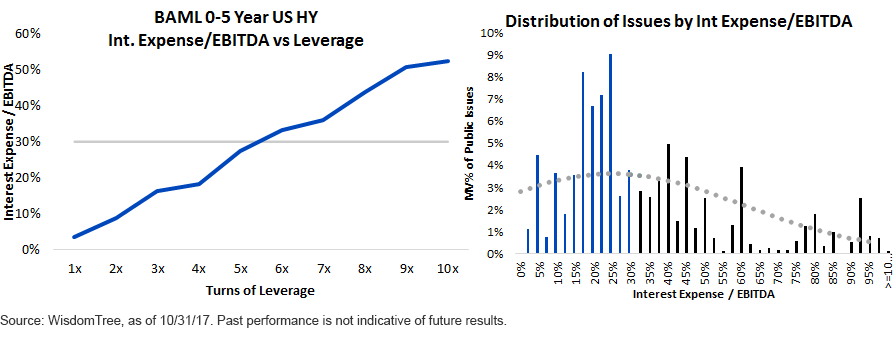
In the current environment, companies choosing to finance themselves with debt are permitted to fully deduct interest payments. As a result, companies have an incentive to finance themselves with debt as opposed to equity. In order to help dampen the fiscal impact of tax cuts on the federal budget, the current proposal would limit the deductible amount of interest expenses to 30% of EBITDA.

Fundamentally, this provision should have a much greater impact on the HY market. Given that risky borrowers tend to pay higher interest rates and (all else being equal) tend to deploy more leverage, the 30% cap on deductions should impact a larger percentage of the market. As we show in the chart below, HY companies with leverage of approximately 5.5x would likely be unable to fully deduct their interest expenses. In the second chart, we show that this makes up approximately 40% of the total market.2

Market Impact

While attempting to draw broad-based conclusions about individual companies can be tricky, a few key points stand out. In our analysis of firms with public financials, we estimate that 91% of CCCs will be unable to fully deduct their interest expenses. Continue Reading…

What is Personal Finance and why is it necessary?

By Brenda Cagara

Special to the Financial Independence Hub

Personal finance is the art of managing finance individually or for household purposes.

Why would I call it an art? As there are several factors that need to be taken into consideration, the word may seem simple but it is not.

These factors may include purchasing of financial products example, home and life insurance, credit cards mortgages, investments and vehicles: In other words, handling budget, savings, and spending monetary resources over time, taking into account various financial risks and benefits for future life events.

Nowadays, personal finance is regarded as a specialty on its own. Historically, it was taught as a part of home economics or termed as “consumer economics,” which was included as a curriculum in various schools, colleges and university. In 1947, Herbert A. Simon, a Nobel laureate, suggested a decision maker did not always make the best financial decision because of limited educational resources and personal inclinations.

In 2009, Dan Ariely suggested the 2008 financial crisis emphasized the fact human beings do not always make rational financial decisions, and the market is not necessarily self-regulating or corrective of any imbalances in the economy.  Therefore, it is crucial to obtain some basic information about this topic to help an individual or a family to make rational financial decisions throughout his or their lifetime.

Planning Personal Finance

To understand personal finance, one should first have at least a vague idea of financial planning. Financial planning can be defined as a process that requires regular monitoring and re-evaluation of income and expenses. It includes five components: assessment, goals, planning, implementation, monitoring and re-evaluation.

  1. Assessment. Financial position can be assessed by making a balance sheet or personal statement. A balance sheet includes value of all the personal assets and liabilities. A personal statement personal income and expenses.
  2. Setting up small targets acts as an incentive for a person to work hard enough to achieve a financial position is a smart idea. These goals can be divided into short term and long term. Long-term goals may be being retired at the age of 60 with a net worth of $15,00,000, whereas an example of short-term goal may be saving up to buy a new house, a car or a new television.
  3. Once we’ve decided our aims and objectives, we need to have a plan as to how we are going to go about it to achieve it. An ideal plan should include a road map to decrease expenses and a way to enhance earning.
  4. This is the most crucial part of the five steps and in fact the most difficult of all. Once a person comes up with an ideal plan, there should strict implementation of it with discipline and perseverance.
  5. Monitoring and reassessment. With time there are changes in every individual’s life, family and priorities. In order to accommodate these changes the plan will require some alterations over the period of time, making monitoring and reassessment very important.

Personal Finance Tips

1.) A budget is a financial roadmap allows you to live within your means, while having enough left over to save for long-term goals. A simple example of budget can be as follows:

Continue Reading…

How the CRA and IRS cooperate in taxing dual citizens

By Peter Muto

Special to the Financial Independence Hub

Canada and the United States have very different tax regimes, and if you live and work in Canada but happen to be an American citizen, you better pay attention. It is estimated that up to two million Americans currently reside in Canada either as full-time or part-time residents. Full-timers who hold jobs in this country, effectively U.S. citizens and green card holders, sometimes start thinking of themselves as being Canadian. But as far as the IRS is concerned, that is a big mistake.

Unbeknownst to many, the IRS in the U.S. and the Canada Revenue Agency (CRA) in Canada can assist each other in collecting taxes from their respective citizens, and this also goes for those with dual citizenship. The fact is tax debts can be enforceable in a foreign jurisdiction. Canada currently has collection-assistance provisions in treaties with such countries as Germany, the Netherlands, Norway, New Zealand, the United Kingdom and Spain. And the United States.

A recent case concerning an American who was ordered to pay a big penalty in U.S. district court demonstrates this all too well.

How one Canadian resident fell afoul of the IRS

The man, Donald Dewees, teaches at the University of Toronto. He lives and works in Canada, and dutifully pays his Canadian income tax. But, as mentioned at the outset, Canada and the U.S. have very different tax regimes. The biggest difference is that in this country the federal government taxes people based on residency, but the U.S. imposes tax obligations on all its citizens regardless where they live, even if they have no U.S. income.

According to the rules, Dewees is supposed to file with the IRS a document called an FBAR: the Report of Foreign Bank and Financial Accounts, which is known as Form FinCEN 114. He has to do that annually. What is this for? One situation it applies in is when an American citizen or green card holder has financial interest in, or signature authority over, one or more foreign accounts as long as the aggregate value is more than US$10,000 at any time during the reporting period. So, even though the person may not hold an American bank account and may not even earn American source income, they still have to file this report with the IRS every year.

Voluntary Disclosure Programs

In this case, back in 2009 Dewees entered what is known as the Offshore Voluntary Disclosure Program (OVDP). He did that so he would be compliant with his U.S. tax obligations. So far, so good. This program is similar to Canada’s Voluntary Disclosure Program, which allows a taxpayer to pay fixed penalties. In this way you know right away how much you owe. Also, when you are in the U.S. OVDP, criminal charges will never be laid against you.

However, here is where DeWees veered off course. After entering the OVDP program, he wanted to know how much he owed in penalties and the amount was about US$185,000. So he withdrew from the OVDP program.

After that the IRS got involved. The IRS assessed a penalty for failing to file form 5471, which is required when you own a controlling interest in a foreign company; in this case a non-U.S. company. The minimum penalty is US$10,000 and that is for every year of non-compliance. For Dewees, that meant 12 years and 12 X $10,000 is US$120,000. That is the total for which he was assessed.

Continue Reading…

Financial planning should be a Parallel, not Serial, process

By Darren Coleman

Special to the Financial Independence Hub

In a serial circuit when one light bulb goes out, all the lights go out. Each light is wired to the next and all of them have to work for each one to work. In a parallel circuit all the lights are wired together but independently from each other, so when one light goes out, the other lights still stay on.

This concept is important and comes into play in my book ‘RECALCULATING – Find Financial Success and Never Feel Lost Again’. The book applies the analogy of driving to investing and financial planning. (See earlier Hub blog on the book).

I have spent almost a quarter of a century counseling clients about their money and assets, and often see people who believe their financial planning should look like a serial circuit. They think they must achieve one goal before moving on to the next. They have constructed an order or sequence that must be strictly followed for them to feel comfortable about achieving their plan.

This is the view Marvin and Jesse had when I met them. A successful, professional couple, they had young children and a list of goals. No. 1 on the list was that they wanted to be mortgage-free by age 45. They also wanted their kids to go to a private school, and vacations every year with the family. In addition, they wanted a comfortable retirement by their late fifties. They had great jobs, were disciplined savers, and figured they should be able to achieve all these goals. But they didn’t know how to put all the pieces together and make it happen.

I reviewed the situation to gain an understanding of their current state, and discovered that almost all their uncommitted cash flow went to pay down the mortgage. There were only token amounts being saved for their children’s education, family vacations, and retirement plans.

A couple that used serial financial planning

When I asked about this, they said paying down the mortgage as quickly as possible was the central assumption – the core pillar – of their financial planning. In short, this couple looked at all their desired destinations as if they were part of a serial circuit. Once they had paid off the mortgage, they would move on to the other plans.

I told them they could do this, but achieving that milestone of being mortgage-free by age 45 meant they could not put their children in private school, take annual holidays with the family, or make tax-advantaged contributions to their retirement plans. So, while they could be mortgage-free at an early age, they would not accomplish their other goals. And, of course, they couldn’t get the time back.

None of us can.

Shift to financial planning in parallel

I showed them that changing the picture from a serial circuit to a parallel circuit might be the answer. Continue Reading…