
Building Wealth

For the first 30 or so years of working, saving and investing, you’ll be first in the mode of getting out of the hole (paying down debt), and then building your net worth (that’s wealth accumulation.). But don’t forget, wealth accumulation isn’t the ultimate goal. Decumulation is! (a separate category here at the Hub).

Prosperium Q&A Part 2; Dawn of the Prosperity Economy

Prosperium Inc. CEO Doug Coyle

The following is Part 2 of a sponsored Q&A with the founders of the firm behind Canada’s new Prosperium cybercurrency. Doug Coyle, pictured on the left, is the Chief Executive Officer of Toronto-based Prosperium Inc. Tony Humble is President and Chief Organizational Officer. You can find the introductory blog in this series by clicking on Blockchain Revolution, Global Prosperity and Prosperium. Also, a new white paper has just been published.

The pre-Sale rollout plan for Prosperium tokens

Jon Chevreau: Let’s resume with a recap how you’re rolling out Prosperium units and how pricing steps up over time.

Doug Coyle: Our currency Prosperium does have a period at the beginning, which we call our Presale period, when accredited investors can buy the coin at a value that is rising over time. The current value that we’re offering our token at is $2 per token for the presale token. That will be stepped up to $2, $4, $6, $8, $10, $15, $20, then by increments of $10 until finally it gets to $100 per presale token.

That price is based upon the network value; as we accomplish various milestones and increase the value and utility of the Prosperium platform and token the market price increases steadily; but once you reach $100 it then converts at 100 to 1 so one Prosperium token becomes 100 Prosperium “dollars” at a 1 to 1 ratio. It becomes stable at that point. That means that 1 Prosperium dollar is equal to one Canadian dollar. From then on it’s stabilized by smart contracts so it becomes very easy for someone to look at their Smartphone, see their balance is 1000 Prosperium dollars and they know what they what can buy with one thousand Prosperium dollars since it’s equal to C$1,000.

Jon: And outside Canada?

Doug: Each country will have its own Prosperium token that matches the local fiat currency. So in England, one Prosperium pound will equal one UK pound; same with the peso or the US dollar etc. We are set to be a stable-value token in all countries that accept us: wherver the regulators accept our platform so people are able to trade in a currency and know the price of anything in Prosperium dollars or tokens.

This is very different than Bitcoin because right now Bitcoin is worth around $4,000. So on any given day how do know how much the price of a cup of coffee is in Bitcoin? You don’t, not without doing a bit of a calculation or having your phone do it for you. So it’s a big advantage having a stable-value currency for everyday use that you can trust won’t fluctuate and be volatile while they hold it and that they know the price of things in that currency.

Fiat currencies vs cybercurrencies

Hub CFO Jon Chevreau

Jon: You used the term fiat currency just now. Can you comment on traditional “money” and so-called fiat currencies like the dollar, Euro etc.? There’s nothing magical about the value of a dollar except that it’s dictated by governments, right? At least since it’s no longer backed by gold.

Doug: You’re right: part of understanding how to design a currency for Prosperium is understanding the mechanism that all currencies play in an economy; an economy is just a community of people trading their work with each other: goods and services. The economy, the GNP or GDP, is just the sum of all those transactions in that community; so what is money? Money is just a trusted accounting system; and the important word there is trusted. If you’re in an economy or country that has its currency backed by gold or silver or some commodity, you’re using that commodity to create that trust factor; you’re trusting that gold will be relatively stable over time.

If you live in a country like Canada or the United States, or most of the world now, it’s not backed by a commodity like gold or silver but by the promise of the sovereign: of the government.  You are relying on the fact that the government will say yes, we’re going to back that dollar and manage it and keep it at a relatively stable value. You can question how much you can trust any sovereign to handle money but that’s the theory. So you have those two systems of creating trust; backed by a commodity or backed by the promise of a sovereign.

Jon: Do you use the term fiat?

Doug: Yes, we use the term fiat. Fiat just means by demand or by order. I as the king demand, or order, that this piece of paper here is worth one Canadian dollar.

What is backing Prosperium?

Jon: At least when it was backed by gold, it was finite, like Bitcoin. But now it’s potentially infinite? Look at Zimbabwe and what happens with inflation when it’s backed by nothing? Or Venezuela.

Doug: Yes, which raises a very interesting question. What is backing Prosperium? In our case, it’s a very concrete thing that backs it. New currency can be created; you have to remember that all currency is created. Continue Reading…


A Q&A with the founders of the new Prosperium Cryptocurrency

Prosperium Inc. CEO Doug Coyle (L); President and COO Tony Humble (R)

The following is a sponsored Q&A with the founders of the firm behind Canada’s new Prosperium cyryptocurrency.

Tony Humble is President and Chief Organizational Officer of Toronto-based Prosperium Inc. and Doug Coyle is Chief Executive Officer (both pictured on the left).

You can find the introductory blog in this series by clicking on Blockchain Revolution, Global Prosperity and Prosperium.  

Also, a new white paper has just been published. The overall Prosperous business model is described on its home page. And for a layperson’s perspective, see Tony’s blog. 

The Q&A will continue tomorrow. 


Jon Chevreau: In the first blog, we mentioned Ethereum and Prospereum as two examples of cryptocurrencies spawned in Canada. Clearly, the name Ethereum inspired your name and it was a clever stroke to get the word Prosper in there too. Can you confirm this genesis of the name?

Tony Humble

Tony Humble: Well, the name Prosperium was a natural, but we tried a few others first, like Prosperus, as in “prosper us all” and “prosperous” and ProsperX.  But the elemental affinity with Ethereum was irresistible:  like atomic bonds.  Ethereum is named for both a celestial region and an “element” in the periodic table.  On earth, it is both a currency and a platform for smart blockchain contracts: revolutionary and brilliant.

Jon: Can you elaborate on what the name means in practice, relative to Ethereum? Is it the same business model?

Tony: Like Bitcoin, the total number of coins issued by Etherium will be fixed, aiming for continuous growth in value.  In comparison, Prosperium is also named as an element, is a crypto-currency, and is a platform:  for growth in real prosperity.  In contrast, however, once Prosperium has reached a target value it will be fixed in price and supported at that value, but the number of coins issued will continue to grow.  It will be minted for measurable value, created by regional accelerators to generate jobs and production, and its use for transactional purposes will be tracked on the Prosperium blockchain.  It will be 100% open and auditable by governments, and will maintain a large reserve to support the price in the marketplace.

Jon: A prospectus for Canada’s first Bitcoin ETF was recently filed. I’m not sure if that shows your timing is impeccable or whether you’re late to the party?

Doug Coyle: I do see that there are more and more ETF funds being launched in Canada and around the world for Bitcoin.

Jon: Starting with the Winklevoss twins of Facebook fame?

Doug: Yes, they tried to get a Bitcoin ETF going and ran into some barriers but they prepared the ground a great deal. I feel it’s adding infrastructure so I’m in favor of multiple ETFs for Bitcoin or any other crypto currency being established.

Jon: Is Prosperium going that route?

Doug: Not directly. In some ways we do provide the ability for clients who hold Prosperium tokens to trade those tokens and eventually the currency itself will be freely trading; so we have a very sophisticated way of doing a — call it an ETF — but we hold a reserve account that is core to how we stabilize the Prosperium coin. Buyers can find a ready market there at all times; they don’t have to count on any broker to find a match on buying and selling; it’s all done automatically in the software.

Why Prosperium isn’t going the ICO route

Jon: You chose not to go the ICO (Initial Coin Offering) route although it sounds like you were thinking about it. Why not, or are you doing the same thing under a different name? Continue Reading…

Borrowing to invest? Beware of rising interest rates.

Del Chatterson

By Del Chatterson

Special to the Financial Independence Hub

Your financial advisor is probably not recommending it and you may be naturally averse to more borrowing, but it is hard to ignore the basic principles of financial leverage from Finance 101. (The principles have not changed, since I first taught the course in 1972!)

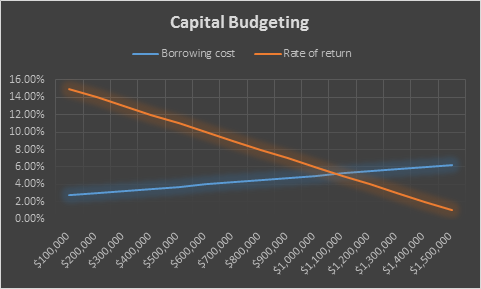
As explained in a chapter on Capital Budgeting, companies and investors should continue to invest in projects until the marginal cost of capital equals the marginal rate of return: assuming you select projects in order from the highest return to the lowest return and that the cost of borrowing increases with the total amount of loans outstanding.

So in the example chart shown to the right, you would borrow and invest up to $1.0 million, which is the point where the expected rate of return declines to meet increasing cost of borrowing at about 5%.

You may have confirmed the theory from your own experience. Your current portfolio has a few investments that are achieving better than 10% or 12% returns, most congregate around the long-term average of 7% to 8% and a few continuing disappointments are returning below 5%, or worse.  Your lowest cost of borrowing is probably the mortgage you signed in 2015 at 2.5% or a car loan at 1.9%, but your subsequent borrowing for a personal line of credit is at 3.25%.

Continue Reading…

Liberal tax changes would spark exodus of Canadian entrepreneurs

By David J Rotfleisch, CA, CPA, JD

Special to the Financial Independence Hub

The proposed changes to the Income Tax Act that the Minister of Finance, the Honourable Bill Morneau, has released have real-world implications. The consultation period ends October 2, 2017, so now is the time to make your voice heard. Call or email your member of Parliament, or Minister Morneau directly.

I recently had a meeting with a high-tech entrepreneur in an internet-based business. He is very conservative and has not carried out any tax planning. His wife helps him but he does not do any income splitting with her. He has about $1 million in his corporate bank account for possible business use, but has not invested it and just earns minimal bank interest. The hype about the proposals has caused him to take notice of his tax affairs and meet with me.

I told him that under the new proposals income splitting with his wife, other than a fair salary for services performed, will be prohibited. His wife will probably not be able to participate in the lifetime capital gains exemption. If he decides to invest his retained earnings, there may be an additional tax on his income. He is now thinking about lifestyle and whether he wants to leave the country. I fully expect to prepare a memo for him about becoming non-resident.

Minister Morneau’s proposed tax changes will have the effect of causing an exodus of Canadian entrepreneurs for more business-friendly jurisdictions.

I had lunch with accountants a few days ago and they reported the same types of conversations with high-tech clients. They are considering leaving the country. Now, some won’t because of the education of their children, to be close to aging parents, adult children,or because they like their Canadian lifestyle. Others will decide it’s more important to maximize after-tax income and that it makes sense to move offshore.

70% of Canadians work for firms with 100 or fewer employees

Remember,  statistics show that the vast majority of Canadians — 70 per cent — who are the economic engine of this country, work for companies with between 1 and 100 employees: the very targets of these new measures, and who are able in many cases to pack up and leave.

This is not just the view of tax professionals. Ryan Holmes, the CEO of social media internet company Hootsuite, was reported as saying on Sept 14, 2017 that the proposals are causing a lot of concern to business owners and that “I think you need to be very favourable at the small end of the market.”

I was recently contacted by a Liberal MP who is very opposed to what his government is doing. He has an entrepreneurial background and he realizes the impact of these proposals.

Continue Reading…

Toronto Rentals vs. Hong Kong: A matter of perspective

There’s been plenty of discussion recently surrounding Toronto’s hot housing market. First-time buyers are being priced out and young prospective home buyers are being pushed further and further away from the city’s desirable centre. With all this talk, it’s easy to get caught up and lose perspective, but lucky for you, I’m here to remind you to count those blessings (however meagre they may be).

Sure, the housing situation in cities like Vancouver and Toronto may be less than ideal, and yes, something should be done to improve the way things are going. However, there are far more dire housing situations in other top-tier cities, which, when compared to Toronto, really make everything here seem — dare I say –breezy?

Related Read: INFOGRAPHIC – July GTA Sales Plunge 40%

Taking A Global Rental Perspective

Take, for instance, Hong Kong. As those who’ve read my posts on Findependence Hub may know, I lived in Hong Kong teaching English. It is one of the most bustling, vibrant cities I’ve ever experienced, but I can only defend it so much once the subject of housing prices comes up. Year after year, Hong Kong tops all the lists of ‘most expensive housing,’ and having rented there for a year, I have to concede defeat on that point. For what you get in Hong Kong, there is much to be desired.


Chevreau’s Hong Kong apartment was tight on square footage.

Chevreau’s Hong Kong apartment was tight on square footage

If you’re like most millennials and looking to break into the housing market for the first time –- perhaps in a Toronto condo –- you’ve most likely experienced the disillusionment that inevitably comes when you realize the prices you’re looking at paying, even after this summer’s price correction. In the city of Toronto, the average price per square foot, or PPSF, is around $649 with an average home cost of around $550,000. This number spikes to $800 PSF if you’re looking to put down roots in ‘downtown Toronto’ (anywhere south of Bloor, west of Yonge, east of Bathurst).

Related Read: 5 Ways to Get Ahead in the Toronto Rental Market

Continue Reading…