Building Wealth

For the first 30 or so years of working, saving and investing, you’ll be first in the mode of getting out of the hole (paying down debt), and then building your net worth (that’s wealth accumulation.). But don’t forget, wealth accumulation isn’t the ultimate goal. Decumulation is! (a separate category here at the Hub).

Loss avoidance: The power of long-term thinking

By John WIlson

Special to the Financial Independence Hub

A friend of mine was planning a long trip outside of Canada and didn’t really have a definite date as to when he’d be back. He was thinking a good six months to a year. I remember asking him about what he would do with his car; where he planned to park it. He thought it would cost too much to put it in long-term parking, somewhere around $200 to $300 a month. He was, as he saw it, just going to park it on the street.

You may detect where this story is heading.

A few months into the trip his car was impounded. As he wasn’t back in the country yet, he asked me if I could go to the lot on his behalf. About $2,500 in fees and several (not so enjoyable) hours later, his car was finally retrieved.

By choosing not to pay long-term parking up front, my friend may have enjoyed the short-term benefit of not having to put effort into making arrangements or paying any money. But the inherent risk in that decision played out; the car ended up in the impound lot and he had to pay quite a significant amount of money: not to mention the embarrassment of asking a friend to go for a long, impromptu visit to the lot on his behalf.

Short-term gratification can hurt in the long run

This story reminds me of how some of the highest-return investments in life are investments of time, where the payoff comes from the avoidance of loss.

We often see the tradeoff between short-term and long-term thinking in our interactions with management teams. For example, a company can really inflate its current earnings and make the latest report or annual release look a lot better by under-investing in intangibles, such as marketing.

Marketing is an expense that will hit the income statement every quarter, but often doesn’t provide a benefit until two, three, four or ten years down the road. The same thing goes with investments in R&D. The management team that focuses too much on optimizing current period earnings will often do so to the detriment of future profitability and competitive positioning. This is one of the reasons we encourage managers to adopt incentive plans that are based on long-term performance rather than short-term earnings targets or share price movements.

Continue Reading…

Contrasting opportunities in Emerging Markets: FX, Equities and Bonds

By Bradley Krom, WisdomTree Investments

Special to the Financial Independence Hub

Year-to-date, more than US$32 billion has flowed in to emerging market (EM) exchange-traded funds (ETFs) in the U.S.1 As a consequence, EM equities, bonds and foreign exchange (FX) markets are outperforming most developed markets by a sizable margin. Despite a proliferation of choices over the last several years, WisdomTree continues to advocate a multiasset approach to EM. Below, we contrast the various risks and drivers of return for EM FX, equities and the fixed income market.2

How much risk (Volatility)?

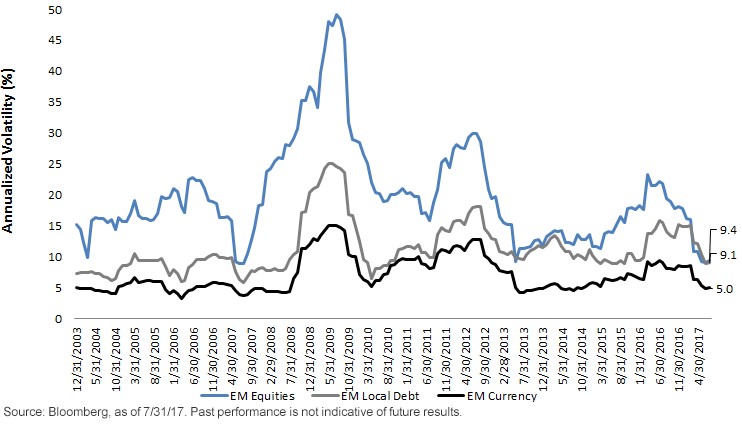
One of the more puzzling issues for global investors is the general lack of volatility across major asset classes. Emerging markets are no exception. As the chart below shows,  returns have been strong and volatility has generally been declining, similar to other markets. In the case of EM equities, volatility has fallen to levels not seen since 2007.

Rolling 12-Month Volatility (%)

While we are not in the camp that says low volatility implies that a market correction is imminent, it is notable that EM equity volatility has dipped below EM local debt over the last 12 months. This is attributable to several factors, most notably the underlying currency exposure difference between the equity index and bond index.

Equities: More In Asia with lower FX volatility, Fixed Income more in Latin America with higher FX volatility

Due to underlying macro conditions, currencies in Asia tend to be less volatile than currencies in Latin America. EM equities have over 72% of their exposure in EM Asia compared to the EM local debt,3 which only has a 23% weight.4 Therefore, even though the underlying asset of equities may be higher than bonds, the overall exposures may not always tell the same story.

The last time volatility converged in this way was 2013 during the “taper tantrum.” For the 12 months ending June 30, 2013, returns between EM local debt and EM equities were similar (1.32% versus 2.87%). However, in the next 12 months ending June 30, 2014, EM equities outperformed EM local debt by over 1,000 basis points while maintaining comparable volatility. With volatility particularly difficult to forecast, we would continue to advocate EM equity risk over rate risk in the low-volatility, low-interest rate environment.

Drivers of Return

Continue Reading…

Always show up for a free lunch!

By Heather Compton

Special to the Financial Independence Hub

Always show up for a free lunch!

That’s the tongue-in-cheek advice I give all “soon to retire” folks but, frankly, taking advantage of free lunches is key for every investor.

I use the term “free lunches” for all manner of benefits and it’s alarming to me how many people pass them by. Many employers offer employees matching contributions to Retirement Savings accounts that require the employees to pull out their own wallet too.

One major corporation I worked with gave all employees a contribution of 6% of their salary to the Defined Contribution Pension Plan.  The employer would contribute a further 4%, contingent upon the employee also contributing 4%. That’s a great free lunch! A shocking number of employees felt they couldn’t afford to participate:  they said they couldn’t meet all their other financial obligations without that 4% of salary. Actually, by making the 4% RRSP contribution they also earned a tax deduction, so the after-tax, out-of-pocket expense was even less.

Don’t overlook the daily Special

Many companies offer employees the convenience of group savings programs, even where there are no company-funded contributions. That too has value; the investment choices available in these plans often have significantly below market rate MERs (management expense ratios) and no account fees or cost to buy or sell. One company with which I am familiar has a savings plan offering a solid range of investment funds with MERs ranging from a low of 0.10% to a high of 0.58%.

Only a knowledgeable investor, capable of building a low cost ETF (exchange traded fund) portfolio, could match this low-cost option. If the contributions are made to a group RRSP, the employer can also add the convenience of reducing the tax paid at source. Since the contributions and investments are made regularly, often monthly, we can add the benefit of dollar cost averaging to the mix.

What other free lunches are often overlooked?

Continue Reading…

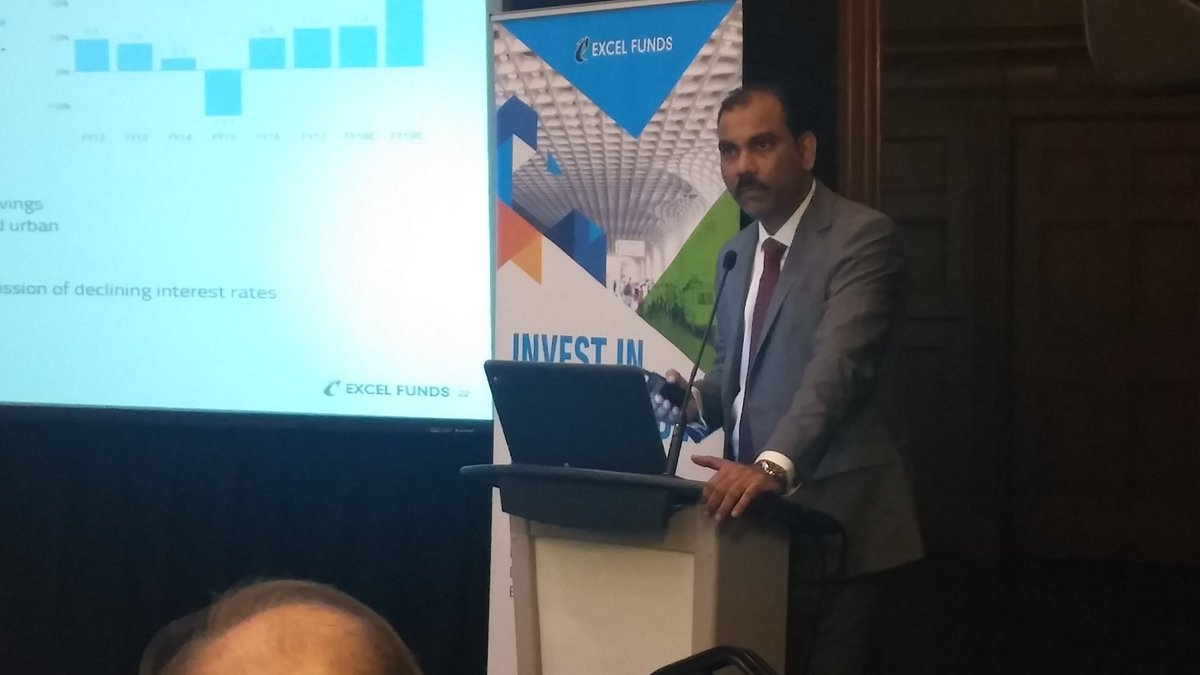
Indian economy poised for sustainable growth: Excel Funds’ Atul Penkar

Atul Penkar at Excel Funds Indian Road Show

(Sponsor Content)

The Indian economy is firing on all cylinders, fueled by policy reforms that are the catalysts for growth in one of the world’s fastest growing economies.

This was the central theme of the message delivered by Atul Penkar, lead sub-advisor of the Excel India Fund at an investor conference held in Toronto on September 19th. Mr Penkar is also the Head of Offshore Equities at Birla Sun Life Asset Management Company Ltd. (BSLAMC) in India.

Titled “Expert Insights into India: The World’s Growth Giant,” the conference was sponsored by Excel Funds Management Inc., in association with BSLAMC, the on-the ground sub-adviser of Excel’s three India-focused funds: Excel India Fund, Excel India Balanced Fund and Excel New Leaders Fund.

Mr. Penkar noted that India’s GDP growth has exceeded long-term projections made by Goldman Sachs and that the country was already close to achieving 2020 growth forecasts five years earlier.[1]

Huge Demographic Dividend 

Continue Reading…

Stocktrades.ca’s author interview on Findependence and Victory Lap Retirement

By Dylan Callahan, Stocktrades.ca

Special to the Financial Independence Hub

We’re constantly reaching out to financial authorities we feel would benefit our audience the most. From Mark Seed, to Xiaolei Liu, to Rob Carrick, we are always looking to compile information and pick the brains of experts in the industry. This is why we were ecstatic to hear that Jon Chevreau was willing to do a little interview with us about his most recent book. (Highlighted link is to original post at Stocktrades.ca)

A little bit about Jon before we start

snippetpicture-150x150Jon has long had our attention here at Stocktrades from his writing at Moneysense and the Financial Post. He is the owner of FinancialIndependenceHub, the author of Findependence Day and the co-author of Victory Lap Retirement, which is what this interview will be about. He was a columnist for the National Post from 1993 to 2012 and was Editor-in-Chief for Moneysense Magazine from 2012 to 2014. If we had to choose some financial authorities on the internet today that we’d follow, Jon would be near the top of the list.

We hope you enjoy this interview, and if you’re interested in purchasing Jon’s book, head on over Victorylapretirement.com to see what it’s all about or purchase it from Amazon here.

WHAT INSPIRED YOU TO WRITE THIS BOOK?

Jon: Co-author Mike Drak approached me with the idea of a book about Retirement/Victory Laps after he encountered my website, the Financial Independence Hub, and my financial novel, Findependence Day. We thought we could marry the two concepts since Findependence gets you to the point you can launch a proper Victory Lap.

COULD YOU BRIEFLY DESCRIBE THESE FOLLOWING TERMS IN YOUR OWN OPINION, OR AS THEY RELATE TO THE BOOK?

What is Findependence?

JonathanChevreauJon: Findependence is simply a contraction of the phrase Financial Independence. And so Findependence Day is the day you achieve financial independence, which we define as the moment when all sources of passive income (pensions, investments, royalties etc.) exceed your monthly expenses nut (rent/mortgage, food, clothing, utilities etc.)

Explain a Victory Lap Retirement?

Jon: Victory Lap Retirement can be described variously as semi-retirement, self-employment, an encore career or launching a creative career (writer, artist, musician) that lets you monetize what was previously a hobby. Normally, the Victory Lap is made possible by first achieving Financial Independence. It differs from traditional full-stop retirement in that you may still be working, albeit not for a single employer.

Rather you have multiple streams of income, some of which may be passive (pensions, investments) and some of which may be active (part-time work, contracts, an online business). This allows you to pursue the inner creative dreams you may have harbored when you were young, and which you may have put aside during the decades you worked in a traditional “Job” and raised a family. In your Victory Lap, you work because you want to, not because you have to (financially speaking).

Lastly what is an Encore Career?

Jon: An Encore Career or Legacy Career is a late-life reinvention of your career, as described by the website encore.org and the book Encore by Marc Freedman. Its subtitle says it all: Finding Work that Matters in the Second Half of Life.

snippetpicture-150x150IN YOUR OPINION, HOW IS A VICTORY LAP RETIREMENT MORE BENEFICIAL THAN THE TRADITIONAL RETIREMENT?

Jon: We think it’s crazy to go from the 100% work mode of traditional salaried employment to 100% non-stop leisure, which is the traditional “full-stop” retirement that often occurs at age 65. By the way, I turn 65 next April and don’t expect to slow down much if at all. I’m in the fourth year of my own Victory Lap and am as productive as ever, and probably in much better physical and mental health.

Continue Reading…