
Building Wealth

For the first 30 or so years of working, saving and investing, you’ll be first in the mode of getting out of the hole (paying down debt), and then building your net worth (that’s wealth accumulation.). But don’t forget, wealth accumulation isn’t the ultimate goal. Decumulation is! (a separate category here at the Hub).

Opinion: Morneau rings death knell for entrepreneurial spirit in name of “fairness”

Finance Minister Bill Morneau

By Trevor Parry

Special to the Financial Independence Hub

Liberals are majestic creatures, always knowing what is better for the masses, and careful never to swallow a dose of their own medicine.  One can conjure up the Hogwartsian image of the Little Prince and “Red” Billy Morneau stumbling hand and hand through the torch-lit catacombs of the Department of Finance, where, to their great joy, hidden behind the cobweb-covered portrait of Alan MacEachen they find a secret passage to Chamber of the Knights of the Just Society.

For it can only be a long forgotten cell of Birkenstock-wearing discredited ideologues, clutching fervently to their well-worn copies of the Carter Commission Report that have vomited forth Tuesday’s discussion paper decrying the apparent abuses perpetrated by the shareholders of private corporations.

Mr. Trudeau likely can’t spell dividend, and Mr. Morneau dare not ask his father how his tuition to the LSE (coincidentally, founded by the Fabian Socialist Society) might have been funded. For these two, along with a good portion of the Liberal caucus, are completely unaware of the sacrifices that are made to create a successful business, or create a professional carreer, and who frankly shake hands with the Holy Spirit of Hypocrisy on a daily basis.

Entrepreneurialism is a plague to Liberals

No, to the Liberal Party of Canada entrepreneurialism is a plague to be eradicated, replaced by a compliant corporate oligopoly working in symbiosis with a burgeoning civil service, and of course legions of ravenous consultants.

The  Department of Finance Paper seeks to target corporate tax planning strategies that have been in place for over 30  years. Paying dividends to adult children, parents and other family members in lower tax brackets, often as a measure of generosity or as a means to pay for higher education (something Mr. Trudeau aspired to but could not achieve), multiplication of the capital gains exemption to preserve a life’s work, and realizing deferral as a means to create capital are apparently at odds with the omniscient and ubiquitous Liberal goal of “fairness.”

Tax fairness should be holding all to the lowest possible measure of taxation, not subjecting everyone to the highest. For in Trudeau’s lexicon fairness is synonymous with mediocrity.    For it is an unassailable lesson of history that the fundamental precondition for the creation of economic dynamism is the creation of surplus savings and capital by the entrepreneurial class. The tax strategies that Mr. Morneau and his Office of the Five Year Plan (formerly known as the Department of Finance) targeted on Tuesday had in some tiny measure allowed for that.

In Liberal Canada economic results must be ordained, not by a higher power, or by the ability or drive of the individual but by a collection of over-entitled, mentally ossified Liberal politburo. By every measure possible; some of which arguably violate the Charter of Rights and Freedoms, in that they directly and unabashedly discriminate against familial relationships, anyone who dare exceed the rigid definition of “middle class” (which for most of the country is “lower” middle class at best) will be assaulted by the great level of an over-50% tax rate. The product of this fairness will be the corpulent rewarding of Liberal sacred cows without even the pretence of accountability.

Continue Reading…

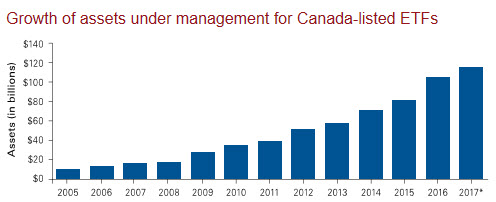
Canadian ETF growth continues in 2017 but still early innings

Source: Strategic Insight data as of December 31 of each year. As of April 30th for 2017.


By Atul Tiwari 

Special to the Financial Independence Hub

With summer in full swing, along with warmer weather and blooming gardens, it got me thinking about cycles in investing. In particular ETFs, which have been taking root in Canada over the past few years.

When Vanguard entered the Canadian market in December 2011, we were one of only eight ETF providers. Our own evolution illustrates how much has changed in just over five years: We started with six index-based ETFs and currently offer a lineup of 33 ETFs, including four actively managed equity factor-based ETFs launched in June 2016.

Industry-wide more than 500 ETFs now vie for the attention of investors and advisors. And it’s not just products that have proliferated; new ETF providers enter the industry every month. More than $130 billion in Canada-domiciled ETF assets is now divided among 24 ETF providers. And there’s room to grow. ETFs make up only 8% of Canadian investable assets while capturing 25% of industry flows for the first quarter.1

Investors have clearly grown more comfortable adding ETFs to their portfolios. While I’m not one to make predictions about whether the pace of expansion will continue, I do see three trends that tend to favour it.

1.)  Greater fee transparency

Thanks to the second phase of Canada’s Client Relationship Model reforms (CRM2), investors are starting to see — in dollar terms on their account statements — what they’re paying their advisory firms. Canadian regulators are also considering a potential ban on embedded trailing commissions. This will surely generate discussion and shine an even brighter light on investment fees.

No less an expert than billionaire investor Warren Buffett extolled the long-term benefits of low-cost investing in his 2016 letter to Berkshire Hathaway shareholders. Cost plays a critical role in total investment return. The less investors pay in fees, the more of the potential returns they can keep. This is true whether you are investing in an ETF, mutual fund or any other investment vehicle.

2.)  Fee-based advisors are on the rise

Driven partly by regulatory changes and heightened awareness of investment fees, many financial advisors are moving to fee-based business practices. We favour this transition as we believe it better aligns advisors with the needs of investors and creates full transparency. Continue Reading…

Two free lunches: Diversification and Rebalancing

“Excellence is not a skill. It is an attitude.” — Ralph Marston

Diversification and Rebalancing strategies are two essential, time-tested portfolio tools. They improve your chances of achieving better consistency of long-term returns. Tasty free lunches are still being served in your investing patch.

Diversification spreads your risks among a variety of investments. Rebalancing makes periodic adjustments to bring allocations back in line with targets set within your road map. I assume that your road map is in place.

Experience shows that asset mix decisions have the greatest impact on your portfolio returns than any other factor. The foundation of investing your nest egg requires patience, discipline and clear investment policies.

Diversification is one necessary safeguard. You don’t want problems arising in any asset class to ruin your well designed portfolio. Diversification increases the odds of you being right more often. If some selections are suffering, others can help cushion the rest.

Initial allocations and weights of your portfolio selections will drift over time as markets rise and retreat. When drift becomes significant, it affects your investment profile and typically requires some re-balancing.

Periodic rebalancing strategies sell some assets and buy others within your asset mix. My preferred time to rebalance is when you inject new money into the portfolio or withdraw some. Use rebalancing techniques as portfolio tweaks, not for wholesale changes.

Possible ways

I highlight 10 ways to achieve portfolio changes: Continue Reading…

Life Insurance denied? Top reasons this could happen

By Lorne Marr, LSM Insurance

Special to the Financial Independence Hub

Life Insurance is designed to provide a financial safety net to the ones left behind in the unfortunate event of death. However, there may be instances when an insurance claim is denied. The best way to avoid this from happening is to follow the rules. Understand your policy and follow these simple rules to ensure your investment in your family’s future will be protected.

1.) Lying On Your Application

Leaving out certain items or fudging the truth a bit might sound harmless enough, but it could mean the difference between a payout and a denial when it comes time for your beneficiaries to collect. The application may seem large and some of the questions might sound like an invasion of privacy, but the insurance company is taking a big risk insuring you. They need as much information as possible in order to properly assess your situation.

Insurance companies can uncover any lies or secrets you may want to hide. Lying on your application is a breech of contract, which means your claim will be denied.

2.) Unintentionally Leaving Out Information

You are supposed to be completely honest when filling out an application. What if you unintentionally leave something out like a routine checkup? Even if your checkout came out clean, be leaving it out the insurance company might automatically assume you have something to hide.

Take your time when completing the application to ensure nothing is left out, no matter how minor it may seem. If you are unsure of an answer, find out. A simple call to your doctor will confirm the date of your last visit. By rushing or guessing, you could nullify your policy.

3.) Using an Under-qualified Agent

Most people will only need to complete one or two life insurance applications in their lifetime. Continue Reading…

How to set your Retirement savings target

How much to save for retirement depends on the type of lifestyle you’re   aiming for

How much to save for retirement varies for each investor. A fulfilling retirement is not simply a matter of accumulating sufficient wealth to give you peace of mind. It is equally a matter of knowing what you will do — in effect, ensuring that you will be as active and productive with your time as you were during your working days.

These days, more investors suffer from what you might call “pre-retirement financial stress syndrome.” That’s the malady that strikes when it dawns on you that you don’t have enough money saved to be able to earn the retirement income stream you were banking on.

To alleviate this worry, we recommend that you base your retirement planning on a sound financial plan. Here are the four key variables that your plan should address to ensure you have sufficient retirement income:

  • How much you expect to save prior to retirement;
  • The return you expect on your savings;
  • How much of that return you’ll have left after taxes;
  • How much retirement income you’ll need once you’ve left the workforce.

Consider taxes when determining how much to save for retirement

As for the tax structure, it keeps changing. But it’s safe to assume that you’ll pay a lower rate of tax on dividends and capital gains than on interest, and that you’ll generally pay taxes on capital gains only when you sell.

As for the return you expect, it’s best to aim low. If you invest in bonds, assume you will earn the current yield; don’t assume you can make money trading in bonds. For stocks, the market returned 10% or so yearly on average over the past 80 or so years. Aim lower — 8% a year, say — to allow for unforeseeable problems and setbacks.

Continue Reading…

Powered by the Financial Independence Hub.
© 2013-2026 All Rights Reserved.
Financial Independence Hub Logo

Sign up for our Daily Digest E-Mail!

Get daily updates from the FindependenceHub.com straight to your inbox.