Building Wealth

For the first 30 or so years of working, saving and investing, you’ll be first in the mode of getting out of the hole (paying down debt), and then building your net worth (that’s wealth accumulation.). But don’t forget, wealth accumulation isn’t the ultimate goal. Decumulation is! (a separate category here at the Hub).

Retirement Reflections Entering our 25th year of Financial Independence

retirement_reflections1
Billy and Akaisha Kaderli

By Billy and Akaisha Kaderli

Special to the Financial Independence Hub

In January we began our 25th year of Financial Independence. Few people can say they have 24 years of self-funded retirement by age of 62, and have a higher net worth after spending and inflation than when they started. This is something of which we are quite proud.

As we have aged one thing we have learned is that the long term is getting shorter every day. Life is to be enjoyed now, not someday – the older we get, the more we appreciate that view. Life is continuously full of opportunities and we want to take them.

Opportunities abound

retirement_reflections7For example, last year we were approached by a startup company that sponsored us for several months in Saigon, Vietnam. Continue Reading…

Weekly Wrap: We ARE saving enough for retirement; CPP & Social Security Redux, frugal millionaires

MalcolmHamilton
Malcolm Hamilton at MoneySense’s fall Retiring Rich event

Retired actuary and retirement guru Malcolm Hamilton this week released a C.D. Howe paper entitled Do Canadians Save Too Little? The Hub’s initial take ran Thursday here: It’s an exaggeration to say we are saving too little for retirement.

Hamilton also wrote a summary of the paper in the FP Comment section of the Financial Post on Thursday, bearing the title False pension assumptions on Canadian savings.

We at the Hub have always said frugality is the key to saving and ultimately building wealth. But according to the most-emailed New York Times article this week, it’s tough for millionaires to dump the frugal habits that got them there: Millionaires who are frugal when they don’t have to be.  Shades of the book, The Millionaire Next Door!

More (much more!) on Voluntary CPP Continue Reading…

C.D. Howe’s Malcolm Hamilton — it’s an exaggeration to say we are saving too little for Retirement

maxresdefault
Malcolm Hamilton (YouTube.com)

By Jonathan Chevreau

Financial Independence Hub

Don’t believe various reports that Canadians are saving too little for retirement, says C.D. Howe senior fellow Malcolm Hamilton in a report issued Thursday. You can get the full 30-page report on PDF by clicking here.

As is typical of Hamilton, now a retired actuary, the report is insightful and entertaining. While there are exceptions, generally speaking, “Canadians are reasonably well prepared for retirement,” he writes.

Right under the report’s Headline (Do Canadians Save Too Little?) the answer is delivered in small Italic type on the title page: “Reports of undersaving by Canadians for retirement are exaggerated. They rely on faulty assumptions, questionable numbers and ignore the diversity of individual retirement goals.”

Among the various reports cited, one is the Ontario Government’s backgrounders that served as its rationale for launching its own Ontario Retirement Pension Plan, more on which below. Continue Reading…

A savings account that rewards inertia

By Robb Engen, Boomer & Echo

Special to the Financial Independence Hub

Canadians have few reasons to save these days. Cheap borrowing coupled with feeble returns on your savings deposits makes it hardly seem worthwhile to park your cash in a savings account. Some banks have decided to punish savers even further by charging fees just for moving your money around.

Gaining Momentum Through Inertia

But one bank has turned to the carrot rather than the stick approach to help its customers save. Scotiabank, which already boasts the best suite of rewards credit cards, in addition to its Moneyback chequing account, has raised the stakes with a new high-interest savings product called the Momentum Savings Account. Here’s how it works:

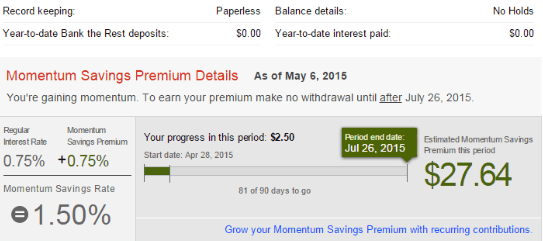
Using a unique incentive that rewards “inaction”, or our tendency to drift toward financial inertia, the Scotiabank Momentum Savings Account pays a bonus interest rate for customers who do not make a withdrawal in a 90-day period.

The account pays regular interest of 0.75 percent when you keep a balance of $5,000 or more. If you resist the temptation to withdraw from your account for 90-days, you’ll receive a 0.75 percent bonus, for a total interest rate of 1.5 percent.

Customers who open an account by June 15th, 2015 will get an additional 0.5 percent bonus, for a total of up to 2 percent until July 31st, 2015.

Momentum Savings also comes with an “Account Tracker” that customers can access online and through their mobile app. It provides a visual “countdown” to the extra interest payment, so you can see when you’ll receive the extra interest. With this tool, you can be strategic about when to withdraw from the account to ensure maximum savings.
Scotia Momentum Savings Account

Continue Reading…

Voluntary CPP is an old idea … has its time finally come?

jplaporte
Jean-Pierre Laporte (Linked In)

By Jean-Pierre Laporte

Special to the Financial Independence Hub 

Much ink has already been spilled since Minister of Finance Oliver rose in the House of Commons on May 26th to announce that the federal government was open to the idea of allowing additional voluntary contributions to the Canada Pension Plan, in order to give Canadians yet another avenue to save for their retirement.

Pundits and pension experts have since wondered what this new policy initiative would look like when fully fleshed out. The details provided by the Hon. Oliver have been scant except to say that employers would not be forced to contribute to the Supplemental Canada Pension Plan (S/CPP for a lack of a better acronym).

The S/CPP policy announcement comes at critical time, as the Ontario government is refining its own proposed CPP expansion initiative known as the Ontario Retirement Pension Plan ( ORPP ). The ORPP is a mandatory extension of the CPP for all workers not otherwise exempted because they work for a federal employer, or participate in a ‘comparable’ pension plan like a defined benefit plan. The ORPP was Ontario’s reaction to the lack of willingness on the part of the Harper government to impose a mandatory increase to the basic CPP benefit.

Foundation laid in 2004

Continue Reading…