Building Wealth

For the first 30 or so years of working, saving and investing, you’ll be first in the mode of getting out of the hole (paying down debt), and then building your net worth (that’s wealth accumulation.). But don’t forget, wealth accumulation isn’t the ultimate goal. Decumulation is! (a separate category here at the Hub).

Why I Pushed My Findependence Day Back 5 Years

robb-engen
Robb Engen, Boomer & Echo

By Robb Engen, Boomer & Echo

Special to the Financial Independence Hub

Last summer I thought I’d be financially free by 40. Reality – and unplanned expenses – set in this year and I’ve adjusted that ambitious projection by five years. I’m still on track to reach a net worth of $1 million by the time I turn 41, but financial independence will have to wait a few more years.

Here’s why:

Remember, financial independence doesn’t necessarily mean retirement. It simply means the date your income from investments exceeds your day-to-day expenses so that you no longer have to rely on regular employment to meet your needs.

My initial projection was indeed ambitious – with us having a paid-off mortgage by 2020 and increasing the income withdrawn from our business by 100 per cent (from $3,000 per month to $6,000).

But borrowing $35,000 to develop our basement this year meant we couldn’t continue our aggressive mortgage pay-down, and a four-year car loan has cut into our ability to save as much as we wanted.

That’s okay – on paper the original plan didn’t factor in these expenses, plus I hadn’t fleshed out exactly how I’d make those numbers work. Now I have a better idea, but unfortunately it’ll cost us five years. Here’s our financial Freedom 45 plan:

Financial independence at 45

In late 2016, once we pay off the HELOC and car loan, we’ll have $27,000 per year to save toward our ‘findependence’ goal. With that amount, we’ll put $12,000 into my RRSP and $10,000 into our TFSAs, plus throw an extra $5,000 payment toward our mortgage.

That pushes our mortgage freedom date back to January 1, 2025. At that time, our home should be worth $600,000 (using a conservative 3 per cent annual growth rate), my RRSP should be worth $380,000, tax-free savings accounts should total in excess of $150,000, and the commuted value of my defined benefit pension will be roughly $310,000.

The key to paying our monthly expenses after financial independence will come from our business income. We currently withdraw $3,000 per month from our small business, which includes income earned from three websites, freelance writing, and from my fee-only financial planning business.

My original plan showed business income increasing to $6,000 per month in five years, but without any clear path to explain how to double revenue. And, after losing my main freelancing gig at the Toronto Star, this goal seemed unrealistic.

But the fee-only planning service has gone better than anticipated – earning $10,000 in less than one year and expected to grow to $18,000 in year two as existing clients stay on and I continue to add one or two clients per month.

After completing the CFP certification in two years I’ll have the opportunity to ramp up my efforts and potentially offer fee-only planning services full-time. At that point, between existing and new clients, the service could bring in roughly $36,000 per year.

My three blogs collectively earn about the same – $36,000 per year – after expenses and so if I can maintain or increase that income then I’ll be able to meet my $6,000 per month goal for business income.

Our projected expenses haven’t changed. After the mortgage is paid off we could live comfortably on $36,000 per year, which leaves the additional $36,000 of income to go toward taxes, short-term savings, and retirement.

Final thoughts

A financial plan is just words on a page unless you commit to taking action. Even if your financial independence date seems like a moving target, it’ll become more precise as you monitor and update projections based on your true reality.

While it’s disappointing to push financial independence back five years, it’s comforting to know that I’m zeroing in on a target date that’s based on reality and not a wild projection.

Editor’s Note:You can find the original version of this blog at Boomer & Echo earlier this week, here. Note too the several comments at the bottom. When we can coordinate at both ends, we hope to make Robb or Marie’s blog available here as many Thursdays as we can manage. Also, in his original headline, Robb used the phrase “Findependence Date.” When I asked why not “Day,” he said he “didn’t want to steal your thunder.” I realize that good bloggers respect others’  intellectual property but let me make it clear that I’m fine with people using the phrase Findependence Day and Findependence. Half the point of this site is to bring these terms into general usage and displace “Retirement.” — JC

If you can’t take the pain of plunging markets, don’t watch

The Financial Post ran this column by me this weekend about my take on the market mayhem of the past week, most of it triggered by plunging oil prices.  While I’ve chosen to put this in the Wealth Accumulation section of the Hub, it occurs to me that the way things are going, it could also be in Decumulation: albeit not the kind of Decumulation we had in mind when we created the section!

For convenience and archiving purposes, I’ve included the full piece below:

Depositphotos_19057551_xsBy Jonathan Chevreau

The worse it gets, the less I look and the less I act. When it comes to market mayhem, I firmly believe that the time to sell is when stocks are up and everyone is buying.

Except maybe in 2008, when it seemed financial Armageddon was genuinely possible, panic seldom serves the investor well in the long run. I understand the psychology of panic as markets sink: fear takes control and investors become convinced that with every passing day, their wealth will vaporize. And yes, if you knew for sure that markets were due for a 10% correction or 20% bear market, then it would make sense to sell.

But we don’t know for sure what tomorrow will bring, and certainly not what stock market averages will be. We do know that interest rates right now are still near historic lows, even if they are expected to start moving higher in 2015. We know that in the long run, stocks are the best-performing asset class, even measured against fixed-income investments that pay more than what is on offer late in 2014. And therefore, for time horizons of five years or longer, investors accept – or should accept – that a significant portion of their wealth should be invested in stocks.

Preferably quality dividend-paying stocks spread across the major economic sectors. Barring that, a broadly diversified “Couch Potato” portfolio of index funds or exchange-traded funds, with exposure to all economic sectors and roughly equal geographical exposure to Canada, the United States and international markets outside North America.

Did they say were plunging or plummeting?

 “But markets are plunging!,” the recent convert to stocks cries. Or worse, plummeting, if indeed plummeting denotes a bigger drop than a mere plunge. You can be sure that headlines will make liberal use of both verbs if this correction continues.

So what to do? If your mix of investments was decided in happier times and you’re comfortable with the amount of risk you had agreed to, then I’d say do nothing. Or, if you have sufficient cash reserves, I’d say buy stocks while they’re on sale. Certain sectors – oil stocks and commodities in general – certainly appear to be on sale. Oil is a cyclical commodity and it seems like only yesterday when the doomsayers were predicting $150 or $200 oil. That day will likely come again but in the meantime many people and companies benefit from rock-bottom oil prices: airlines to name one, and everyday commuters to name a second group of beneficiaries of low-priced oil.

Pros were buying this week

When the mayhem really started to gather steam this week, I was at a meeting with a group of semi-retired professional pension managers and investors. We barely talked about the markets over the two hours we had together, although when it did come up peripherally, one said he was buying the market across the board at these levels, while another was scooping up specific individual oil stocks.

But what if you’ve come to the sickening realization that your risk tolerance isn’t quite as hardy as you thought it was? If you were 90% in stocks but really can’t handle a 30 or 40% potential drop in more than half your portfolio, then you know your optimal asset allocation would be closer to 50% stocks to 50% bonds, not 90% to 10%. But “rebalancing” your investment mix is much better performed when stocks are rising, not falling. You’ve heard the expression “catching a falling knife?” Selling even more stocks into a broadly based general market sell-off is not a recipe for making long-term profits in the stock market.

Consolation of tax-loss selling

However, since it is tax-loss selling season and if you had previously booked gains on some winners in a taxable portfolio, you could sell a few losers right now and get your cash up to a more tolerable level, and tax-wise merely offset the previous gains. That way, at least, the taxman would share your pain and if markets worsened in the coming weeks or months, you’d have a bit of cash to snap up some real bargains, if indeed they materialize.

Of course, the declines could end as suddenly as they began. Personally, I am taking no action at all during this sell-off. And as my financial advisor often reminds his clients, if you’re in dividend-reinvestment plans, as stocks fall you’ll be reinvesting in those stocks at slightly better prices. High-yielding dividend payers will start to pay out even more tempting amounts. When stocks previously paying out 3 or 4% start yielding 5 or 6% (as the stock values themselves fall), I’d be tempted to load up on more, as many did at the depths of 2008.

Until then, try not to overdose on the day-to-day melodrama of crashing markets. Go for long walks, read fiction or otherwise get your mind off paper losses that may prove to be merely temporary.

Jonathan Chevreau recently launched a North American web portal focused on financial independence: http://www.financialindependencehub.com. He can be reached at jonathan@findependenceday.com


How Behavioural Biases Stopped Me from Becoming an Indexer

We’re delighted to run the first of what we hope will be many contributions from the popular Boomer & Echo blog.  The topic is something I suspect many investors can relate to if they have an intellectual understanding of the powerful reason for indexing but are unable to fully commit to it because of the behavioural biases Robb Engen so eloquently describes. Robb is the “Echo” part of Boomer & Echo and you can read all about him here.  The piece originally ran in September. Link to the original is below.

robb-engenBy Robb Engen, Boomer & Echo

Special to the Financial Independence Hub

I’ve spent the last five years convincing myself – and many of you – that I’m a sophisticated do-it-yourself investor with a sound strategy that will outperform the market over the long run.

My dividend growth investment approach has indeed performed well, returning over 16% per year since 2009. But the stock market in general has also been red hot over that time. It’ll take another bear market cycle to determine whether my investment returns were skill, luck, or something in between.

In the meantime, since launching our fee-only planning business earlier this year, I’ve been recommending a couch potato investment approach to anyone who’ll listen. I truly believe that 99% of investors would be better off indexing their portfolio with three or four low cost, broadly diversified ETFs.

Related: Why investors should embrace simple solutions

So lately I’ve started to wonder, what makes my situation so special? Why stick with a strategy that I don’t even recommend to my clients?

The answer lies in a whole bunch of hidden behavioural biases that cloud my judgement – framing, recency bias, home country bias, and overconfidence.

Framing

It’s difficult to part ways with a successful investing approach.  Selling a portfolio of winning stocks – my babies that I’ve nurtured through this five-year bull market – just doesn’t feel right. But if I were sitting on $100,000 in cash instead of stocks I’d have no problem starting a couch potato portfolio today.

Recency bias

As the bull market rages on and my investments continue to perform well, it gets harder and harder to recall what a bear market feels like and what I might do if my investment returns start to lag my benchmark.

Related: How are your investments performing?

This year my portfolio has trailed its benchmark by about one per cent – not huge, but enough to make me pause and reconsider my approach.

Home country bias

When I started my DIY portfolio, I bought the 10 highest yielding stocks on the TSX. While I’ve refined my stock-picking approach since then, I’ve stuck with Canadian dividend payers even though Canadian firms make up a tiny slice of the global economy.

Making matters worse, instead of keeping my Canadian dividend stocks in a TFSA or non-registered account, they’re held inside my RRSP. Not an optimal strategy when it comes to tax efficiency.

Overconfidence

It’s hard not to be overconfident when you’ve beaten your benchmark by a full 3% per year over the last five years. But even the best investors will eventually suffer periods of underperformance.

Related: 5 lessons learned about investing

Why wait for that to happen before accepting the inevitable? Indexing gives me the best chance of achieving my investment goals over the very long term.

No shame in becoming an indexer

Norm Rothery had a great piece in the Globe and Mail in mid-September about a DIY investor whose U.S. stock picks had under-performed the market by a good 3% per year since 2007. The investor decided to stop picking U.S. stocks and move to index funds instead – opting for Vanguard’s FTSE All-World ex Canada ETF (VXC) to get his U.S. exposure.

Rothery goes on to write:

Scott’s decision to stop picking U.S. stocks is an uncommon one. Most self-directed investors remain far too confident in their abilities for far too long. Instead, disappointing long-term results are often attributed to misfortune or peculiar circumstances rather than the lack of a competitive edge.

There is no shame in admitting that you’re not the next Warren Buffett. The vast majority of investors aren’t. Those who figure it out are likely to improve their returns dramatically by following simple low-cost mechanical methods such as investing in low-fee index funds.”

Speaking of Buffett, the ‘Oracle of Omaha’ has famously touted the benefits of a low cost, broadly diversified investment approach, saying that most investors would be better off in an index fund rather than trying to beat the market by picking stocks or actively managed mutual funds.

Final thoughts

The more I read about, write about, and teach others about investing, the more I’m convinced that passive investing is the right approach.

It’s not that I stopped believing in a dividend growth strategy – it’s a fine approach that many investors will have success with – but it’s not ideal for my RRSP.  And frankly, the time and effort needed to manage it properly may not be worth it in the long run.

I suspect it’s only a matter of time before I pull the trigger and become a full-fledged indexer.

Robb Engen is a fee-only planner and personal finance blogger at Boomer & Echo. He lives in Lethbridge, Alberta with his wife and two children.

This article  originally ran in September of this year.  Even if you read the Hub’s version above, it’s worth clicking through to the original to read the more than 60 comments appended to it.

Don’t let Taxman’s crackdown stop you from maxing out your TFSA

My latest post at MoneySense.ca is headlined “CRA TFSA crackdown no cause for alarm.” Click through for the full piece. While you’re at it check out this post from the Hub recapping Tuesday’s one-hour live web chat with myself and Financial Post columnist Garry Marr, who has been breaking the stories about the CRA’s crackdown on excessively traded humungous TFSAs. The crackdown drew plenty of comments and suggestions.

For one-stop shopping purposes and convenience, I reproduce below the original text for my MoneySense blog on how investors should react to this crackdown.

Only minority targeted in CRA crackdown; keep maxing out your TFSA early in January

By Jonathan Chevreau

Woman frightened by taxesTax Free Savings Accounts (TFSAs) have come in for a drubbing lately, based on various media reports of a CRA “crackdown” on frequent traders who have racked up excessive gains.

On social media there seem to be a lot of ordinary investors taken aback by this, even though as I have said on Twitter, 99.99% of the almost 10 million Canadians who have a TFSA hardly need to worry about this obscure attack on a few sophisticated frequent traders of speculative stocks in their accounts.

Anyone who holds index funds, ETFs, blue-chip stocks or fixed income and is holding for the proverbial long term should stick with their plans for using their TFSA, including making a full maximum contribution early in January. Frequent online traders making dozens of trades a day are the target, especially if their trading patterns causes the CRA to view them as running businesses inside their TFSAs: if you or I traded that often we’d be losing a lot in trading commissions, even at the $5 or $10 a pop that most online brokerages charge.

As I have also pointed out, TFSAs are the mirror image of the RRSP, which has been around more than half a century. Even if there is a way to define what an “excessive” gain is, does this mean Ottawa would go back through half a century’s worth of deferred RRSP gains? It seems hardly likely.

TFSA remains best game in a highly taxed town

This is really a tempest in a teapot and I’d hate to think anyone scared off by this would fail to top up their TFSA early in January. As I’ve also said more than once, the TFSA is just about the best game in an otherwise highly taxed town. And as I said in this blog a few weeks ago, the uncovering of an end run that lets the wealthy contort their finances so as to collect for three years the Guaranteed Income Supplement (intended for the elderly poor) suggests that either GIS or TFSA rules or both may get tinkered with sometime in the next few years. So it’s best to fill up TFSAs while you can, just in case Ottawa starts to curtail their use for whatever reason. And that includes maximizing your children’s TFSAs if you’re able.

To be safe, check the CRA’s 8-point audit list

The Canada Revenue Agency has rolled out an 8-point list for a TFSA “audit” but a quick scan of the items should reassure ordinary investors that there’s little cause for alarm. I can see how some knowledgeable do-it-yourself investors who love to research stocks and spend time at their trading terminals might feel a bit uncomfortable but it’s pretty clear the CRA is more worried about those who make many (10 or 15 a day) trades and who quickly liquidate their positions. Also on the list are speculative non-dividend paying stocks, people who use margin or debt to leverage their positions, and those who advertise their willingness to purchase certain securities: again, well outside the realm of the ordinary investor trying to create a little tax-free dividend or interest income.
For most TFSA holders, danger is lack of capital gains not excessive ones


The irony about all this attention to a handful of professional speculators gaming the system for spectacular capital gains is that far too many TFSA users are doing the precise opposite. If all you do is go with a default GIC or low interest-bearing investment in your TFSA, then you’re not doing this vehicle justice. Chris Cottier, a Vancouver-based investment adviser with Richardson GMP, says any young investor with large debts – especially high-interest credit-card debt – should forget about TFSAs until they’ve eliminated that debt.

Very few investments can create gains greater than those accruing to those who pay off credit-card debt that approaches 20% per year.
But when are debt-free (except the mortgage), you’ll be better off holding equities in your TFSA than fixed-income investments sporting today’s minuscule interest rates.

MoneySense has long espoused a passive “Couch Potato” approach to investing in broadly diversified portfolios spread over geographies and multiple asset classes. That approach is particularly apt for TFSAs and is clearly the polar opposite of the type of investor the CRA is looking for.

So when January rolls around, do not hesitate to max out your TFSA contribution for the year 2015 and if it’s a quality ETF from a well-established manufacturer, I wouldn’t waste a minute’s thought on the CRA.

Jonathan Chevreau is Chief Findependence Officer for FinancialIndependenceHub.com.

ING vs. Tangerine: two years since the Buyout

mypic
Danielle Kubes, Pretty Little Poor Girl

By Danielle Kubes,

Special to the Financial Independence Hub

I haven’t noticed many changes since Scotiabank bought out ING Direct in 2012, except for two:

  1. They changed the name to Tangerine

Why did they do this? Is it a fruit? Is it a colour? WHY? People like my parents already think ING is a fake bank that will steal all my money: calling it something as light and fluffy as Tangerine does not help my case that it is a real bank with real interest rates, and that banks with tellers and real estate are as 20th century as AOL.

I will forgive them, however, because CEO  Peter Aceto told Canadian Business that they weren’t allowed to use the name ING anymore. Here’s the rationale behind that decision:

“Simplicity” and “innovation” were two things the bank wanted to come across in its new name—the idea was to hearken back to its earlier days (being an alternative, simplified place to do your banking), but push the brand forward at the same time. The name Orange was considered on the shortlist, but was considered to be “too safe or obvious of a choice.” Tangerine makes reference to ING Direct’s orange history, (Ed Note [DK]: by orange history, do they mean just using the colour orange? How does a bank have colour history?) while also being significantly different.

Aceto says part of the branding discussion also took into account the more “fun” aspects of the name.

“We understood the risk that a name like that could be interpreted as being silly, or not serious,” he says. “Banking is important, it’s serious. We’re asking you to give us your life savings, or to help you buy a home or invest.”

That’s why there won’t be any references to fruit in any of Tangerine’s advertising materials or promotional campaigns. The fun name “does a lot of work for us” in sparking interest in Tangerine, Aceto says, but service at the customer level needs to be thoughtful and earnest in order to build a client base.

“I want people to think, oh, they’re different. They’re not like everyone else.”


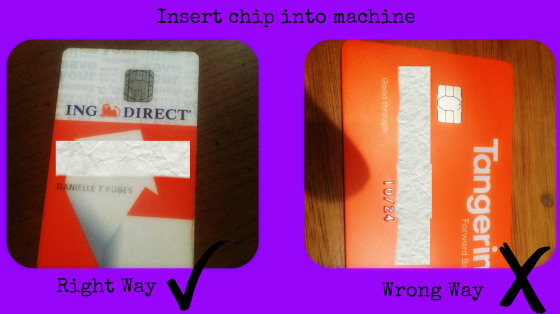
  1. tangerine-ing-direct-debit-interactThey changed the debit card by making it flimsier and WRONG

Writing the bank name horizontally across a debit card made sense when we signed for things.

Now we use a chip and PIN# method of payment. The chip is always entered vertically.

So why, on all debit cards, is the bank name still horizontal?

ING was the only card to write its name vertically, which was logical and made them seem the most current.

With the buyout, it has gone backwards and written its company name horizontally.

Also, while you can’t see this in a picture, the new card is very flimsy and bendy. It’s not really a problem but coupled with Tangerine it just kind of makes the bank seem flimsy.

Now, these are all  personal pet peeves that have no affect on how they do business; banking  with them hasn’t changed. They don’t have the best interest rates anymore; that award would go to credit unions in Western Canada, but they are still way better than the Big Five banks and they also have lower fees (no fees!) than the credit unions.

All in all, it’s still my favourite Canadian bank with which to do my daily banking, but it’s no longer my favourite choice with which to invest in GICs, which will be the subject of another  post.

Here’s how this article originally appeared at Danielle’s Pretty Little Poor Girl blog. And you should click on the link because apart from Danielle’s awesome slogan, she includes an extra paragraph at the bottom of her original post that further teases the good folks at Tangerine: JC.