For the first 30 or so years of working, saving and investing, you’ll be first in the mode of getting out of the hole (paying down debt), and then building your net worth (that’s wealth accumulation.). But don’t forget, wealth accumulation isn’t the ultimate goal. Decumulation is! (a separate category here at the Hub).
By Dale Roberts, Retirement Club/cutthecrapinvesting
Special to Financial Independence Hub
Exchange traded funds (ETFs) are likely the greatest advancement for investorkind. We can gain much-needed diversifcation and keep the fees super low. Compared to traditional actively managed mutual funds, ETFs are usually a 90% to 95% off sale. Over the decades this fee saving can amount to a life-changing event. But what if we go one step further and buy enough stocks to potentially replicate the index? Here’s how I bought stocks and left the ETF fees behind.
As always the following is not advice.
In most cases it might not make sense to sell an ETF to recreate the index. The fees can be next to nothing. An ETF such as XIC-T, which tracks the broad Canadian TSX Composite Index, offers investors an extremely low-cost way to gain diversified exposure to Canadian equities. With a Management Expense Ratio (MER) of just 0.06%, the fees are next to nothing. On a $100,000 portfolio, the annual cost is only $60.
ETF fees are peanuts
On a $500,000 portfolio the fees are just $300 per year. That’s peanuts. If you seek exposure to the broad Canadian stock market in cap-weighted form, XIC-T or similar is likely for you. Cap-weighted means that the largest companies, based on their market capitalization (total market value), receive the greatest weight in the index. For example, Royal Bank of Canada is one of the largest companies on the TSX by market capitalization, so it has one of the largest weights in the index. The larger a company becomes relative to the other companies in the index, the greater its influence on the index’s performance.
Of course you can buy the markets for U.S. and International stocks in the same low-fee manner. For portfolio ideas check out the core global ETF portfolio models on Cut The Crap Investing. And as readers likely know, you can purchase an all-in-one global ETF portfolio at various risk levels. See the asset allocation ETF page.
Of course, it’s a personal decision whether to buy an index fund or gain exposure to the Canadian market by way of a stock portfolio. The good news? We can keep it simple. Canada’s bluest-of-blue-chip companies have a long history of delivering excellent returns: and often beating the broader market.
Most Canadian self-directed investors build their portfolios around Canadian stocks, then add U.S. and international exposure through ETFs. That’s exactly what I do. And that’s also why you might want to check out Wealth Club for Canadians. It’s a premium service focused on wealth creation, with specific Canadian stock portfolio models designed to help investors build and manage their own portfolios.
In my personal RRSP portfolio I created a version of a Canadian Wide Moat portfolio. It has a blue chip focus, but sticks to the wide moat sectors:
Canadian financials
Railways
Grocers
Broader utilities (including pipelines and telcos)
I shared this wide moat (out) performance example on Twitter / X …
Yes, please. Follow me on Twitter.
In my personal RRSP portfolio I held a concentrated portfolio of banks, pipelines and telcos. It’s somewhat close to the Essentials Portfolio that has a nice history of out performance.
Hanging up on the telco sector
In the utilities camp I held BCE-T and Telus T-T. As we know the telco sector fell on hard times. In early 2024 I mostly hung up on the telco sector. The rules changed and higher borrowing costs caused by rate increases piled on.
And while my Canadian banks have performed very well, I thought I should seek exposure to the greater Canadian Financials sector. So, I kept most of RBC-T and bought XFN-T, iShares S&P/TSX Capped Financials Index ETF. The fund mostly holds the big 6 Canadian banks, the insurers and Brookfield BN-T.
I have also been fortunate to hold Canadian oil and gas stocks from about 600% ago. I also hold/held some gold and other inflation-fighting “stuff” such as PRA-T.
The “problem” is, XFN-T has an MER of 0.61%. We are paying $610 on every $100,000. I’m not complaining. The ETF delivered a ‘quick’ 100% or more. RBC had even greater returns for the period. Yes, we’ve all be treated very well by our Canadian financials. They are even trouncing U.S. tech in recent years.
Most Canadian investors know they need to shelter investments from taxes as much as possible but these can be taxed differently depending on which account holds them. Professionals call this Asset Location. Here’s how to optimally place them in the most tax-efficient vehicles.
By Curtis Travis
Special to Financial Independence Hub
Most Canadian investors learn the first rule quickly enough: shelter it. Fill the registered accounts before a dollar goes into a plain taxable one. It is the single most valuable habit in Canadian investing, and if you read this site you have almost certainly done it.
Almost nobody does the second step.
Here it is: the same investment is taxed differently depending on which account holds it. Not the same investment in a different year, or bought at a different price: the identical holding, on the identical day, taxed differently because of the drawer it sits in. Professionals call this Asset Location. It costs nothing but a few minutes of thought, and getting it backwards can quietly cost you thousands over a couple of decades.
Three facts drive the whole thing.
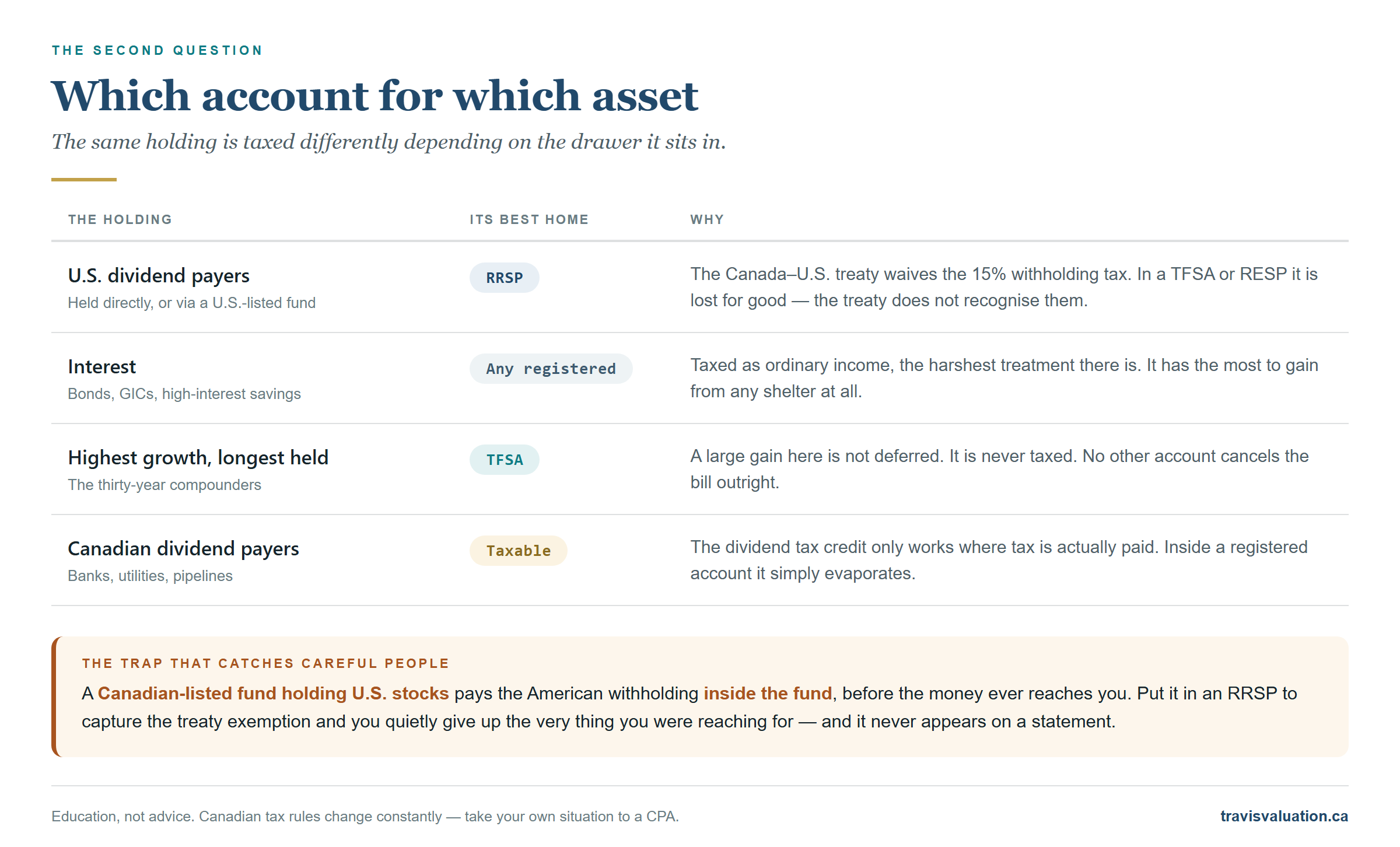
The first is that the dividend tax credit — the break that makes eligible Canadian dividends so gentle in a taxable account — is lost inside a registered account. A TFSA or an RRSP isn’t paying tax in the first place, so the credit has nothing to offset. It simply evaporates.
The second is that American dividends arrive with tax already taken off the top. The United States withholds 15% under the Canada/U.S. treaty. In a taxable account you can generally claim that back as a foreign tax credit. In an RRSP the treaty exempts it entirely. And in a TFSA, an FHSA or an RESP it is gone for good: the treaty doesn’t recognise those accounts, and there is no tax return on which to recover it.
The third is that interest is taxed as ordinary income, the harshest treatment there is. It has the most to gain from any shelter at all.
Line those up and a rough map falls out. Not a clever one: the kind a CPA will refine but not overturn.
American dividend payers belong in the RRSP, where the withholding disappears. Interest-bearing holdings belong in a registered account too, because they are punished worst outside one. Canadian dividend payers are the natural residents of a taxable account, where the credit actually does its work; so when registered room is tight and something has to sit outside, the Canadian banks and utilities are, for most people, the last things that need sheltering. And your highest-growth, longest-held positions belong in the TFSA, where a large gain is not merely deferred but never taxed at all.
That last one is worth sitting with. A TFSA doesn’t defer the tax on a thirty-year compounder. It cancels it.
Now the part that catches careful people.
The RRSP exemption on American dividends only applies when you hold the American shares, or an American-listed fund, directly. A Canadian-listed fund that owns American stocks pays the withholding inside the fund, before the money ever reaches you. In a taxable account that is survivable: the fund passes the tax through on your slip and the credit is still yours. In an RRSP it is simply lost, and you will never see it on a statement.
This surprises people who did everything else right. They bought a Canadian-listed U.S. equity fund, put it in the RRSP because that is where American exposure is supposed to go, and quietly gave up the treaty benefit they were trying to capture.
Where good intentions get expensive
Two more pieces of fine print, because this is where good intentions get expensive.
The RRSP is a deferral, not an exemption. Everything that comes out comes out as ordinary income: capital gains and dividends included. A gain that would have been taxed at the favourable capital-gains rate in a taxable account is taxed in full when it leaves an RRSP. The deduction you took going in is what pays for that. And by the end of the year you turn 71 the account must be wound up, for most people into a RRIF, which from the following year pays you out on a schedule whether you want the money or not.
The TFSA has three habits worth knowing. Room you withdraw comes back: but not until the following January, so a withdrawal and a re-deposit in the same calendar year can quietly push you over your limit. The penalty is a tax of 1% per month on the excess, which is not a rounding error. And a TFSA is for investing: the tax agency has taken the position, and the courts have backed it, that an account run like a day-trading business can have its gains taxed as business income, tax-free wrapper or not. Buy well and sit still and you will never meet that rule. Continue Reading…
Staying with the same employer for years can demonstrate commitment. You might also expect that loyalty to eventually reward you with steady raises, promotions and greater financial security. However, when you’re pursuing Financial Independence, Retire Early (FIRE) goals, you need to look at company loyalty through a different lens because your income directly affects how much you can save and invest.
If your annual raises consistently trail market rates, staying put can quietly lead to salary stagnation. You earn less, have less money available to invest and miss out on potential compound growth. That gap can grow large enough to push your target retirement date back by years.
The Hidden FIRE Cost of Salary Stagnation
Even when you receive an annual raise, your compensation can fall behind market salaries for professionals with similar skills and experience. This problem becomes more significant when you stay with the same employer for years. Wage pressures also affect workers across the income spectrum, with more than 800,000 U.S. workers aged 16 and older earning at or below the federal minimum wage.
When you remain underpaid, you lose more than the difference between your current salary and what you could earn elsewhere. You also have less money to invest, which reduces the amount that can benefit from compound growth and potentially pushes your FIRE date further into the future.
When Job Switching can Accelerate your FIRE Timeline
In 2026, people who switched companies saw their annual pay increase by an average of 6.6%, compared with 4.4% for those who stayed with their current employer. That difference matters when you’re pursuing FIRE because a higher income gives you more room to increase your savings rate without making additional spending cuts.
Directing much of each raise toward investment can increase your contributions and give that additional money more time to compound instead of losing it to lifestyle inflation. However, you should approach job switching strategically and compare total compensation because pensions and health coverage can sometimes make staying more financially valuable.
Maximize the Savings Mechanisms available to you
If you work in the U.S., consider making strategic use of your 401(k), Individual Retirement Account (IRA) and eligible health savings accounts before directing all your money toward taxable accounts. Annual contribution limits apply to 401(k)s and IRAs. However, once you reach age 50, catch-up contributions generally allow you to contribute additional amounts. You should also capture your full employer match when available, since leaving matching funds unused can slow your progress toward your FIRE target. Continue Reading…
As we aim to do roughly every month, today’s blog on Financial Independence taps the expertise of multiple business owners and investment experts on both sides of the border gathered through Connectively in partnership with LinkedIn.
This edition looks specifically at the FIRE movement, which of course is an acronym for Financial Independence Retire Early.
The paragraph reproduced below is how we posed the question.
The subsequent replies chosen are presented almost in full, with links to the source contained in their bios at the end of each section. I’ve added subheadings to speed readers through the content I hope is relevant to them.
What is your take on the FIRE movement (Financial Independence Retire Early)? Do you prefer a different term, do you believe in the FI part but not the RE part? How early is too early to “retire?” How do you define Retirement? Full-stop never work again, or just no longer being a corporate salaried employee. Any favorite FIRE blogs or podcasts you subscribe to or recommend?
“Most FIRE folks I’ve encountered don’t actually stop working; they stop working for someone else.”
Ah, the FIRE movement: where twenty-somethings eat rice and beans for a decade so they never have to attend another Monday morning meeting. I love the “FI” part with my whole heart. Financial Independence isn’t a trend; it’s just smart adulting. Building an emergency fund, crushing high-interest debt, investing consistently: that’s timeless wisdom dressed up in a catchy acronym.
The “RE” part, though? That’s where I raise a legal eyebrow. Retiring at 32 sounds thrilling until you realize you’ve got 50+ years of healthcare costs, inflation, and “what if the market tanks in year three” anxiety ahead of you. I’ve seen too many bankruptcy filings from people who front-loaded their optimism and back-loaded their income planning. So my official stance: FI, yes. RE, only if your math is bulletproof and you have a contingency plan tighter than a loan shark’s payment schedule.
How early is too early? There’s no magic number, but if you’re retiring before you’ve stress-tested your plan against a recession, a health crisis, and at least one kid’s emergency root canal, you’re retiring on hope, not strategy. I’d rather see someone retire at 45 with a fortress of a financial plan than at 35 with a house of cards.
As for defining “retirement”, I don’t buy the full-stop-never-work-again version. Most FIRE folks I’ve encountered don’t actually stop working; they stop working for someone else. They pivot to consulting, passion projects, or that Etsy shop selling hand-painted rocks. That’s not retirement—that’s career emancipation. And frankly, that’s healthier. Purposeless days can be as damaging to your well-being as an unpaid credit card is to your credit score.
Favorite resources? I keep an eye on “ChooseFI” for community-driven inspiration and practical steps, and “Mr. Money Mustache” for someone who’ll bluntly tell you to stop buying lattes and start buying index funds. But I always tell people: read these for motivation, not gospel. Your debt situation, your state’s laws, and your risk tolerance are yours alone—no blog can litigate your specific financial life like a good advisor (or attorney) can.
Bottom line: chase Financial Independence like it’s your job. Just make sure “Retiring Early” doesn’t quietly become “Filing for Bankruptcy Early” instead. — Loretta Kilday, DebtCC Spokesperson, Debt Consolidation Care
“I prefer the term Financial Autonomy.”
Financial Independence is the ultimate risk management strategy, yet the “Retire Early” label often misdiagnoses the goal as an escape from productivity rather than an acquisition of professional autonomy.
I prefer the term Financial Autonomy because it reflects a shift in capital allocation rather than a cessation of value creation. After two decades overseeing financial strategy and delivery operations, I have found that high-performing leaders rarely want to stop contributing; they simply want to stop answering to inefficient structures. Retirement should not be defined as a full-stop end to work, but as the pivot point where professional activity is driven entirely by intellectual curiosity rather than financial necessity.
The math of independence must be approached with the same discipline as a corporate balance sheet. Many proponents of early retirement rely on withdrawal models that fail to account for long-tail risks like global healthcare inflation or currency volatility across a 50-year horizon. It is too early to step away until a portfolio has been stress-tested against at least two distinct economic cycles. True independence requires ensuring that passive cash flow exceeds lifestyle burn even during prolonged periods of market stagnation.
Durable financial planning relies on economic history and financial biographies rather than the fleeting trends of modern hustle culture. Understanding how capital markets and labor value have shifted over the last century provides a more stable framework for long-term planning. The objective is to reach a stage where you are no longer a salaried employee by obligation, but a contributor to the economy by design. Sustainable returns are not just about the balance in a brokerage account; they are about the continued growth and leverage of your human capital. — Abhishek Pareek, Founder & Director, Coders.dev
“Real freedom is being able to say no to what drains you and yes to what sustains you.”
I’ve seen too many high achievers burn out chasing Financial Independence, then realize they don’t know who they are without the hustle. The problem isn’t the FIRE framework itself, it’s that people use it to escape rather than create. They’re running from burnout instead of asking why they’re burned out in the first place.
I believe in the FI part because autonomy matters. But retiring at 35 or 40 can backfire if you haven’t figured out what actually fulfills you beyond hitting achievement metrics. I think of retirement as the freedom to choose work that aligns with your values, not necessarily stopping work altogether. Some of my most miserable clients were financially independent but spiritually empty because they’d built their entire identity around accumulation. Real freedom is being able to say no to what drains you and yes to what sustains you, whether that happens at 45 or 65. — Samka Keranovic, Founder, Drwmbs
“Financial Independence is about buying your freedom to choose.”
I love the ambition behind FIRE, but I’d reframe it slightly: Financial Independence is about buying your freedom to choose, and that’s something I think about constantly running operations.
The FI part is undeniable. When you’ve built enough cushion that a bad month doesn’t sink you, you make sharper decisions, negotiate better, and sleep easier. The RE part is where I’d push back on the label, because most people who “retire early” at 35 or 40 are really just changing what they work on, not stopping work entirely.
That’s my definition of retirement, honestly: it’s not never working again, it’s never being forced to work on something you don’t care about. Full-stop retirement sounds like a fast track to boredom for a lot of driven people. The folks I admire treat FI as leverage. They leave the salaried corporate role and pour energy into something they own, whether that’s a business, a portfolio of projects, or in my world, building free tools like our customizable QR code generator because they want to, not because payroll depends on it.
How early is too early? Whenever the math only works if nothing ever goes wrong. I apply the same logic I use with clients: we back our SEO plans with a six-month performance guarantee, continuing services for free if KPIs aren’t met, because we’d rather absorb the risk ourselves than ask a small business to bet everything on hope. That’s the FIRE mindset done right, protect the downside first, then race toward freedom. If someone at 32 has a plan that survives market crashes, health surprises, and inflation, more power to them. If it only works in a spreadsheet, they’ve built a fantasy, not a plan.
For reading and listening, I’d point people to Mr. Money Mustache for the no-nonsense math and ChooseFI for the community side of the equation. Both do a great job separating hype from substance, which is the same standard I’d hold any advice to, financial or otherwise. — Melissa Basmayor, Marketing Coordinator, Freeqrcode.ai
“The financial objective, in my view, should be freedom of choice rather than freedom from all work.”
I strongly believe in the FI part of FIRE, but I am less attached to the idea that financial independence should automatically lead to retiring as early as possible.
For me, Financial Independence means reaching the point where your decisions are no longer dictated by the next paycheck. That could mean leaving a corporate job, changing careers, starting a business, working fewer hours, or simply having enough financial security to say no to work you no longer want to do.
I therefore prefer to think of FIRE as “Financial Independence, Reclaiming Employment” rather than necessarily “Retire Early.”
I do not think there is a universal age that is too early to retire. The bigger question is what someone is retiring to. Work provides more than income: routine, social contact, intellectual challenge and a sense of usefulness. If someone reaches financial independence at 40 but removes all of those things without replacing them, early retirement may not feel as rewarding as expected.
My definition of retirement is not “never earn another dollar.” It is reaching the point where paid work becomes optional rather than compulsory.
The financial objective, in my view, should be freedom of choice rather than freedom from all work. — Cem Oner, Founder / Finance & Public Data Publisher, Hesap Cebimde
“My definition of retirement is not ‘never work again.’ It’s never being forced to work again. Huge difference.”
I’m a believer in the FI part, one hundred percent. The RE part is where I push back, and here’s why: I built Scale By SEO from scratch, and I’ve watched consistent effort compound the same way money does. Walking away from work you love at 35 to sit on a beach sounds like quitting a marathon at mile twenty because your legs feel fine.
My preferred term is “Financial independence, work on your terms.” The money buys you optionality, not an exit. It means you take a client because you want to, not because rent is due. That’s the real win.
How early is too early? There’s no magic number, but too early is when you retire from something instead of to something. If you don’t have a reason to get up in the morning that isn’t a paycheck, the money won’t fix that. I’ve watched business owners sell out and go stir-crazy within a year. Purpose doesn’t have a price target.
And my definition of retirement is not “never work again.” It’s never being forced to work again. Huge difference. I run an SEO agency out of Harlingen, Texas, and I genuinely enjoy helping small businesses, plumbers, healthcare practices, auto body shops, get found online. Would I stop doing that because a portfolio hit a number? Absolutely not. Work you choose is one of life’s great pleasures.
On resources, Mr. Money Mustache is still the best voice in the space, and his writing is funny on top of being smart.
The ChooseFI podcast is my go-to for practical tactics, and JL Collins’ “The Simple Path to Wealth” is the book I’d hand anyone starting from zero. His stock series alone is worth hours of your time.
One warning: the FIRE crowd can obsess over the math and skip the meaning. Independence is a tool. Decide what it’s for before you chase it. I’d rather be sixty and excited about my work than forty and bored on a beach. — Wayne Lowry, CEO, Scale By SEO
“Buy the freedom, skip the recliner.”
Buy the freedom, skip the recliner. That’s my FIRE philosophy in one line, and I think it’s the healthiest version of the movement.
I buy the FI part completely. Financial Independence is just margin in your life: low overhead, real savings, the ability to say no. Running a small roastery teaches you that fast. Since Craig Keel founded Equipoise Coffee in 2021, every day has been about prioritizing when resources are tight. Do we spend on another single-origin like the Ethiopian Yirgacheffe, or on brewing guides that help people make better coffee at home? Margin is what lets you make those calls from strategy instead of panic. Personal finance works the same way.
The RE part is where I’d edit the script. I prefer “financial independence” plain and simple, maybe “financial autonomy,” because “retire early” sells an ending when most people actually want a beginning. I define retirement as the point where work becomes a choice rather than an obligation. By that definition, I know plenty of “retired” people who work more passionately than any salaried employee, and plenty of employed people who retired emotionally years ago.
How early is too early? When you’ve funded decades of pure consumption with nothing you’re building toward, you’ve traded one imbalance for another. Our whole brand philosophy is balance, in the cup and in life. A coffee that’s all brightness and no body falls flat, and so does a life that’s all freedom and no purpose.
On resources, Mr. Money Mustache is the classic and still worth reading, less for the math than for the “build the life you want, then save for it” ethos. ChooseFI is a solid podcast with a wide range of guest stories worth sampling.
So if FIRE means engineering the freedom to do work you love, I’m all in. If it means never working again, that just sounds like a long, quiet fade. — Rory Keel, Owner, Equipoise Coffee
My honest take: the “FI” half matters far more than the “RE” half
My honest take: the “FI” half matters far more than the “RE” half — the math (25 times your annual expenses, per the 4% rule) doesn’t care whether financial independence means quitting work entirely or just no longer needing the paycheck, and that distinction gets lost when people fixate on “retiring early.” I’d define retirement less as “never earning another dollar” and more as your paycheck becoming optional — once a portfolio can sustain a lower, safe withdrawal without more contributions, working becomes a choice about meaning rather than survival. The lever that actually moves someone’s FIRE date isn’t income, it’s savings rate: saving 10% of your income buys roughly one year of retirement for every nine years worked, but push that to 50% and it gets close to one-for-one, a bigger shift than most raises ever deliver. I build the free FIRE and compound-interest calculators at TheSmartWealthTools.com, so I watch that one input move people’s timelines by decades more than any other number on the page. — Haggai Tzouk, Founder, TheSmartWealthTools.com
Financial Independence is real. The “retire early” part is where people lose the plot.
I’m Runbo Li, co-founder and CEO of Magic Hour. The FIRE movement gets the diagnosis right but the prescription wrong. Financial independence is real. The “retire early” part is where people lose the plot.
I watched my parents run small businesses my entire life. They never talked about retirement. They talked about freedom. Freedom to pick which problems they wanted to solve, which customers they wanted to serve, which days they wanted to work. That’s a fundamentally different orientation than “stop working as fast as possible.” Continue Reading…
Understanding the difference between penny stocks and blue chip stocks will help you pick the best investments for your portfolio. Learn all about it now.
TSInetwork.ca
In penny stocks the odds are against you. So, time works against you. The longer or more often you play, the likelier you are to lose. On the other hand, blue chip stocks are your best promise of investment quality: and of strong returns for years to come.
Knowing the difference between penny stocks and blue chip stocks is important for your portfolio returns.
Understanding the difference between penny stocks and blue chip stocks: Penny stocks are highly speculative, while blue chips have proven track records
If you lose money in speculative pennies or other low-quality stocks, you may think your main mistake was bad timing. That’s a misconception. All penny stocks rely on luck to become wildly profitable. Even with luck on the side of the penny stock investor, if they play long enough, the “house odds” eventually triumph over any run of good luck for the investor.
They should note, however, that there are several potential risks when investors venture into penny stocks.
Buying low-quality penny stocks is one of those things that can appear to be successful before it goes badly wrong. Some get hooked on it, since low-quality stocks can be highly profitable over short periods. That’s because they are generally more volatile than high-quality stocks.
On the other hand, blue-chip companies can give investors an additional measure of safety in volatile markets. And the best ones offer an attractive combination of moderate p/e’s (the ratio of a stock’s price per share to its per-share earnings), steady or rising dividend yields (annual dividend divided by the share price), and promising growth prospects.
Understand that there is a big difference between penny stocks and blue chip stocks over time
Penny stocks: Although the price may seem right, the average penny offers a poor long-term return. After all, it’s hard to create a successful business. It’s much easier and cheaper to set up a company and sell stock to the public. That’s why bad penny stocks always outnumber good ones.
Penny stocks can also be more easily manipulated than most stocks that trade on exchanges because of their generally low trading levels and the resulting price volatility. Combine this with a lack of regulatory oversight on some stock exchanges and the fact these companies are easy to launch, and you can appreciate why investment frauds are more common with penny stocks.
Blue chip stocks: The blue-chip investments we recommend have a history of profits going back for at least 5 to 10 years. Companies that make money regularly are safer than chronic or even occasional money losers.
Blue chip companies can give investors an additional measure of safety in volatile markets. And the best ones offer an attractive combination of moderate p/e’s (the ratio of a stock’s price to its per-share earnings), steady or rising dividend yields (annual dividend divided by the share price) and promising growth prospects.
Know the difference between penny stocks and blue-chip stocks to protect your portfolio from loss
We feel most investors should hold the largest part of their investment portfolios in securities from blue-chip companies. All these stocks should offer good “value,” that is, they should trade at reasonable multiples of earnings, cash flow, book value and so on. Ideally, they should also have above average-growth prospects in expanding markets.
In general, on the other hand, penny stocks have lower trading volumes or liquidity, and this lack of liquidity means it may be more difficult to sell a stock when you want to. They also suffer from large price fluctuations, so any bit of news will cause a penny stock’s price to rise or fall.
We think you should apply our sell-half rule with pennies. Selling half your holdings after the stock doubles is a good strategy for any high-risk investment, but especially so for penny stocks.
This can give you a clearer perspective on what to do with the other half of your investment. After all, if you are too slow to sell speculative stuff, your profits and even your principal can evaporate all too quickly.
Ultimately, penny stocks should be limited to a small part of any diversified portfolio. You should only buy the most speculative of them with money you can afford to lose.
Use our three-part Successful Investor approach for better investment results
Invest mainly in well-established, dividend-paying companies;
Spread your money out across most if not all of the five main economic sectors (Manufacturing & Industry; Resources & Commodities; Consumer; Finance; Utilities);
Downplay or avoid stocks in the broker/media limelight.
What would persuade you to buy penny stocks over blue chip stocks?
Have you been tempted to buy penny stocks? What made you choose them?
Pat McKeough has been one of Canada’s most respected investment advisors for over three decades. He is the founder and senior editor of TSI Network and the founder of Successful Investor Wealth Management. He is also the author of several acclaimed investment books. This post was originally published in 2014 and is updated regularly, mostly recently on March 26, 2026. It is republished on Findependence Hub with permission.


 Posted By



 Posted By









 Posted By