Building Wealth

For the first 30 or so years of working, saving and investing, you’ll be first in the mode of getting out of the hole (paying down debt), and then building your net worth (that’s wealth accumulation.). But don’t forget, wealth accumulation isn’t the ultimate goal. Decumulation is! (a separate category here at the Hub).

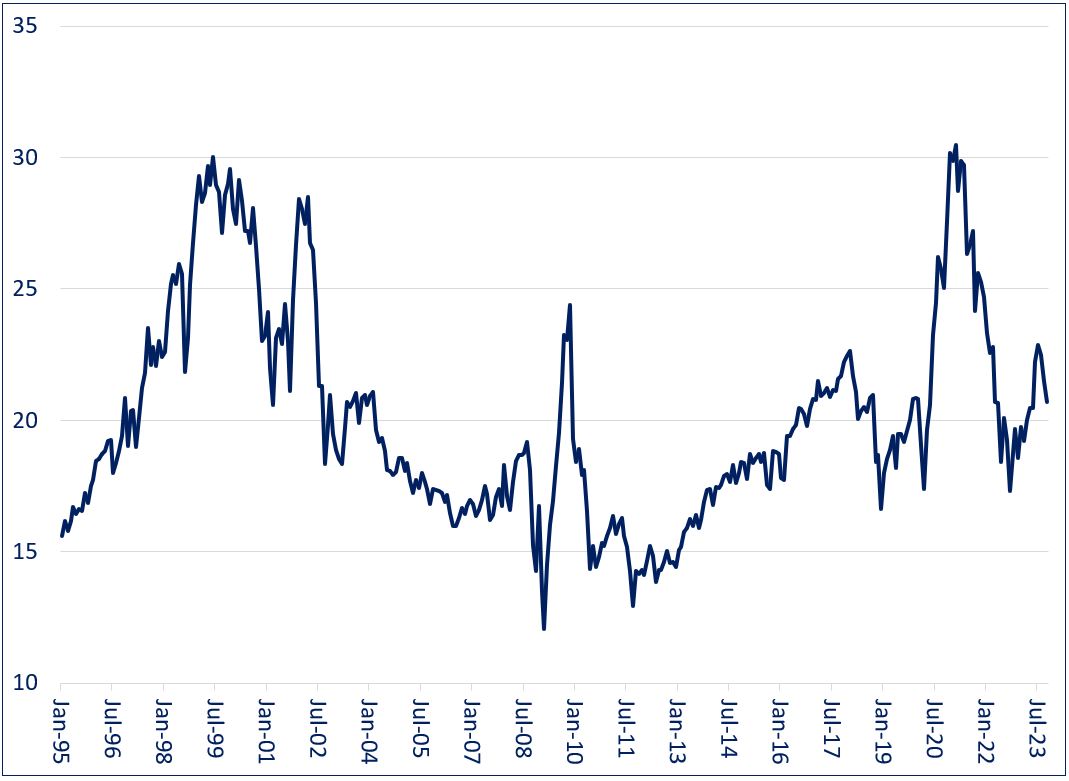
Valuation: Good for Long but not for Short

Graphic courtesy Outcome/QuoteInspector.com.

By Noah Solomon

Special to Financial Independence Hub

As I have written in the past, valuations are of no use for determining broad market returns over the short term.

To be clear, I am NOT implying that valuation doesn’t matter. Historical experience demonstrates that it has been an extremely powerful predictor of average returns over the long term. Without fail, whenever valuations have stood well below average levels, strong returns ensued over the next 7-10 years. Conversely, highly elevated valuations have preceded anemic or negative returns.

For investors interested in shorter-term market movements, sentiment indicators may harbor greater potential than their macroeconomic or valuation-based counterparts. In this month’s missive, I explore some of the more commonly cited indicators that purportedly possess short-term predictive capabilities to ascertain:

(1) Whether the historical record confirms the presence of any predictive power, and
(2) What these variables are signaling for markets in the near term.

The VIX Index: Embrace the Fear

The VIX Index represents the market’s expectations of the S&P 500 Index’s volatility over the next 30 days. Its level is derived from the prices of S&P 500 options with near-term expiration dates. Dubbed the “fear index,” the VIX is often used to gauge market sentiment, and in particular the degree of fear among market participants.

Historically, the VIX has served as a good, if imperfect indicator of market turning points:

  • Although it failed to provide a clear “get out of dodge” signal before the peak of the tech bubble in early 2000, the VIX’s historically stratospheric level in late 2002 indicated a level of extreme fear that signaled that better times were at hand.
  • In early 2007, the VIX stood at very depressed levels, indicating the high degree of complacency that contributed to the global financial crisis of 2008. Unfortunately, it was far too early in signaling the recovery. In October 2008, extremely elevated VIX levels were signaling the type of abundance of fear that often precedes rebounds, yet stocks still had plenty of downside before ultimately bottoming in March of 2009.
  • More recently, the VIX failed to provide a warning signal of the market turmoil of 2022. However, its extremely elevated stance in late October of 2022 signaled that a rebound was imminent.

VIX Index Levels and S&P 500 Index Returns: 1997 – Present

Putting specific bear markets and recoveries aside, the above table demonstrates that elevated VIX/fear levels have on average preceded higher returns, and depressed VIX/lower fear levels have foreshadowed lower returns. The historical record lends credence to Buffett’s sage advice that it is wise for investors to be “fearful when others are greedy, and greedy when others are fearful.”

Put Call Ratio: Beware Cheap Insurance

Like the VIX Index, the put-call ratio (PCR) is widely used to gauge the overall mood of the market. Put options provide the right to sell stocks at a predetermined price and are often purchased as insurance to protect portfolios from market declines. Call options offer the right to buy stocks at a predetermined price and are frequently bought to capture upside participation when stock prices rise.

The PCR increases when the market participants’ desire for downside protection rises relative to their desire for upside participation. Alternately stated, a rise in the PCR is indicative of a rise in bearish sentiment. Conversely, the PCR falls when people become more focused on reaping gains than on avoiding losses, which is indicative of a rise in bullish sentiment.

Since 1997, the PCR has been a contrarian indicator, whereby elevated levels (high fear/low greed) have on average signaled higher returns and lower PCRs (low fear/high greed) have heralded subdued or negative results. Continue Reading…

Canada’s Best Energy Dividend Stocks 2023

By Dale Roberts,

Million Dollar Journey

Special to Financial Independence Hub 

Canada’s energy stocks have been a key part of my investing strategy for some time now.

In August of 2020 I asked if Canada’s energy dividends were in trouble?

Of course that was before energy prices and energy stocks were dominating the headlines. At the time Canadian oil prices were about $30 a barrel and energy dividends were under a lot of pressure due to collapsed earnings.

That price has more than tripled, was above $115 U.S. and now sits near $70 U.S. in 2023. Those generous oil prices have fuelled incredible earnings and dividend growth. There is no sector over the last few years with greater free cash flow.

The oil and gas sector was also the only sector in Canada to provide positive total returns in 2022. This came as no surprise, as energy is the only sector known to provide reliable inflation protection.

That said, the price of oil has been coming down thanks to the rising rate environment that is designed to cool economic activity and by extension bring down troubling inflation. We have global recession fears and the Chinese lack of demand has also weighed on oil prices.

The following chart reflects the price of Canadian oil priced in U.S. dollars. In Canadian dollars the price is in the $57 range.

cci graph
Source: Oilsandsmagazine.com

Here is a video that explains the spread (difference in prices) between Canadian oil and U.S. oil.

Higher oil prices are wonderful for top Canadian energy companies, mostly operating or active in the Canadian oil sands, but many of the producers also have global operations. They have already become free cash flow gushers. More investors, fund managers and retail investors are going along for the ride.

While the last year hasn’t exactly been spectacular (with the TSX Capped Index ETF XEG down 16%), I’m still up over 270% since I started writing about Canadian energy stocks in August of 2020.  That’s before we really dig into the juicy dividend raises and special dividends that poured into my brokerage account over the last few years.

energy stocks dividend graph
Source: YCharts.com

In October of 2020, on my blog, I had suggested that investors take a look at Canadian oil and gas stocks:

“The Canadian energy sector has been beaten up. Foreign investors have given up and so have many Canadian investors. Where there is incredible pessimism there can be incredible rewards. But there is certainly no guarantee that the pessimism for the Canadian energy patch is not deserved.
That said, it is also certainly possible that the pessimism has jumped the shark. There may be incredible value in the energy sector for Canadian investors.”

Canadian investors who went against the flow were rewarded handsomely, and it was not as big a risk as many would think. The macroeconomic and energy-specific story was quite simple. Continue Reading…

Modern Monetary Theory


By John De Goey, CFP, CIM

For generations, undergraduates have been fed a steady diet of what might otherwise be called “traditional” economics – economic theory that is predicated on the plausible but largely unsubstantiated premise that people make rational decisions in their own economic self-interest.

That notion of economic self-interest, first championed by Adam Smith, is now nearly a quarter millennium old and there are a number of variants that come from it.  For instance, there are the ongoing debates between monetarists and Keynesians; debates between the so-called ‘salt water schools’ and ‘freshwater schools’ and debates between traditionalists and behaviouralists. Economics, the ‘dismal science’ isn’t really much of a science at all, given that economic theories implicitly recognize the influence of systems theory – where one decision will affect another and so on.  The idea of simple, measurable cause and effect testing is quaint in theory, but almost always impossible to replicate in practice.

A recent ideological variant is something called Modern Monetary Theory (MMT).  It’s an updated wrinkle on the traditional monetarist approach.  Historically, monetarists have posited that the role of central banks is twofold: to ensure both price stability and strong economic growth, as defined by something approaching full employment.  We all saw a proactive form of MMT in action in the U.S. late in 2019 when, despite decades-low unemployment numbers and inflation that was well within the 2% target range (give or take 1%), there were three consecutive rate cuts implemented by Governor Powell. This was a clear attempt to avert a possible recession since the U.S. yield curve had inverted earlier last spring.

Central banks hinting we ain’t seen nothing yet

Lately, central banks have been hinting at the notion that we ain’t seen nothin’ yet.  Apparently, they are now prepared to keep rates low for a very long time (decades at least, but possibly generations) in order to keep more people working.  In essence, the twin monetarist objectives mentioned earlier have now been given a hierarchy. Continue Reading…

An answer to “Can you help me with my investments?”

By Michael J. Wiener

Special to Financial Independence Hub

Occasionally, a friend or family member asks for help with their investments.  Whether or not I can help depends on many factors, and this article is my attempt to gather my thoughts for the common case where the person asking is dissatisfied with their bank or other seller of expensive mutual funds or segregated funds.  I’ve written this as though I’m speaking directly to someone who wants help, and I’ve added some details to an otherwise general discussion for concreteness.

Assessing the situation

I’ve taken a look at your portfolio.  You’ve got $600,000 invested, 60% in stocks, and 40% in bonds.  You pay $12,000 per year ($1000/month) in fees that were technically disclosed to you in some deliberately confusing documents, but you didn’t know that before I told you.  These fees are roughly half for the poor financial advice you’re getting, and half for running the poor mutual funds you own.

It’s pretty easy for a financial advisor to put your savings into some mutual funds, so the $500 per month you’re paying for financial advice should include some advice on life goals, taxes, insurance, and other financial areas, all specific to your particular circumstances.  Instead, when you talk to your advisor, he or she focuses on trying to get you to invest more money or tries to talk you out of withdrawing from your investments.

The mutual funds you own are called closet index funds.  An index is a list of all stocks or bonds in a given market.  An index fund is a fund that owns all the stocks or bonds in that index.  The advantage of index funds is that they don’t require any expensive professional management to choose stocks or bonds, so they can charge low fees.  Vanguard Canada has index funds that would cost you only $120 per month.  Your mutual funds are just pretending to be different from an index fund, but they charge you $500 per month to manage them on top of the other $500 per month for the poor financial advice you’re getting.

Other approaches

Before looking at whether I can help you with your investments, it’s worth looking at other options.  There are organizations that take their duty to their clients more seriously than the mutual fund sales team you have now. Continue Reading…

Is Fat FIRE realistic?

By Mark Seed, myownadvisor

Special to Financial Independence Hub


Weekend Reading - is Fat FIRE Realistic
Image Source: Pexels, Gantas Vaičiulėnas

Is Fat FIRE realistic?

Before my answer to that question, for those outside the personal finance, devout FIRE (Financial Independence, Retire Early) bubble, a primer based on what I know …

What is FIRE?

I would like to provide a universal definition from the personal finance community today but there isn’t one. There are, however, some general thoughts/themes when it comes to FIRE and those who follow the philosophy around it:

  • Financial Independence, Retire Early (FIRE) is a movement related to extreme/aggressive savings rates and investment tactics that allow individuals to retire sooner than potentially any traditional budgeting or retirement planning approach might permit.
  • When it comes to savings rates: in some circles, by saving up to 70% of your annual income, some FIRE enthusiasts aim to retire early (and live off small portfolio withdrawals from their accumulated assets).
  • When it comes to portfolio withdrawals: in some circles, by withdrawing a small % of the accumulated assets (e.g., 4% of the portfolio), said FIRE enthusiasts may expect their portfolio to last a lifetime without fear of running out of money.

The FIRE movement – new term, old concept

The FIRE movement takes direct aim at some traditional retirement ages, such as age 60, 65 or even later on but there is no consensus on what is / is not a retirement age, of course.

The theory and movement goes: by dedicating the majority of your after-tax income to savings and specifically saving for retirement, well, you could “retire” sooner than most. Probably true.

From this perspective, FIRE is not a new concept even though the moniker is somewhat newish.

I’ve written multiple times about the FIRE movement and my thoughts on FIRE.

I’ll link to those thoughts here for additional reading as well.

I’m hardly anti-FIRE; this movement/approach/philosophy has always resonated how I live for the most part:

  • To live within your means or slightly below what you make as income.
  • To save early and often.
  • To avoid long-term debt that is not used for wealth generation.
  • To optimize your investing (i.e., keep your costs low and diversified, and avoid money managers).

Several FIRE retirement variations have emerged over the years to frame a particular lifestyle expectation that could come with FIRE. I’ll rank them in order of cashflow significance although these terms also vary based on the FIRE enthusiast you’re talking to:

1. Lean FIRE

As the first word suggests, lean is a strict adherence to a minimalist lifestyle. Many Lean FIRE adherents live on $25,000 per year, or less per year. Here are a few examples:

Jacob Fisker – Early Retirement Extreme. How he used to live on just $7,000 per year. Not a typo.

There is Jessica from Financial Mechanic, who spent less than $20,000 in 2020.

In more recent years, A Purple Life, wrote about a nomadic life earlier this year, living off less than $25K USD.

These are certainly jaw-dropping low numbers …

2. Barista FIRE

Not that you have to become a barista, rather, the term is used to highlight a combination of work-life balance that can be juggled – a form of semi-retirement if you will.

Barista FIRE is a type of semi-retirement whereby you can consider part-time work or work on your own terms, and still enjoy the benefits of some income and workplace benefits. (The term was coined as such since Starbucks offers benefits to part-time workers … something to consider for your semi-retirement plans!?) Continue Reading…