Tag Archives: bonds

A Failure to understand Rebalancing


By Michael J. Wiener

Special to the Financial Independence Hub

Recently, the Stingy Investor pointed to an article whose title caught my eye: The Academic Failure to Understand Rebalancing, written by mathematician and economist Michael Edesess.  He claims that academics get portfolio rebalancing all wrong, and that there’s more money to be made by not rebalancing.  Fortunately, his arguments are clear enough that it’s easy to see where his reasoning goes wrong.


Edesess’ argument

Edesess makes his case against portfolio rebalancing based on a simple hypothetical investment: either your money doubles or gets cut in half based on a coin flip.  If you let a dollar ride through 20 iterations of this investment, it could get cut in half as many as 20 times, or it could double as many as 20 times.  If you get exactly 10 heads and 10 tails, the doublings and halvings cancel and you’ll be left with just your original dollar.

The optimum way to use this investment based on the mathematics behind rebalancing and the Kelly criterion is to wager 50 cents and hold back the other 50 cents.  So, after a single coin flip, you’ll either gain 50 cents or lose 25 cents.  After 20 flips of wagering half your money each time, if you get 10 heads and 10 tails, you’ll be left with $3.25.  This is a big improvement over just getting back your original dollar when you bet the whole amount on each flip in this 10 heads and 10 tails scenario.  This is the advantage rebalancing gives you.

However, Edesess digs further.  If you wager everything each flip and get 11 good flips and 9 bad flips, you’ll have $4, and with the reverse outcome you’ll have 25 cents.  Either you gain $3 or lose only 75 cents.  At 12 good flips vs. 12 bad flips, the difference grows further to gaining $15 or losing 94 cents.  We see that the upside is substantially larger than the downside.

Let’s refer to one set of 20 flips starting with one dollar as a “game.”  We could think of playing this game multiple times, each time starting by wagering a single dollar.  Edesess calculates that “if you were to play the game 1,001 times, you would end up with $87,000 with the 100% buy-and-hold strategy,”  “but only $11,000 with the rebalancing strategy.”

The problem with this reasoning

Edesess’ calculations are correct.  If you play this game thousands of times, you’re virtually certain to come out far ahead by letting your money ride instead of risking only half on each flip.  However, this is only true if you start each game with a fresh dollar. Continue Reading…
Inverted Yield Curves & Recession: How smart are Markets?

Image Outcome/Creative Commons

By Noah Solomon

Special to Financial Independence Hub

Today’s Special: An Inverted Yield Curve with a Side Order of (Possible) Recession

In our discussions with clients over the past several months, the two frequent topics of conversation have been:

  1. The inversion of the U.S. Treasury curve, and
  2. The possibility of a recession occurring within the next few quarters.

In the following missive, I use a data-based, historical approach to explore the possible investment implications of these concerns.

How Smart is the Yield Curve?

The U.S. Treasury market has an impressive track record in terms of forecasting recessions. Going back to the late 1980s, every time the yield on 10-year U.S. Treasury bonds has remained below that of its two-year counterpart for at least six months, a recession has followed. Such was the case with the recession of the early 1990s, of the early 2000s, and of the global financial crisis.

When it comes to investing (as with many things), timing is critical. Given that yield curves do occasionally invert and that recessions do happen from time to time, it follows that every recession has been preceded by an inverted curve, and vice-versa. What makes the historical prescience of inverted yield curves so impressive is that the recessions which followed them did so within a relatively short period.

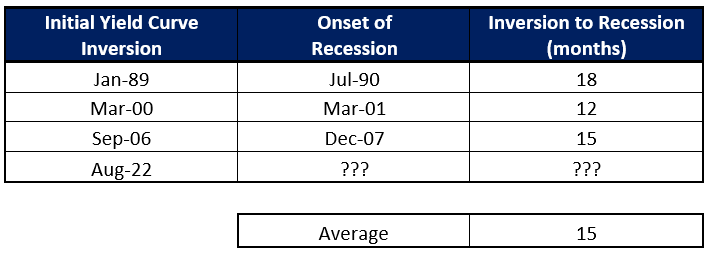
United States – Months from Yield Curve Inversion to Onset of Recession: 1989-Present

The table above covers the past three U.S. recessions, excluding the Covid-induced contraction of 2020, which I have omitted since it had nothing to do with macroeconomic factors, monetary policy, etc. As the table demonstrates, the time lag between yield curve inversions and economic contractions has ranged between 12 and 18 months, with an average of 15 months.

However, the yield curve’s impeccable record of predicting recessions has not been matched by its market timing abilities. As summarized in the following table, the S&P 500 Index has produced mixed results following past inversions in the Treasury curve.

S&P 500 Performance Following Yield Curve Inversions: 1989-Present

When the Treasury curve inverted at the beginning of 1989, stocks proceeded to perform well, returning 24.1% over the following two years. Conversely, when the curve became inverted in March 2000, the S&P 500 fared poorly, losing 21.5% over the same timeframe. The index suffered a similarly undesirable fate following the Treasury curve inversion in September 2006, when stocks suffered a two-year decline of 9.1%.

How Smart is the Stock Market?

In the past, the economy and equity markets have not been correlated. Stock prices are forward looking. Historically, equities have started to decline prior to peaks in economic growth and have tended to rebound in advance of economic recoveries.

The trillion-dollar question is not whether the market is smart, but whether it is smart enough. Do prices bake in a sufficient amount of bad news ahead of time so that they avoid further losses following the onset of recessions? Or do they lack sufficient pessimism to avoid this fate? Frustratingly, the answer depends on the recession!

S&P 500 Performance Following Start of Recessions: 1990-Present

Stocks managed to skate through the recession of the early 1990s unscathed. Following the peak of the economy in mid-1990, the S&P 500 Index went on to produce a total return of 27.2% over the next two years. Unfortunately, investors were not so lucky during the recession of the early 2000s, with stocks losing 24.6% in the two years after the recession began. Similarly, the recession of 2008 was no walk in the park for markets, with the S&P 500 falling 20.3% after the economy began contracting at the end of 2007. Continue Reading…

Losing an Illusion makes you Wiser than finding a Truth

Image courtesy Outcome/picpedia.org

By Noah Solomon

Special to Financial Independence Hub

According to satirist Karl Ludwig Borne, “Losing an illusion makes one wiser than finding a truth.”

I have become completely disavowed of the illusion that:

1.) People are able to predict the future with any degree of accuracy or consistency.

2.) Investors can improve their results by forecasting (or by following the forecasts of others).

Not even the almighty Federal Reserve, with its vast resources, near limitless access to data, and armies of economists and researchers has been particularly successful in its forecasting endeavors. For example:

  • Near the height of the dotcom bubble in 1999, Fed Chairman Greenspan argued that the internet was bringing a new paradigm of permanently higher productivity, thereby justifying lofty stock price valuations and encouraging investors to push prices up even further to unsustainable levels.
  • In 2006, Chairman Bernanke brushed off the most pronounced housing bubble in U.S. history, stating that “U.S. house prices merely reflect a strong U.S. economy.”
  • In late 2021, the Fed determined that the spike in inflation was “transitory.” It neglected to combat it, leaving itself in a position where it had no choice but to subsequently ratchet up rates at the fastest pace in 40 years and risk throwing the U.S. (and perhaps global) economy into recession.

The following commentary describes the underlying challenges relating to economic and market predictions. I will also provide some of the reasons why, despite strong evidence to the contrary, investors continue to incorporate them into their processes.

The Three Enemies of Forecasting: Complexity, Non-Stationarity and People

There is a near infinite number of factors that influence economies and markets. The sheer magnitude of these variables makes it near, if not completely impossible, to convert them into a useful forecast. Further complicating the matter is the fact that economies and markets are non-stationary. Not only do the things that influence markets change over time, but so do their relative importance. To produce accurate forecasts economists and strategists not only need to hit an incredibly small target, but also one that is constantly moving!

For most of the postwar era, economists and central banks relied heavily on the Phillips curve to inform their forecasts and policies. An unemployment rate of approximately 5.5% indicated that the U.S. economy was at “full employment.” Until the global financial crisis, any declines below this level had spurred inflation. Confoundingly, when unemployment fell below 5.5% in early 2015 and hit a low of 3.5% in late 2019, an increase in inflation failed to materialize.

This problem is well summarized by former GE executive Ian H. Wilson, who stated “No amount of sophistication is going to change the fact that all your knowledge is about the past and all your decisions are about the future.”

Saved by 50/50

When it comes to economies and markets, it’s hard enough to be right on any single prediction. A forecaster who gets it right 70% of the time would be a rare (and perhaps even a freakish) specimen.

However, investment theses are rarely predicated on a single prediction. When a forecaster predicts that inflation will (a) remain stubbornly high, (b) rates will rise further, and (c) that these two developments will cause stocks to fall, they are technically making three separate predictions. Even with a 70% chance of being right on each of these forecasts, their overall prediction about the market has only a 70% chance of a 70% chance of a 70% chance of being right, which is only 34.3%! Continue Reading…

Rate Hike hiatus?

By Dale Roberts, cutthecrapinvesting

Special to Financial Independence Hub

Late in January, the Bank of Canada boosted rates by another 0.25% and signalled that they will now pause and evaluate. I’ve been calling that the rate hike hiatus. As I touched on in mid-January, inflation is moving in the right direction and the consumer is holding up quite well. It’s a Goldilocks scenario, for now. That said, the rate hikes have not worked their way through the economy. In fact, many suggest that we’ve felt almost no economic damage from the rate hikes. There is a lag affect; it can take a year or two for hikes to be felt in full. But let’s call the rate hike hiatus good news.

The big news last month was the announced rate hike hiatus in Canada. Of course, markets are forward “thinking” and they are pricing in a soft landing and rate cuts in 2023. That Yahoo!Finance post suggest that cuts are likely not on the table this year. That would only happen if something breaks and we get a serious-enough recession. Also, inflation would have to be completly under control. The Bank of Canada is not likely to cut rates if inflation is not close to that 2% target.

Rate guesses, not so good …

The consensus appears to be the call that there will be no rate cuts in 2023, though there is a sprinkling of calls for cuts in late 2023. And all said, we should remember the rate predictions from March.  Not even close.

Inflation is so unpredicatable. And inflation might still be driving the bus in 2023.

Coming in for a landing

Lance Roberts looks at the history of soft landing and hard landings. There were 3 past soft landing scenarios, but none in an inflationary environment. The affect of rate hikes have largely not been felt, and likely have had little push on inflation. But that will come over time of course.

Here’s the chart that shows the positive effect of a weak U.S. Dollar for international equities. With bonds looking better and the potential for international markets, the traditional balanced portfolio might ‘be back’ one day soon.

A Weak Dollar Bodes Well For Non-U.S. Equities – ⁦@SoberLook⁩ ⁦@bcaresearch

Originally tweeted by Rob Hager (@Rob_Hager) on January 24, 2023.

Stacking those dividends

Dividend Daddy knows how to stack and count those dividends.

Here is a popular tweet on the simple basics of wealth creation and the path to financial happiness … Continue Reading…

The Inevitable masquerading as the Unexpected


By Michael J. Wiener

Special to the Financial Independence Hub

Rising interest rates are causing a lot of unhappiness among bond investors, heavily-indebted homeowners, real estate agents, and others who make their livings from home sales.  The exact nature of what is happening now was unpredictable, but the fact that interest rates would eventually rise was inevitable.

Long-Term Bonds

On the bond investing side, I was disappointed that so few prominent financial advisors saw the danger in long-term bonds back in 2020.  If all you do is follow historical bond returns, then the recent crash in long-term bonds looks like a black swan, a nasty surprise.  However, when 30-year Canadian government bond yields got down to 1.2%, it was obvious that they were a terrible investment if held to maturity. This made it inevitable that whoever was holding these hot potatoes when interest rates rose would get burned.  Owning long-term bonds at that time was crazy.

One might ask whether we could say the same thing about holding stocks in 2020 when interest rates were so low.  The answer is no.  Bond returns are very different from stock returns in terms of unpredictability.  We use bond prices to calculate bond yields; one is completely determined by the other.  The situation is very different with stocks.  Even when conditions don’t look good for stocks, they may still give better returns than the interest you’d get if you sold them to hold cash.  All the evidence says that most investors are better off not trying to time the stock market.

Most of the time, investors are better off not trying to time the bond market either.  However, the conditions in 2020 were extraordinary.  Long-term bonds were guaranteed to give unacceptably low returns if held to maturity.  This was a perfectly sensible time to shift long-term bonds to short-term bonds or cash savings.

Houses

The only way house prices could rise to the crazy heights they reached was with interest rates so low that mortgage payments remained barely affordable.  Fortunately, the government imposed a stress test that forced buyers to qualify for a mortgage based on payments higher than their actual payments.  This reduced the damage we’re starting to see now.  Unfortunately, there is evidence that some homeowners faked their income (with industry help) so they could qualify for a mortgage.  This offset some of the good the stress test did. Continue Reading…