A month ago, I wrote about how the cycles pointed out by Kuznets, Kondratieff, and Minsky, combined with the writings of Joseph Schumpeter seemed to be coming together at the same time. Now that the war in Iran is nearly a month old, it seems the match has been lit that will set the frightening confluence ablaze. It sure looks like we’re in a credit bubble that is beginning to burst.
The challenge when writing about major developments is to sound calm and purposeful when the natural inclination might be to be more animated. How to get people to take urgent action without coming across as an over-the-top doomsayer?
To begin, I need to stress that I do not see myself as a pessimist. I’ve been speaking to college students throughout southern Ontario for the past few months and when I tell them about something I call Bullshift (the optimism bias fomented by the financial services industry), they often ask if I’m not being biased and overly gloomy. I respond both with evidence and by conceding that everyone has biases, so their allegations against me, while not incorrect, are nonetheless likely to be overstated. My view is that better wealth decisions are made using facts, critical thinking and a dash of skepticism regarding the finance industry’s motives.
If Iran war lingers on, credit markets will be stressed
There are multiple indicators that are now showing credit markets in a state of high stress. The longer the war in Iran persists, the worse the situation is likely to become. As such, here are a few things you could do immediately to reduce your exposure to credit:
1.) If you have not already done so, build an emergency fund. Many people use the equity in their home for this. The caveat here is that real estate prices are likely to drop in the short term, as well, so be careful. Where possible, consider setting aside money in a high-yield savings account for emergencies. When you’re financially cushioned, you’re less likely to rely on more punitive alternatives when money is tight. Continue Reading…
Department of FinanceDepartment of Finance: Francois-Philippe Champagne
Prime Minister Mark Carney’s first federal budget was delivered Tuesday afternoon shortly after 4 pm by Minister of Finance and National Revenue Francois-Philippe Champagne.
Go here for full documents and to find downloadable documents for the 405-page Budget. (The above screenshot is not enabled for downloading.)
Below is one of the first releases released by the Department of Finance website. It’s followed with headlines and hyperlinks to the most recent Budget coverage in the Globe & Mail and National Post.
This blog may be revised as new updates arrive from various media sources.
Government of Canada releases Budget 2025: Canada Strong
Canada’s new government puts forward a plan to build, protect, and empower Canada
November 4, 2025 – Ottawa, Ontario – Department of Finance Canada
Canada faces a rapidly changing and increasingly uncertain world. The rules-based international order and the trading system that powered Canada’s prosperity for decades are being reshaped – hurting companies, displacing workers, causing major disruption and upheaval for Canadians.
In the face of global uncertainty, Canada’s new government is focused on what we can control. Budget 2025: Canada Strong is our plan to transform our economy from one that is reliant on a single trade partner, to one that is stronger, more self-sufficient, and more resilient to global shocks. Our plan builds on Canada’s strengths – world-class industries, skilled and talented workers, diverse trade partnerships, and a strong domestic market where Canadians can be our own best customers. We are creating an economy by Canadians, for Canadians.
We are building Canada Strong. This is a plan to build the major infrastructure, homes, and industries that grow our economy and create lasting prosperity. This is a plan that will protect our communities, our borders, and our way of life. This is a plan to empower Canadians with better careers, strong public services, and a more affordable life. We are building a stronger economy, so that Canadians can build their own future.
To do that, Canada’s new government is delivering an investment budget. We are spending less on government operations – and investingmore in the workers, businesses, and nation-building infrastructure that will grow our economy. Budget 2025 delivers on the government’s Comprehensive Expenditure Review to modernise government, improve efficiencies, and deliver better results and services for Canadians. It includes a total of $60 billion in savings and revenues over five years, and makes generational investments in housing, infrastructure, defence, productivity and competitiveness. These are the smart, strategic investments that will enable $1 trillion in total investments over the next five years through smarter public spending and stronger capital investment.
Countries across the world are facing global economic challenges – and Canada is no different. Budget 2025 is Canada’s new government’s plan to address these challenges from a position of strength, determination, and action. It is our plan to take control and build the future we want for ourselves, as a people and a country. It is our plan to build Canada Strong.
Quotes
“The global uncertainty we are facing demands bold action to secure Canada’s future. Budget 2025 is an investment budget. We are making generational investments to meet the moment and ensure our country doesn’t just weather this moment but thrives in it. This is our moment to build Canada Strong and our plan is clear – we will build our economy, protect our country, and empower you to get ahead. When we play to our strengths, we can create more for ourselves than can ever be taken away.”
The Honourable François-Philippe Champagne, Minister of Finance and National Revenue
Quick facts
Canada has the fiscal capacity to meet its ambition:
Canada has the lowest net debt-to-GDP ratio in the G7 at 13.3 per cent according to the IMF October 2025 Fiscal Monitor. Canada also has one of the lowest deficit-to-GDP ratios in the G7, second only to Japan. This strong fiscal position enables us to respond to global challenges.
Canada is one of only two G7 economies with a AAA credit rating, making Canada one of the best places to invest in the world.
Canada has the best deal of any U.S. trading partner, with 85 per cent of our trade tariff-free. While some sectors remain deeply impacted, overall, Canadian exporters benefit from the lowest average U.S. tariff of any country at 5.4 per cent.
Budget 2025 rests on two fiscal anchors:
Balancing day-to-day operating spending with revenues by 2028–29, shifting spending toward investments that grow the economy; and
Maintaining a declining deficit-to-GDP ratio to ensure disciplined fiscal management for future generations.
In addition to the two fiscal anchors, Budget 2025 enables $1 trillion in total investments over the next five years through smarter public spending and stronger capital investment.
Here are some headlines with hyperlinks in red to the latest Globe & Mail stories on the budget, for those with subscriptions to the paper.
A recent survey from Canadian fintech company Spring Financial, found that nearly three quarters (74%) of respondents plan on reducing holiday spending this year and shoppers, particularly Gen Z (66%) and millennials (64%), are finding the financial strain of buying gifts to be the most stressful part of the holidays.
The economy has been challenging this year so it’s no surprise that shoppers are feeling added stress this holiday season. Whether you’ve already started your shopping or you haven’t even started your list, below are some practical holiday shopping tips to help make your spending less stressful and more manageable.
1.) Spread the joy of pre-loved items
This one might be easier said than done but with half of shoppers opting for gift alternatives, there’s a good chance your friends and family may be relieved about the idea of traditional gifts with more financially feasible alternatives. For example, places like Facebook marketplace often have gently-used children’s toys that offer a more budget-friendly price tag for the little ones on your list, while a traditional baking or book exchange can be a great alternative to Secret Santa games for the adults in your life.
2.) Set a budget and stick to it
It can be so easy to overspend during the holidays. There is always someone to shop for and shops — whether online or in-store — are set up in a way that encourages impulse buying and overspending. To set yourself up for success, set a budget and shopping plan before starting shopping to ensure you’re sticking to a spending limit that works for you. Don’t forget to account for all the extra expenses that come with this time of year like food, host gifts, and transportation to and from any holiday parties you have coming up.
3.) Compare your debt options
Sometimes, taking on a bit of debt is necessary to keep the holiday magic alive. The good news is, there are lots of financial options available to shoppers. Comparing the interest rates on any buy-now-pay-later programs as well as credit cards, lines of credit and loan is a great way to determine which debt option will be the easiest to pay off post-holidays. Continue Reading…
Financial Independence is the goal of everyone with a bank account, and budgeting plays a main role in achieving that.
It can be difficult to understand where to start or how to get yourself back on track.
With these valuable pieces of insight from leading industry experts, you can start your own Fnancial Independence journey.
Pay yourself first
“One essential budgeting tip for achieving financial independence is to adopt a ‘pay yourself first’ approach. This means prioritizing savings and investments by setting aside a certain portion of your income as soon as you receive it, before using it for bills, expenses, or discretionary spending. By automating savings and investments into accounts like emergency funds, retirement accounts, or other investment accounts, you’re prioritizing your financial goals and building a habit of consistently contributing toward them. Over time, this proactive approach allows your savings to grow, helps you avoid lifestyle inflation, and keeps you focused on long-term financial stability rather than short-term gratification.” – Bill Lyons, CEO of Griffin Funding
Financial independence wildly relies on smart budgeting and disciplined financial practices. One powerful strategy is to leverage your tax return, which is often a lump sum. Consider depositing your tax return directly into a separate savings account from your tax software. This strategic move creates somewhat of a safety net. This disciplined approach not only safeguards your funds but also provides a foundation for future investments or emergency expenses. Over time, this habit can contribute significantly to your financial independence.
Minimize Debt
“Minimizing your debt can help achieve financial independence, as it reduces financial burdens and frees up resources for other financial goals. When you prioritize the repayment of high-interest debts, such as credit-card debt or personal loans, individuals can save significant amounts of money on interest payments over time. This disciplined approach to debt reduction can also improve credit scores, making it easier to qualify for private financing options when purchasing a home or commercial property. Minimizing debt, individuals can strengthen their financial position and increase their chances of securing favorable terms and rates for private financing, ultimately helping them achieve their real estate ownership goals.” – Sacha Ferrandi Founder & Principal, Source Capital
“A practical budgeting method divides income into three categories: 50% for needs, 30% for wants, and 20% for savings or debt repayment. This system assists individuals in efficiently allocating their funds, ensuring they cover essential expenses such as housing, groceries, and utilities, while also setting aside money for financial goals. Wants to include discretionary spending such as entertainment and dining out. The remaining portion goes towards savings or paying off debts, contributing to long-term financial security. This budgeting approach offers a simple framework for managing finances, preventing overspending on non-essentials while prioritizing savings. It’s adaptable to different income levels, making it a balanced way to manage money.”– California Credit Union
Plan for irregular expenses
“Planning for irregular expenses is a wise budgeting strategy that can contribute to financial independence. By anticipating and setting aside funds for irregular expenses, individuals can avoid financial stress when unexpected costs arise. One effective way to allocate funds for irregular expenses is by saving a portion of your tax refund return instead of immediately spending it on unnecessary items. Exercising discipline and directing your tax refund towards an emergency fund or a dedicated savings account, you can build a financial cushion that provides peace of mind and protects you from unexpected financial setbacks. This proactive approach to budgeting ensures that you are prepared for unexpected irregular expenses and helps you maintain control over your financial well-being.”– Lisa Green-Lewis Tax Expert, Turbo Tax Continue Reading…
I start with Die with Zero because it most directly deals with the topic of money as we age. In fact, as most retirees know, one of the biggest fears behind the whole retirement saving concept is running out of money before you run out of life.
But it appears that many of us have become so fixated with saving for retirement, we may end up wasting much of our precious life energy, and being the proverbial richest inhabitant of the cemetery. For you super savers out there, this book may be an eye opener, as is the other book, 4,000 Weeks.
As I note in the column, this genre of personal finance started with Die Broke, by Stephen Pollan and Mark Levine, which I read shortly after it was first published in 1998. That’s where I encountered the amusing quip that “The last check you write should be to your undertaker … and it should bounce.”
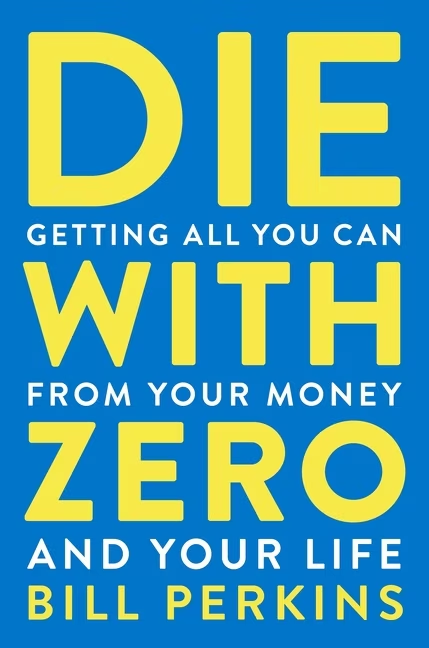
The premise is similar in both books: there are trade-offs between time, money and health. Indeed, as you can see from the cover shot above, its subtitle is Getting all you can from your money and your life. As with another influential book, Your Money or Your Life, we exchange our time and life energy for money, which can therefore be viewed as a form of stored life energy. So if you die with lots of money, you’ve in effect “wasted” some of your precious life energy. Similarly, if you encounter mobility issues or other afflictions in your 70s or 80s, you may not be able to travel and engage in many activities that you may have thought you had been “saving up” for.
A treatise on Life’s Brevity and appreciating the moment
Amazon.com
The companion book is Four Thousand Weeks : Time Management for Mortals, by Oliver Burkeman. If you haven’t already guessed, 4,000 weeks is roughly the number of weeks someone will live if they reach age 77 [77 years multiplied by 52 equals 4,004.] Even the oldest person on record, Jeanne Calment, lived only 6,400 weeks, having died at age 122.
I actually enjoyed this book more than Die with Zero. It’s more philosophical and amusing in spots. Some of the more intriguing chapters are “Becoming a better procrastinator” and “Cosmic Insignificance Therapy.” I underlined way too many passages to flag here but here’s a sample from the former chapter: “The core challenge of managing our limited time isn’t about how to get everything done – that’s never going to happen – but how to decide most wisely what not to do … we need to learn to get better at procrastinating.”


 Posted By
 Posted By