Tag Archives: debt

Is a Tax Credit a better way to support Social Housing?

image courtesy CMI Financial Group

By Kevin Fettig

Special to Financial Independence Hub

One of the biggest challenges in Canada’s rental housing crisis is the lack of new affordable housing units being built.

Despite efforts through the National Housing Strategy’s five programs, only 17,000 units were delivered after four years. This disappointing outcome is only a modest improvement over Ottawa’s track record in the past 30 years. For example, between 1996 and 2013, fewer than 7,000 new units were provided by federal and provincial governments.

In contrast, the United States built 3.5 million subsidized rental units from 1987 to 2021. Adjusted for population, this is equivalent to building 11,000 units per year in Canada. Both countries have tightened the tax benefits of rental real estate, but the U.S. offset this policy shift by introducing the Low-Income Housing Tax Credit (LIHTC) to mitigate the impact of these changes on low- and middle-income renters.

A Canadian LIHTC would offer an alternative method of federal funding by leveraging private-sector expertise in owning, building, and managing low-income rental housing. The LIHTC would provide tax credits to both for-profit and nonprofit owners of rental housing, with nonprofits having the option to sell these tax credits. A key aspect of the program would be its efficient resource allocation, achieved by creating competition among developers for tax credits and using a market-based test for the viability and need for low-income housing.

Complements existing Renter Support Initiatives

The program could be designed to complement existing renter support initiatives, such as local government programs, housing allowances, and rent supplements. It would work by providing tax credits to developers, who would then pass them on to investors to offset their income tax.

Unlike earlier tax credit programs like the Multiple Unit Residential Buildings (MURB) provision, this program would have a cap, with credits allocated annually to each region based on population. The credits would be federally funded and awarded according to provincial objectives. Continue Reading…


Navigating the Challenges of Solo Entrepreneurship

Unsplash

By Devin Partida

Special to Financial Independence Hub

Solo entrepreneurs face unique financial challenges, including inconsistent income streams, high operational costs, limited access to capital and the difficulty of separating personal and business finances. Effective financial planning becomes crucial to navigating these hurdles and ensuring sustainable business operations and long-term success.

Creating realistic budgets, building emergency funds and managing expenses allows solo entrepreneurs to stabilize their financial health. Additionally, seeking professional financial advice offers personalized strategies, tax planning and investment guidance, which are essential for securing a stable and prosperous future.

Unique financial hurdles for Solo Entrepreneurs

Variable revenue presents significant challenges for solo entrepreneurs in budgeting and managing expenses. The unpredictable nature of income makes it difficult to plan for consistent cash flow, often leading to financial strain. According to a recent survey, 77% of respondents reported their expenses increased by 6% or more due to inflation, further complicating financial planning.

Solo entrepreneurs also face the challenge of managing overhead costs without the benefit of economies of scale. Unlike larger businesses that can reduce per-unit costs through bulk purchasing, they must find ways to cover operational expenses efficiently. In fact, 37% of small businesses resort to borrowing to meet their operating expenses, which highlights the financial pressure they endure.

Securing loans and investments is another hurdle for solo entrepreneurs. Financial institutions and investors may view them as high-risk due to their lack of a proven track record and limited collateral. This makes it difficult for single proprietors to obtain the necessary funding to grow and sustain their businesses. Continue Reading…

How to keep your business solvent

Image courtesy BDO Canada

By Matthew Marchand

Special to Financial Independence Hub

More Canadian businesses are failing this year.

In the second quarter of 2023, the Canadian Association of Insolvency and Restructuring Professionals (CAIRP) noted that there were 1,090 business insolvencies — an increase of 36.9% compared to the same period in last year. It was also the highest volume since 2014.

There are two main reasons why this is occurring.

First, the combination of rising interest rates and high debt levels has resulted in slower consumer demand and increased debt servicing costs for both businesses and consumers. The prime rate has risen 475 basis points since early 2022 and now sits at 7.2%.

Second, the loss of government financial aid plus the need to repay a portion of the aid received — along with tightening credit conditions — are making it more challenging to obtain new financing or to refinance existing debt.

During the height of the COVID-19 pandemic, government financial aid helped limit insolvencies during those challenging times. What we’re seeing now is a normalization after an abnormal period.

It should also be noted that many businesses were beginning to experience financial difficulties prior to the pandemic and the financial aid acted as a buoy to some degree. We’ve seen many instances of businesses being unprofitable prior to the pandemic that became profitable during the pandemic, with much or all the profits being derived from government financial aid.

Now that the financial aid is no longer available and may need to be repaid in the future (depending on the support received), businesses are feeling the challenges of this economic reality.

Ways businesses can survive

Many businesses may think a wind-down of operations is the only option, but that’s not the case. In fact, there are other options:

  • A restructuring or compromise of debt (payments to creditors accepted as a settlement of the debts)
  • Turnaround initiatives, such as lease disclaimers, labour force reductions or the sale of non-core assets

For businesses that are facing financial challenges now, they should expect interest rates will remain elevated for the foreseeable future. While the Bank of Canada left the overnight rate unchanged at 5% in September, it says it “remains concerned about the persistence of underlying inflationary pressures, and is prepared to increase the policy interest rate further if needed.”

Your organization should update its business plans and financial projections accordingly. If your business doesn’t have a detailed cash flow projection, make one.

You should also conduct a stress test on your financial projections to determine potential financial scenarios and what proactive efforts may need to be taken to avoid worst case outcomes. For example, if sales fall 10% or 15%, how will it affect the financial performance of the business? Will the business be able to meet its debt servicing obligations and other critical payments as they become due, and if so, for how long? Continue Reading…

I Will Teach You to be Rich (Review)

Amazon.ca

By Michael J. Wiener

Special to Financial Independence Hub


There aren’t many financial gurus willing to call out financial companies by name for their bad behaviour, but Ramit Sethi is one of them.  In his book I Will Teach You to be Rich, he promises “a 6-week program that works,” and he includes advice on which banks to use and which to avoid.

The book is aimed at American Millennials; Canadians will learn useful lessons as well, but much of the specific advice would have to be translated to Canadian laws, banking system, and account types.  The book’s style is irreverent, which helps to keep the pages turning.

It may seem impossible to fix a person’s finances in only 6 weeks, but this is how long Sethi says it will take to lay the groundwork for a solid plan and automate it with the right bank accounts and periodic transfers.  The execution of the plan (e.g., eliminating debt or building savings) will take much longer.

Sethi is rare in the financial world because he will say what he really thinks about banks.  “I hate Wells Fargo and Bank of America.”  “These banks are pieces of shit.  They rip you off, charge near-extortionate fees, and use deceptive practices to beat down the average consumer.  Nobody will speak up against them because everyone in the financial world wants to strike a deal with them.  I have zero interest in deals with these banks.”  For the banks he does recommend, “I make no money from these recommendations.  I just want you to avoid getting ripped off.”

People have many reasons why they can’t save and are in debt, but Sethi sees them as just excuses in most cases.  “I don’t have a lot of sympathy for people who complain about their situation in life but do nothing about it.”  “Cynics don’t want results; they want an excuse to not take action.”  He urges readers to “put the excuses aside” and get on with the business of making positive changes.

The Program

The first step in the program is to “Optimize Your Credit Cards.”  I found it interesting that Sethi focused on credit card perks before he covered eliminating credit card debt.  He wants readers to “play offense by using credit cards responsibly and getting as many benefits out of them as possible” instead of “playing defense and avoiding credit cards altogether.”  This approach sets him apart from many other experts on getting out of debt.  While he does teach methods of eliminating debt, his focus is more on building wealth steadily.

The second step is to open “high-interest, low-hassle accounts.”  Interestingly, he wants readers to open a chequing account at one bank and a savings account at another bank.  Among his reasons are that the psychology of a separation between accounts makes us less likely to raid savings.  Some might think opening a savings account is pointless if they have no money to deposit, but Sethi insists that you need to lay the groundwork now for a better future, even if you’ve only got $50 to deposit.

The third step is opening investment accounts.  The author favours very simple investments, such as a Vanguard mutual fund account invested in a target date fund.  “Don’t get fooled by smooth-talking salespeople: You can easily manage your investment account by yourself.”  Unfortunately, Vanguard mutual funds are only available to Americans.  Canadians can find one-fund solutions with certain Exchange-Traded Funds (ETFs).

To create the cash flow to reduce debt and invest, the fourth step is about “conscious spending,” which is “cutting costs mercilessly on the things you don’t love, but spending extravagantly on the things you do.”  Achieving this involves tracking spending in different categories, but not traditional budgeting. Continue Reading…

65% of Americans say partner having too much debt is a marital dealbreaker

65% of Americans say their partner having too much debt is a dealbreaker in deciding to get married. Little wonder that the national marriage rate in the United States has declined 60% over the last 50 years.

Source: Clever Real Estate — Marriage Survey, May 2023

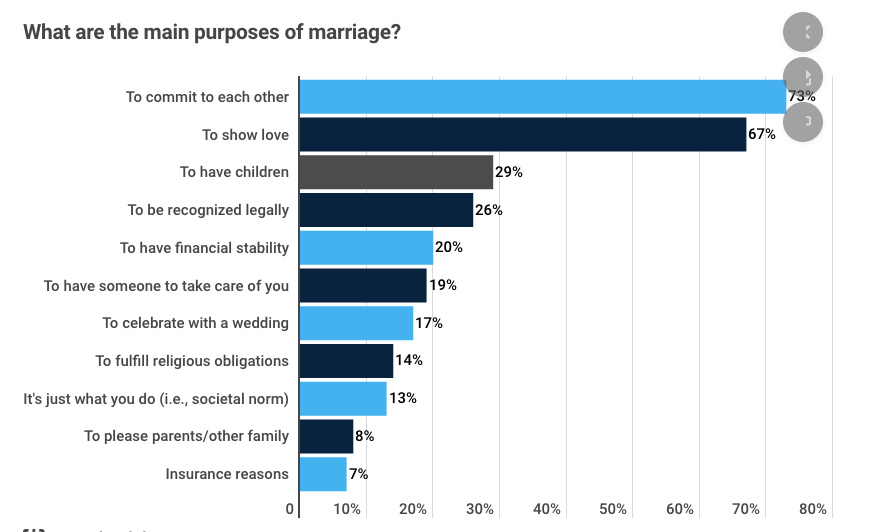
According to the Marriage Survey of 1,000 American adults conducted by Clever Real Estate in May (see graph above), financial stability is a primary purpose for marriage, as reported by 1 in 5 Americans (20%). In fact, 19% admit they would marry solely for money reasons (19%). Entering into the calculation are factors like high inflation, escalating living costs, and an expensive real estate market.

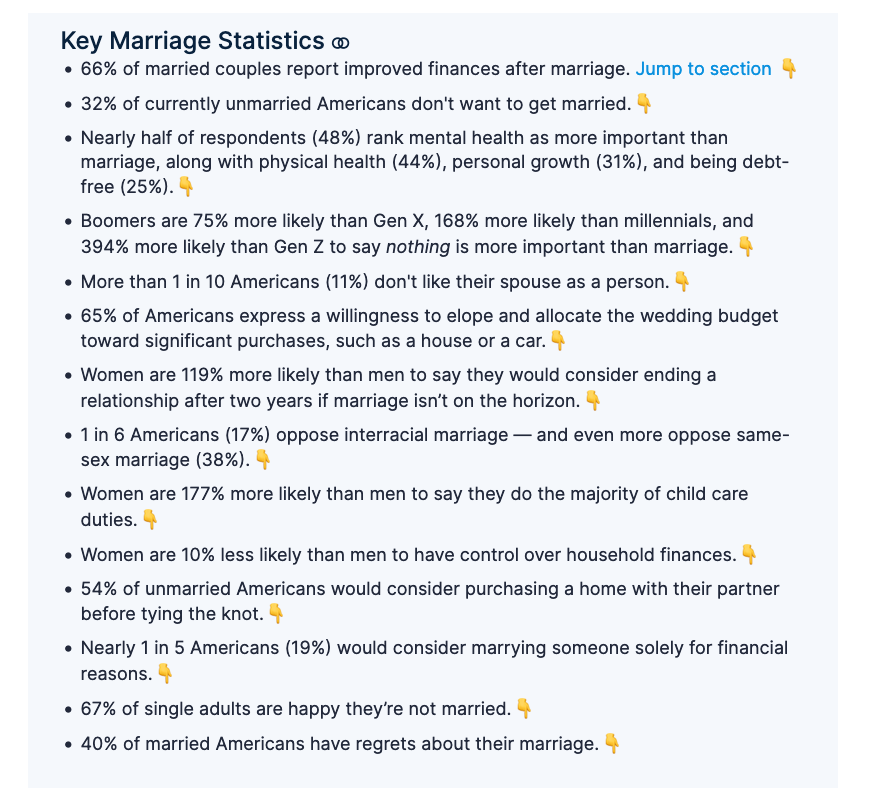
While marriage positively impacts finances for 66% of couples, only 54% of married couples discuss finances regularly, and 7% never broach the topic.  53% favor separate bank accounts. However, married women are 10% less likely to manage finances in their marriage than men.  Money-related issues contribute to about 1 in 6 divorces (16%). Looking back at their lives, 10% of married respondents wish they chose a partner more financially responsible.

For more on Americans’ views on marriage, read the full report: 2023 Data: 1 in 4 Americans Think Marriage Is an Outdated Concept

Here are other highlights: