Tag Archives: debt

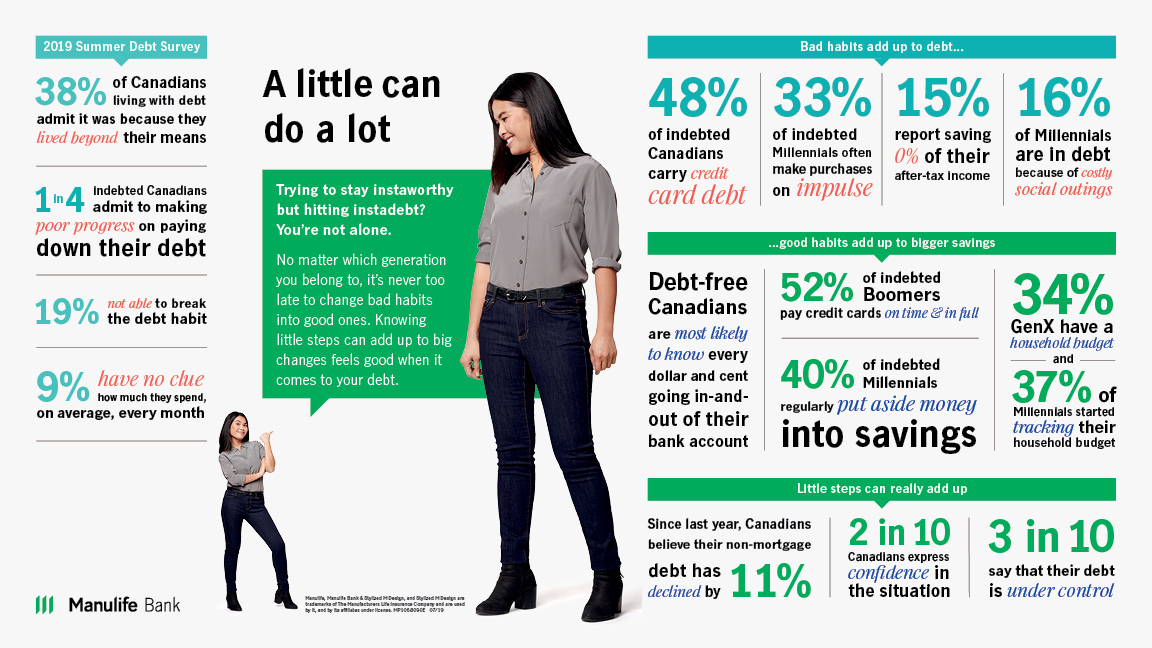
No surprise: living beyond our means is why 38% are in Debt

Talk about cause and effect: 38% of Canadians admit that living beyond their means resulted in their being in debt. That’s according to a survey being released this week by Manulife Bank of Canada. It also found a third of Canadians aged 20 to 69 with a household income of at least $40,000 say their spending growth outpaces their income, and 19% of those who went into debt cited not being able to break the debt habit. Almost half (49%) on indebted Canadians between the age of 20 and 34 and a majority of those aged 35 to 54 report carrying credit cards with a balance.

No surprise then that one in ten (9%) admit to being “clueless” about how much they are spending each month on average.

Blame YOLO and FOMO

Apparently cultural attitudes like “You only live once” (YOLO) and “Fear of Missing Out” (FOMO) are starting to take their toll on indebtedness. Apart from the 38% who admit their debt arose because of living beyond their means, 12% directly correlated their indebtedness to the outcome of too many costly outings with friends or family.

While 19% of debtors say they can’t break the habit, the survey also reveals that seeing debt paid off can result in joy, which is what 36% of Canadians say.

Manulife CEO Rick Lunny

And once again (see yesterday’s post on the HSBC study), Canada’s high housing prices are seen impacting this country’s Millennials. Millennials are now at the age many want to get on the property ladder and start families, two areas where Manulife is seeing expenses grow. “Housing affordability remains at near-historic highs across the country and child-care costs have risen faster than inflation for Canadians,” said Manulife Bank president and CEO Rick Lunny in a press release, “We have a financial wellness crisis in Canada.”

Obviously debt can limit one’s social life but the survey quantifies this. it found that debt limits activities with family and friends (22%), makes it impossible to spend money on entertainment (18%) and negatively impacts mental health (in 17% of cases.)

Manulife says Boomers feel less affected by debt: one would hope so since any Boomer contemplating retirement should by now have a healthy positive net worth rather than a negative one! In which case, they will be less constrained in spending on entertainment or meeting with family and friends.

Manulife finds that those under 55, women, and those with high levels of debt are most likely to feel stressed by these circumstances. It also found a “gradual yet significant” decline in the proportion of Canadians with mortgagers who express comfort with the payments. “There has been a sharp year-over-year decline in the proportion who claim to feel very comfortable about both the payments (28%, down 8 from Spring 2018) and the amount owing (21%, down 9) on their mortgage.”

The Joy of getting out of Debt

Asked to rate the perceived joy they would get from various financial accomplishments, two thirds of Canadians put getting out of debt (“escaping”) first or second overall, with having a hefty retirement nest egg a distant third.

Of course, reducing debt is easier said than done. Manulife suggests a clear “area of opportunity” is making adjustments to non-essential spending but there are demographic differences. Millennials are much more willing to sacrifice dining out compared to those who are over 35. Women are twice as likely as men to stop shopping for non-essential goods and services. Men and those who are 35 or older are most willing to give up travelling (which I’d say is certainly a non-essential spending activity!)

There are some positives in the survey. it found that three in ten say their debt is under control and they don’t need any help to control it. Others believe there are more effective ways to track debt and curb spending. Manulife cites its own Manulife All-in Banking Package, which includes Saving Sweeps that automatically moves excess funds into savings accounts each night. For more on the Debt Survey, click here.

Student Debt remains even after Bankruptcy: Study

By Mike Brown

Special to the Financial Independence Hub

Student loan debt in the United States is a rapidly developing issue for consumers. More than 44 million Americans owe around US$1.5 trillion in student loan debt; that figure means student loan debt only trails credit card debt when it comes to the highest forms of outstanding debt.

However, student loan debt is one form of debt that is virtually impossible to discharge in bankruptcy whereas debts from things like credit cards or automobiles can be discharged much more easily.

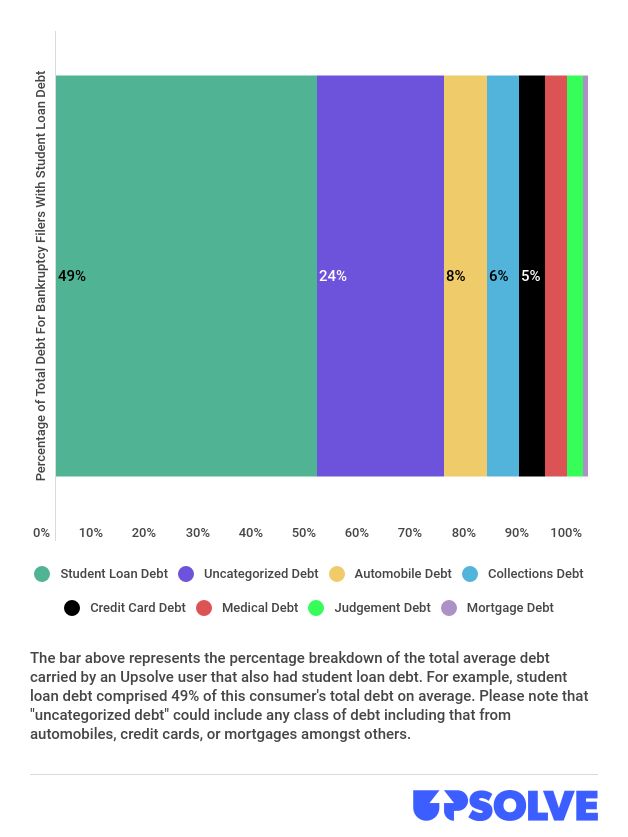
To look at bankruptcy figures in regards to student debt, we used exclusive anonymized data provided by Upsolve, a non-profit that assists low-income individuals file for Chapter 7 bankruptcy free of charge. This data was then analyzed to discover what percentage of bankruptcy filers carry student loan debt and what percent of their total debt is comprised of student loan debt.

How many Bankruptcy filers also carry Student Loan debt?

According to the anonymized bankruptcy data provided by Upsolve and analyzed by LendEDU, 32% of all bankruptcy filers also carried some amount of student loan debt.

Further, for these filers with student loan debt, the vast majority of their liabilities totaled is solely from those student loans. On average, student loan debt takes up 49% of this group’s debt. Even including all consumers, those with and without student debt, student loan debt still takes up 21% of all Upsolve user debt.

Filing for Chapter 7 bankruptcy will liquidate a consumer’s total assets and utilize the subsequent funds to pay off as much outstanding debt as possible. According to the data, essentially one-third of consumers who do declare bankruptcy also have student loan debt, and Chapter 7 will not allow for the offloading of this student debt.

Additionally, due to student debt being almost 50% of all debts incurred by that individual, the person can successfully declare Chapter 7 bankruptcy and still have close to 50% of their debts remaining.

Rather than a restart on one’s financial life, which is the point of bankruptcy, only half of their debt discharges and they are still left having to pay off the other half. Since the data shows that student loan debt is such a huge component of the financial situation for nearly one-third of bankruptcy filers, there appears to be a nonsensical policy in place at the moment in regards to student loan debt being impossible to discharge in bankruptcy.

Where we stand with Student Loan Debt & Bankruptcy

Currently within the U.S., whether it be private or federal student loans, student loan debt cannot be discharged in bankruptcy unless the borrower can prove “undue hardship” in the court of law.

Proving undue hardship for student loans is notoriously challenging, and the current standard in which to prove “undue hardship” is to pass the “Brunner test.” This test requires the student loan borrowers to exhibit that they cannot meet a minimal standard of living (e.g., homelessness) if forced to continue to repay their student loans.

A “certainty of hopelessness” must also be proven, in which case the circumstances that constitute “undue hardship” will persist if the consumer is forced to pay off the outstanding student loan debts. Further, the borrower must prove that a good-faith effort has been put forth to repay his or her student loans and all other options have been exhausted to repay their loans. Continue Reading…

Motley Fool: Getting out of Debt as the first step to achieving Findependence

Those who are regulars to this site will know that Getting out of Debt is the first step towards achieving Findependence, or Financial Independence.

My latest Motley Fool Canada blog has just been published on this topic, which you can read in full by clicking on the highlighted headline: Getting out of Debt to achieve Financial Independence.

As one of the characters in my financial novel, Findependence Day, says to the protagonists: “You can’t climb the tower of Wealth while you’re still mired in the basement of debt.”

As the article reprises, most of us start our financial life cycle with zero or even negative net worth, depending on how much student debt, credit-card debt or later mortgage debt one has accumulated. So if a young person has graduated from college or university and is able to get out of the hole early in their working life, that should be regarded as a huge initial step towards achieving Financial Independence, or Findependence (my contraction).

Keep up the frugal behaviour that got you out of debt

So how do you get out of debt as quickly as possible? The book coins another phrase, guerrilla frugality, which simply means super frugality, whether brown bagging your lunches, taking public transit or any number of other money-saving activities that ensure that you are living within and well below your means. Continue Reading…

Why I haven’t paid off my mortgage … yet

Followers of this blog know that I tend to focus on saving and investing rather than trying to pay off my mortgage faster. Indeed, our household assets are projected to exceed $1 million this year but we’ve still got a $200,000 mortgage to contend with.

So why don’t I make it a priority to pay off my mortgage? It’s not strictly about dollars and cents. Here are three reasons:

1.) Higher Priorities

Setting priorities is part of any good financial plan, and those priorities change as you move through different stages of life.

For many years we put all our effort into paying off student loan and consumer debt. Then we became laser-focused on saving for a large house down-payment. Priorities shifted again towards maxing out my unused RRSP contribution room. And now, finally, we’re catching up on years of unused TFSA contribution room.

My wife and I are on the same page with our financial priorities. Right now, we’re focused on these four areas:

  • TFSA – contribute $1,000/month
  • RRSP – max out our available contribution room
  • RESP – max out contributions for our two kids
  • Travel – Visit Scotland/Ireland this summer. Vancouver in October. Maui in February.

Paying off the mortgage slides in at priority number five, which leads to the second reason.

2.) Finite Resources

In a perfect world we would all max out our RRSPs, TFSAs, RESPs, and start investing in a taxable account: all while doubling up on our mortgage payments and still having money left over for dining, travel, and sending the kids to hockey school.

Reality check. We don’t have infinite resources, so we need to make choices and trade-offs.

I mentioned above that we neglected our TFSAs for many years. That’s because we decided to get a new car and pay it off over four years. Our TFSA contributions turned into monthly car payments.

Now that the car is paid off, we can go back to funding our TFSAs and hopefully catch up on all that unused room before we need a new car again.

Speaking of cars, ours are now 12 and six years old. This “sacrifice” – if you can call not getting a new car every 4-5 years a sacrifice – allows us to increase our savings rate and fund more of our financial priorities each year.

Unfortunately, there isn’t another $800/month money leak in our budget to close that will allow us to fund a fifth financial priority (extra mortgage payments). Not yet, anyway.

And remember, it’s not simply about earning more money. I’m already combatting stagnant wage growth and creating my own raise by freelancing, selling used items online, and earning credit card rewards. That extra income allows us to do everything we’re doing now, plus keep pace with inflation and feed a growing family.

3.) Mortgage debt and asset allocation

We tend to think of mortgages and investments in isolation, but if an investor has any debt at all – including a mortgage – then he or she is effectively borrowing to invest.

You could say that I have a leveraged investment loan of $200,000. Another way to think about the mortgage is that I am short fixed income. Continue Reading…

Retirement #2 priority but four in ten Americans don’t see it happening

Retirement is a close second to home ownership, according to a LendEDU survey of American saving priorities

While having enough money saved for Retirement is narrowly behind buying a home, more than a third of Americans don’t expect they’ll ever be able to retire, according to a survey released Tuesday from LendEDU.com.

Retirement saving was cited by 19% of 1,000 respondents, versus 20% prioritizing “buying my own house or apartment.” Paying off credit-card debt was cited by 14% and building an emergency fund by 10%.

While there was only a minor lack of confidence about paying off credit cards and building an emergency fund, 17% don’t believe they’ll ever become homeowners and but almost four in ten Americas (39%) don’t believe they’ll ever be able retire.

Of those doubting their ability to retire, 52% were over age 54, 30% were between 45 and 54, and 15% were 35 to 44.

As for emergency savings, 33% said a major bill resulting from an injury would destroy their savings and therefore their long-term financial goals; another 14% cited some form of debt that could quickly get out of hand. However, 28% felt “relatively secure” and did not believe their financial goals could be derailed.

Secondary priorities

After home ownership and retirement, the most cited financial priorities were some form of getting out of debt: 14% cited paying off credit-card debt, 7% paying off student-loan debt, and 4% cited paying off other forms of debt apart from credit cards or student loans. 6% answered “Building my credit score,” 5% wanted enough saved to move out of their parents’ homes and rent a home or apartment, 4% said “Buying a car,” and 3% wanted to start a business.

1% wanted to invest in real estate, another 1% wanted to buy a second home and yet another 1% wanted to buy a second or third car. 3% want to “create a retirement account” and 2% want to “invest in the market outside my retirement account.”

Money a bigger priority than Love?

Of the 37% who were not currently in a long-term relationship, 72% were more focused on their financial targets, versus a minority 23% who prioritized finding a romantic partner. (The rest preferred not to say). The survey sees this as a “glass half full” finding: “It is good that Americans are quite serious when it comes to realizing their personal finance goals. But, on the glass empty side, sometimes one’s finances can’t buy happiness, or in this case love, and it is always important to understand what is truly important in life.” Continue Reading…