My latest MoneySense Retired Money column was just published, focused on Monday morning’s release of the 2019 RBC Financial Independence in Retirement poll.
And yes, they did use my term Findependence in the headline, which is a neologism I coined and is of course merely a contraction for Financial Independence.
May as well save a few keystrokes and/or syllables!
As I note in the column, I like the fact that RBC uses the term Financial Independence instead of the more commonly used “Retirement.” The two are not the same thing: it’s possible to be financially independent but not retired (that’s the case for myself and possibly many who frequent this website). But as I also note, it’s pretty hard to be retired if you’re NOT also financially independent. If the distinction eludes you, read my book Findependence Day.
In its poll, RBC can’t resist throwing out the figure $1 million as the level many non-retired Canadians believe is necessary to amass: not for “Retirement” per se, mind, but for what they call “a comfortable financial future.”
Call it what you will but RBC identifies four “top motivators” to accumulating such a nest egg: being debt-free, having things to make life more comfortable, having money to take part in desired experiences, and having enough to travel wherever you want.
BC needs $1 million for Findependence, Quebec just $427,000
So how much does it take to get there? Apparently, those in British Columbia need a little more than the rest of us: $1.07 million, compared to a national average of $787,000. Continue Reading…
Owning a house may sound daunting. It can be an instant switch that can make you feel excited, nervous and really conflicted.
Although home ownership is a trial and error thing, it is a possible goal if you aim for it. One thing that can help you with this journey is a solid house-buying battle plan.
Like any other major purchases, you need help, research, and a strong resolve, but as a parent, you may be more motivated on this goal. After all, there is nothing greater than getting your own roof for your family.
Ready to embark on this ride to successful homeownership? Here are five tips to get you on your way.
1.) Know what you and your family need
We all have a certain dream house. While we may rather live in a castle or a glass house, we have our family to account for.
It is crucial that you choose with your brain and not your heart. To do this, you need to acknowledge what your family needs. You need to think of your lifestyle and look for a home that perfectly fits this kind of living.
Knowing what you need in a home is the first step in owning one. There are many kinds of houses: apartment, single-family home, condominium space or even a cottage in the countryside.
Aside from this, you also need to write down how many rooms, bathrooms, kitchens, and other utilities you need. Do you need a garden? A large garage? Balconies facing the sunsets? You should take all of this into consideration.
However, be realistic. You can’t exactly buy the best and grandest home you can imagine. Unfortunately, we have what we call a budget. In the end, choosing a house will still go down on how much you can afford.
2.) Save. Save. Save.
The biggest question in owning a home is glaringly challenging: how much can you afford?
But do not let this keep you down. With a grueling but fruitful savings regime and iron-clad perseverance, you can save up enough money for your dream home.
How?
You can:
Create a budget plan.
Give your savings a time frame to move things up.
Cut down any unnecessary bills and payment.
Earn larger amount money.
3.) Stick to your budget
The idea of maximizing all your income and savings sounds reasonable enough, right? Unfortunately, it is not practical. Continue Reading…
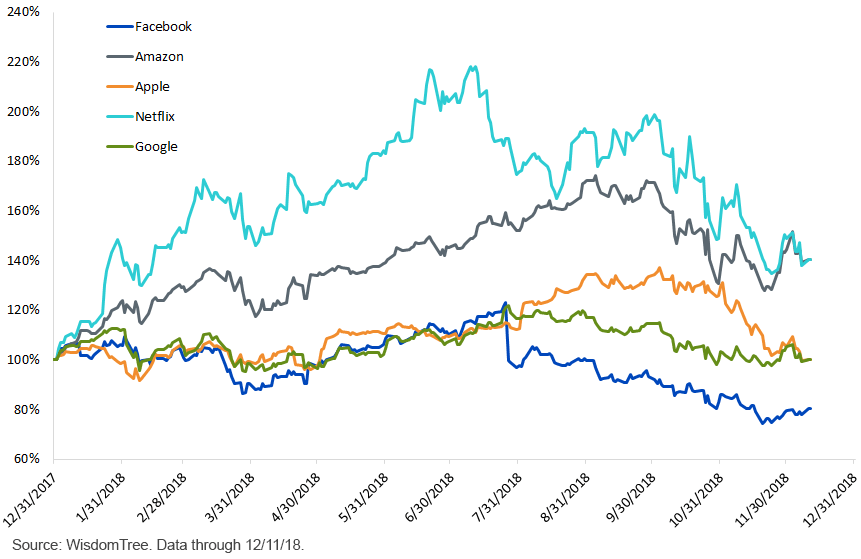
FAANG. What an acronym. A FAANG stock, cobra logo on its uniform, is like the antagonist in the classic 1984 movie The Karate Kid.
The FAANG (Facebook, Apple, Amazon, Netflix and Google-parent Alphabet) is unstoppable as he sweeps the leg and kicks the proverbial “value stock,” Daniel-san, in his broken ribs. No mercy. Miyagi, Daniel-san’s mentor, cannot help him.
At least that was the situation until a few months ago, when both Apple and Amazon reached valuations north of $1 trillion.
Not many of us have issues with Netflix as an organization. But the other four FAANGs’ public reputations are on tenterhooks.
Amazon gives millions of small businesses sleepless nights, while its employees complain of poor working conditions. Want to talk about business risk? Wake up one morning to President Trump doing a Teddy Roosevelt trust-buster impersonation. You’re unstoppable until Daniel-san gets into the crane position.
Or look at the half-dozen reasons that reasonable people hate Facebook. One of them is probably our collective inability to prevent hundreds of images of our children from being plastered on its site, even if we are not “on Facebook.” If you don’t like it, tough luck. The BBC cites an Ofcom study finding that 70% of people do not think it is OK to share images of others without permission. It’s that other 30% that the rest of us have to worry about.
But there’s so much more.
Facebook is beset by accusations about “fake news” and political biases. Also, how about your high schooler’s shrinking attention span and growing self-doubt as friends post solely their life’s highlights?
Stock market sentiment is a fragile thing: $408 billion is a lot to pay for a company that you and your next-door neighbour dislike.
And while we’re talking about aiding and abetting our society’s mass experiment with device-addicted zombie scatterbrains, there’s Apple. It sells the pipe to the smoker.
There is no shortage of people itching for Daniel-san to kick some of these companies in the face, in the interest of civil society. Our industry wants to talk about environmental, social and governance (ESG) screens. Great. Let’s talk candidates.
Google cannot be forgotten. The internet was supposed to be a utopia of free discourse. Free discourse, unless the Chinese Communist Party’s censors give you heat.
When a company like Sears or Woolworth’s rolls over, most of us feel bad, nostalgic even. But there is something unsettling when the top of the S&P 500 is populated by companies that are dinner table pariahs.
If Daniel-san is doing that awesome crane pose and kicking some of these FAANGs across the face, there are value-investing “Miyagis” out there watching from the sidelines, giving a slow nod of approval.
Jeff Weniger, CFA serves as Asset Allocation Strategist at WisdomTree. Jeff has a background in fundamental, economic and behavioral analysis for strategic and tactical asset allocation. Prior to joining WisdomTree, he was Director, Senior Strategist with BMO from 2006 to 2017, serving on the Asset Allocation Committee and co-managing the firm’s ETF model portfolios. Jeff has a B.S. in Finance from the University of Florida and an MBA from Notre Dame. He is a CFA charter holder and an active member of the CFA Society of Chicago and the CFA Institute since 2006. He has appeared in various financial publications such as Barron’s and the Wall Street Journal and makes regular appearances on Canada’s Business News Network (BNN) and Wharton Business Radio.
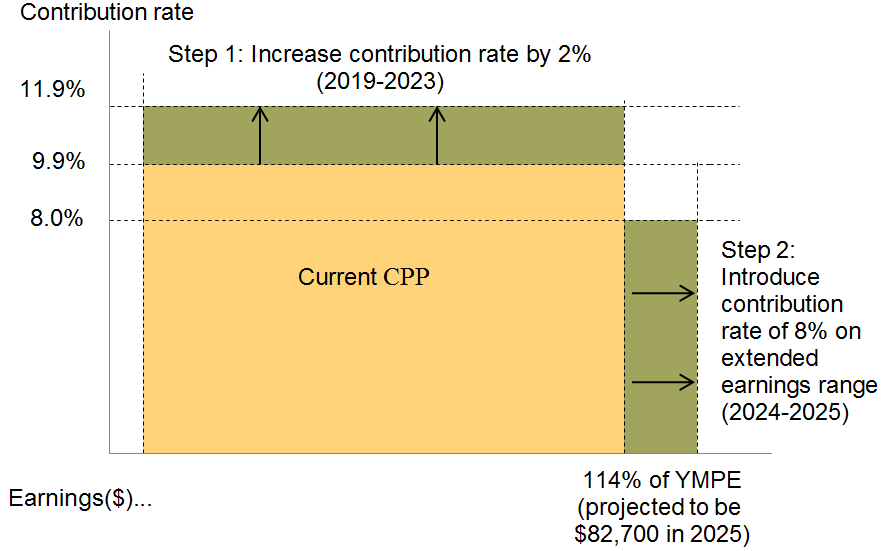
It summarizes the new enhanced Canada Pension Plan regime, which has (as of this month) started to show itself in slightly higher payroll deductions for both employers and employees.
Won’t fully kick in for 45 years
But as the piece explains, the enhanced CPP won’t fully kick in until 45 years from now, and most Baby Boomers will be retired before feeling any benefits beyond that of the normal practice of delaying CPP till age 70. And as one source explains, even the expanded CPP still isn’t as generous as Social Security is in the United States. Not only do they pay slightly higher payroll premiums to fund Social Security, but they also pay based on a much higher level of income.
U.S. Social Security still more generous
US contributions are up to US$132,900 in income, compared to about half that in Canada: a Year’s Maximum Pensionable Earnings limit (YMPE) of $57,400 in effect in 2019. CPP was originally designed to “replace” about 25% of the average worker’s income but the enhanced CPP will take that up to about 33.3% once it’s fully implemented. Gradually, the limit will rise to $65,400 (rounded down, 2019 dollars.)
While the full payout is 45 years away, benefits start edging up this year. Until now, the maximum CPP benefit at the traditional retirement age of 65 was $1,154.58 assuming earnings at or beyond the YMPE, according to Doug Runchey, of Vancouver Island-based DR Pensions Consulting.
The maximum benefit will be $1,207.83 in 2026, and eventually reach $1,753.78 by 2065. That’s a whopping $21,045 a year!
Too late for the Boomers
Still, Runchey says, “if you’re thinking of applying for your CPP earlier than 2025, the enhanced CPP will be of little value for you.”
As I said at the outset, that’s unlikely to be helpful for Baby Boomers at or on the cusp of retirement. Even so, the combination of an enhanced CPP and the decade-old Tax-free Savings Accounts (TFSAs) is something most Boomers wish they had when they were young!
For more on the enhanced CPP, go to the Government of Canada’s website here.
In Part 1, I shared some thoughts on a recent report by the Ontario Securities Commission (OSC) outlining the challenges the financial services industry is having in getting Millennials to invest. The OSC report had a great opportunity to address those investing pain points, but like so many financial literacy initiatives, the messaging is not clear, consistent, and understandable. The report identifies solutions, yet they are separate and not integrated and use a lot of industry jargon that people just won’t connect with. They emphasize processes over results. What is the outcome we want Millennials to achieve with investing?
Another way?
In this post, I’d like to share from my experience as Investment Coach and as someone who works with people to develop their investing competencies, some approaches that I found have better motivated people and not just Millennials into becoming more engaged with investing. They address the pain points people have with expressed about investing which include; being scared of investing, feeling overwhelmed by the process, feeling paralyzed when trying to make a decision, and not knowing how to start and take that first step. These are my takes and perspectives. They are by no means the most definitive and all encompassing.
The First Step: Define the investing path
The OSC report identified taking the first step in investing as a major pain point for people. For most people, after they have the epiphany that they should start growing their savings and invest, the most common series of events that occur include opening a brokerage account, buying some books or researching investing on the Internet or simply doing what their peers are doing. They buy a few stocks and some work out and some don’t and that’s where the fear pain point comes in.
The default for investing seems to be buying stocks, but does this really apply to everyone? In Part 1, I said that investing can be a very boring, repetitive, and time consuming process. Investing in stocks requires a major time commitment to analyze and evaluate stocks and managing the portfolio. For a lot of people, they really couldn’t be bothered to learn about investing because they have other more pressing priorities in their life … and that’s OK.
There are different investing paths we can take but ultimately we want to be on an investing path that compatible our life situation. If I don’t have the time to invest maybe I should consider working with a financial advisor, maybe use a robo-advisor service. Maybe buying a basket of Exchange Traded Funds (ETF’s) is a better path than buying individual stocks.
Why are you investing?
It is critical that at the people define right away the appropriate investing path they want to travel. It begins with defining what the end of the path looks like (Why am investing?) as well how the road will be travelled. Will I travel it alone (Do-It-Yourself) or with someone else?
Once you’ve been able to answer these questions and defined a path, then you will have defined and reduced your scope of investments that you will use and begin work on building your investing competencies. Why learn about investing in stocks when you will be investing in ETFs?
The investment industry doesn’t really take the time to work with people on defining their investing path because they established a default that people that come to them want to invest in stocks when in reality they may have no interest or tolerance for it. The starting point is such a difficult pain point for many because once they begin to follow an investing path that was not compatible with their life and quickly they fell off it and into a ditch, it becomes harder to emotionally get back at it. These type of conversations need to happen before opening a broker account or signing up for an investing course.
Building investing competencies
I view financial literacy to be more about building competencies, more specifically investing competencies. From my experience, the people that have this investing thing pretty figured out possess three competencies. My role as an Investment Coach is to help people develop these investing competencies.
Competency 1: Education – Principles versus Formulas
Once we have defined an investing path, we can target our learning to focus on developing our investing competencies in those areas. If we are committed to investing in individual stocks then we should focus our education on learning that area. Most investing education focuses on the mechanical aspects of investing and those mechanics which involve formulas, spreadsheets, and math trigger people’s pain points of finding investing overwhelming. Continue Reading…


 Posted By
  My latest MoneySense Retired Money column was just published, focused on Monday morning’s release of the 2019 RBC Financial Independence in Retirement poll.
 Posted By