
Tag Archives: Financial Independence

Are you concerned about Retirement?

“Retirement: World’s longest coffee break.”
—Author Unknown

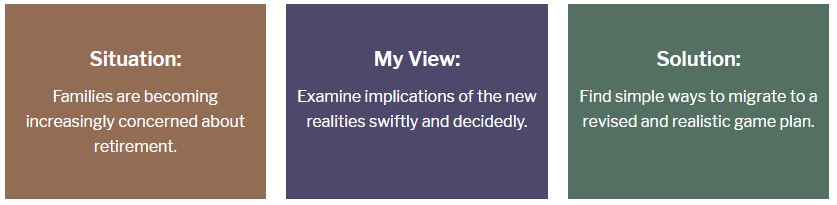
Families are becoming increasingly concerned about achieving and maintaining their long term retirement goals. Some retirements will be in doubt. Others will fall short of the objectives. Having sufficient, reliable sources of funds is at the top of the worry list. Deploying a secure retirement plan spanning 20 to 30 years, often longer, is a demanding journey for many.

Planning for retirement remains a balancing exercise between providing for today and salting away a big enough portion for the later years. Sadly, not everyone gets it right. Hopefully, you will never have to face that dreaded realization. That is, you don’t have enough money to retire, or continue retirement, as planned.

“Most retirement concerns or mishaps typically surface after age 60.”

Someone who is broadly qualified should be in charge of stickhandling this exercise. Perhaps, someone who can take on duties of a “wealth pilot.” Extensive experience is desirable in navigating the nest egg through the myriad of temptations for making sudden moves. Logical decisions that place the family’s best interests first are a must. It also manages overreactions to daily headlines.
Canadian families rely on a combination of financial sources to fund retirement: personal savings such as cash, RRSP, RRIF and TFSA accounts. A variety of real estate properties contribute. Employer pension plan benefits are important to many. Government benefits typically include Old Age Security payments net of clawbacks and the Canada Pension Plan. The last two offer some flexibility as to when they commence. American families have their own assortment of registered accounts, such as 401(k) and IRAs, along with entitlements to Social Security.

Most retirement concerns or mishaps typically surface after age 60. This situation may pose a variety of difficulties to recover from. Some investing landscapes have been getting a little tattered of late. Continued low-return environments contribute to the dilemma.

What causes shortfalls

All retirements need to deal with several moving parts at once that develop along the roadway. I summarize some of the more critical reasons that affect retirement funding shortfalls:

  • Not saving enough to fully fund the family retirement.
  • Being in denial that the nest egg is not sufficient.
  • Spending more than can be safely drawn from the nest egg on hand.
  • Incurring large investment losses or borrowing more than safe limits.
  • Sustaining a breakup of the marriage or relationship.
  • Employer developments forced you to early retire sooner than planned.
  • Enduring a business failure or financial setback.
  • Involuntary payment reductions from an employer pension.
  • Incurring significant health costs or financial emergency.
  • Investment game plan is too conservative or concentrated.
  • Underestimating costs incurred, such as a retirement home facility.
  • Ignoring the adverse impact of inflation over the long run.

Investors are wise to delve into the pressures of delivering long-term portfolio results. Most nest eggs receive little or no saving capacity after retirement begins. Think of this as having to rely only on investment returns, say for 30 years. That is both hard to imagine and accomplish.

In addition, emotional attachments to investments owned typically prevent portfolios from taking corrective actions in a timely manner. For example, investors hold onto loss positions far longer than necessary.

Any one reason, or combination, can abruptly slam the brakes on family retirement goals. You typically need to act quickly to rectify the setback in the making.

I suggest starting with a deep breath. Then proceed to methodically analyze and estimate the size of your retirement shortfall. Sketching a few “what if” scenarios should help your family identify and select the best ways to move forward.

Assess your options

Continue Reading…

GreedyRates.ca: The 5 degrees of Financial Freedom

Image: GreedyRates.ca/Shutterstock

My first article for GreedyRates.ca ran over the weekend. Click on The 5 Degrees of Financial Freedom for the full article. It talks about how many terms in personal finance are used interchangeably, and often imprecisely: financial security, financial independence, retirement and especially financial freedom.

I suggest that most of us travel through a financial life cycle as predictable as the human life cycle, and there is a corresponding hierarchy of growth stages that we need to keep in mind in order to continually meet and exceed our financial goals. But because the term financial freedom can apply to so many stages, I argue it’s better to use more precise terms to identify the various degrees of Financial Freedom.

From the 5-stage hierarchy below, I argue that the key milestone in our financial lives is Findependence (a contraction of Financial Independence), a turning point that I define as the moment all sources of passive income exceed your monthly living expenses. Note that the full version at GreedyRates.ca contains three key bullet points for each of the stages, for a total of 15. Below, I summarize just the stages themselves.

Stage (Sub) 0: Indebted Wage Slavery

We may start out our financial lives with student debt, credit-card debt or mortgage debt in the early years of forging careers and raising families. Whatever its nature, debt keeps you chained to employment or work of some type.  Since those starting their financial journey in debt haven’t really begun their financial journey at all, I call the preliminary stage Stage 0. As a character in my financial novel, Findependence Day, tells a young Millennial couple still in debt: “You can’t climb the tower of wealth while you’re still mired in the basement of debt.”

Stage 1: Financial Security

The next level to aspire to in the ascending hierarchy is Financial Security. In this stage you have eliminated your debts and have accumulated enough wealth so that your absolutely necessary monthly expenses (rent/mortgage, food, utilities, travel and basic entertainment) are taken care of for the near future.

Stage 2: Financial Vitality

It can take a long time just to establish a modicum of financial security but I argue you need to aim higher than mere financial survival and embrace what Tony Robbins dubs Financial Vitality. You want enough flexibility in your cash flow that, after the necessities are taken care of, you can enjoy little luxuries like new clothing or intangibles like gym or yoga memberships, and attend the occasional sporting or cultural event. It’s the difference between financially surviving and financially thriving.

Continue Reading…

Online Fraud: 7 simple ways to protect yourself from a #clicktastrophe

By Rob Fodor

Special to the Financial Independence Hub

If you’re like most people, you have a phobia about phishing. In fact, as we found in a recent Interac survey, almost one quarter of Canadians have clicked on a link that resulted in a phishing scam.

It’s no wonder Canadians are more likely to be worried about payment fraud scams such as phishing and skimming than they are about having their homes broken into or their cars stolen. Fortunately, just as you can take steps to protect your home and car, there are things you can do to protect yourself from online scams, too.

Beware Phishing trips

Phishing is a scam where fraudsters try to get your personal or financial information – such as passwords or card numbers – by masquerading as a trusted person or business, usually through email, text or an instant message, but also sometimes by phone. Continue Reading…

Retired Money: The case for early partial annuitization

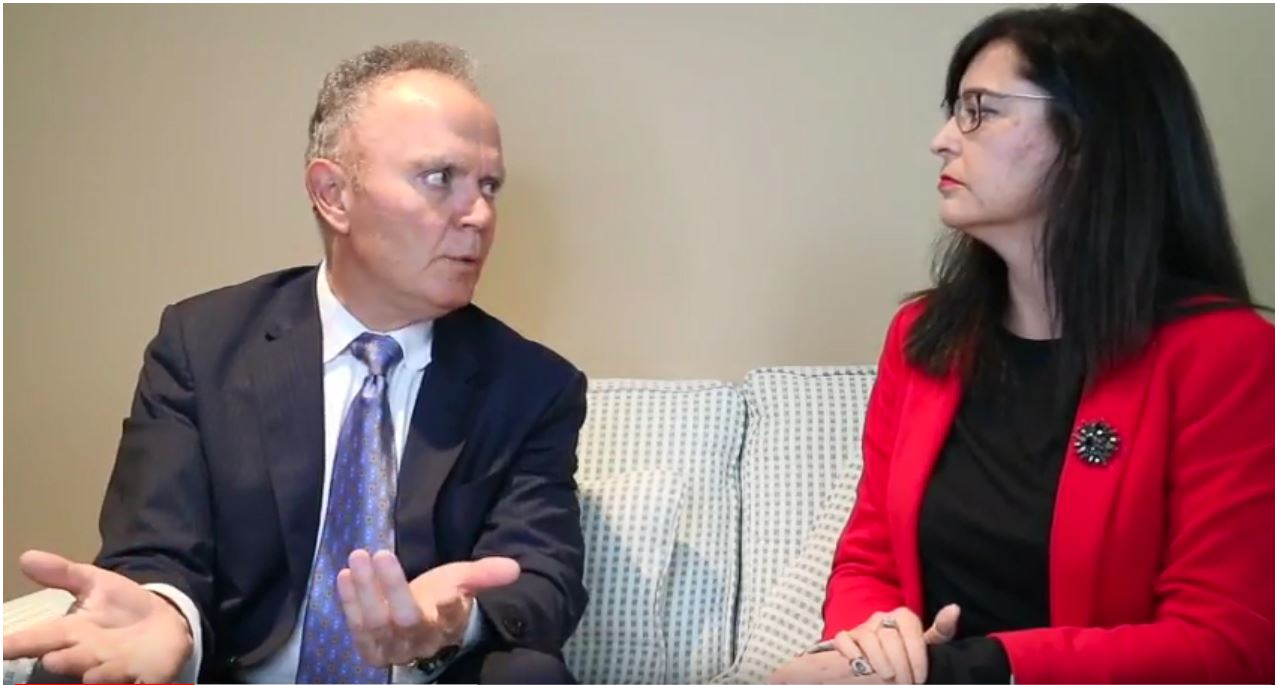
Fred Vettese and Rona Birenbaum in YouTube video

If you lack what finance professor and author Moshe Milevky calls a “real” pension (i.e. an employer-sponsored Defined Benefit plan), then you’re a likely candidate for annuitization or at least partial annuitization of your RRSP and/or RRIF.

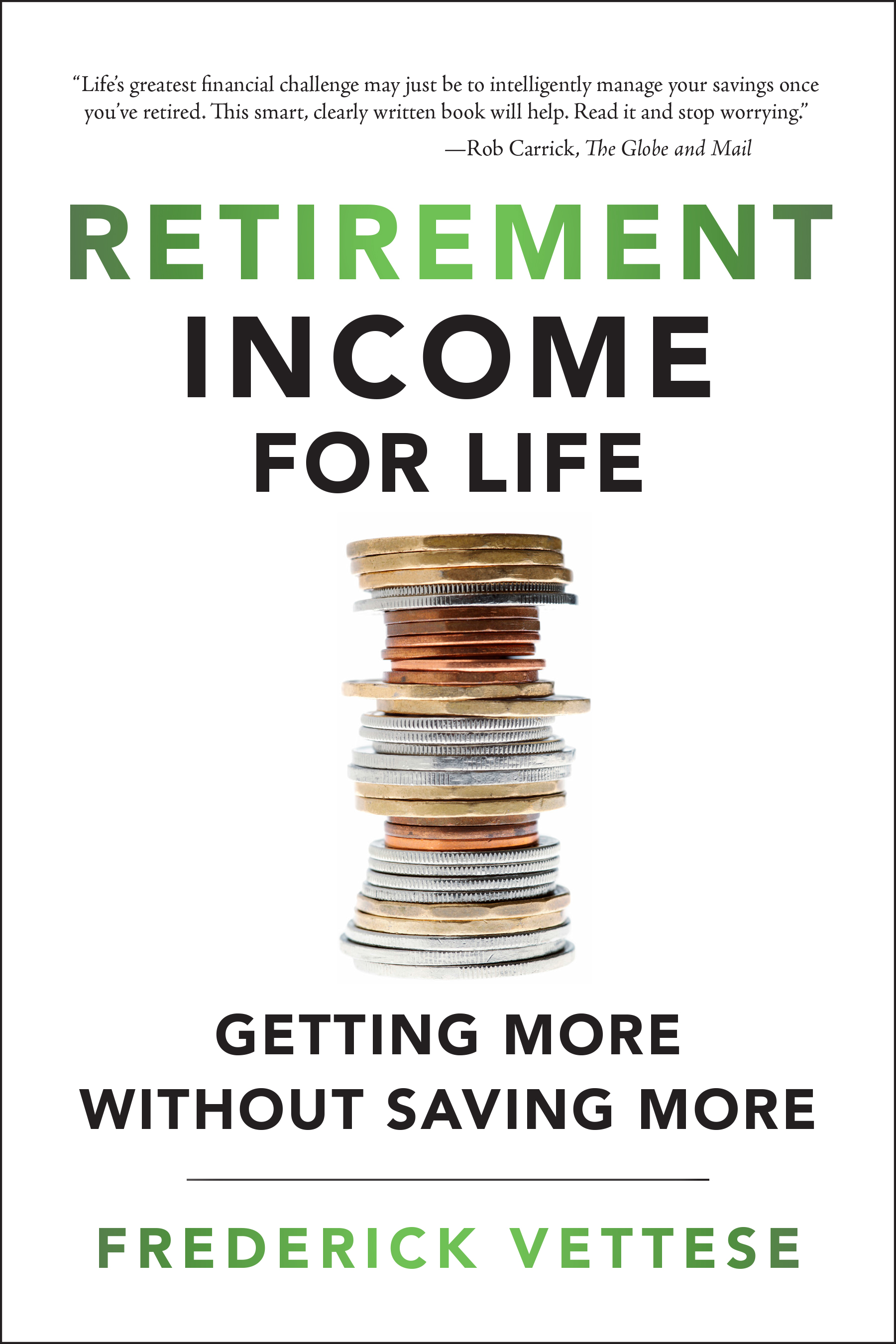
My latest MoneySense Retired Money column revisits Fred Vettese’s excellent new book, Retirement Income for Life, and in particular his third “enhancement” suggestion for maximizing retirement income. We  formally reviewed Vettese’s book in the MoneySense column before that, and commented on it further here at the Hub. 

You can find the new piece drilling down on the partial annuitization enhancement by clicking on the highlighted headline: RRIF or Annuity? How about Both.

One of the main sources in the piece is fee-only planner Rona Birenbaum (pictured above with Fred Vettese), who has some useful videos on YouTube about annuities, including an interview with Vettese about the partial annuitization strategy described in the new MoneySense column. See Is it time for annuities?

Expect an annuity wave from retiring boomers without DB pensions

Certainly you’re going to hear a lot more about annuities as the baby boomers move seriously from Wealth accumulation mode to de-accumulation, aka “decumulation.” Coincidentally both Vettese and I are 1953 babies with April birthdays. In an interview with Fred, he told me he bought some annuities a year ago and that he believes that those who plan to retire at age 65 (and who lack a traditional employer-sponsored Defined Benefit pension) should consider at least partly annualizing at 65, to the tune of roughly 30% of the value of their nest egg (typically in an RRSP or RRIF). That means registered annuities.

Certainly, in light of the 10% “correction” in stocks that occurred in the last few weeks, the possibility of a more severe stock market retrenchment has to be upper most in the minds of soon-to-retire baby boomers. I note in his recent G&M column, Ian McGugan (in his early 60s) confessed he was slowly starting to take some profits from stocks and move them to safer fixed-income investments like GICs. See The Market’s gone mad: Here’s how to protect yourself. See also Graham Bodel’s article earlier this week: Response to an investor who frets the market is going to crash.

Annuities are one way to hedge against market risk, since you’re in effect transferring some of the market risk inherent in an RRSP or a RRIF to the shoulders of the insurance company offering the annuity. That’s one reason in the YouTube video above, Vettese talks about partly annuitizing as soon as you retire, whether that be age 65, or sooner or later than that traditional retirement date.

Financial advisors may not agree with all of Vettese’s five “enhancements.”

The earlier column reviewing the book mentioned that not many of Vettese’s “enhancements” to retirement income may be endorsed by the average commission-compensated financial advisor. Even so, as the Royal Bank argued earlier this year here at the Hub, annuities can help fund a full lifestyle in retirement. It observed that 62% of Canadians aged 55 to 75 are worried they’ll outlive their retirement savings but only 10% use or plan to use an annuity to ensure they’ll have a viable lifestyle in retirement.

Regular Hub contributor Robb Engen — a fee-only financial planner who also runs the Boomer & Echo website — wrote recently (on both sites) that annuities are one way retirees or would-be retirees without traditional DB pensions can Create their own personal pension in retirement.

As I note in the MoneySense column, while I’m certainly approaching the age when partial annuitization may make sense, I’ll probably wait a year or two. But in preparation for that possibility, as well as for the column, I asked Birenbaum to prepare three quotes for a $100,000 registered annuity, starting at ages 65, 70 and 75. As you might expect, the longer you wait to begin receiving payments, the higher the payout, but it’s not such a massive rise that you could rule out early payments if you really needed them to live on.

The mechanics of buying an annuity

And should you be ready to take the step, it’s not all that complicated. In the above case, you would liquidate $100,000 worth of investments in your RRSP so the cash is available to transfer, then complete an annuity purchase application and fill out and submit a T2033 RRSP transfer form. That form is sent to your RRSP administrator, and they transfer the cash to the insurance company without triggering tax. Once all these preliminary steps have been taken, payments begin the month following the annuity purchase.

Oh, and one last step, Birenbaum adds: Start relaxing!

Retired Money: How to boost Retirement Income with Fred Vettese’s 5 enhancements

 Once they move from the wealth accumulation phase to “decumulation” retirees and near-retirees start to focus on how to boost Retirement Income.

The latest instalment of my MoneySense Retired Money column looks at five “enhancements” to do this, all contained in Fred Vettese’s about-to-be-published book, Retirement Income for Life, subtitled Getting More Without Saving More. You can find the full column by clicking on this highlighted headline: A Guide to Having Retirement Income for Life.

You’ll be seeing various reviews of this book as it becomes available online late in February and likely in bookstores by early March. I predict it will be a bestseller since it taps the huge market of baby boomers turning 65 (1,100 every day!): including author Fred Vettese and even Yours Truly in a few months time.

That’s because a lot of people need help in generating a pension-like income from savings, typically RRSPs, group RRSPs and Defined Contribution plans, TFSAs, non-registered investments and the like. In other words, anybody who doesn’t enjoy a guaranteed-for-life Defined Benefit pension plan, of the type that are still common in the public sector but becoming rare in the private sector.

The core of the book are the five “enhancements” Vettese has identified that help to ensure that those seeking to pensionize their nest eggs (to paraphrase the title of Moshe Milevsky’s book that covers some of this ground) don’t outlive their money. Vettese says many of these concepts are current in the academic literature but have been slow to migrate to the mainstream, in part because few of these “enhancements” will be welcomed by the typical commission-compensated financial advisor. That in itself will make this book controversial.

Each of these “enhancements” get a whole chapter but in a nutshell they are:

1.) Enhancement 1: Reducing Fees

By moving from high-fee mutual funds or similar vehicles to low-cost ETFs (exchange-traded funds), Vettese explains how investment fees can be cut from 1.5 to 3% to as little as 0.5% a year, all of which goes directly to boosting retirement income flows. One of his takeaways is that “Tangible evidence of added value from active management is hard to find.”

2.)  Enhancement 2: Deferring CPP Pension

We’ve covered the topic of deferring CPP to age 70 frequently in various articles, some of which can be found here on the Hub’s search engine. Even so, very few Canadians opt to wait till age 70 to collect the Canada Pension Plan. Because CPP is a valuable inflation-indexed guaranteed for life instrument — in effect, an annuity that you can never outlive — Vettese argues for deferral, although he (like me) is fine with taking Old Age Security as soon as it’s available at age 65. He argues that for someone who contributed to CPP until age 65, they can boost their CPP income by almost 50% by waiting till 70 to collect.  “You are essentially transferring some of your investment risk and longevity risk back to the government, and you are doing so at zero cost.” Continue Reading…