How you deploy your accumulated assets to fund the second half of your life is much harder than how you built them up in your accumulation years.
Read this again if you need to, but be sure you get this point.
First build an asset pool under the spell of “Dollar Cost Averaging over the long-term” — the favorite aphorism of the investment management salesperson. For the 30-odd years of your prime saving and accumulation years this mantra encourages you to keep giving money to them, disguises bad performance and promises you future success. Given enough time, however, let’s hope you have more than when you started.
There’s a popular story told by banks and financial authors to encourage people to start saving for retirement at an early age. It’s called the Parable of the Twins and it goes something like this:
One twin puts aside $3,000 every year into his tax-free savings account starting at age 22, and stops at 32 – never adding another penny to the account. His sister starts saving $3,000 annually at age 32, and continues until 62. Who has the larger nest egg?
You know how this story goes by now. Assuming an annual return of eight per cent, the twin brother wins hands-down. He ends up with $437,320 in his TFSA, compared to his sister’s $339,850, even though he contributed $60,000 less than his sister.
It’s a ubiquitous tale, but one that resonated with me at a young age. I was drawn to the awesome power of compounding – how money grows exponentially over time. Continue Reading…
Here’s my latest MoneySense blog, which it titled Is your advisor retirement ready? It came out of a conference I attended in Niagara Falls last week: the National Elder Planning Issues Conference. I had delivered the keynote address on why Longevity changes everything — a theme you’ll often see in the Hub’s Longevity & Aging section — but also sat in on a couple of sessions on which this blog is based. As you’ll see it’s also quite relevant to our Decumulation & Downsizing section.
For archival and one-stop shopping purposes, here’s the blog below, with a few photos and subheadings added: Continue Reading…
The Twelve Tables formed the basis for Roman law. The twelve suggestions below form the foundation of a sound financial plan. It should be devised and agreed upon by you and your partner and should result in a secure financial future.
1.) Believe you can succeed
No enterprise, be it financial success or otherwise, can succeed without a belief that it is possible. Much else goes into accomplishing your goals but without a belief you can succeed, they are doomed to failure.
2.) Agree on the definitions of the terms in your financial plan
You and your partner must have the same idea of what wealth, risk, budget and a lot of other terms mean or you will be working at cross purposes.
Are the Baby Boomers part of the Ageless Generation?
Many of us seem to act as if that were the case but there’s little doubt most of us feel younger than we appear. To me, the poster child for this ageless generation is Jane Fonda, whose famous workout videos appear to have held her in good stead in her personal twilight career.
(Technically, since she was born in 1937, Jane Fonda is not a post-war baby boomer but her spirit certainly seems to epitomize the zeitgeist of the generation that came soon after her).
If you get Netflix check out the recently released series Grace & Frankie, where Fonda plays a 70-year old recent divorcee: even though she herself is actually 77! Equally vibrant are her aging costars: Lilly Tomlin, Martin Sheen and Sam Waterston (best known as the prosecutor on Law & Order). Tomlin is 75 and the two male co-stars are 74.
Medical advances will transform the global economy
Amazon.com
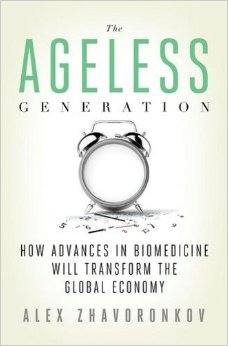
The Ageless Generationalso happens to be the title of a recent (2013) book by Dr. Alex Zhavornonkov, director of the Biogerontology Research Foundation and founder of the International Aging Research Portfolio. It’s one of about a dozen books I read in recent months in preparation for a talk on Longevity that I gave on Monday to the National Elder Planning Issues Conference in Niagara Falls.
The book’s subtitle summarizes the gist of it: How advances in biomedicine will transform the global economy. Since the focus is on the United States, it will come as no surprise that Zhavornonkov believes breakthroughs in extending Longevity can only make a shaky Social Security and Medicare system that much more fragile in the United States, and by extension their equivalent programs in other advanced nations.


 Posted By
 Posted By
 Posted By