Tag Archives: investing

Reframing the RRSP advantage

I’ve read a lot of bad takes on RRSP contributions and tax rates over the years. One that stands out is the argument that you should avoid RRSP contributions entirely, and focus instead on investing in your TFSA and (gasp) your non-registered account. This idea tends to come from wealthy retired folks who are upset that their minimum mandatory RRIF withdrawals lead to higher taxes and potential OAS clawbacks. They also seem to forget about the tax deduction generated from their RRSP contributions and the tax-sheltered growth they enjoyed for many years leading up to retirement.

I’m hoping to dispel the notion of an RRSP disadvantage by reframing the way we think about RRSP contributions, RRIF withdrawals, and tax rates. Here’s what I’m thinking:

Most reasonable RRSP versus TFSA comparisons say that it’s best for high income earners to prioritize their RRSP contributions first, while lower income earners should prioritize their TFSA contributions first.

The advantage goes to the RRSP when you can contribute at a higher marginal tax rate and then withdraw at a lower marginal tax rate, while the advantage goes to the TFSA when you contribute at a lower rate and withdraw (tax free) at a higher rate.

If your tax rate in your contribution years is the same as in your withdrawal years then there’s no advantage to prioritizing either account. They’re mirror images of each other.

Related: The next tax bracket myth

This comparison focuses on marginal tax rates. But is this the correct way to frame the discussion?

Marginal Tax Rate vs. Average Tax Rate

Isn’t it fair to say that an RRSP contribution always gives the contributor a tax deduction based on their top marginal tax rate (assuming the deduction is claimed that year)?

But when you look at retirement withdrawals, shouldn’t we focus on the average tax rate and not the marginal tax rate?

An example is Mr. Jones, an Alberta resident with a salary of $97,000 – giving him a marginal tax rate of 30.50% and an average tax rate of 23.59%

Alberta MTR $97k

If Mr. Jones contributes $10,000 to his RRSP he will reduce his taxable income to $87,000 and get tax relief of $3,050 ($10,000 x 30.5%).

RRSP deduction

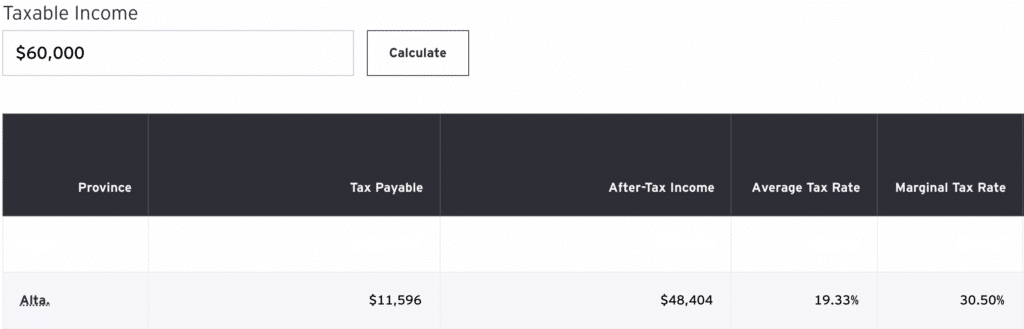
Fast forward to retirement, where Mr. Jones has taxable income of $60,000 from various income sources, including a defined benefit pension, CPP, OAS, and his $10,000 minimum mandatory RRIF withdrawal.

The range of income in each tax bracket can be quite broad. With $60,000 in taxable income, Mr. Jones is still at a 30.5% marginal tax rate, but his average tax rate is just 19.33%. That’s right, he pays just $11,596 in taxes for the year.

Alberta MTR $60k

Conventional thinking about RRSPs and marginal tax rates would tell us that Mr. Jones should be indifferent about contributing to an RRSP in his working years because he’ll end up in the same marginal tax bracket in retirement.

But when we consider all of our retirement income sources, why do we treat the RRSP/RRIF withdrawals as the last dollars of income taken (at the top marginal rate) instead of, say, income from CPP or OAS or from a defined benefit pension? Why would Mr. Jones’ $10,000 RRIF withdrawal be taxed at 30.5% when it’s his average tax rate that matters? Continue Reading…

How to generate Passive Income 

Image Credit: Pixabay

By Mike Khorev

Special to the Financial Independence Hub

Many of us strive for financial security; luckily, passive income investments open up the opportunity to make extra money on the side. 

All you need is the willingness to put in some fundamental groundwork: you don’t necessarily need savings to kickstart your investment. There are plenty of options when it comes to generating passive income that go far beyond the realms of compound investing. Here are some fresh ideas to get you started.

1.) Investments

Exchange-traded funds (ETFs)

Exchange-Traded Funds, known as ETFs, are a great way to invest in the stock market without needing to research individual companies. Investing in ETFs provides both capital gains and dividends. Diversify your investments to receive the maximum benefit. ETFs are rather low maintenance and yield a lower risk than regular equities.

Dividend-paying stocks

Feel the benefits of dividend stock investments with a range of stocks yielding up to 5% dividends. The hardest part is knowing which stocks are worth investment. The best way to generate larger profits is to choose dividends that come with franking credits. Stock market unpredictability is no secret, be willing to face a sudden rise and fall in value or cut dividends altogether.  

Robo-advisors

If you’re looking for an affordable financial advisor to manage your investments, Robo-Advisors could be for you. They personalise automated trading decisions based on your financial targets, limits and time frames for a fraction of the cost. They are one of the most passive forms of income. 

2.) Real estate

Rental income

Rental yield can be one of the most profitable forms of passive income. Experts state that small apartments containing 1-2 bedrooms have more success on the market generating returns of over 8%. Real Estate Agents will handle legal documentation, rent collection, and advertise your property for a recurring fee of 5-12% of the monthly rent.

Airbnb

Airbnb is a thriving marketplace with host’s estimated monthly earnings sitting at $924 per month. While properties are free to list, hosts are charged a 3-5% service fee and are liable to income tax. Many hosts invest earnings into outsourced housekeepers to maintain passiveness. 

Real estate investment trusts (REITs)

REIT investments are perfect for those who are interested in real estate without the responsibility of sustaining individual properties. Typically, REITs support non-residential buildings such as offices, apartment complexes, and retail centres. Commercial buildings are famous for yielding large profits, passive income will be paid in the form of dividends.

3.) Content creation and advertising

Affiliate marketing

Affiliate links are more negotiable than ever, not only do they support affiliate businesses, they are also a manageable form of passive income. Invest some time into digital content creation that generates healthy volumes of traffic. Aim to recommend products you truly believe in to build a trusting relationship with your audience and boost clicks.  Continue Reading…

Embracing Uncertainty: Do Nothing and hope Nothing Happens but don’t make me Think

By Noah Solomon

Special to the Financial Independence Hub

One of my favourite quotes is attributable to the late, great economist John Maynard Keynes. During a high-profile government hearing, when a critic accused him of being inconsistent, Keynes responded, “When the facts change, I change my mind. What do you do, sir?”

Being uncertain of what to do and/or scared of being wrong can cause investors to cling to their existing strategies and portfolios regardless of changes in the economic backdrop or market environment.

Another cause of investor inertia lies with the wealth management industry, which generally espouses a “do nothing and hope nothing happens” approach to investing whereby clients are encouraged to adopt a static, buy-and-hold approach and refrain from making any significant changes to their portfolios, regardless of changes in the investment environment.

The behavioral explanation behind the abdication of action in favor of passivity is nicely summarized by the following quote:

“You see, Dr. Stadler, people don’t want to think. And the deeper they get into trouble, the less they want to think. But by some sort of instinct, they feel that they ought to and it makes them feel guilty. So they’ll bless and follow anyone who gives them a justification for not thinking.”

– Ayn Rand, Atlas Shrugged

Despite this tendency to cling to the status quo, the fact remains that refusing to change your portfolio in response to changing conditions has historically been one of the costliest mistakes in investing.

Sometimes It’s OK to Do Nothing (But it’s really hard to know when)

When asked what went through his mind when he listened to his own music, jazz legend Miles Davis responded, “I always listen for what I can leave out.” Davis meant that there are times when less is more: restraint can be more effective than action. As is the case with music, there are investment climates in which it’s best to do nothing.

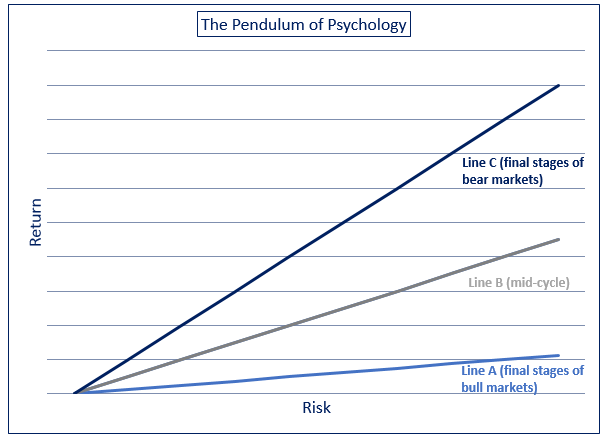
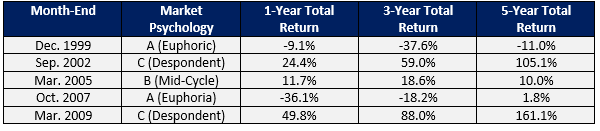
The value of sound risk management varies depending on the market environment. The ability to manage risk has little value when conditions are favourable.  During a bull market that occurs against a backdrop of attractive valuations, low leverage, and a favourbale economic climate, risks are minimal and any move to take profits and reduce risk will likely make you worse off: just sit back and enjoy the proverbial ride. Conversely, there have been (and inevitably will be) times when risk management and flexibility can prevent a great deal of financial (not to mention emotional) pain.

So far so good: swing for the fences and make huge returns in favourable markets and apply the brakes to avoid losses when conditions turn hostile. But wait! To pull this off, you need to do the impossible and successfully predict exactly when markets will turn from favourable to hostile and vice-versa. In other words, you need to be consistently right … or do you?

It’s not just about Being Right. It’s also about What you Do when you’re Wrong

People put too much emphasis on being right. One explanation for this is that people get psychic income from being right:  taking profits on winning positions makes them feel good. Conversely, accepting a loss forces us to admit we were wrong, which can be psychologically challenging even for professional investors. The net result of these opposing reactions is that investors often strive to maximize their percentage of winning vs. losing positions. While this strategy seems like a good idea, it can lead to highly sub optimal results. Continue Reading…

History lessons for managing Market Mishaps: 10 things you can do

By Steve Lowrie, CFA

Special to the Financial Independence Hub

If there’s a consolation prize for growing older, it’s that we get to learn an increasing number of history lessons first-hand.  Take, for example, my past post on lessons from the 2008–2009 bear market:  “What Should I Do – or NOT Do – During the Next Bear Market?”  One suggestion I made for when the next bear came along (now here), was to revisit the article and review the lessons history has to offer us … if only we will heed them.

Good idea.  The circumstances precipitating each event may vary, but the abiding lessons remain relevant every time.  Continuing the theme, today’s post combines a two-part series revisiting 10 points on how to navigate down markets and economic crises.

Since most of us prefer action to idleness, we’ll first cover the following five actions you can take to help. In part 2, right below Part 1 here on the Hub, we’ll cover five things not to do in troubled financial times.

#1:  Simplify

It’s hard to remain calm in turbulent times, when everything seems to be happening at once.  To help, try embracing simplicity, in your life and your financial plans.  That’s not always so easy!  Here are two pieces to assist:

Why Simplicity Beats Complexity

Simple Investing Isn’t Easy

#2:  Trust the evidence to avoid “the big mistake.”

Every investor yearns to buy low and sell high.  But many end up doing just the opposite in a crisis, assuming, “this time, it’s different.”  Here’s a post on using evidence-based history to avoid making this big (if common) mistake:

How Evidence Based Investing Saves Long-Term Wealth by Avoiding the Big Mistake

#3:  Control the controllable

When the world around us seems especially chaotic, it can feel as if we have no say over anything.  There are some greater forces we must leave to fate, but disciplined portfolio management needn’t be one of them, as described in this important January 2019 post:

The Best Year-End Commentary Almost Never Published

#4:  Rebalance back to plan 

Among the most important “controllables” is sticking to your personalized investment mix by rebalancing your portfolio back to plan during down markets. Because this typically calls for selling excess bonds and buying low-priced stocks, rebalancing can feel scary and counterintuitive at the time. Here’s a piece on why it’s still a sensible thing to do:

Rebalancing in Down Markets: Scary, But Important

#5:  Maintain an adequate lifestyle reserve

So, this last one was much better completed in advance.  Still, it’s worth using the current crisis to see how you feel about past efforts:  Are your current lifestyle reserves enough for now?  If the answer is no, make a note to revisit this piece in the future … for next time. Continue Reading…

Whose Bias is it, anyway?


One of the great benefits of living in a free society is that people can have legitimate differences of opinion about the meaning of information and best courses of action.  In this space and, more recently, on social media, I have taken to pointing out the small army of credible sources who concur with my viewpoint that markets are frothy and likely headed for a significant tumble.  Not surprisingly, there are plenty of folks who think things look rosy and that there are no significant storm clouds on the horizon at all.  Obviously, we can’t both be right.

What I find interesting is that I have critics who allege that I am guilty of confirmation bias, a behavioural economics term that suggests people only seek out evidence that supports their pre-existing viewpoint.  While I certainly acknowledge that that might be possible, I find it interesting that the people making the accusation don’t recognize that the same allegation could be levied against them just as easily.  Both sides of the ongoing debate about what might be in store on the capital markets horizon could be accused of looking primarily, perhaps even exclusively, at information that supports their preferred narrative.  How exactly does one prove that one’s thinking has been fulsome and comprehensive? Continue Reading…

Powered by the Financial Independence Hub.
© 2013-2026 All Rights Reserved.
Financial Independence Hub Logo

Sign up for our Daily Digest E-Mail!

Get daily updates from the FindependenceHub.com straight to your inbox.