Now that 2024 is in the books, I thought I would look back financially to where we started this adventure, from January of 1991. The chart below shows the ascent of the S&P 500 Index over our 34 years of retirement.
On our retirement date of January 14, 1991, the S&P 500 index closed at 312.49. It has recently closed over 6000, making over 8% annual gains plus a couple per cent counting dividends. Hard to imagine, right? With all of the market ups and downs, global turmoil, governments coming and going, businesses expanding and failing, and still producing a better than 10% annual return.
But is this really a one-off period and not the norm?
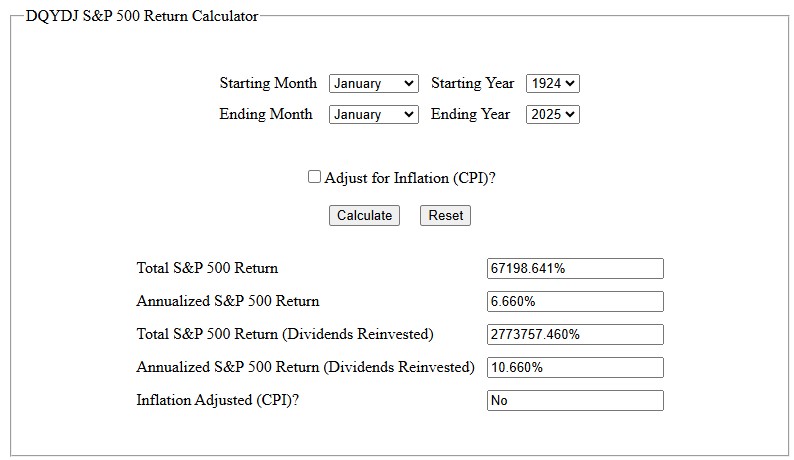
Using a calculator, we can see that the S&P 500 returns for the last 100 years, including dividends, is 10.660%.
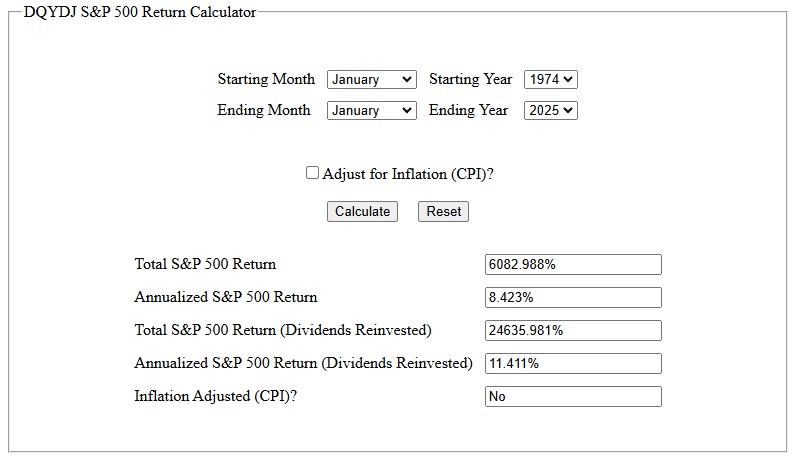
And recalculating for the last fifty years, total return is 11.411%. Clearly there is a trend here.
Does this mean that every year you invest you are going to have a 10% return? No!
But what it does tell us is that over longer time periods the return on your investment is handsomely rewarded.
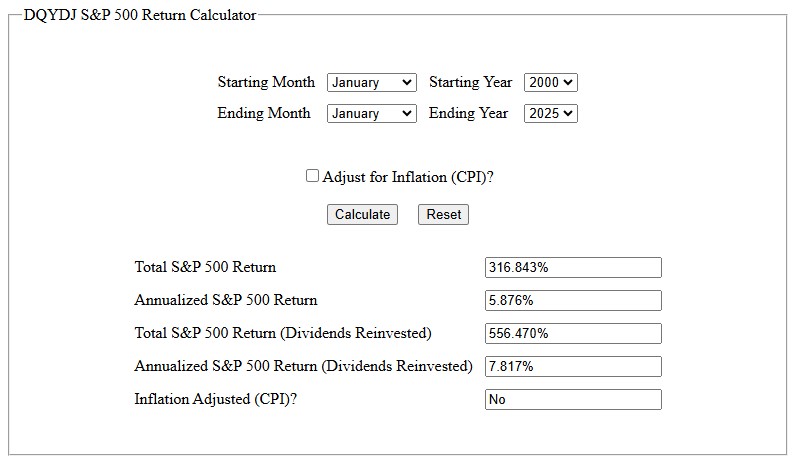
However, if we look at the returns since the year 2000 they have been sub par at an annualized rate of just 7.817%.
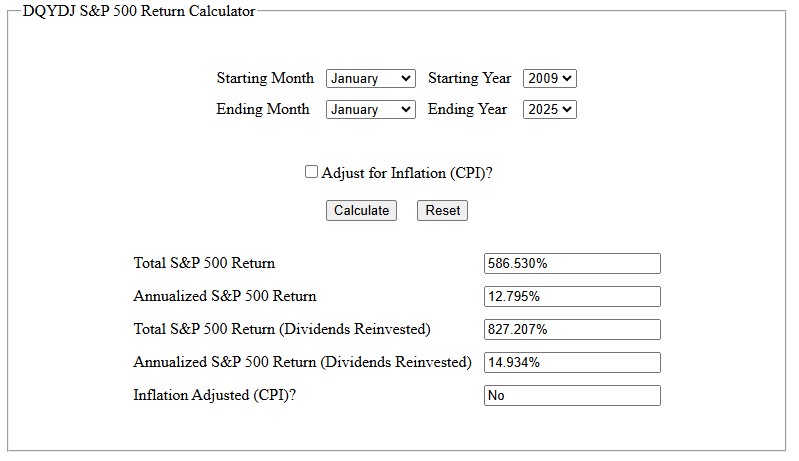
And finally, since the financial crisis in 2009, the S&P 500 Index produced a total return of 14.934% including dividends.
Getting your house in order for retirement or financial independence is not that difficult. Many investment professionals, journalists, and commentators seem to complicate the issue to the point that even we can’t understand it. Safe withdrawal rates, stocks, bonds, balanced funds, commodities, options, laddered portfolios, annuities, offshore accounts, hedge funds, life insurance … are you kidding? No wonder some people are confused and scared!
What’s a person to do?
First, you need to recognize your needs. Let’s be realistic here. How much are you spending now? Not how much do you make a year, but how much are you paying out? With today’s computer online tools and spreadsheets, this is a very easy task to compute.
Once you know your expenditures per year, take a look at where that money is going. If it’s to pay credit card bills or other consumer debt, you need to pay that off first. It’s fine to use credit cards as long as you completely pay off your balance monthly. And stay out of debt. I know this is not easy, but it’s your future, and the money you were paying in interest can now be invested.
With your debts paid off, you can commit to financial independence. Analysts say a guideline of 25 times your annual capital outlay should be enough to sustain your current lifestyle. With the data you’ve collected in your chart, you can easily calculate a target amount.
Canadians in retirement, or those nearing retirement, are faced with unique challenges in the present-day market. Interest rates have moved up from their historic lows since 2022. The benchmark rate for the Bank of Canada (BoC) reached its zenith of 5.00% in July 2023. Economic headwinds forced the hand of the BoC in 2024 and 2025. The benchmark rate now stands at 2.75%, with more rate cuts expected before the end of the year. (The BOC stood pat on April 16th).
This downward trend for interest rates means that investors who want a secure investment while outpacing inflation may have to look beyond GICs and other fixed-income products in this changing climate. Market volatility is another headwind investors are now contending with, spurred on by a new and aggressive U.S. administration.
There was enthusiasm surrounding the broader economy and the stock market coming into 2025. The previous GOP administration cultivated a reputation as a market-friendly one in the late 2010s. That momentum ground to a halt due to the COVID-19 pandemic, but the perception of a market-friendly GOP largely remained.
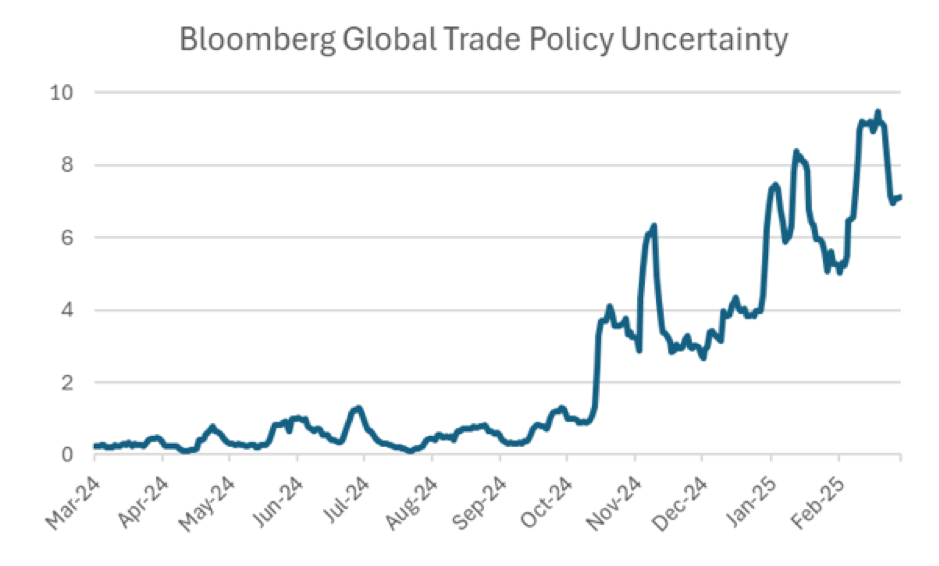
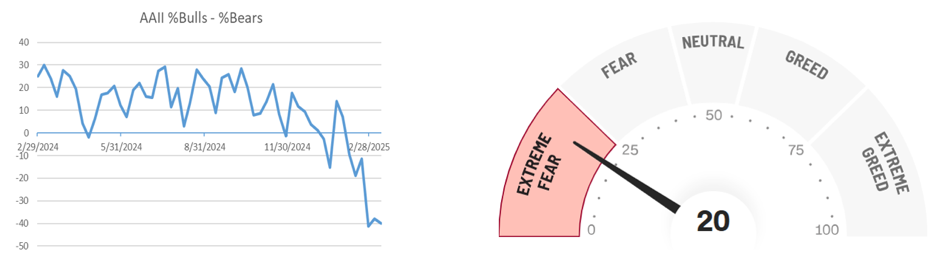
Investor outlook has soured in the late winter and early spring, in large part due to the uncertainty surrounding U.S. government policy, particularly when it comes to tariffs.
Source: American Association of Individual Investors, Bloomberg, Harvest ETFs. As of March 21, 2025.
This uncertainty has resulted in elevated levels of market volatility. Some names have suffered retracements of 50% or more over the past two months. This market is unique in that the sell-off was not triggered by one significant catalyst. Indeed, it is lingering trade policy uncertainty that is fuelling negative sentiment.
Source: American Association of Individual Investors, CNN (Fear and Greed Index). As of March 20, 2025.
The S&P 500 has dropped 8% in the year-to-date period as of close on Friday, April 10, 2025. A research note from Vanguard recently speculated that volatility was likely to remain due to factors like policy uncertainty, disruptive currents in the economy like artificial intelligence development, and the shifting policy of the Federal Reserve.
Demand for Low Volatility products has increased in this environment. These ETFs offer Canadian retirees a pure low volatility play with exposure to 100% Canadian equities. Moreover, we have introduced Harvest’s trusted option writing strategy to the second Low Volatility ETF. It aims to lower portfolio volatility while generating high monthly cash distributions.
Harvest Low Volatility ETFs: A smoother Investment Experience
Harvest’s new Low Volatility ETF suite could be appealing to defensive and long-term investors. This approach to equity investing is factor-based, disciplined, outcome-oriented, is designed to mitigate risk, as well as provide long-term growth. Moreover, the suite includes a high-income solution that generates monthly cash distributions through an active covered call writing strategy. Continue Reading…
The very first thing Prime Minister Mark Carney did upon taking office was to scrap the consumer carbon tax. Depending on your degree of cynicism, the move was either desperate or brilliant. There is not much middle ground. He did so while noting that the tax had become divisive.
Few would disagree. The very large majority of economists who study the subject argue that putting a price on carbon is the most efficient and effective way of curbing CO2 emissions. Nobel laureate William Nordhaus has shown this convincingly. Despite the evidence, retail investors simply hated the scheme.
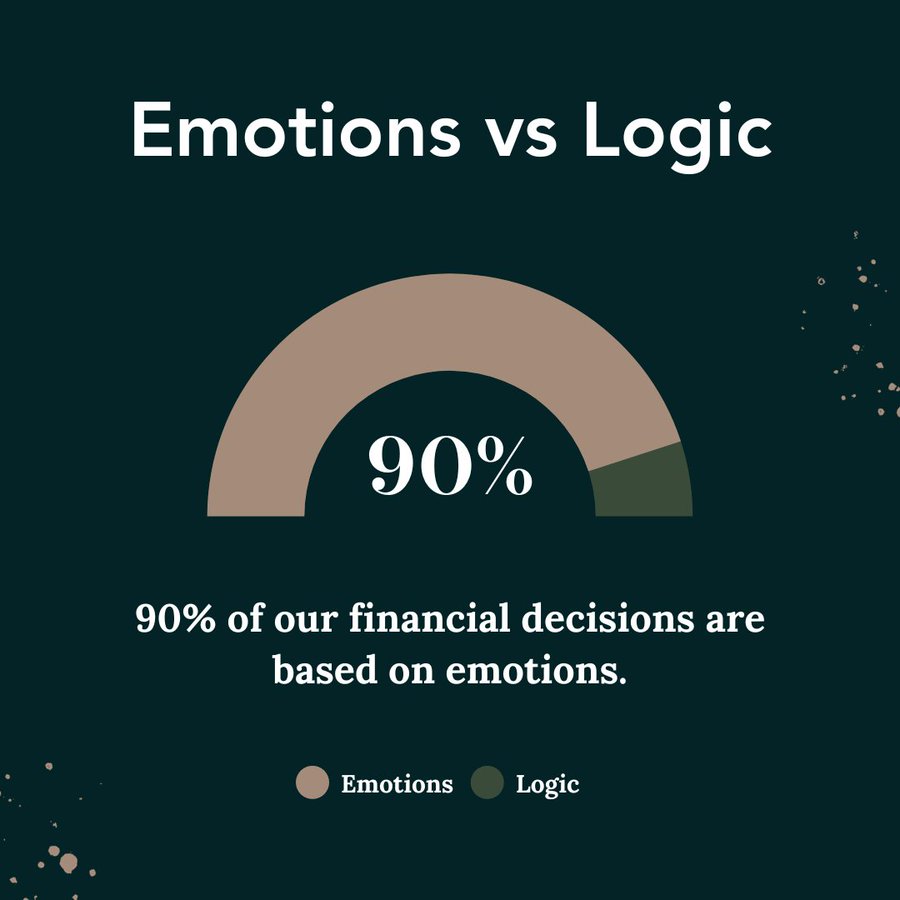
Sometimes there’s a major disconnect between public policy and retail politics. Sensible policies can be rejected because a large percentage of the populace is determined to make decisions based on emotion rather than rationality. People will do what feels good you respective of what the evidence says.
It has been proven many times over that four out of five Canadians were better off paying the tax while cashing the rebate cheques, yet a large percentage of those same Canadians rejected putting a price on carbon at the consumer level. Since about 89% of all emissions come from industrial outputs, the political capital gained by Carney in dropping the consumer portion of the tax far exceeded the opportunity cost of a marginal emissions reduction. Why do so many people viscerally hate policies that conspicuously work against their own self-interest?
Confirmation Bias and Cognitive Dissonance
I believe the answer lies in both confirmation bias and cognitive dissonance. Simply put, people believe what they want to believe:
a) because it makes them feel good; and
b) because they engage in herding behaviour and conform to groupthink
It seems a substantial percentage of the human population actively resists evidence. Sometimes, that resistance appears in the form of political populism where ‘elites’, ‘globalists’ and ‘intelligentsia’ are rejected in favour of whatever populist leaders pass off as ‘common sense’. Confirmation bias is essentially pretending to look for evidence dispassionately, well actually looking for evidence that merely ‘confirms your priors.’ Stated differently, if you were predisposed to disliking a tax on carbon, no evidence to the contrary would have likely changed your opinion.
Similarly, in investing, there are several long-held beliefs that many people harbour that often go unchecked. Some are factually false, while others are merely dubious and open to interpretation and debate. In all cases, however, there is at least some suspension of disbelief to protect a pre-existing viewpoint that simply feels better than the evidence-based alternative. Continue Reading…
Theatrical release poster for the film, Idiocracy. via Wikipedia.
By Mark Seed, myownadvisor
Special to Financial Independence Hub
A few months ago I wrote:
“Yes, interesting times may call for interesting portfolio changes! Or not. :)”
Well, here we are.
Regardless about how you feel about the current U.S. Administration, I would think most people would agree that this U.S. President feels very emboldened right now. With no future term to go: this is his last shot at taking shots at pretty much anything and everyone he wants without too many consequences near-term. At least it seems that way …
Since writing this post below from December I thought I would update such a post about any recent portfolio changes and beyond that, how our shopping habits have shifted (if at all) in recent months.
How to invest and shop during Trump idiocracy
I put the term “idiocracy” in the post title since it’s very much how I feel right now.
It’s like watching the Ferris Bueller movie scene: on tariffs.
History repeats.
Now that tariffs are in place and we’re now in a (trade) war between Canadian and U.S. businesses, consumers and workers (sadly), I’m expecting these tariffs will roil stock markets for months or years to come.
I have.
This is how I intend to invest and shop during some prolonged Trump idiocracy.
Approach #1 – What investments can withstand stagflation?
New tariffs are likely, in my opinion, to trigger a sustained period of low economic growth and even higher inflation: which will impact everyone.
At the most basic level, inflation means a rise in the general level of prices of goods and/or services over a period of time. When inflation occurs, each unit of currency buys fewer goods and services. Inflation results in a loss in the value of money and purchasing power. We will all be impacted by this.
Stagflationis essentially a combination of stagnant economic growth, high unemployment, and high inflation. When you think about it …. this combination probably shouldn’t exist: prices shouldn’t go up when people have less or no money to spend. This could be a place where things are trending…
Farmland might perform well during stagflation but we don’t own any.
Instead, I own some “defensive stocks” including some in key economic sectors like consumer staples, healthcare and utilities in my low-cost ETFs that should be able to weather a prolonged disruption. I also consider a few selected stocks we own as defensive plays: waste management companies. At the time of this post, both Waste Management (WM) and Waste Connections (WCN) we own have held up very well and provided stellar returns over the last 5+ years that I’ve owned them.
WM is up almost 100% in the last 5-years.
WCN is up over 100% in the last 5-years.
We’ll see what the future brings and my low-cost ETFs are a great diversifier: regardless.
Approach #2 – Staying global while keeping cash
Beyend certain sectors, investors should always consider holding a well-diversified stock portfolio across different sectors and different economic regions to reduce the long-term reliance on industries directly affected by tariffs.
While I have enjoyed a nice tech-kicker return from owning low-cost ETF QQQ for approaching 10 years now, and I will continue to hold some QQQ in my portfolio, I could see technology stocks tanking near-term. To help offset that, I own some XAW ETF for geographical diversification beyond the U.S. stock market. Thankfully.
Times of market stress are however times to buy stocks and equity ETFs.
Near-term and long-term investing creates buying opportunities for disciplined investors. A well-structured, diversified global mix of stocks including those beyond the U.S. could provide some decent defence against a very toxic, unpredictable economic and political agenda.
For new and established readers on this site, you might be aware I’ve mentioned that our investing approach could be considered a “hybrid approach” – a structure that was established about 15 years ago as follows:
We invest in a mix of Canadian stocks in our taxable account: to deliver income and some growth, and
Beyond the taxable account, we own a bunch of low-cost ETFs like QQQ and XAW inside our registered accounts: inside our RRSPs, TFSAs and my LIRA for extra diversification.
I like the hybrid approach, the process and the results to date.
At the time of this post, I just don’t see how I should be making any significant changes to our equity portfolio.
Beyond our portfolio of stocks and equity ETFs we keep cash/cash equivalents.
Cash savings remains a good hedge for a very uncertain near-term future. We have a mix of Interest Savings Accounts (ISAs) / High Interest Savings Accounts (HISAs), along with Money Market Funds (MMFs) in particular in our registered accounts. Generally, plain-vanilla savings accounts offer very low interest rates. So, if you want to earn more on your savings deposits (rather than simply using your savings account) then consider an ISA or HISA.
The greatest appeal of ISAs and HISAs for taxable savings IMO is liquidity, while earning interest, and member financial institutions of Canada Deposit Insurance Corporation (CDIC) insure savings of up to $100,000. It’s good business for banks and institutions as well since money deposited generates interest by allowing the bank to access those funds for loans to others. There are usually no fees for these accounts and while interest rates have come down in recent months, ISA and HISA interest rates are consistently north of 2% at the time of this post.
I believe some form of savings account / ISA / HISA remains the cornerstone of everyone’s personal finance portfolio since 1. your money is saved for future expenses or ready for emergencies, 2. it is safe/low risk, 3. it is liquid, and 4. you still earn returns.
Let your equities do as they wish after that.
Approach #3 – Shop local, buy local, and avoid U.S. travel
We are fortunate to live in an area in Ottawa where we can shop local and buy from local farmers. We will continue to do that.
For those that want to shop more in Canada and buy more Canadian goods visit here:
We’ve been fortunate to save up some money in our “sunshine fund” as I call it for some future travel. I/we have no near-term plans to spend our money in the U.S.
I’ve been fortunate to visit many, many U.S. States over the years but given this recent trade war initiated by this current U.S. Administration I hardly have any desire to spend my money in a country whereby that government talks about annexing us.
It’s that simple for us.
I encourage other Canadians who can and do travel, to consider the same – avoiding the U.S. – not because of its citizens but the U.S. Administration decisions. Continue Reading…
A key concern many investors have at the moment is the impact of Trump’s tariffs on goods produced outside the U.S. on the markets. I’m hearing from those wondering if they should do something to protect their wealth; their primary question is: What should I do with my investments?
My answer (as it usually is when investors are concerned about the geopolitical impact on the markets): stick with the plan because, by the time the news is public and you become concerned, the markets have already accounted for it/priced it in, so any reaction you take is too late.
A useful historical reference on tariffs is President Trump’s first term. Starting in 2017, his administration targeted China, implementing tariffs on a broad range of products by 2018. The following years saw ongoing trade negotiations that led to an agreement, though many tariffs remained. Despite the uncertainty, both U.S. and Chinese markets outperformed the MSCI World ex USA Index over Trump’s four-year term. Have a look at the data from 2017 to 2020, as Dimensional compares China MSCI Index to US S&P 500 Index to MSCI World ex USA Index.
Markets are forward-looking, meaning that the potential economic effects of tariffs are likely already factored into current prices. As a result, when these anticipated changes materialize, their impact on markets may be limited.
Understanding how Market Pricing Works
Let’s talk about the price of stocks.
It stands to reason: To make money in the market, you need to sell your holdings for more than you paid. Of course, we’re all familiar with good old “buy low, sell high.” But despite its simplicity, many investors fall short. Instead, they end up doing just the opposite, or at least leaving returns on the table that could have been theirs to keep.
You can defend against these human foibles by understanding how stock pricing works and using that knowledge to your advantage.
Good News, Bad News, and Market Views
How do you know when a stock or stock fund is priced for buying or selling?
The short answer is, we don’t.
And yet, many investors still let current events dominate their decisions. They sell when they fear bad news means prices are going to fall. Or they buy when good news breaks. They invest in funds that do the same.
While this may seem logical, there’s a problem with it: You’re betting you or your fund manager can place winning trades before markets have already priced in the news.
To be blunt, that’s a losing bet.
You’re betting that you know more about what the price should be at any given point than what the formidable force of the market has already decided. Every so often, you might be right. But the preponderance of the evidence suggests any “wins” are more a matter of luck than skill.
Me and You against the World
Whenever you try to buy low or sell high, who is the force on the other side of the trading table?
It’s the market.
The market includes millions of individuals, institutions, banks, and brokerages trading hundreds of billions of dollars every moment of every day. It includes highly paid analysts continuously watching every move the markets make. It includes AI-driven engines seeking to get their trades in nanoseconds ahead of everyone else.
And you think you can beat that?
We believe it’s far more reasonable to assume, by the time you’ve heard the news, the collective market has too, and has already priced it in.
News of a recession, under way or avoided? It’s already priced in.
Inflation on the rise, or abating? It’s already priced in.
A company suffers a calamity or makes a major breakthrough? It’s already priced in.
The government passes critical legislation that helps or hinders global trading? It’s…
And so on. Here’s your best assumption:
If it’s public knowledge, it’s already priced in.(And if it’s insider information, it’s illegal to trade on it.)
What we don’t yet Know
As soon as an event is priced in, several things make it difficult to profitably trade on the news:
You’re Buying High, Selling Low: If you trade on news after it’s been priced in, odds are you’ll buy at a higher price (after good news) or sell at a lower price (based on bad news). Continue Reading…


 Posted By