Tag Archives: investing

A philosophy to help investors cope in this uncertain time

Katie Moum: Unsplash

By David Miller, CFP, RFP

Special to the Financial Independence Hub

If you are feeling uneasy about your financial situation and your investment portfolio, you are not alone.

Our lives have changed. Right now, most of us are working from our home offices, suddenly teaching Algebra and Social Studies to our kids, and watching more Netflix than we should. Healthy behaviours have hopefully changed for the better, with extra hand washing and social distancing. Shaking hands may be a thing of the past.

The economy, for the most part, is shut down, so does that mean your investment behaviours should change too?

That depends …

  • What kind of Plan have you committed to?

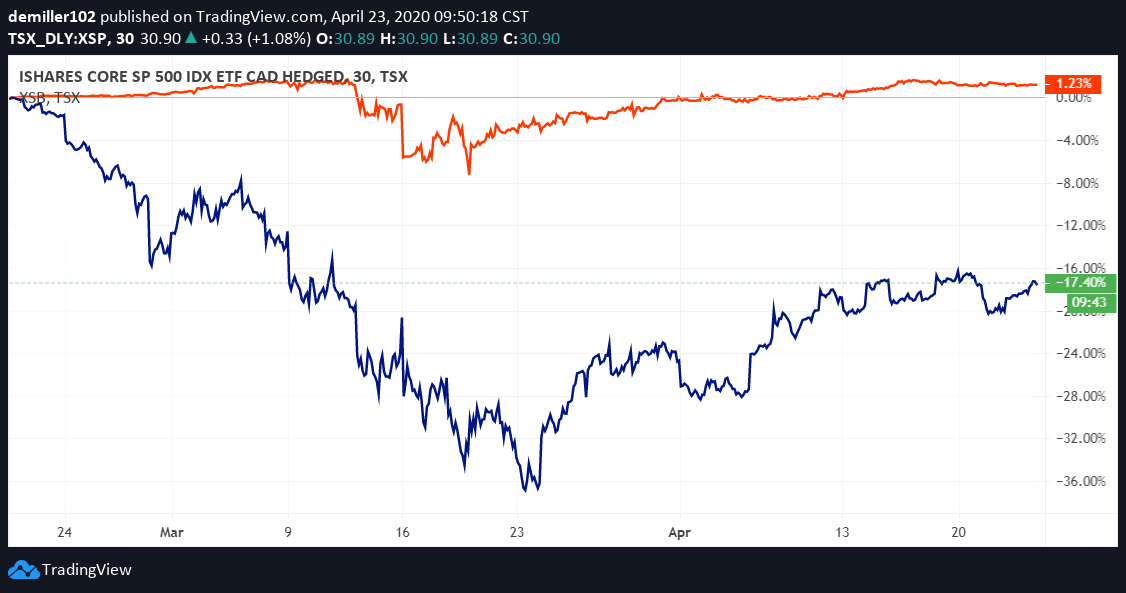
If you have an investment plan that looks to take advantage of the low prices during a downturn and if you have stuck with it during this unprecedented time, kudos to you! The panic selling during March 2020 dropped the S&P 500 (the ‘top’ 500 listed companies in the US) by 36%! Scary stuff that made a lot of people feel stressed out, and it feels like it could get worse. But let us check that feeling with historical facts.

March 3rd, 2009 was the technical bottom of the 2008/09 Financial Crisis, but no one recognized it until much, much later. Here is a quote from CNNMoney.com from that day 11 years ago; note the language:

“I think people are at a loss for answers right now,” said Larry Glazer, managing director at Mayflower Advisors. “Investors are mentally exhausted, and the market at multiyear lows has a psychological impact.”

He said it’s possible that the declines are part of a cycle the market needs to go through to get to healthier footing, but that, regardless of that, it’s very painful for investors in the near term.

“This is a risky market and investors need to ask themselves if the stocks they own are ones they want to own through an extended downturn,” said Robert Loest, portfolio manager at Integrity Funds. “If not, they should be raising cash.”*1

This language seems similar to the sentiment around today’s markets. Today is a much different situation but much of the same fear-based feelings are predicated in the media every day. I’m not saying that we’ve already seen the market bottom of this unprecedented event, but if you had followed the advice of the Portfolio Manager above and picked March 3rd, 2009 to sell your investments and raise cash, you just lost out on the best possible day to invest for the next 11 years. Just as no one could have predicted March 23rd, 2020 would be the day the markets would rebound for 20+ days after, even amid worsening Pandemic numbers and an evolving oil crisis.

Table 1: S&P 500 (CAD Hedged) vs. Canadian Short-Term Bonds

The point is, no one knows where the market will go in the short-term. A lot of the market movement is based on fear and greed, not grounded economic reality and fundamentals. Holding a long-term view and a strategy to buy into these short-term panics is vital to investment success.

As an investment firm, we took a cautious approach that last week of March, dipping our toes into the water, selling only some of the short-term bonds that we hold and buying into the down markets. We did not buy exactly at the bottom, but we were close, buying near a 30% discount from February’s highs. If the equity markets drop down again, we will sell more of the safe assets and buy equity again.

What allows us to buy near the bottom during a panic? For each of our clients, we build a holistic strategy that includes a written commitment in the form of an Investment Policy Statement.

“Writing down your goals means that you can visually see them. This is an important point because when we see something, it affects how we act.”*2

  • The Investment Policy Statement

Simply defined, an Investment Policy Statement (IPS) is our guide to how we invest your money. It lays out, in writing, your long-term goals, risk tolerance, methods to invest, expected long-term rates of return, downside risks, and corresponding asset allocation targets. Continue Reading…

7 timeless strategies investors need to remember in this time of market turmoil

The world as we knew it suddenly changed. What a surprise beyond belief for all of us.

There was no announcement six months ago. There was no new or updated playbook for any of this upheaval.

A harsh pandemic is a sure way of turning lives upside down. Treacherous times are firmly entrenched as the new roadway.

Stock and bond markets march at will in both directions. Investors wonder whether they are closer to a market bottom or to a top. All sorts of fears and worries are sprouting everywhere.

This is a reminder for all to go slow: younger and older, novices and seasoned. Try your utmost to use all the investing common sense you can muster. Sitting on your hands is often a worthy move.

My strategies:

Accordingly, I have selected seven timeless strategies that every investor ought to be familiar with in detail. They form a solid foundation for guiding the family nest egg.

I’ve kept them brief and to the point for the sake of simplicity. Here is my summary of critical strategies:

1). Short term trading is best suited for your “speculative” money. Conversely, long term investing is the best fit for your “serious” money, such as funding retirement. These two portfolios are constructed differently, so don’t mix them.

2). Chasing returns has been far from a consistent winner. Instead, pay attention to acquiring broadly diversified “quality” investments. These portfolios typically fare better during bouts of market turmoil.

3). Set aside the could’ve, should’ve and would’ve schools of hindsight. Make your decisions based on available information and move forward. Looking back in your rear view only creates distractions you can’t do anything about.

4). Becoming attached to your stocks is akin to making emotional decisions. Instead, I recommend pursuing logical moves designed to embrace your best interests. Your investing success should improve.

5). Don’t make investment decision out of fears. Rather, wait until the coast begins to clear. You have absolutely no control over what happens to market fears.

6). Decide whether you seek the return “of” your money, or the return “on” your money. That strategy sheds light on the fit of your desired portfolio. It also keeps you better invested within a more comfortable asset mix.

7). Investing your money all at once is usually not a preferred strategy. Studies show that asset mix delivers the biggest impact on portfolio outcomes. Neither superior stock selection, nor timing of purchases are close seconds.

My premise:

My premise is that investing strategy need not be complicated. I recommend that the main ingredient is always plenty of patience combined with common sense. Focus on logical and sensible approaches that contribute to your discipline. Continue Reading…

Aman Raina’s 5-year Robo advisor review — and how Robos are holding up in the bear market

By Aman Raina, SageInvestors.ca

Special to the Financial Independence Hub

NOTE: This review was initially undertaken using data compiled as of January 30, 2020, which marked the 5-year anniversary during which the portfolio was active but prior to the severe market turbulence that occurred in February and March 2020.  As it became apparent that the market pullback was becoming an epic meltdown, additional data was compiled and included into the review.

Five years ago I embarked on a personal experiment. I was having a hard time getting any insights on the effectiveness of a new investment services that was shaking the ground at the time in 2015.

Known or labeled as Robo Advisors, these new wealth management companies offered services to invest on behalf of others using an online platform and a combination of algorithms and computer coding to buy and sell specific investments and manage portfolios. Five years ago these firms were just stepping into the investing consciousness, but since then they have mushroomed and even traditional investment companies are now offering some flavor of online investment management services.

It all seemed quite appealing; however, there was one thing that many marketing materials, blogs, and mainstream media were avoiding … do these types of services make money for investors? Is this the type of service that would successfully bring more people, who naturally feel intimidated and frustrated by the whole investing concept into the investing domain?

Since no robo advisor company back then was interested in disclosing their performance (they still avoid it) other than citing research that their low cost/passive oriented strategy is superior, I decided five years ago to try an experiment to get some more insights that did not involve boilerplate marketing speak. I set up an account with one of the “large” Robo Adviser firms and invested $5000 of my own money into it.

My goal was to go through the process and blog about my experience using the service, how the ROBO went about making decisions and how it managed my portfolio, and more importantly, the results. I’ve always said that we need a good five years to really get a handle on how effective these services are compared to traditional wealth management services. Well, I just crossed the five-year mark of my ROBO journey, so let’s check back in and take a look at how it’s been doing. I’ve also said that I would reserve my opinions about this service until we reached that five-year threshold. Well here we are and I’m ready to unload my takes.


2019 was an epic year for stocks. US major stock indexes were up just over 30 per cent on the year. Fantastic returns. Hopefully my ROBO got a good piece of that action.

Performance

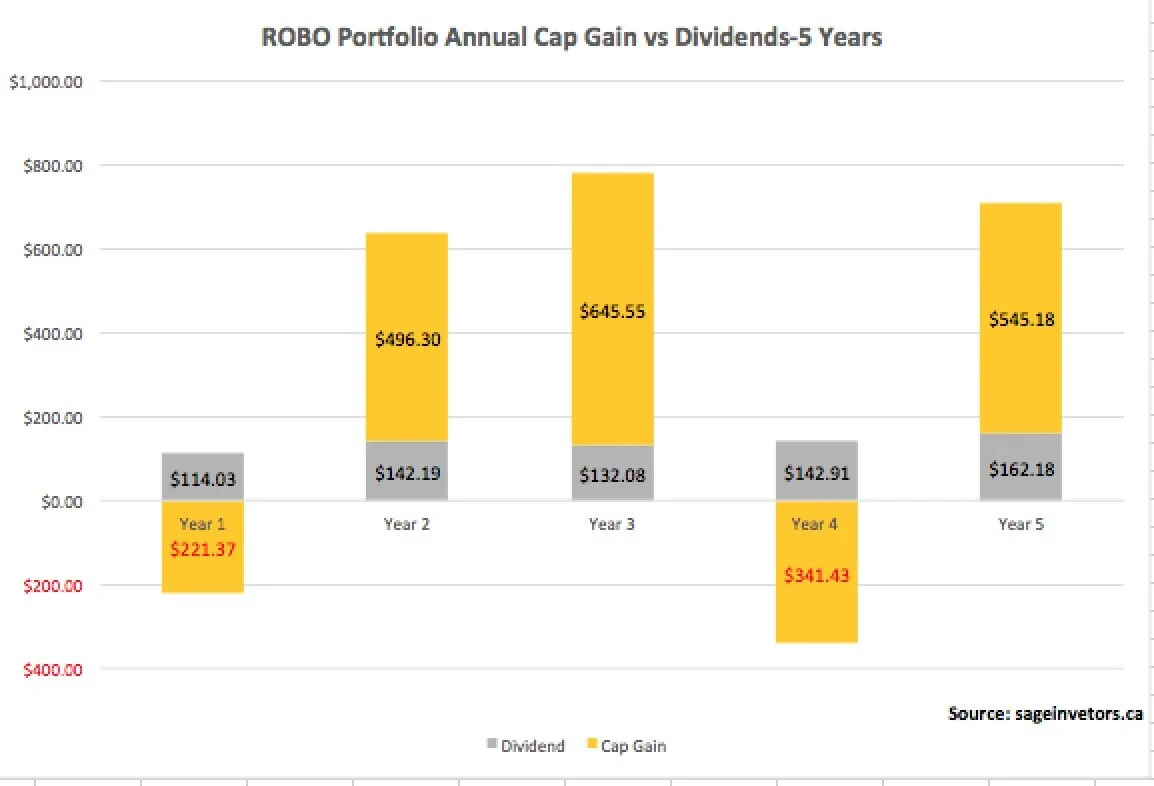
Overall, my ROBO portfolio posted a solid year. The portfolio was up 11.6 per cent year over year, a nice rebound from the previous year where it lost 2.1 per cent. Over the 5 years, the portfolio generated positive returns in three of the 5 years, and posted double-digit returns in those three years. The portfolio increased by $707, of which $162 came from dividend income while the remaining $545 came from capital gains. Over the year period, the ROBO portfolio increased from my initial $5000 to $6817, a cumulative return of 36 per cent. Of the $1817 increase, 1/3 was from dividends while the remainders was from capital gains. The portfolio continued to benefit from higher concentration of US and Canadian equities, which again hit it out of the park the past year.

ROBO Annual Return Chart.jpg
ROBO Cap Gain vs Dividend Chart.jpg

Below is the breakdown of the portfolio. Five years ago when I set up the account I answered a series of questions about my financial literacy and risk tolerance. ROBO took my responses and crafted a portfolio that it felt was compatible with my profile. Continue Reading…

Americans extremely worried about job security, finances and Retirement due to Coronavirus

By Mike Brown

Special to the Financial Independence Hub

Due to COVID-19, 57% of adult Americans are worried about their job security, while 63% are concerned about both their retirement savings and ability to make monthly student loan payments. Plus, many other insights from LendEDU’s newest survey.

At the time of this writing, Johns Hopkins’ Coronavirus Resource Center has reported 353,692 cases of Coronavirus around the world and 15,430 deaths. In the United States, there have been 35,345, while the total number of deaths is 473 by most estimates.

Then there’s the economic fallout in the U.S. as the stock market has gone into a tailspin, and a recession, or worse, seems likely. With the nation necessarily self-quarantining itself, countless small businesses are shuddering their doors and laying people off.

In the wake of this global pandemic, LendEDU has surveyed 1,000 adult Americans to better gauge the micro-level economic impact that COVID-19 will have on our country.

We found that a substantial proportion of people are worried about their job security, retirement savings, mortgage or student loan payments, and taking on too much credit card debt.

Click here to jump to the full survey results

If you would like to see a specific breakdown of the data other than those provided (ex. state-by-state, gender, age), please email me at brown@lendedu.com.

Observations & Analysis: How is Coronavirus Impacting the Finances & Employment of Americans?

All data is based on a survey of 1,000 adult Americans commissioned by LendEDU and conducted by research firm Pollfish. The survey was conducted on March 18, 2020. For some questions, the answer percentages may not add up to 100% exactly due to rounding.

Job Security

We first asked respondents how Coronavirus has already impacted their job since the virus’ impacts started being felt by the U.S.

35% of adult Americans have been fortunate enough to see no changes to their job due to COVID-19, while a combined 24% have not lost their job, but have seen their hours either reduced or eliminated. Unfortunately, 6% of respondents have lost their job in the Coronavirus fallout.

But, just because the majority of respondents have kept their job in some manner does not mean they aren’t still concerned about losing it. This rings especially true amongst those who have seen hour reductions.

Amongst those that maintained their job in some manner, the majority, 57%, were still concerned about job security moving forward as the impact of Coronavirus widens.

67% of those who have seen reduced hours are worried about keeping their job, while 73% of respondents who had their hours completely cut but kept their job are concerned over job security.

Compare these numbers to the 48% of those who have seen no change in their job, but are still worried about their losing it.

No matter the position employees find themselves in as COVID-19 takes hold, it is clear that stressing over job security will almost be impossible to avoid during this time. Maintaining morale will be a challenge for employees, employers, and the economy as a whole.

General Finances

Before Coronavirus and its impacts hit home here in the U.S., how many Americans were living paycheck to paycheck?

No matter how the data is broken down, the majority of respondents were living paycheck to paycheck before COVID-19 became a large-scale issue in the U.S. This has been reported in other studies as well.

So, while the Coronavirus outbreak in the U.S. may not drastically change the financial lives of those who have seen no changes to their jobs, it could cause severe trouble for those who have seen reduced hours or lost their jobs completely.

For example, 70% of those who have seen their hours partially cut due to COVID-19 were already living paycheck to paycheck, while 82% who have lost their jobs because of the pandemic were doing the same.

Over the next few weeks or even months, these folks will be stretched thin like never before when it comes to their finances. This is why a plan to send Americans checks due to COVID-19 is being discussed in Washington D.C.

With financial woes forthcoming or already here for many Americans, some will be drawing from an emergency fund or savings account to cover expenses.

And when it came to the expenses that Coronavirus has brought on, whether it be toilet paper or T-bone steaks, we found that our respondents have spent an average of $335.65 on COVID-19-related expenses since the pandemic began to seriously impact the U.S.

When expenses run high, many consumers need to access debt, typically via credit card, to finance their purchases. We asked poll participants with at least one credit card if they will be taking on more credit card debt than they would like due to Coronavirus.

Retirement Savings

Coronavirus has already had a crippling impact on the stock market, and it’s likely to get worse. For older Americans especially, there’s a pervasive fear that retirement nest eggs might get completely decimated as a result.

38% of our respondents indicated they are currently saving for retirement through something like a 401(k), Roth IRA, or high-yield savings account. We asked these folks about their concerns over their retirement savings due to COVID-19.

Within each age breakdown, the majority of Americans indicated that they are worried about their retirement savings due to COVID-19 and the ramifications it will have on the market.

Not surprisingly, this is especially true for older Americans ages 55 and up who are in the retirement red zone. 67% of this cohort are concerned about their retirement nest eggs.

Monthly Finance Payments (Mortgages, Student Loans, & Credit Cards)

With financial worries widespread and budgets tightening, we wanted to ask a few questions related to common financial obligations that Americans have, like payments for student loans, credit cards, or a mortgage.

The following graphics are based on questions only asked to those respondents that stated they had a mortgage (35%), outstanding student loan debt (23%), and/or at least one open credit card account (63%).

Many respondents are quite concerned about meeting their monthly financial obligations, whether they be related to a mortgage, student loans, credit cards, or all three.

Most alarming was how those adult Americans that lost their jobs due to Coronavirus answered these few questions. 96% of this group was worried about meeting mortgage payments, 88% about student loan payments, and 93% about credit card payments.

Widespread delinquency or default would have severe implications on the economy at large. In an attempt to combat this, we have seen the Trump Administration waive further accruing interest on student loans and suspend all evictions and foreclosures until April for FHA-insured mortgages.

Investments

While we did touch on investments as they pertained to retirement savings earlier, we wanted to dedicate a section to more active, personal investments that consumers make through personal brokerage accounts.

To describe the stock market in the last couple of weeks as turbulent would be an understatement. There have been sharp rises and drops (mostly the latter), and trading has actually been halted a few times in recent weeks on both the New York Stock Exchange and Nasdaq. The 15-minute halts happen when an initial steep drop in the market triggers “circuit breakers” that shut down trading.

27% of our poll participants indicated that they were actively invested in the market through a personal brokerage account when COVID-19 started impacting the U.S.

We asked this group a couple of questions in regards to playing the market.

As expected, the vast majority of Americans who were making personal investments in the market when Coronavirus escalated got clobbered. 79% of respondents indicated they lost money, while just 8% made a profit.

And, how will these respondents invest moving forward as the pandemic continues to disrupt daily life?

As it turns out, the majority of investors plan on riding out the storm and holding steady on their stock plays. Meanwhile, 21% plan on buying more during this crisis, while 13% will be looking to dump shares.

Full Survey Results

Continue Reading…

It’s too late to ‘re-evaluate’ your Risk Tolerance

By Michael J. Wiener

Special to the Financial Independence Hub

It’s not easy to know your true investment risk tolerance. Fred Schwed explained this problem wonderfully in his book Where are the Customers’ Yachts?:

“There are certain things that cannot be adequately explained to a virgin either by words or pictures. Nor can any description that I might offer here even approximate what it feels like to lose a real chunk of money that you used to own.”

Now that the stock market has tanked and investors are learning what it feels like to lose money, experts like financial planner Jonathan Bednar are saying “This is a great time to re-evaluate your true risk tolerance,” and “If you are nervous then you may be taking on more risk than you are really comfortable with and should rebalance into a more conservative portfolio.”

This advice amounts to “sell stocks while they are low.” The best time to figure out that you don’t have the stomach for a stock market crash is while prices are still high. It’s now too late to reduce your stock allocation without permanently locking in losses.

Easy to think you have high risk tolerance in a bull market

Unfortunately, when stocks are soaring it’s far too easy to convince yourself that your risk tolerance is high. So maybe we need a different strategy. Perhaps we should record videos of ourselves saying how we feel after stocks crashed, and set a calendar reminder to watch this video annually. The next time stocks are soaring again, maybe the video will help us lighten up on stocks while prices are still high. Continue Reading…