Tag Archives: investing

9 top Personal Tips for Long-Term Index Fund Investments

Photo by Yan Krukau on Pexels

Long-term investments in index funds can secure your financial future, but what strategies do the experts use? In this article, insights from business leaders and Financial Officers shed light on successful investment tactics.

Learn why diversifying across sectors and regions is crucial, and discover the benefits of adopting a set-it-and-forget-it approach.

This post compiles nine valuable tips to help you navigate your investment journey.


  • Diversify Across Sectors and Regions
  • Start Early and Invest Consistently
  • Maintain Consistency Through Market Fluctuations
  • Stay the Course During Market Downturns
  • Diversify Across Global Markets
  • Avoid Over-Diversifying with Index Funds
  • Automate and Regularly Invest
  • Stick with a Single Index Fund
  • Adopt a Set-It-and-Forget-It Approach

Diversify across Sectors and Regions

When I invest in index funds for the long-run, I like to spread my money across different sectors and regions. This way, I’m not putting all my eggs in one basket, and can buffer against any market downturn. I also regularly rebalance my portfolio to keep everything in the right proportions as the markets move. By consistently adding to my investments, and avoiding the urge to time the market, I’ve found a reliable way to achieve steady growth over time. — Shane McEvoy, MD, Flycast Media

Start Early and Invest Consistently

The approach is simple: Start early and invest consistently, regardless of market conditions. This method, known as dollar-cost averaging, has proven effective based on my analysis of market trends and investment patterns.

Here’s the gist: Choose a broad, low-cost index fund (like one tracking the S&P 500) and invest in it regularly: monthly or quarterly. The key is maintaining this routine even during market turbulence.

This strategy works by removing the stress of timing the market and allowing you to buy more shares when prices dip. Over time, this can lead to significant returns. — Markus Kraus, Founder, Trading Verstehen

Maintain Consistency through Market Fluctuations

One key tip for long-term investments in index funds is consistency. Regularly invest through dollar-cost averaging, regardless of market fluctuations. This strategy reduces the impact of market volatility and allows you to benefit from compounding returns over time. Additionally, stay focused on your long-term goals and avoid reacting to short-term market noise. Patience and discipline are essential when investing in index funds, as they provide steady growth over extended periods. — Jocarl Zaide, Chief Financial Officer, SAFC

Stay the Course during Market Downturns

One personal tip for making long-term investments in index funds is to stay the course and avoid timing the market. Index funds are designed to mirror the performance of entire markets, and over the long term, markets tend to grow despite short-term volatility. Based on my experience, consistently investing — even during market downturns — through a strategy like dollar-cost averaging can help smooth out the effects of market fluctuations and take advantage of buying opportunities when prices are lower.

Patience is key. By keeping a long-term perspective and regularly contributing to your index fund, you allow compound growth to work in your favor. Resist the urge to react to market drops by selling or trying to predict market highs, as this often results in missed gains. The power of index funds lies in their diversification and ability to grow with the broader market over time, making them a reliable choice for long-term wealth-building. — Rose Jimenez, Chief Finance Officer, Culture.org

Diversify across Global Markets

My top recommendation for long-term index-fund investing is to diversify across global markets. While many investors focus solely on domestic indices, incorporating international exposure can significantly enhance your portfolio’s resilience and growth potential. Consider allocating a portion of your investments to index funds tracking developed and emerging markets worldwide. This approach helps spread risk across different economic cycles and currencies, potentially smoothing out returns over time.

On top of that, as the global economy becomes increasingly interconnected, you’ll be better positioned to capture growth opportunities wherever they arise. Remember, diversification doesn’t guarantee profits or protect against losses, but it’s a powerful tool for managing risk. Regularly review and adjust your global allocation based on changing market conditions and your risk tolerance, always keeping your long-term objectives in sight. — Brandon Aversano, CEO, The Alloy Market Continue Reading…

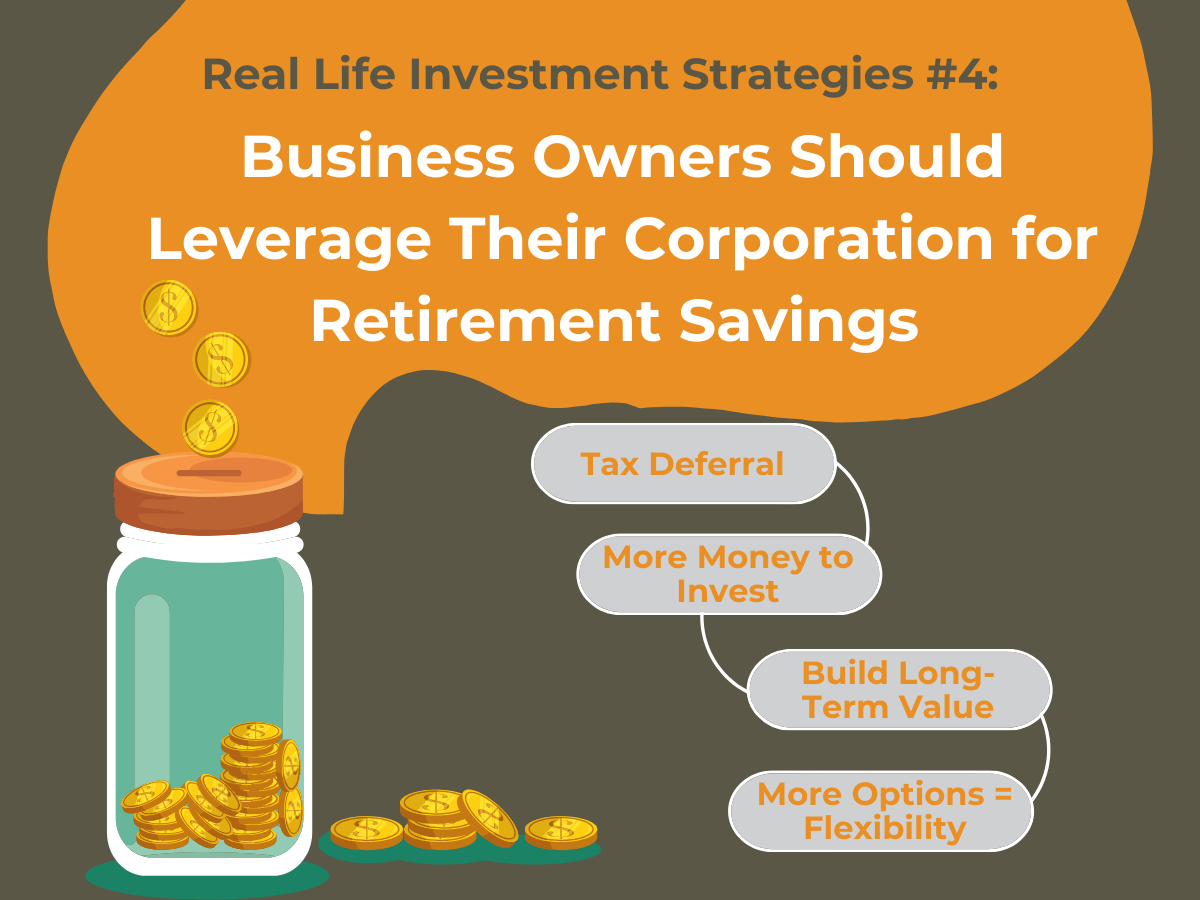
Real Life Investment Strategies #4: Business Owners should Leverage their Corporation for Retirement Savings

Lowrie Financial/Canva Custom Creation

By Steve Lowrie, CFA

Special to Financial Independence Hub

When you’re immersed in running a business, thoughts of saving for retirement often take a back seat; Employees in the corporate world may rely on employer pensions, but as a business owner, the responsibility for your retirement falls squarely on your shoulders.

Starting your retirement planning early and consistently contributing allows you to benefit from compounding returns to steadily build your nest egg over time. Investing in your retirement can ensure you have the financial means to enjoy life post-retirement, whether it’s traveling, pursuing new passions, passing along a little financial freedom to family members, and more.

This blog explores how business owners can utilize their corporation (Canadian-controlled private corporations or CCPCs) to retain business income that exceeds operational and personal lifestyle needs.

Changes to Income Tax Rules (Capital Gains Inclusion Rate) can throw Business Owners’ Retirement Savings Plans into Chaos

The 2024 Federal Budget is a perfect example of how income tax rules can change, sometimes less smoothly and with less notice than what is reasonable.

Specifically, the 2024 budget included an increase in capital gains inclusion rate that affects:

  • Individuals with over $250,000 of capital gains in a tax year (only on the amount in excess of $250,000)
  • Corporations
  • Trusts

To make matters worse, the timeframe for any pro-active tax planning was very short and with few specific details before the tax changes became effective on June 25, 2024.

Many have also speculated that capital gain tax increase was a last-minute addition to a budget that was politically motivated and not based on sound economic policy.  Among the critics was none other than, Bill Morneau, the former Trudeau-Liberal finance minister.

There is also a high probability that there will be a change in Federal Government in 2025, which may bring a complete taxation review and reform.  Among the taxation reforms might be to roll back this tax increase.

Given this context and uncertainty, what should an individual with corporate investment assets do?

The best advice I can give you is to step back and view these tax changes versus your long-term financial goals, and to avoid making hasty decisions.  If there is major tax reform in the next few years, many individuals might find their hasty planning decisions to be very costly.

Even with higher capital gains inclusion rates, investing in your corporation still has many advantages.

Using Your Corporation for Retirement Savings still Provides you with Numerous Advantages

Retirees increasingly rely on their savings to sustain their lifestyle after leaving the workforce, presenting unique challenges (and opportunities) for business owners pre- and post-retirement. Over time, these corporations can accumulate investment assets and simply selling the business for retirement funds isn’t always the best option. The corporation can reliably serve as a source of dividends for the owner-manager in retirement. When a corporation is involved, it opens up another retirement savings and withdrawal option which, although advantageous, can be complex. We’ll walk though how saving within your corporation can be a great choice for business owners, but it is quite important to work with a competent independent financial advisor, accountant, and other professionals to determine the best retirement saving planning for each specific situation.

4 Reasons you should be Using your Corporation to Save for Retirement

  1. Tax Deferral

By retaining excess funds within the company, the initial tax benefit is that the income is taxed at a lower corporate rate vs. your personal tax rate – the extent of the advantage can vary depending on whether your corporation qualifies for the small business tax rate, which would be even more advantageous. Hand-in-hand, the tax benefit is also gained by the postponement of personal taxation. When funds are distributed to the business owner later as dividends, even with consideration of tax integration, the investment returns of the funds held within the company can generally more than compensate.

  1. Tax Deferral means more Money to Invest Today

By taking advantage of the tax deferral due to the reduced corporate tax rate, you have access to more investable capital today. This increased liquidity opens up the possibility of generating higher returns on your investments within the corporation, amplifying the potential growth of your wealth over time.

  1. Build Up Long-Term Value of the Corporation

If you plan to sell your corporation down the road, you can also take advantage of the Lifetime Capital Gains Exemption (LCGE), which Budget 2024 is proposing to increase to $1,250,000 (for dispositions after June 25, 2024) when you sell shares in the business.  Let’s say you sell a business for $2 million; the exemption amount means you wouldn’t pay tax on 62.5% of that profit. This translates to hundreds of thousands of dollars in tax savings.

In addition, the LCGE is a lifetime limit – so you can also choose to apply the exemption multiple times until you reach the limit. So, you have the option to sell shares over time and use the LCGE for multiple years until you’ve capped out. Figuring out how best to apply the LCGE can be challenging but worth the effort.

Lastly, with proactive planning, leveraging the lifetime exemptions of multiple family members can potentially mitigate or even eliminate the capital gains tax liability on higher-value businesses. A reliable professional financial planner and accountant can help you determine the best way to allocate and dispose of corporation shares to realize the optimal financial result.

  1. More Options for Savings & Withdrawal Streams = Flexibility

The most important advantage of saving for retirement within your corporation is that it gives you more options for both your retirement savings and investment options and your retirement withdrawal pools. Essentially, it gives you another tool in your toolbox. Most people are limited to three investment streams: RRSP, Tax-Free Savings Account, and Non-Registered Investments.

The corporation gives you a 4th pool of funds to work with – for both saving and withdrawal.  This allows for the flexibility to optimally select the best pool of funds for savings and withdrawal over time. For example, in any given year, your lifestyle needs may drastically change, so saving within the corporation gives you one more place to pull money in a way that best works for you. The following year, you have the flexibility to change it up in a way that works better. You don’t need to be limited to only 3 pools of your savings.

Another option that saving within your corporation opens up is the way you withdraw your money – during your prime working years, as you ramp down, and into retirement. Business owners can take money out of the corporation via dividends or salary.

Dividends are not tax deductible for the corporation. But with dividends, there are also no payroll taxes. Dividends also allow for more flexibility around how much you withdraw from the corporation and when. This is a great advantage for changing needs dictated by your personal lifestyle needs.

Withdrawing from your corporation via salary is advantageous due to the tax deduction for the corporation. In addition, salary withdrawal creates personal RRSP investment room. However, you would need to pay CPP at both the personal and corporate level. In addition, other payroll taxes would be required to be paid by the corporation.

Considerations when Saving for Retirement in your Corporation

With so many advantages to saving within a corporation, it may seem like a no-brainer. However, I need to point out some things you should consider as you use your corporation as a retirement savings pool.

Firstly, there is some extra complexity that comes with managing that extra stream of savings, which makes your reliance on a trusted accountant and financial advisor even more important.

Obviously, there are extra costs that come with owning an incorporated business, but if you are reading this blog, you are already paying these expenses. But, due to the extra complexity of managing more, there might be slightly more costs associated for your accountant. Although more cost, it is likely minimal and wouldn’t offset the advantages.

Another consideration about saving in your corporation is how you plan to retire: selling your business, winding down, succession, downsize, family takeover, etc. Thinking about the right path for the specific situation results in questions (and answers) about the best way to proceed. Continue Reading…


Investing in AI: what stocks will it pay off for?

Investing in Artificial Intelligence: We feel it could have a huge positive potential, but watch for these risks and rewards

Deposit Photos

Artificial Intelligence (AI) only crossed the fiction-to-news barrier in recent years, after decades as a staple of Arnold Schwarzenegger films, but it’s already influencing the economy and is likely to increase its impact. We feel it could have a huge positive potential. This development has also caught the attention of many investors who are contemplating the prospects of investing in AI.

Media comments on this subject abound, as do surveys.  The average person seems fascinated with AI’s potential for good, but wary of its potential for harm. You might say this resembles the atmosphere a decade or so ago when self-driving cars started appearing in the news.

In both cases, middle-of-the-roaders were in the majority. Extreme types came up with much different outlooks.

Negative observers said self-driving vehicles would lead to an economic collapse because multitudes of drivers of trucks, taxis, buses and so on would lose their jobs.

At the other end of the spectrum, a smaller extreme felt driver-less vehicles would balloon human productivity and expand wealth around the world. After all, people could do valuable work in traffic, just as well as in an office, or use the time for a nap. They looked forward to a day when owning your own car would be a needless extravagance. When you needed a lift, you’d just summon a driver-less limo on your cellphone. A little further along, new homes will be available with or without garages or parking spots. Your self-driver will be able to valet itself to a community parking lot.

Looking a little further still, your car might be able to take itself out for maintenance, service, fuel, or any number of errands. Artificial Intelligence just might speed the arrival of these advances.

However, there’s an even wider opinion spectrum on Artificial Intelligence. Rather than a booming jobless rate, the negative side foresees Armageddon: humans versus machines.

It seems conflicts of interest are playing a role, along with honest differences of opinion, in disputes over Artificial Intelligence. This reminds me of the debate over Y2K.

The Y2K debate showed there is big money in alarmism. Some of the top Y2K promoters used Y2K fears to build a following and boost their incomes from writing, consulting or public speaking. Pessimists worried needlessly about Y2K and made a lot of money. I expect the same reaction to AI.

Mainstream opinion or Al Gore on steroids?

Ratings for cable news pioneer CNN have been slumping for a decade. Coincidentally, CNN.com recently published an essay entitled: “Experts are warning AI could lead to human extinction. Are we taking it seriously enough?”

The essay begins: “Think about it for a second … The erasure of the human race from planet Earth. That is what top industry leaders are frantically sounding the alarm about … potential dangers artificial intelligence poses to the very existence of civilization.”

It passes along a warning: “… hundreds of top AI scientists, researchers, and others … voiced deep concern for the future of humanity, signing a one-sentence (italics added) open letter to the public … mitigating the risk of extinction from AI should be a global priority alongside other societal-scale risks such as pandemics and nuclear war …”

You have to give them credit for leaving climate change off the list.

Read Marc Andreessen’s essay on AI

If you’re investing in AI and Artificial Intelligence fears keep you awake at night, I’d suggest a 7,000-word remedy by Marc Andreessen, entitled, “Why AI will save the world.”

In all I’ve read about AI, this is the best comment I’ve seen. It describes AI in plain English; explains how AI can expand human intelligence; how we have used human intelligence over millennia to create today’s world. It also speculates about the gains we may see in the new era of AI. Continue Reading…

Lessons we Learned in 2024

Billy and Akaisha in Sorrento, Southern Italy; Photo courtesy of RetireEarlyLifestyle.com

By Akaisha Kaderli, RetireEarlyLifestyle.com

Special to Financial Independence Hub

 “Improvise, Adapt, and Overcome” – Marine slogan

What a year!

Every year brings new challenges that we must face. Life doesn’t stop and the best way to meet the “new” is with an open attitude and a sense of confidence. Fear doesn’t help anyone or anything.

Solid plans often break

Our Readers will sometimes say they have just a few more things to settle, a few more “I’s” to dot and “T’s” to cross before retiring. They’re waiting for the health care issue to be settled, waiting for the bonus check next year, waiting to hit “this” particular financial number, waiting for next year to sell their properties, waiting for things to mellow out in the country, waiting for inflation to go down, waiting for the market to go back up,… they’re waiting…

Personal Financial Independence was put off until this imaginary perfect time, and then finally they planned a year of travel. But BAM! One of the spouses became gravely ill with a disease that not only shook them up, but forced them to shelve all excursion plans. Or the market started pulling back giving them the willies and they lost confidence in their future plans of early retirement.

Ask yourself, “What are you waiting for and why?” Then ask yourself if you have a Plan B for these unexpected situations.

Lots of people wait until they graduate from law school, or get the degree or wait until they get married, or until they buy that perfect house, or until the kids get out of school, or they hit that magic number to retire – in order to be happy.

They live for tomorrow and forget all about the pleasures and happiness of today.

Stop settling, start living. NOW.

You’re not going to get anything in Life by playing it safe. There are no guarantees.

Lesson learned; Faith over Fear, Don’t Worry be Happy

Image courtesy RetireEarlyLifestyle.com

We only have control of ourselves.

I get push back on this one, sometimes. Usually it falls under the “You don’t understand what I’m going through” category.

But if you think about it, stuff happens.

We can’t control a loved one getting ill, can’t control that our children or spouse do what we prefer. We don’t have a lot of say in international peace relations. Whether our children get divorced, illness knocks you or a loved one for a loop, there’s a huge business loss or politics don’t go our way – all we have control overis our response to the situation.

If you are feeling out of control on your moods, there are lots of tools to clarify your mind and calm yourself down and lots of services available to you. Don’t let the stress build up until you have an even worse situation happen.

Lesson Learned; Life is not in our total control – only our response to it is.

Relationships change

Relationships are cemented or lost every year. Change is part of life, and some relationships don’t move forward with us.

Once again if you think about it, when you got married, had a child, moved cross-country, got that promotion, contracted a serious illness, got divorced, retired early or hit any other life milestone, did some friendships recede?

Most likely.

Life is change and sometimes your better future lies ahead of you, without those loved people in them.

Yes, it IS difficult to let go of habits and people. We’ve all been there at different points in our lives. It’s better to process the loss and continue to move forward, creating the life of our dreams, than to become bitter and angry over the loss.

In my opinion, 2024 was a year of clarification.

What I mean is, yup. Things fall away. Sometimes it’s beloved things and people. I think this helps us to focus on what really matters to us. This is a blessing in disguise and you will be stronger for it.

Lesson Learned; As you grow, some relationships won’t make it into your future.

Fear seems ever-present

When we are afraid of something, chances are, we don’t know much about it. Our perceptions are skewed because of this.

Remember the old saying – FEAR is False Evidence Appearing Real?

Take control and choose to find out more. The knowledge you discover will give you options and open up doors for you. Question the thoughts you are thinking and the beliefs you are holding. Question the definitions you have set for yourself. Fear does not serve you in any way and will only force you to contract, limiting your options even further.

This is a choice.

You can either learn and grow or contract and suffer because of it.

Lesson Learned; Fear is related to ignorance. Choose to learn more

People retreated into perceived safety

There is no safety, there are no guarantees. And sometimes as we age, we think we’ll feel better if we just “don’t take any chances.”

Remember Helen Keller’s quote:

Security is mostly a superstition. It does not exist in nature, nor do the children of men as a whole experience it. Avoiding danger is no safer in the long run than outright exposure. Life is either a daring adventure, or nothing.

You can either live your life or live in FEAR.

Make the most of life every day. It’s later than you think!

Lesson Learned; Life is a risk every day. Manage it.

Anxiety seems to be everywhere

This is a good one, and it surprised me a bit.

Living the “life of my dreams” I hadn’t realized that I was still carrying friction and tension in assorted areas of my life. Billy and I started getting massages more often. I began going to a chiropractor, and my customary yoga became more important. We upped our exercise routine, I meditated more and I opened my mind to new information.

Anything that just didn’t “fall into place easily” or no longer worked … we dropped.

This made us feel freer and gave us more physical energy, clearing our minds.

Lesson Learned; Make things easier on yourself in any and all ways.

Don’t stop living your life

When things change beyond our control, we must find the advantages in the situation and make the most of where we are. Continue Reading…

Five ways that Financial Marketing can mislead investors

Public domain image provided by Justwealth

By Robin Powell, The Evidence-Based Investor*  

Special to Financial Independence Hub

* Republished from the Just Word Blog from Robin Powell, the U.K.-based editor of The Evidence-Based investor and consultant to investors, planners & advisors  

Much as we like to think of ourselves as savvy consumers, we are actually very susceptible to PR and advertising. This is particularly true when it comes to investing.

Big banks like TD, RBC and Scotiabank, asset managers like Sun Life and Manulife, and online trading and investing platforms like Questrade and Wealthsimple, spend vast sums promoting their products and services. The more they spend, the more customers they attract.

Why, then, are people so receptive to financial marketing and so easily persuaded by it? In most cases it’s a lack of understanding. The financial markets are complex, and we’re bombarded with suggestions as to how to invest our money. In a world saturated with information, consumers rely on simple marketing messages to help them make decisions. They also derive comfort and security from large financial brands they’re already familiar with.

Big does not mean Best

The problem for investors is that the firms whose products are most often featured in the media are usually not the best ones to buy. The brands you’re most likely to see sponsoring hockey teams or film festivals, for example, or plastered across billboards in airports or train stations, are often just the sorts of companies you should avoid giving your business to. Why? Because the interests of consumers and big financial brands are often misaligned.

Financial firms are very clever at making it look as though their primary motivation is to help the likes of you and me to achieve better outcomes. But the bottom line is that they’re businesses, and their number one priority is to generate profits. To put it bluntly, these companies want our money. The more money we invest with them, and the more trading we do, the bigger the profits they make.

Financial education is extremely valuable. Educated investors almost invariably enjoy better outcomes. The danger, though, is that, all too often, we think we’re being educated when in fact we’re being sold to.

How Big Brands mislead us

There are all sorts of ways in which big financial brands mislead us. Here are five main ones.

1.) Emotional Appeal

Ideally, investors would act at all times in a calm and rational manner. We would only make decisions after carefully considering the available information and weighing up the options. But human beings are emotional animals, and financial marketers understand this better than anyone. This is why they deliberately appeal to emotions like fear and greed, and the fear of missing out, or FOMO, which, in a sense, is a combination of the two.

2.) Cognitive Biases

As well as their emotions, investors have to contend with a range of cognitive, or behavioural, biases that all of us are prone to. These include confirmation bias (our tendency to seek out information that confirms our pre-existing beliefs), herd behaviour (our instinct to copy what those around us are doing) and recency bias (our tendency to attach more weight than we should to recent events). Financial marketers know just the right buttons to press to exploit these built-in biases.

3.) Expert Endorsements

In his book Influence: The Psychology of Persuasion, the American psychologist Robert Cialdini writes about the importance of what he calls social proof. When we feel uncertain, he explains, we tend to look to others for answers as to how we should think and act. Closely related to this is the principle of authority, or the idea that people follow the lead of credible experts. So, for example, if someone recommends a certain product or strategy in the media, we’re inclined to take notice, even though that person may be heavily biased or not an expert at all.

4.) Scarcity and Urgency

Another way in which financial marketing leads consumers astray is that it generates a false sense of urgency. So, for instance, we might read about a particular investment “opportunity” — perhaps a hot stock or fund — in the weekend newspapers and feel impelled to buy it first thing on Monday morning. This is a very foolish way to invest. Of course, that stock or fund may well rise in value, but its price could just as easily fall. Regardless, investors are much better off taking a long-term view. It is very rarely, if ever, the case that you need to make an investment decision straight away.

5.) Financial Jargon

The final reason why the industry spin machine causes more harm than good is that it often contains financial jargon. At best, jargon confuses investors and over-complicates the investment process; at worst, it can be used to cloud and deliberately mislead. It can exploit people’s lack of financial literacy and give a false impression of trustworthiness and expertise. But the principles underpinning sensible investing are really quite simple, and consumers should place their trust instead in firms that simplify investing and explain how it works in clear, concise language.

Who can be Trusted?

You may be wondering, “If I can’t trust financial companies to tell me what’s best for me as an investor, who can I trust?” Continue Reading…