

 Posted By
 By Noah Solomon
Special to Financial Independence Hub

Well, I won’t back down
No, I won’t back down
You could stand me up at the gates of Hell
But I won’t back down
No, I’ll stand my ground
Won’t be turned around
And I’ll keep this world from draggin’ me down
Gonna stand my ground
And I won’t back down
- I won’t Back Down, by Tom Petty
It is well understood that people with a lower tolerance for risk must accept lower returns than those who have a greater tolerance. By the same token, investors who are willing to bear more risk can expect to reap higher returns than their more conservative peers.
However, this does not change the fact that any rational person, regardless of their tolerance for risk, would prefer higher rather than lower returns given the amount of risk they are willing to take. Similarly, they would prefer to experience lower rather than higher volatility given their target rate of return.
These self-evident truths beg the following question: For any given level of risk tolerance, what is the optimal path to achieving higher returns? In this month’s missive, I will explore various paths to accomplishing this objective, including their respective strengths and weaknesses.
Live by the Sword, Die by the Sword
If managers try to outperform their benchmarks then by definition they must hold portfolios which are different than their benchmarks, either in terms of its individual assets, their respective weightings within the portfolio, or both.
However, holding a portfolio which differs from its benchmark constitutes the proverbial double-edged sword. The pursuit of great performance can just as easily be wrong or right. If you strive for performance which is far better than the norm, you must hold a portfolio that exposes you to the risk of being far worse. Moreover, over the long term, it is highly likely that you will assume both roles in equal proportion or worse.
The long-term effects of oscillating between strong outperformance and strong underperformance are illustrated in the table below, which incorporates the following data:
- Monthly returns for the TSX Dividend Aristocrats Index ETF (the benchmark that S&P Global uses to evaluate dividend-focused Canadian equity funds) going back to 2008, which is the first full calendar year of the fund’s existence.
- Monthly returns over the same period for an “Alternator Fund” which switches every twelve months between underperforming the index by 5% and outperforming it by 5%.
Benchmark Portfolio vs. Alternator Fund: 2008-2025
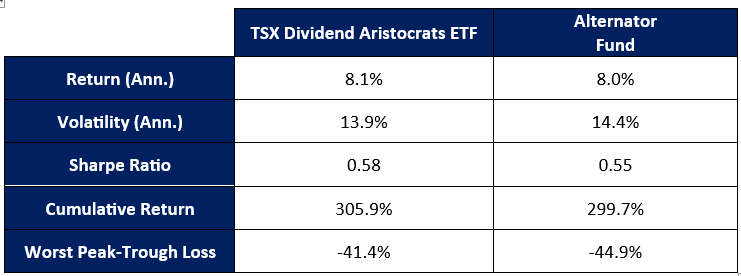
A symmetrical combination of well above and below average returns produces a long-term record that is characterized by slightly lower returns, higher volatility, and larger losses in challenging markets. The punchline is that managers who strive to consistently outperform by a substantial margin every year are highly likely to deliver subpar results over the long-term.
Slow and Steady Wins the Race
Legendary investor Howard Marks once recalled a discussion he had in 1990 with the director of a major mid-West pension plan. During the conversation, he learned that the plan’s stock portfolio had far outperformed the S&P 500 Index over the past 14 years. Even more striking than its headline performance was the path that it had followed to achieve it.
Notwithstanding that the plan’s returns in any given year had never placed below the 47th percentile or above the 27th percentile, its portfolio’s performance over the entire fourteen-year period placed it in the 4th percentile.
The proverbial moral of the story is that if you swing for the fences and attempt to be in the top 5% or 10% every year, you will fall victim to the double-edged sword, delivering long-term returns that are (at best) mediocre and that are accompanied by high volatility. By contrast, if you deliver performance that is slightly above average on a realistically consistent basis with particular emphasis on outperforming in bear markets, (1) your long-term outperformance will be substantially better than average, and (2) you will be subject to lower volatility and shallower losses in challenging markets.
Munger’s Inversion and the “When” of Outperformance
The late great Charlie Munger, investment guru and longtime Buffett partner, stated, “Invert, always invert.” This statement describes his inclination for taking a given scenario and reversing it to evaluate the ramifications of the opposite scenario. Munger used this approach, which spotlights what to avoid rather than what to seek, to solve complex problems.
Outperformance not only stems from how often and by how much you outperform or underperform, but when you do so. With respect to long-term compounding and wealth creation, it is far more important to outperform in bad times than in good times.
Since its inception in October 2018, the performance of the Outcome Canadian Equity Income fund has consistently adhered to this pattern. At times when the TSX Dividend Aristocrats Index has risen, the fund has on average participated in 85.3% of these gains. Conversely, whenever the benchmark has declined, the fund has on average suffered only 67.7% of these losses. In simple terms, our mandate has generally managed to capture most of the upside in the good times while avoiding a very sizeable portion of the downside in bad times.
The following table applies these attributes to historical data going back to 2008, which marks the first full calendar year of the Dividend Aristocrats ETF’s existence. In deference to Munger, the table also applies an “inverted” strategy that has symmetrically opposite attributes to those of the Outcome mandate. More precisely, the inverted portfolio captures slightly more than 100% of the upside in rising markets while suffering well over 100% of the downside in falling markets.
Benchmark, Outcome, & Outcome Inverted (2008 – 2025)
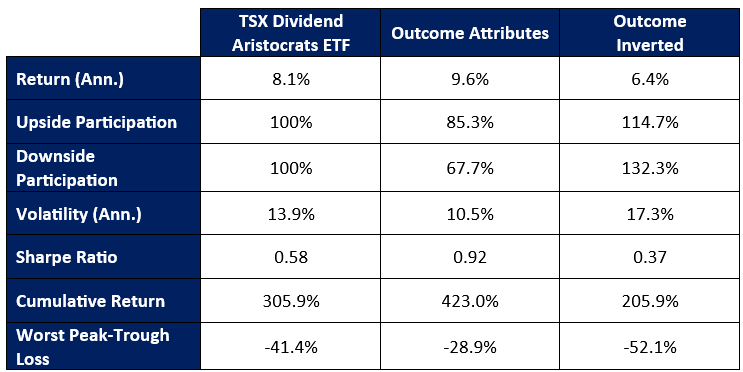
The long-term results of being “favourably lopsided” (i.e. participating in the vast majority of rising markets while participating in approximately two-thirds of falling markets) are clear. Specifically, these characteristics lead to vastly superior long-term returns and far shallower losses in challenging environments. By contrast, the inverse of these characteristics is nothing short of devastating, resulting in anemic returns over the long-term while exposing you to extreme volatility and devastating losses.
The “Machine” Figured it out: It’s about being Robust
At Outcome, we use machine-learning to develop and refine investment models. In doing so, we take great care to ensure that these models are robust. In layman’s terms, a robust model performs well in real-world scenarios and performs consistently in different scenarios and environments.
Prior to launching the Outcome Canadian Equity Income strategy in October 2018, our algorithms were “learning” the optimal path to achieving superior results over the long term. Interestingly, they concluded that there was no feasible way to consistently outperform year after year. Rather, they determined that the optimal path to delivering value over the long term necessitates (1) consistency, and (2) focusing outperformance on declining rather than rising markets. Accordingly, the fund has consistently exhibited these very characteristics over the span of its lifetime.
Several months ago, we began conducting research to apply these same principles to international equities and started incubating the resulting strategy at the beginning of this year. We will be launching the mandate in fund form in Q2, which we expect will follow in its Canadian counterpart’s footsteps in adding value for our clients.
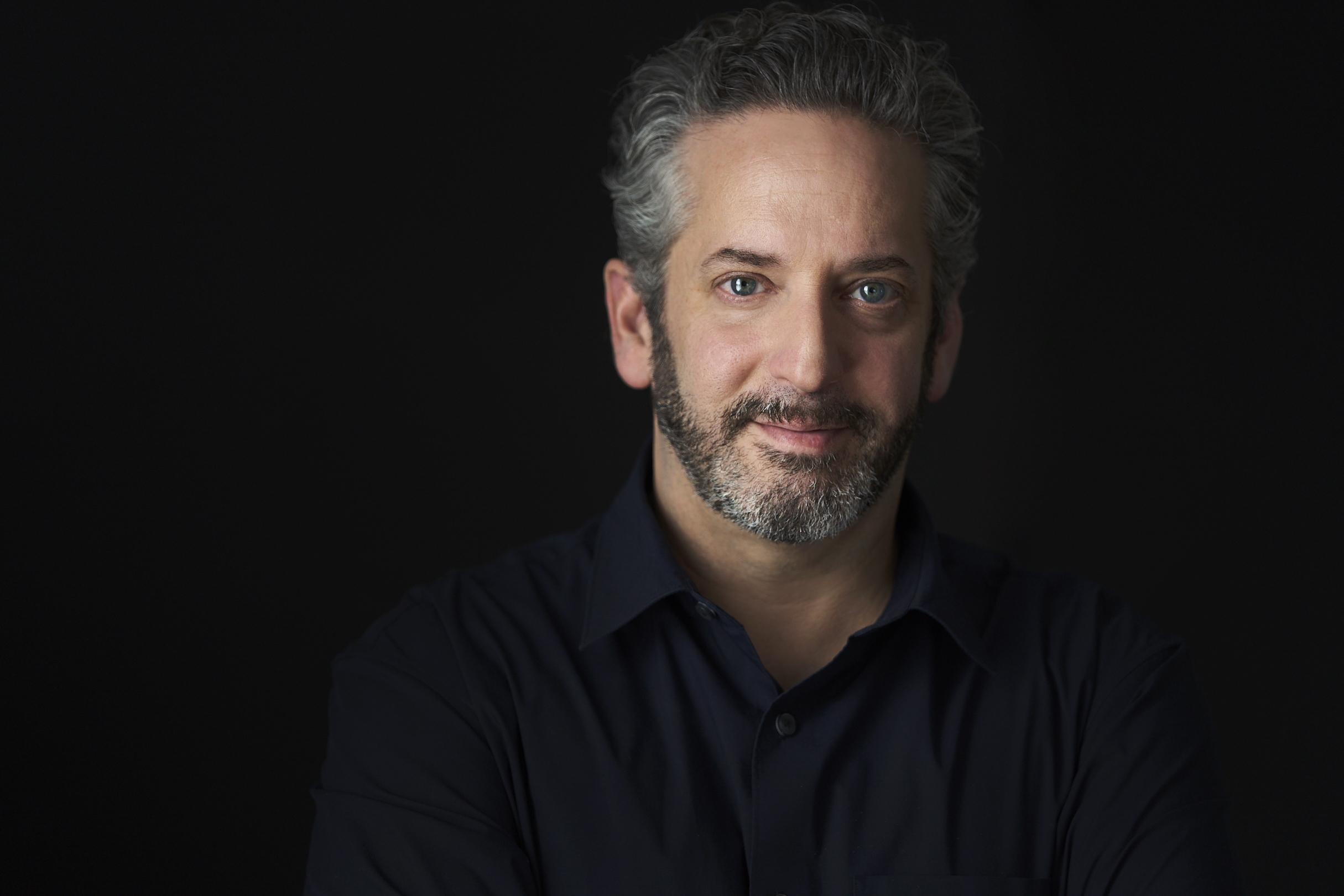
Noah Solomon is Chief Investment Officer for Outcome Metric Asset Management Limited Partnership. From 2008 to 2016, Noah was CEO and CIO of GenFund Management Inc. (formerly Genuity Fund Management), where he designed and managed data-driven, statistically-based equity funds.
Between 2002 and 2008, Noah was a proprietary trader in the equities division of Goldman Sachs, where he deployed the firm’s capital in several quantitatively-driven investment strategies. Prior to joining Goldman, Noah worked at Citibank and Lehman Brothers. Noah holds an MBA from the Wharton School of Business at the University of Pennsylvania, where he graduated as a Palmer Scholar (top 5% of graduating class). He also holds a BA from McGill University (magna cum laude).
Noah is frequently featured in the media including a regular column in the Financial Post and appearances on BNN. This blog originally appeared in the January 2026 Outcome newsletter and is republished on Findependence Hub with permission.
