Tag Archives: investing

The Financial Side of the Medical Industry: What to Know

Navigating the financial landscape of the medical industry is essential for healthcare professionals and medical students aiming to build successful careers. Understanding the economic aspects enhances the ability to make informed decisions and contributes to better resource management, ultimately improving patient care.

Here’s what to know about the financial side of the medical industry.

By Dan Coconate

Special to Financial Independence Hub

Image by Adobe Stock/Photographer Nuttapong Punna|.

When it comes to fast-growing industries, few stand out like healthcare.

While the top priority in healthcare is always quality patient care, you can only provide that care if you can afford to keep the lights on.

In other words, strong financial management is the foundation that allows any healthcare organization to fulfill its primary purpose.

Let’s take a quick look and discover the financial dynamics of the medical industry, covering budgeting, revenue cycles, and economic challenges healthcare providers face.

Cost Management and Budgeting

Cost management aids in sustaining healthcare facilities. Hospitals and clinics must carefully budget for various expenses:

  • Staffing
  • Medical supplies
  • Equipment
  • Technology upgrades

By implementing strategic budgeting practices, healthcare providers can optimize their operations, reduce waste, and allocate resources more efficiently. This is particularly vital in rural areas, where financial constraints can impact the quality of healthcare services.

Funding and Revenue Streams

Understanding the various funding and revenue streams is fundamental in the medical industry. In Canada, healthcare is primarily funded through public sources, including federal and provincial government allocations. However, private contributions, grants, and partnerships also supplement these funds.

Healthcare professionals and administrators should be well-versed in navigating these financial avenues to ensure their institutions remain well-funded and capable of delivering high-quality care.

Financial Compliance and Regulations

All healthcare providers must adhere to financial compliance and regulatory standards. This includes maintaining accurate financial records, adhering to billing practices, and ensuring transparency in financial transactions.

Compliance safeguards entire institutions against legal repercussions and builds trust with patients and stakeholders. Staying updated with the latest regulations and implementing financial management systems can prevent discrepancies and enhance operational efficiency.

Investment in Technology and Innovation

Investment in technology and innovation is a significant financial consideration for professionals in the healthcare industry. Advanced medical technologies, electronic health records (EHRs), and telemedicine platforms require substantial financial outlays but offer long-term benefits. Continue Reading…

June Checkup: Healthcare & Technology

Image courtesy Harvest ETFs

By Ambrose O’Callaghan, Harvest ETFs

(Sponsor Blog)

The United States stock markets have delivered positive returns through much of 2024, continuing the positive momentum that was established in the previous year.

However, that performance has increasingly been powered by a smaller segment of large-cap companies. Indeed, readers have undoubtedly heard about the outsized performance of the “Magnificent 7” in the tech space over the past year. If we strip out the “big six” of Amazon, Meta, Nvidia, Microsoft, Apple, and Alphabet from the S&P 500, we have experienced three calendar quarters of negative earnings growth across the rest of the market.

Investors took profits in the month of April. Demand resumed in the month of May, but with a broader range of equities. Nvidia continued to show its dominance, but there were other sectors and stocks that were able to catch up with the leaders to close out the first half of 2024.

The summer season is historically slow in the markets. Harvest’s portfolio management team expects volatility to persist for both bonds and equities. Moreover, the team emphasizes that this summer is a key moment to stay active, attentive, and invested. A prudent strategy in this environment involves looking under the surface for opportunities while generating cash flow from call options to support total returns.

June Healthcare check up

The healthcare sector pulled back slightly in the month of May 2024. Negative moves in the healthcare sector over the course of May 2024 were driven by stock specific events. Macroeconomic data sets impacted the healthcare sector in line with others. Within healthcare, the managed care subsectors experienced volatility earlier in 2024 and changes to reimbursement structures impacted valuations in the near term. The Tools & Diagnostics sub-sector has also proven volatile due largely to a slower-than-expected recovery in China.

Regardless, there are still very promising opportunities in the GLP-1 drug category space for diabetes and obesity. The uptake of these drugs in the U.S. has been significant at a still-early stage in their lifespan. A recent study from Manulife Canada found that drug claims for anti-obesity medications in Canada rose more than 42% from 2022 to 2023.

Harvest Healthcare Leaders Income ETF (HHL:TSX) offers exposure to the innovative leaders in this vital sector. This equally weighted portfolio of 20 large-cap global Healthcare companies aims to select stocks for their potential to provide attractive monthly income as well as long-term growth. HHL is the largest active healthcare ETF in Canada and boasts a high monthly cash distribution of $0.0583.

Harvest Healthcare Leaders Enhanced Income ETF (HHLE:TSX) is built to provide higher income every month by applying modest leverage to HHL. It last paid out a monthly cash distribution of $0.0913 per unit. That represents a current yield of 10.44% as at June 14, 2024.

Where does the technology sector stand right now?

Investors poured back into technology stocks in May 2024 after taking profits in the month of April. However, they were more discriminating than in previous months and showed a preference for hardware stocks, specifically semiconductors.

Nvidia maintained its leadership position. It has soared past a $3 trillion market capitalization in the first half of June 2024. However, other AI-related tech stocks encountered turbulence which may give some investors pause around the broader bullish case for AI. Continue Reading…

Investing Advice to follow in the Midst of Two Wars

Investing advice when Putin’s at war against Ukraine. Plus, Putin and the Israel-Hamas War

Deposit Photos

Russia launched the war in 2014, during the second Obama term, when it invaded Ukraine’s Crimean Peninsula. At the time, the U.S. and NATO were still unsure about how to react to Russia’s aggression toward its former possessions. Many observers felt Russia was just trying to retrieve some of the stature it lost with the collapse of the Soviet Union in the early 1990s.

When Russia invaded Ukraine in 2022, it expected Ukraine to collapse right away (the way France collapsed under the 1940 German invasion, say). The U.S. and other observers feared/expected the same. They still began sending security aid to Ukraine before the invasion. They also used threats of trade and financial sanctions to try to scare Russia off. These steps failed. However, Ukraine fought back surprisingly well and attracted additional aid from the West.

Putin soon saw that he had guessed wrong. But he assumed the West would quickly lose interest. Instead, the West stepped up its aid. Russia then began a series of veiled threats of military escalation, all the way up to tactical nuclear weapons.

My sense is that after its initial stumble, Russia still hoped/believed that if it kept up the military pressure and escalation/nuclear threats long enough, Ukraine and its supporters would agree to a lengthy ceasefire that would work in Russia’s favour.

It seemed to me and many other people that this was unlikely. In April of that year, I wrote that “Russia could launch a nuclear war, but it would find itself fighting against most of the advanced countries of the world. Putin is vain and may be deranged, but he isn’t stupid.”

Later I voiced the off-the-cuff view that any nuclear attack on Ukraine would spark a much more lethal response from NATO forces, which vastly outnumber Russia’s.

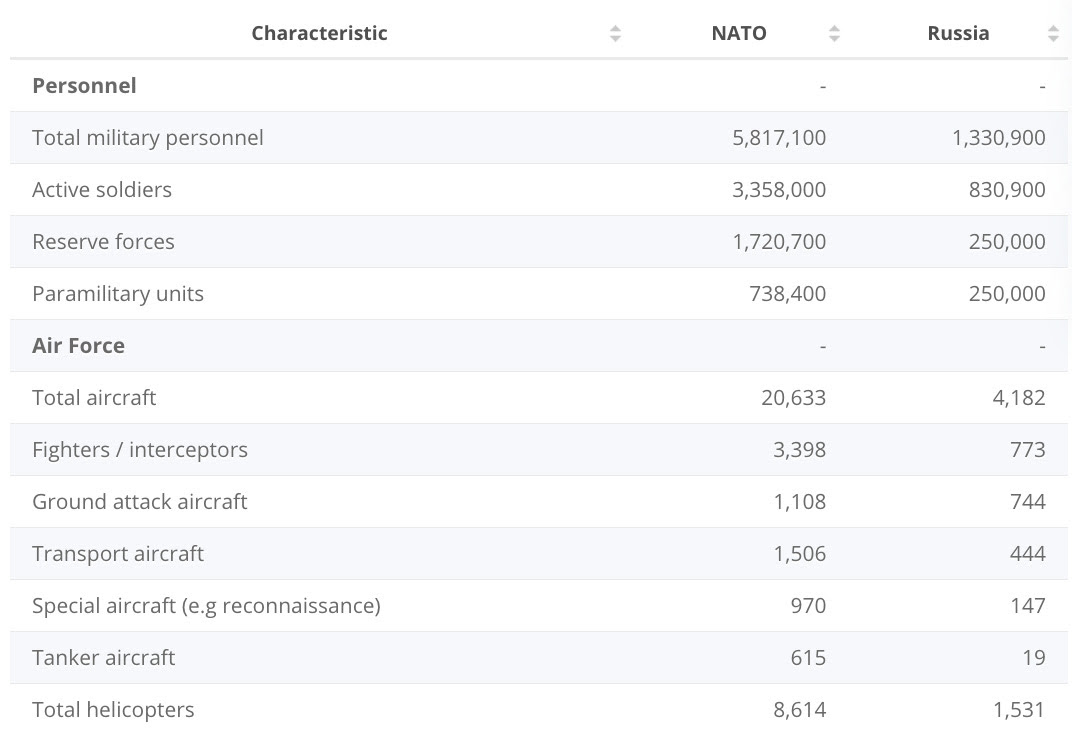
Just recently I came across the actual NATO-versus-Russia figures (below) from veteran Toronto journalist Diane Francis, writing in her Substack.com publication. (Note: her chart refers to a Military Asset as a “Characteristic.”)

Military Asset Comparison Between NATO and Russia

Source: dianefrancis.substack.com

The numbers show an even greater numerical advantage for NATO than I imagined. That’s just the start.

The West is also way ahead of Russia in technology, sanctions, finances, morale, global support and pretty much anything else. Russia’s main advantage in war is its ruthlessness in throwing untrained soldiers — mostly from prisons or Russian-speaking racial/cultural minorities — onto the front lines, until the other side runs out of ammunition.

Putin can only hope that Biden or a successor loses his grip and abruptly pulls out of Ukraine the way the U.S. pulled out of Afghanistan in August 2021, after two decades of hostilities.

As the sarcastic one-liner goes, that’s not likely.

Nobody can predict these things, of course. My sense is that we are seeing the last gasps of Europe’s last empire. I’d guess the outcome won’t be pretty or quick, but it may turn out to be a historical milestone. A worldwide swing back toward democracy and away from authoritarianism just might follow.

Putin and the Israel-Hamas War

My guess is that the Israel-Hamas war is just getting started and will last a long time. I also suspect that Putin had something to do with getting it started, and will do what he can to keep it going. After all, when it comes to running his country, Putin takes a grasping-at-straws approach.

Putin may think that bringing the longstanding Mideast conflict back into the headlines is going to improve his chances of conquering Ukraine and bringing the Soviet Union back from the dead.

He thinks taking a long shot is better than no shot at all. Who knows? He might get lucky.

Early on in his war on Ukraine, Putin seemed to think that Chinese dictator Xi Jinping was going to take pity on him and his country, and offer free money and/or weapons to shore up Russia’s Ukraine invasion. Instead, Xi insists on staying out of the war, while paying discount prices for Russian oil. He takes special care not to let his country get caught up in the economic sanctions that the U.S. and NATO countries and allies are directing against the Russians.

It’s not that Putin is stupid. If a war between Israel and Hamas turns out to be a big drain on the U.S. budget, the U.S. might have less money available to arm Ukraine.

Up until lately, however, Israel has had little to say about Russia’s treatment of Ukraine. Israel may soon take a more active role in helping Ukraine defend itself.

Any war is a terrible thing, and this one is no different. Meanwhile, the stock market seems to be creeping upward. Maybe it knows something that Putin hasn’t figured out. If you’re looking for investing advice related to the wars around us, spend more time learning about the wars themselves.

Meantime, if your stock portfolio made sense to you a week or two ago, we advise against selling due to Mideast fears

No matter what the state of the world, here are three rules you can follow for maximum portfolio success:

Rule #1: Invest mainly in well-established, profitable, dividend-paying stocks.

Our first rule will help you stay out of high-risk, low-quality investments. These investments are always available, in good and bad markets. They come with hidden risks due to conflicts of interest and other negatives. Every year, they lead many inexperienced investors to substantial losses. Continue Reading…

Dividend ETFs: Finding Stability and Growth in Income Investments

Discover the Keys to Identifying Dividend ETFs that offer Consistency, Quality, and Long-Term Growth

Image from Pexels/Anna Nekrashevich

Higher interest rates mean dividend-paying stocks must increasingly compete with fixed-income investments for investor interest. However, sustainable dividends still offer an
attractive and growing income stream for investors.

Companies that pay regular and growing dividends have performed very well over the long run when compared to the broad market indices. For example, a simple strategy such as selecting stocks with an extended history of uninterrupted dividend growth, such as represented by the S&P 500 Dividend Aristocrats, has added 11.5% per year over the past 30 years. This compares to the 10.0% annual gain for the S&P 500 Index. And not only did the dividend payers beat the overall market, but they were also less volatile.

The superior long-term performance of the dividend growth companies can be attributed to a combination of several factors: Companies with long histories of regular and growing dividend payments generally have sound competitive business models and growing profits; these are also companies with experienced managements that make disciplined capital allocation decisions, strive for lower debt levels, and operate firms more profitable than their peers.

Notably, though, the Dividend Aristocrats’ performance lagged over the past 5 years against the S&P 500 index.

Most of this underperformance came over the last year and a half, as higher interest rates made fixed-income investments, such as GICs, more attractive for income-seeking investors when compared to dividend-paying equities.

The dividend sweet spot

Income-seeking investors who decide to take on the risk of the stock markets are faced with a wide range of options including “yield enhanced” dividend-paying ETFs, moderate-yielding companies with average growth rates, and low-yielding but fast-growing companies. Then there is also the group of companies that have very high dividend yields and may seem attractive but, unfortunately, come with elevated risk.

In many cases, a high yield may be a warning sign that all is not well with a company and that future dividend payments are at risk of being cut.

As well, a dividend cut, or even an outright dividend suspension, is often accompanied by a steep decline in the share price, as income investors dump their former dividend favourites.

A 2016 study by a group of U.S.-based academics provides some statistical guidelines for sensible dividend-based investing.

In reviewing the performance of almost 4,000 U.S. companies over 50 years, they found that dividend-paying stocks beat non-dividend payers.

In particular, the middle group of dividend yielders (i.e., those with an average yield of 4.3%) surpassed both the low yielders and the high yielders in terms of total return. Equally important, this superior performance was achieved with lower risk, as measured by the standard deviation of returns.

Based on this long-term study, it makes sense to avoid the highest-yielding stocks and rather look for companies with moderate yields and sound growth prospects. This safety-first approach will result in a lower yield but likely provide a better total return (dividends plus capital) at lower risk.

How to spot dividend ETFs worth investing in

When investing in dividend-paying companies through an ETF, here are key factors to consider: Continue Reading…

The waiting is the hardest part, and the most profitable times for investors


By Dale Roberts

Special to Financial Independence Hub

Investors are starting to notice that their portfolios have been treading water for a couple of years. Over the last two years, a global balanced growth portfolio would essentially be flat. Of course, move out to 3-year, 5-year and 10-year time horizons and we have very solid to generous returns.

At times investors have to wait. We build and springload the portfolio waiting for the next aggressive move higher. In fact, these holding periods can be beneficial: we are loading up on stocks at stagnating or lower prices. We’re able to buy more shares. The waiting is the hardest part for investors. But it is essential that we understand the benefits to sticking to our investment plan.

In January of 2021 I wondered aloud in a MoneySense post if the markets might not like what they see when we get to the other side of the pandemic. That’s an interesting post that looks back at the year 2020, the year the world changed with the first modern day pandemic. That suspicion is ‘kinda’ playing out as the markets stall and try to figure things out.

That’s not to suggest that my hunch was an investable idea. We have to stay invested.

Stick to your plan when the market gets stuck

Patience is the most important practice when it comes to wealth building. When done correctly, building life-changing wealth happens in slow motion and it is VERY boring.

Boring is good.

Waiting can be boring. But maybe it can look and feel more ‘exciting’ if we know what usually happens after the wait. Stock markets work like evolution. There are long periods of stagnation and status quo and then rapid moves and change.

Instead of boring, maybe it should feel like a kid waiting for Christmas. The good stuff is on its way.

Here’s an example of a waiting period, from 1999. The chart is from iShares, for the TSX 60 (XIU/TSX). The returns include dividend reinvestment.

And here’s the stock market ‘explosion’ after the wait.

That’s more than a double from the beginning of the waiting period.

And here’s the wait from 2007, moving through the financial crisis. Ya, that’s a 7-year wait. Talk about the 7-year itch, many investors filed for divorce from the markets.

It was a costly divorce.

Markets went on a very nice run for several years. Continue Reading…