Unless you were literally born yesterday, you’re probably already aware that 2022 was an extraordinary year for investing … extraordinarily bad, that is. It hardly mattered which asset mix you invested in. Both stock and bond markets experienced double-digit losses, so even conservative investors with bond-heavy holdings saw their portfolio values plummet.
That’s investing for you. We may not like it, but we actually expect some years to serve up heaping helpings of realized risk, sometimes across the board. It’s the price we pay to expect these same markets to deliver longer and stronger runs of future returns.
From this perspective, we hope you’ll keep your eyes and your asset allocations focused on the future as we review the 2022 performance for the Vanguard, iShares, BMO, and Mackenzie asset allocation ETFs.
Before we look at the 2022 returns for our asset allocation ETFs, let’s check out the year-end results for their underlying holdings, starting with the equity ETFs.
2022 Equity ETF Returns
Canadian equity ETF returns were similar across the board, with losses of around 6%.
Disappointing, for sure, but their performance was still better than that of global stock markets, which lost 12% in Canadian dollar terms. That’s in large part due to the Canadian stock market’s overweight to energy companies. The energy sector happened to have a stellar year, returning over 50% during 2022.
U.S. equity ETFs also ended 2022 on a low note, losing around 20% in U.S. dollar terms. During this time, the U.S. dollar appreciated by 6.8% against the Canadian dollar, reducing the loss for unhedged Canadian investors. Once we factor in the return bump from U.S. dollar exposure, our selection of U.S. equity ETFs lost around 12%-14%, in Canadian dollar terms, net of withholding taxes.
BMO’s trio of U.S. equity ETFs had noticeably higher returns than the others. This is largely due to the methodology used to construct the S&P indexes tracked by BMO’s ETFs. For these indexes, an S&P index committee selects which companies to include in each index. The indexes tracked by the Vanguard, iShares, and Mackenzie ETFs have a less subjective process. This means there is more active decision-making going on in the three S&P indexes tracked by BMO’s ETFs, which led to a wider short-term return difference between BMO and the rest of the more passive index-tracking providers in 2022.
International equity ETFs ended the year on a disappointing note as well, losing between 8%-10%.
Two components explain most of the performance differences among our international ETF providers: Continue Reading…
Many investors look forward to the annual letter from Warren Buffett. On Saturday, Berkshire Hathaway reported earnings and Mr. Buffett offered commentary and delivered his annual letter to shareholders. The company reported record operating profits and also beat the market handily in 2022. Fearing a recession in 2023, more investors put their trust (and money) in the hands of the world’s greatest investor. Berkshire Hathaway is the largest position in my wife’s accounts. We’re listening to Warren Buffett on the Sunday Reads.
Warren Buffett’s Berkshire Hathaway Inc on Saturday reported its highest-ever annual operating profit, even as foreign currency losses and lower gains from investments caused fourth-quarter profit to fall. Businesses generated $30.8 billion of profit despite rising inflation. Buffett and friends also increased their cash position to near $130 billion.
Sitting on a massive cash pile
The investment giant held ~$128.7B of cash and short-term securities at Dec. 31, 2022, vs. ~$109.0B at Sept. 30. That’s even with the company acquiring Alleghany Corp. in the last quarter of 2022. Owning or purchasing Berkshire delivers an immediate cash hedge, in “pretty good hands”. Should we get a recession, the Berkshire teams will go shopping in a meaningful way. Corrections are when they do their thing and create the conditions for outperformance.
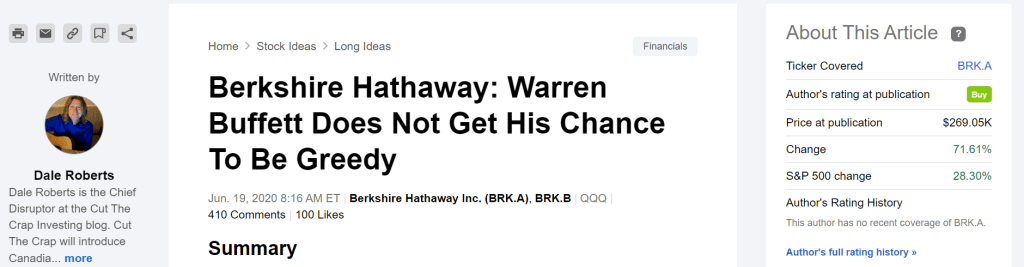
Berkshire’s share price rose 4% in 2022, far outpacing the S&P 500 which fell 18%, reflecting Berkshire’s status as a defensive investment. I have long suggested that investors consider a position in Berkshire (BRK BRK.B). When the going gets tough, Berkshire often gets going.
In the COVID correction Warren Buffett did not get his chance to be greedy. Massive stimulus quickly ended the shallow recession and stock market correction. From the chart above, we can see that the market started to embrace Mr. Buffett and the stock. Will Mr. Buffett get the chance to spend a good chunk of his $130 billion in a recession? Who knows. But I like the idea of having that cash pile in good hands.
You’ll see just a little bit of outperformance from the time of my article, ha. 71% vs 28%. But to be honest, the S&P 500 gets a little boost for that Author’s Rating evaluation, they did not includes the dividends. But it’s still not a fair fight.
This is not advice, but you might consider Berkshire Hathaway as part of your portfolio defense. For Canadian dollar accounts you can purchase Berkshire Hathaway as a CDR listed on the Neo Exchange. Those are currency hedged.
Dale Roberts is the owner operator of the Cut The Crap Investing blog, and a columnist for MoneySense. This blog originally appeared on Cut the Crap Investing on Feb. 26, 2023and is republished on the Hub with permission.
There are obvious ways to generate retirement income but I suspect some might not appeal to you for a few reasons!
Option #1 – Save more. Sigh. I doubt most people will like this option, I don’t! However, more money saved will help combat inflationary pressure, rising healthcare costs and longevity risk.
Option #2 – Work longer. Double sigh. If you didn’t like option #1, you might not like this one! Working longer into your 60s or potentially to your 70s might be the reality for some with a low savings rate.
Option #3 – Spend less. Spending less than you make seems simple but not easy!
Meaning, the path to a well-funded retirement is usually (always?) spending less than you make, investing the difference, and growing that gap over time. This has largely been our plan – to let the power of compounding do its thing – but that does take discipline and time. Investing patience is a virtue.
Our semi-retirement income plan has us leveraging a mix of income streams in a few years:
Earn income from part-time work – to remain mentally engaged but also to fund some income needs and wants in our 50s.
Make strategic Registered Retirement Savings Plans (RRSPs) withdrawals in our 50s and 60s.
We’re not quite “there” yet in terms of having 1, 2 and 3 running smoothly to meet our semi-retirement income needs yet, but we are getting there and making some lifestyle choices accordingly…
We hope to semi-retire sometime in 2024.
We have been working hard to build up our taxable dividend income stream for about 15 years now.
We continue to max out our TFSAs as our first investing priority every January (and we’re saving for that again in early 2023).
We have been maxing out contributions to our RRSPs, and we’ll continue to do so for the next couple of years.
What are my retirement income needs?
In a nutshell, we figure once we can earn close to $30,000 per year from a few key accounts (for example, from our taxable account(s) and TFSAs x2), and then make those strategic RRSP withdrawals on top of that, we should have enough to start part-time work.
Here are some estimated very basic expenses in semi-retirement:
Key expenses
Monthly
Annually
Semi-retirement comments ~ end of 2024??
Mortgage
$2,240
$26,880
We anticipate the mortgage “dead” before the end of 2024.
Groceries/food
$800
$9,600
Although can vary month-to-month!
Dining/takeout
$100
$1,200
Home maintenance/expenses
$700
$8,400
Represents 1% home value per year, increasing by inflation.
Home property taxes
$500
$6,000
Ottawa is not cheap, increasing by inflation or more.
Home utilities + internet/TV/cell phones, subscriptions, etc.
$400
$4,800
Transportation – x1 car (gas, maintenance, licensing)
$150
$1,800
May or may not own a car long-term!
Insurance, including term life
$250
$3,000
Term life ends in 2030, will self-insure after that without life insurance.
Totals with Mortgage
$5,140
$61,680
Totals without Mortgage
$2,900
$34,800
As you can see, once the debt is gone, we’ll be in a much better place for financial independence!
Add in other spending/miscellaneous spending to the tune of $1,000 per month on top of that, and our semi-retirement budget is likely at the basic-level about $4,000-$4,500 per month.
What are your retirement income needs?
Until the end of time, I suspect one of the most popular retirement planning questions will be: how can I generate retirement income?
That’s a HUGE quesiton to answer. I mean, we have rising inflation, higher interest rates, and the need to make your money last to fight any longevity risk, higher taxation and the need to cover essential healthcare costs as you age. This also makes how you can generate retirement income a VERY important question to answer.
Passionate readers of this site will know I’m a big fan of investments that generate meaningful income. Sure, you can invest in real estate, private equity, run a business into your 60s and 70s but for many people: the stock market is a common vehicle for average people/average investors to be long-term business owners.
This makes the hope of capital gains or getting paid today via dividends an interesting paradox.
As I get older, while the best total returns are always the goal, I’m more concerned about the tangible income my portfolio can (and will) generate moreso than hoping for stock market prices to work in my favour.
Full stop: I like investments that generate income. I like individual stocks as investments that pay ever growing income!
While I believe in (and own) low-cost, passive Exchange Traded Funds (ETFs) for total portfolio growth, a major portion of my portfolio rewards me to be a shareholder. I am attracted to investments that pay dividends or distributions. You may wish to consider the same for your meaningful retirement income needs.
Should you use ETFs to generate your retirement income needs?
I believe so, at least a consideration if you’re not going to be an owner of some individual dividend-paying stocks!
By Mirza Shakir, Associate Portfolio Manager, BMO ETFs
(Sponsor Content)
What are Sector ETFs?
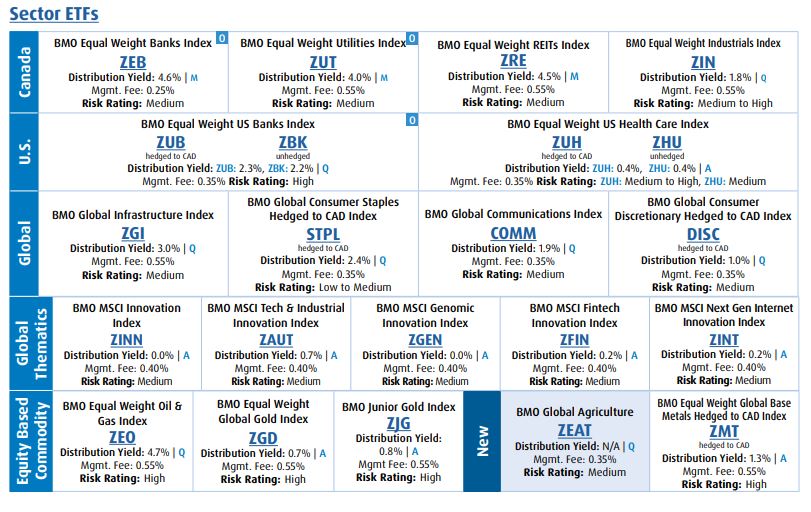
Sector ETFs allow targeted exposure to sectors or industries like financials, materials, or information technology – domestic, regional, or global. The sectors are usually classified according to the Global Industry Classification Standard (GICS), but other classifications can also be used. While sector ETFs could be active funds, most track an index, offering transparency, liquidity, and low fees.
There are eleven broad GICS sectors that can be invested in with sector ETFs.
Energy
Materials
Industrials
Consumer Discretionary
Utilities
Real Estate
Communication Services
Financials
Health Care
Consumer Staples
Information Technology
There are two common approaches in constructing a sector portfolio: market capitalization weighted and equal weighted. As the names suggest, the former approach weights securities in the portfolio by market capitalization while the latter weights them equally.
At BMO ETFs, our suite of sector ETFs covers equal-weighted and market-weighted strategies across all sectors, locally and globally. We opt for equal-weighted strategies for sectors that have the potential to get concentrated in a few large names with the market-capitalization approach, ensuring effective diversification and mitigating individual company risk.
Annualized Distribution Yield: The most recent regular distribution, or expected distribution, (excluding additional year end distributions) annualized for frequency, divided by current NAV.
Risk is defined as the uncertainty of return and the potential for capital loss in your investments.
Why Invest in Sector ETFs?
Sector ETFs can offer differentiated return and risk profiles for investors, not only from broad market portfolios but also from other sectors. Additionally, investing in a sector ETF allows access to a broad range of companies that have businesses that operate in similar or related industries, which can be more diversified than investing in a single stock. The investor does not have to place individual bets on single companies, which helps limit company-specific risks.
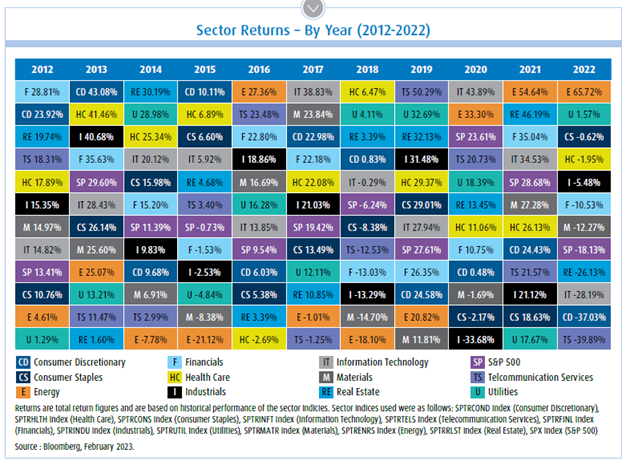
The table shown at the top of this blog, and shown to the right in miniature, shows the performance of all sectors in the U.S. from 2011 to 2022. Notably, the best and worst performing sectors change every year, leaving an opportunity for market timing to generate high returns. However, timing the markets can be extremely difficult. A more effective strategy can be sector rotation, which involves overweighting or underweighting sectors relative to the stage of the business cycle.
Playing Defense – Sector Rotation Strategies
The business or economic cycle refers to a cycle of expansion and contraction that economies undergo, accompanied by similar upswings and downswings in economic output and employment. Continue Reading…
Late in January, the Bank of Canada boosted rates by another 0.25% and signalled that they will now pause and evaluate. I’ve been calling that the rate hike hiatus. As I touched on in mid-January, inflation is moving in the right direction and the consumer is holding up quite well. It’s a Goldilocks scenario, for now. That said, the rate hikes have not worked their way through the economy. In fact, many suggest that we’ve felt almost no economic damage from the rate hikes. There is a lag affect; it can take a year or two for hikes to be felt in full. But let’s call the rate hike hiatus good news.
The big news last month was the announced rate hike hiatus in Canada. Of course, markets are forward “thinking” and they are pricing in a soft landing and rate cuts in 2023. That Yahoo!Finance post suggest that cuts are likely not on the table this year. That would only happen if something breaks and we get a serious-enough recession. Also, inflation would have to be completly under control. The Bank of Canada is not likely to cut rates if inflation is not close to that 2% target.
Rate guesses, not so good …
The consensus appears to be the call that there will be no rate cuts in 2023, though there is a sprinkling of calls for cuts in late 2023. And all said, we should remember the rate predictions from March. Not even close.
Inflation is so unpredicatable. And inflation might still be driving the bus in 2023.
Coming in for a landing
Lance Roberts looks at the history of soft landing and hard landings. There were 3 past soft landing scenarios, but none in an inflationary environment. The affect of rate hikes have largely not been felt, and likely have had little push on inflation. But that will come over time of course.
Here’s the chart that shows the positive effect of a weak U.S. Dollar for international equities. With bonds looking better and the potential for international markets, the traditional balanced portfolio might ‘be back’ one day soon.


 Posted By