Financial and wealth-management advisors tend not to be big fans of robo-investing. No surprise there because service and understanding the client are front and centre in what they do.
But for many investors today, especially younger ones, robo-investing may be seen as a low-cost, low-maintenance way to grow their wealth. Robo-investing relies on algorithms to make investments automatically and this is with minimal human supervision at best. But there is no ‘expert’ service involved and that is not good.
On the other hand, how about using Artificial Intelligence (AI) to assist advisors in better serving their clients and, in the process, help those clients build better portfolios? Don’t look now but the technology is here and it can start with meetings. Nowadays people are slowly but surely returning to the office and financial advisors are even getting back to meeting face-to-face with their clients. But a face-to-face meeting is not always required.
A new world of hybrid meetings
Today, however, we are in a new world of meetings where firms big and small are adopting a mix of online, in-person and ‘hybrid’ meetings which utilize both the virtual and in-person variety. With AI an advisor can make this choice wisely.
It involves human-like AI that enhances the meeting experience for both the host and the attendees by allowing participants to focus on the meeting and forget about labour-intensive tasks like note-taking. How? A full transcript and recording of what transpired are automatically created and then crafted into a concise executive summary. And the technology can do even more by using what is called ‘collected telemetry’ (the conversation data that pertains to everything from context to emotion) to build an advanced analysis of performance and even sentiment. Continue Reading…
By Billy and Akaisha Kaderli, RetireEarlyLifestyle.com
Special to the Financial Independence Hub
According to the Mexican Government, around 1.1 million expatriates lived in Mexico as of 2020. Of those, about 700,000 were from the United States, making Mexico the #1 country worldwide for American Expats.
We have listed a dozen reasons below why Mexico is attractive to those with plenty of money, and also to those who don’t have that much.
Freedom
While there are many reasons to move to Mexico, the Number One reason people come here is for the freedom they experience.
With less regulation on all fronts, critics might think that Mexico is a lawless frontier.
Not so.
Mexico is still a place where one can walk the beach with a beer in hand. We can give a homeless person food without filling out countless forms to gain permission or explain if there is mayonnaise on the sandwich or have the food rejected because it’s not in a paper bag. While we personally are not smokers, an individual who chooses to smoke can do so without being read the riot act or be subjected to invectives about their personal worth as a human being.
Many medications can be purchased over the counter without a prescription. One can afford medical care and not be forced into buying an expensive health insurance policy that doesn’t coincide with their personal health approach. Homeopaths, Naturopaths, Chiropractors and those who practice acupuncture or massage can be found easily and their services are affordable. One can walk into a lab and order an x-ray or a blood test on their own without a prescription.
There is respect for the elderly and those over 60 are not invisible. People who are chubby are not judged and can easily find someone to date or marry. People on the street say hello and good morning to complete strangers, and men still tip their hats to women. The young offer their bus seats to those of us who have more years than they do.
People say “excuse me” when they walk in front of you, and it’s perfectly safe to walk through a group of teenage boys without fear.
Common sense is common.
Some are moving due to political climate at home
The world is changing, no doubt. Many have chosen Mexico to get out from under the tense political climate back home.
Mexican culture is lively and accepting and it’s a breath of fresh air to live here. Smaller towns, especially, are like Norman Rockwell paintings.
But bigger cities offer fabulous diversions away from home country political pressure. There are museums, international dining, hiking, cultural events, music, art and volunteer opportunities too.
The caution here, is to not bring the “old” political attitude with you when you move. Grow into the easy and into the pleasantry here in this country.
Zicatela Beach, Puerto Escondido
Affordability
Having money or not, your quality of life should expand over what you are experiencing now in your current home town. The cost of living is such that you will get more for your money and your nest egg will go farther.
Truthfully, depending on where you might choose to live, purchasing a home can be expensive, but rents are cheap. And if you are at retirement age, you might find that putting your money into “living” versus “housing” might be the better choice, anyway.
In either case, gardeners, housekeepers, maintenance people and supplies are all cheaper than you will find in the US or Canada. In Chapala, Mexico, a housekeeper runs about $6USD for 2.5 hours. In Ajijic, Mexico – another popular Gringo town – it is twice that price, but still not outrageous.
Legalities of permanent status are easier
Getting a permanente or a temporada card is easy to do. While some choose to fill out the paperwork themselves, having a lawyer arrange for this is also quite affordable.
Qualifying for residency is based on your annual income and/or net worth, and the threshold is easy enough to meet. The requirements for getting a temporary card are lower, and after renewing annually for 5 years, the temporada moves into becoming a permanente.
If you have your own state’s driver’s license, you can use that here in Mexico, but if you are not able to renew it, you can obtain a Mexican driver’s license in its place. So long as your present driver’s license is still active, you will only need to take the written exam of 10 questions. You won’t have to perform a driving test in the parking lot.
One can live on Social Security alone
While it’s always great to have more money, one can easily live comfortably on Social Security. The average [monthly] SS check as of 2021 is US$1,658. Rents are available for $300-$600USD per month for a one bedroom or a casita. So, those who are on a limited income can readily find a comfortable place to live and still have money left over for a social life and medical expenses.
For those who actually are millionaires, one can live like royalty in homes with lake views, swimming pools, 3- and 4 bedrooms, plus house and garden help: and they can still keep their millions.
Adaptability
Yes, Mexico is a foreign country. However, our ability as Norte Americanos to adapt to these perspectives can be far smoother than with cultures with which we have less in common.
Celebrating many similar holidays, perceptions and values run concurrent with those we already have. The time zones are also similar to the US and Canada, making contact with family members on Zoom, Facetime, or Skype a breeze.
Weather is better: geographic choices
No matter if you enjoy having four seasons or prefer a tropical climate, Mexico offers it all. Continue Reading…
What makes a great Canadian dividend Exchange Traded Fund?
What are the top Canadian dividend ETFs to own?
You’ve come to the right site and the right post.
Top Canadian Dividend ETFs – what is an ETF?
An ETF (Exchange Traded Fund) is a diverse collection of assets (like a mutual fund) that trades on an exchange (like a stock does).
This makes an ETF a marketable security. It has trading capability. Since you and buy and sell ETFs on an exchange during the day, prices can change throughout the day as they are bought and sold.
ETFs typically have lower fees than mutual funds (although not always), which can make them an attractive alternative to mutual funds.
Based on my personal experiences approaching 20 years as a serious DIY investor, ETFs are easy to buy using a discount brokerage and offer a low-cost way to own dozens if not hundreds of stocks to diversify your portfolio.
Although you don’t need to buy equity ETFs, it is my belief that you’re FAR better off owning more equities than bonds over long investing periods.
The reason for this is rather simple: if you want predictable returns you’re going to have to live with lower, long-term returns that offer this predictability. If you want higher, long-term returns, you’re going to have to live with the short-term volatility that comes with higher-risk equities.
What goes into a good ETF? What should you consider?
Before we get into my favourite Canadian dividend ETFs, here are some elements that make up a solid ETF:
1. Style – ETFs can track an index, follow an industry sector, be rules-based like some smart-beta funds are, or be much more. For the most part, I prefer either plain-vanilla, broad market equity indexed ETFs or dividend ETFs when I share my favourites with readers or other investors. This is because the former provides market-like returns less skimpy money management fees. Dividend ETFs can provide income; tangible money you and I can use as we please while offering some long-term growth. I avoid other types/styles of ETFs based on futures, hedges or swap agreements. By and large those products tend to make the company offering those funds rich, not you.
2. Fees – Hopefully by now you know high money management fees kill portfolio values over time. When it comes to fund fees in particular, my bias is, I try to keep the management expense ratio (MER) (the fee paid to the fund’s manager, as well as taxes and other costs) low for as long as possible. That means I wouldn’t consider owning any ETF over an MER of about 0.50% – including any Canadian dividend ETF. You should also be considering investing in products with fees that are lower than that.
3. Tracking error – In short, tracking error is the difference between the performance of the fund (the ETF) and its benchmark (what it tracks). I would advise you to look at the fund’s prospectus before you buy it and strive to own ETFs with low tracking errors.
4. Diversification – Along the same lines ‘Style,’ you should be very mindful of the assets within an ETF before you buy it. ETFs are not created equal.
XIU holds the largest 60 stocks in Canada. XIU however has nowhere near the number of holdings that VCN has (214 at the time of this post) yet XIU has delivered stellar long-term returns better than most. Just because of the limited fund holdings, is XIU really an inferior product to VCN for our Canadian market? Hardly.
Based on my personal experiences, diversification can be a great ally as a risk mitigation tactic against stock picking but that doesn’t mean it’s bulletproof. Indexed ETFs hold all the studs and duds in fact. Typically the larger the ETF equity holdings are, the better the chance you’ll own all the stock duds and studs as well. More stock holdings does not automatically equate to better returns.
5. Tax efficiency – If you never intend to max out your TFSAs, RRSPs, kids’ RESPs, or other registered accounts then this is a non-issue for you.
For some investors however, who invest outside registered accounts (such as the aforementioned RRSPs, RRIFs, TFSAs, RESPs, LIRAs) like I do, then you need to consider the tax efficiency of your ETFs.
Be wary of ETFs that have lots of turnover by the fund manager (through buying and selling securities) – those funds are likely to result in more costs to you.
In taxable accounts, I would advise you to look at the fund’s prospectus before you buy it and strive to own ETFs that are as tax efficient as possible.
6. History – While past performance is never indicative of future results unfortunately history is all we have since nobody can predict the financial future with any accuracy.
I think owning funds that have an established history of > 3 years or more is generally smart.
While new ETF entrants are fine, ETF tactics can change by the company that runs the fund at will – so buyer beware of any ETF niche products. This is yet another reason I believe sticking to plain vanilla funds or dividend ETFs that are easy to understand; something you can explain to a 10-year-old. Simplicity when it comes to investing is usually more value to you as the long-term investor.
If you are thinking about buying property in Singapore, you should consider a few things first. Diving headfirst is not always the best solution, as difficulties can arise along the way. Carefully planning your transition to a new place will make moving much sweeter. Owning a property is an immense achievement because not everybody can afford it.
Let’s look at the five things you need to know before buying a property in Singapore.
What types of Property you can buy
You need to understand your eligibility status before looking to buy property in Singapore. There are three types of property: public housing (HDB flats), hybrid or public-private housing, and private property such as condominiums.
The eligibility criteria consist of your age and whether you are buying the house alone or with somebody, among other things. It is also salient to know that a Singapore Permanent Resident (SPR) is considered a foreigner, and restrictions or limitations apply when buying property. Only people over 21 years old can purchase property in this country.
An SPR can buy properties like private condos but you cannot buy a resale HDB flat alone, and you can only buy resale ECs that reached a minimum of a 5-year occupation period (MOP).
Another major restriction, if you are not a Singaporean citizen, is that you cannot purchase new HDBs such as Build-to-Order (BTO) and Sale-of-Balance flats (SBF). Non-Singapore PRs can buy private condos, private ECs, and landed properties.
How to find a Property
There are a few ways to find properties in Singapore, but as an ex-pat, it’s easier to hire an agent. Choosing a local agent you can trust can make your search easier and hassle-free. A local agent can refine your search by guiding you towards the properties you can afford and the ones you are allowed.
As an ex-pat, you have some restrictions when purchasing property and land. Having an experienced agent with you means you will only look at the eligible properties. This way, you are also safer from scammers and overpriced property.
As the agent will be local, this person can help you negotiate better deals with the seller. While it does cost to hire an agent, it will make searching for a property way easier than alone. Even if you choose not to go with an agent, there will still be an agency fee of 1% of the purchasing price. It is to pay the agent selling the house.
Another way to look for properties in Singapore is to search online. There are a few good websites where you can get the feel of the housing market in this country. As a rule of thumb, when you search online, consider houses close to public transport and nearby amenities.
Plan your budget
Buying a property is a massive financial investment and a long-term commitment. To purchase any property in Singapore, you will most likely get a 30-year bank loan like most Singaporeans. It means 360 monthly installment plans throughout your life. Continue Reading…
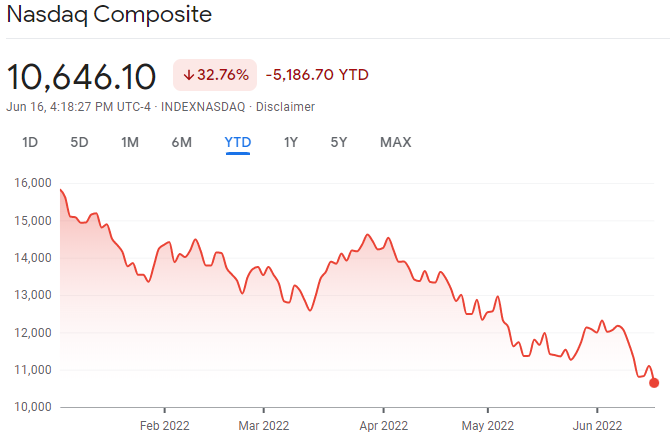
Unless you’ve been living under a rock, you probably have heard that the stock market is crashing. Year-to-date, the S&P 500 is down by 23.55% and the NASDAQ is down by 32.76%, and the Russell 2000 is down by 27.4%. The TSX YTD performance of -10.51% actually doesn’t seem too bad when we compare it to its US counterparts.
I’ll be frank. It’s tough to be an investor right now. Every day your portfolio value is probably down compared to the day before and when you check your net worth at the beginning of each month (if you check that often), it is shrinking fast like an ice cream cone inside a kid’s mouth.When the market is crashing and you’re losing your hard-earned money on paper, it can get really tough for investors. Some investors are probably losing sleep because of the beet-red stock market and want to sell everything and hide cash under their mattresses.Back in February 2020, when there were a lot of uncertainties and fear over the COVID-19 pandemic, the market tanked too. But as the uncertainties and fear cleared away, the market recovered and went for an amazing run.I’d say the current situation is entirely different than what we saw in Q1 2020. The key driver of the stock market crash is the high inflation rate.
Battling high inflation rate
Because interest rates were very low throughout 2020 and 2021, as pandemic restrictions started to lift and pent-up consumer demands for travel, cars, electronics, food, fuel, etc increased, this caused the inflation rate to rise quickly. The Russian invasion of Ukraine caused the price of oil and some commodities to soar further, which drove the CPI even higher.
Inflation rose 8.6% in May in the US, the highest since 1981 – more than four decades!. Here in Canada, we saw an inflation rate of around 6.7% in the same period. This is causing a lot of fear and angst. Both the Federal Reserve and the Bank of Canada are hiking interest rates quickly in an attempt to try to tame the high inflation rate.
Are we going to see the inflation rate start to go down quickly? Or are we’re now battling hyperinflation?
I don’t believe we’ll see hyperinflation like post-WWI in Germany and I think there’s no appetite to see inflation rates in the teens like in the early 80s. The central banks will simply not allow that to happen under their watch. But I have my doubts that the inflation rate will start to go down quickly.
I believe interest rates are still way too low and both the Fed and the BoC should be raising interest rates more aggressively (the Fed did hike interest rates by the biggest amount (0.75%) since 1994 recently). Can we agree that the central banks were too slow in reacting to the pandemic recovery and the pent-up consumer demands? Interest rates probably should have gone up last year but didn’t because there were still a lot of pandemic-related uncertainties.
One thing to keep in mind is that the Fed and the BoC are being very careful about hiking interest rates too quickly. Since many people purchased properties during the past couple of years in a heightened housing price period, some of them do not have additional cash each month to pay for higher mortgage interests. If the Fed and the BoC start to raise interest rates too quickly, this can cause people to default on their mortgages, creating a housing crash, similar to what we saw in the US during the financial crisis. (Apparently nearly 1 in 4 Canadian homeowners ay they’d have to sell their home if interest rates rise more, according to a survey)
Interest rates also impact the unemployment rate. As interest rates rise, companies may decide to freeze hires and lay off people to reduce operational costs and company debt levels. As people lose their jobs, they won’t spend as much money buying things and may have issues paying off mortgages and consumer debt. High unemployment rates also hurt the country’s GDP.
As you can see, interest rates can create a lot of cascade effects and this is why monetary policy can be a very interesting topic.
So what’s my guess when it comes to the high inflation rate? My guess is that the high inflation rate will peak and flatten out later in 2022 or early 2023 before it starts to trend down to the inflation target rates in late 2023.
That’s just a pure guess on my part. As we all know, it is nearly impossible to predict the future.
How do interest rates affect the stock market?
Well, as interest rates go up, the yield for new bonds also goes up. Since bonds are safer than stocks, once bond yields reach a certain rate, bonds become more attractive to some investors and money starts to shift from the stock market to bonds. As people sell their stocks and buy more bonds, this puts pressure on the stock market (remember, stock prices are determined by demand and supply).
Furthermore, rising interest rates mean it is increasingly expensive for businesses to take out loans. So rising interest rates typically have a negative impact on companies that require a lot of new capital to grow. Tech companies usually are considered in this bucket, hence we’re seeing the likes of Amazon, Google, Tesla, Apple, and other major tech companies’ stock prices dropping like stones in the water.
Warren Buffett has repeatedly compared interest rates to gravity, as they represent the risk-free rate of return available to investors. This in turn affects the relative value of other assets. Since high interest rates make borrowing money more expensive, leveraged bets are therefore discouraged.
“The most important item over time in valuation is obviously interest rates,” Buffett said last year. “If interest rates are destined to be at low levels. … It makes any stream of earnings from investments worth more money. The bogey is always what government bonds yield.” Continue Reading…


 Posted By