


All posts by Financial Independence Hub

How the smart home can save you money on energy

Vector concept of smart house or smart home technology system with centralized control of lighting, heating, ventilation and air conditioning, security and video surveillanceBy Dani Nicole

Special to the Financial Independence Hub

You know money doesn’t grow on trees, but did you know your efforts to live a greener lifestyle at home can save you money?

A great way to start is by managing your home’s energy consumption. At Home Improvement Leads, we’re always searching for innovative tech and frugal tips to conserve energy and boost savings. Here are a few of our favourites:

Make Your Home Smarter

We’ve come a long way from the first clunky cell phones. Now, you can control your home’s energy usage from your smartphone. We love innovative tech that makes our home routines more convenient — like smart thermostats. A popular homeowner favorite is the Nest, which actually learns your heating and cooling behaviors and implements an automatic schedule.

frug1You can monitor everything right from your smartphone or tablet, which means you can turn the A/C or heat down when you’re going to be gone for a while, then crank it back up when you’re on your way home.

Smart outlets are great money-savers, too. Plugging appliances and electronics into smart outlets allows you to control everything from an app. Did you leave the iron on at home? No problem. It just takes a few clicks to turn everything off and give you peace of mind. These tech solutions are inexpensive when you think about how much money you can save on your monthly utility bills.

Double Up Your Window Panes

Continue Reading…

What Is the Income Factor in U.S. Equities?

blog-see-more-dividendschris_gannatti_crop-bwBy Christopher Gannatti, Associate Director of Research, WisdomTree

Special to the Financial Independence Hub

The factor discussion is gaining popularity in the world of smart beta indexing. Size, value, momentum, minimum volatility, quality—these are all factors in the current discussion, and for the initiated they are becoming part of the common index lexicon.

But are investors really looking for these specific factors by name? We explore how these factors relate to real-world investment goals.

Translating Factors into Investment Goals

Some commonly referenced investment goals are:

• Keeping principal stable for unexpected expenses and emergencies

• Generating a certain average annual return to meet future goals in retirement

• Drawing income in order to meet planned expenses

We focus on income, as WisdomTree was the first to create a suite of U.S. equity Indexes weighted by cash dividends.

Defining the Income Factor

Continue Reading…

Super Longevity: The 100-year life in a Blue Zone

 the-100-year-lifeBy Mark Venning, ChangeRangers.com

Special to the Financial Independence Hub

If you accept the global average life expectancy as tabled by the World Health Organization (WHO), which currently rests at 71.4 (all factors calculated), it’s hard to imagine taking any projections fourteen years out to 2030 up to age 80, let alone 100.

There is no denying that the number of centenarians has increased in certain parts of the world, and I’m sure there’s a spot in a Blue Zone I can sell you on moving to, if you can’t begin one in your own back yard.

Canada, at an average life expectancy of 82.2, may not be a designated Blue Zone, but if you like the WHO’s info graphics colours, I’ll take Canada’s dark green – a lush, promising shade for an age of longevity. How fortuitous then, in the green of early July, that I should happen to be reading The 100-Year Life by Lynda Gratton & Andrew Scott, another volume written in the re-think aging category of a contemporary western world.

100-year life

Continue Reading…

Affordable Housing: Is it worth it to “Drive until you Qualify”?

DCIM100MEDIADJI_0412.JPGBy Penelope Graham, Zoocasa

Special to the Financial Independence Hub

It’s an affordable housing conundrum for many downtown city dwellers: is it worth it to trade the convenience of urban living for suburban sprawl? As Toronto real estate prices continue their ascent, the only affordable way to own a detached house seems to be packing up and moving beyond city borders.

Hence the term “drive until you qualify”: the practice of moving far away to a region where real estate is still affordable. Doing so often means assuming a long daily commute to and from a bedroom community to an urban business hub – and the need to drive to the nearest corner store just to pick up some milk.

An Urban Exodus

But logging more time behind the wheel doesn’t seem to be deterring buyers in the GTA; according to recent numbers, they’re heading to the burbs in droves.

Sales are soaring in the municipalities surrounding Toronto – 3,586 houses sold in the 905 region in August, up 24% from the previous year, according to the Toronto Real Estate Board (TREB). Townhouses are also in high demand, with 1,154 units sold. By contrast, a scant 863 houses and 357 townhomes sold within Toronto proper.

Condos were the only housing type that remained stronger in the city than on the outskirts: 1964 compared to 822 in the 905.

But is moving out of the city always an affordable decision for those looking to upgrade their real estate, or accommodate their growing families? There are a number of areas to consider.

You Won’t Escape the Bidding War

Continue Reading…

Fixed Income: What about inflation?

WT_Blog_722x140_FixedIncome

kevin-temp2By Kevin Flanagan, Senior Fixed Income Strategist, WisdomTree

Special to the Financial Independence Hub

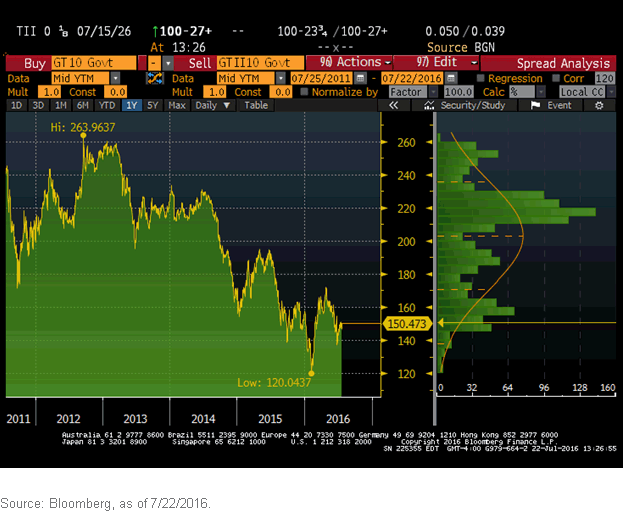
The last few months have certainly given the money and bond markets a lot of divergent news headlines to digest. Not surprisingly, the focus has been on negative rates abroad, geopolitical events and, a bit more recently, some better-than-expected employment news juxtaposed with a softer-than-expected GDP report. That begs the question: What about inflation? Isn’t that a key ingredient in the bond market mix?

Without a doubt, U.S. inflation data has taken a backseat for fixed income investors, and for good reason; there just haven’t been any fresh developments lately. Certainly, the conversation has shifted from a year ago, when deflation concerns were permeating market psychology. But the latest figures don’t elicit concerns that price pressures will be rearing their ugly head anytime soon, or at least that’s what the collective thinking is in the fixed income markets.

Breakeven inflation ratesvrGP Breakeven-Inflation-Rate

So, what does the inflation backdrop look like? According to the widely followed Consumer Price Index (CPI), the year-over-year inflation rate came in at +1.0% in June (Note 1)—very little changed from the readings posted over the last four months, but definitely higher than the +0.1% for the same month in 2015. The core gauge, which excludes food and energy, rose at a +2.3% annual clip and has been residing in a range last seen in 2012. There continues to be a large dichotomy between core goods (-0.6%) and core services (+3.2%) .(Note 2)

Continue Reading…