


All posts by Financial Independence Hub

Staying fit can save you money on Life Insurance

vitalityenglishleaderboard

By Syed Razad, LSM Insurance

Special to the Financial Independence Hub

The cost of life insurance increases as you get older. It is also more expensive for people with less than perfect health. Even if you are in perfect health today, you could become ill tomorrow or your fitness level could drop, especially if you live a sedentary life. People generally become less active when they get older. Insurance companies are now launching new incentives to help keep Canadians fit and healthy longer.

Manulife, one of Canada’s top insurance companies, is introducing an innovative new product called the Vitality Program. This product rewards policyholders for maintaining a high level of health and fitness and Goodlife Fitness is going to help with reduced membership fees.

“You make choices every day. With Manulife Vitality, you get rewarded for the healthy ones.”

This is the first time such a program has ever been offered. The Vitality Program combines the benefits of life insurance with two great features:

• The opportunity to save money on your life insurance premiums

• The opportunity to earn valuable rewards for improving your health

Continue Reading…

Top 5 Credit Card myths Busted

5-myths-blog-img

by Kevin Chu, RateHub.ca

Special to the Financial Independence Hub

Credit cards, much like any financial product, seem to create anxiety for many. With so many rumours surrounding credit cards, we decided to turn to top influencers in the community for help on busting these myths and sharing the facts.

Here are your top 5 credit card myths busted once and for all:

Myth #1: Having a credit card means you are financially irresponsible

Credit cards are a great way for you to start building credit and earn rewards from everyday purchases. If you’re spending wisely and are paying off your balance each month, credit card debt won’t be an issue.

Myth #2: Getting a credit card will hurt your credit score

The exact opposite is actually true here. The best way to establish credit is to start by getting a credit card. By paying off your debt in full each month, there’s nowhere but up for your credit score. Be wary of credit utilization though. A high utilization ratio will affect your credit score negatively.

Continue Reading…

Dividends: The Foundation of the Smart Beta Movement

blog-see-more-dividendschris_gannatti_crop-bwBy Christopher Gannatti, Associate Director of Research, WisdomTree

Special to the Financial Independence Hub

Smart beta exchange-traded funds (ETFs) are rapidly proliferating and capturing assets at a faster clip than the broader ETF industry. In 2015, 143 smart beta ETFs came to market, [Note 1] representing half of the year’s new ETF launches, or double the percentage of traditional beta products born last year.

Dividend strategies are one of the primary drivers of smart beta ETF growth. Smart beta ETFs had about $616 billion in assets under management at the end of 2015, [Note 2] and more than a quarter of that total was allocated to dividend-oriented funds.

Since the publication of the widely followed Fama-French research in 1993, outperformance of fundamentally weighted indexes has mostly been attributed to the market factor, the size factor (mid- and small caps outperforming larger stocks) and the value factor. [Note 3] Later, momentum factor was added as an accepted driver of fundamental weighting’s ability to top market cap-weighted strategies.

At WisdomTree, we believe weighting by dividends elevates fundamental indexing or smart beta. In 2006, 25 dividend ETFs [Note 4] came to market, 22 of which courtesy of WisdomTree. Our Dividend Stream® weighting methodology offers distinct advantages over weighting by market capitalization, dividend yield or focusing on the number of consecutive years that companies have increased payouts. Continue Reading…

Congratulations – Your credit score has just gone up!

Richard is the author of a soon to be released book called "What the Average Joe Needs to Know". He needed a headshot for the website and the other promotional materials related to the book. ©2011, Sean Phillips http://www.RiverwoodPhotography.com
Richard Moxley

By Richard Moxley, eCreditFix.ca

Special to the Financial Independence Hub

Congratulations – Your credit score has just gone up!

I would love to say it increased just because you are reading this article but in reality it is because Equifax has implemented a change in its algorithm (the computer scoring system that banks use to predict the chances of you paying on time).

These changes have had a huge impact on the report and 80 per cent of Canadians have seen a jump in their personal credit score. So if you were declined for financing previously, you might want to try again.

Here are some of the main changes that have been made:

Mortgage Payments now affect your credit score

As of June, your mortgage payment history now affects your credit score. If you are like most Canadians and paying your mortgage is top priority, then this will be one of the main reasons why your score has jumped.

Lines of Credit report different than your Credit Card

Before the recent changes, a high balance (any balance over half of the limit) on a line of credit or a credit card would lower your score the same amount. Now, a high balance on your line of credit will not hurt your score as much as if you have a high balance on a credit card. Continue Reading…

The search for yield ahead

WT_Blog_722x140_FixedIncome

kevin-temp2By Kevin Flanagan, Senior Fixed Income Strategist, WisdomTree

Special to the Financial Independence Hub

Unfortunately for fixed income investors, the search for yield remains an ongoing challenge. Without a doubt, a primary culprit behind the historically low-rate backdrop in the U.S. are overseas developments, as developed world sovereign debt yields have been hitting their own new lows throughout the summer.

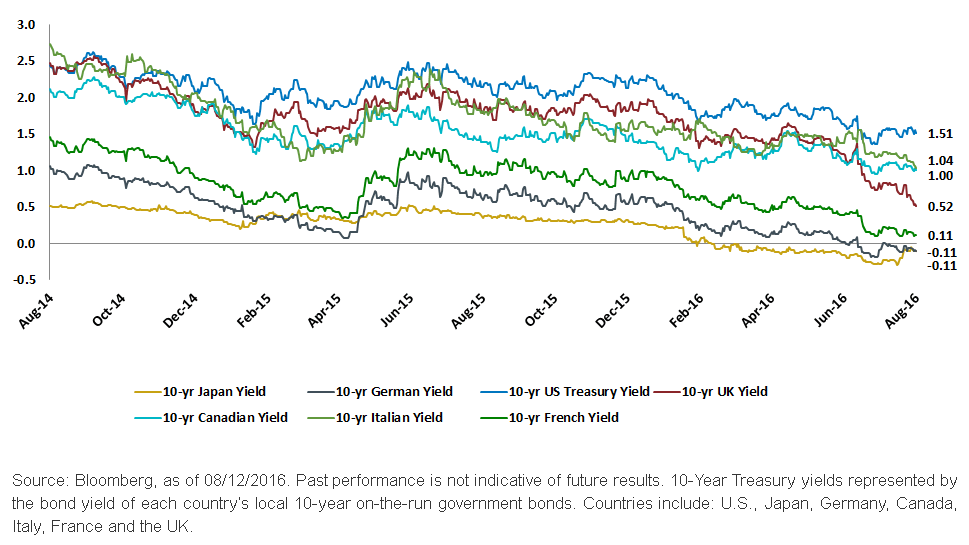
The low-rate phenomenon does not necessarily have a “center of the universe” aspect to it, either, as yield levels on a global scale are all part of this spectacle. As the graph below clearly illustrates, low sovereign debt yields can be found throughout the G7 group of nations, ranging from Japan and Europe (Germany, France, UK, Italy) to North America (U.S., Canada).

Indeed, as of this writing, the bellwether 10-year maturity ranges from a low of -0.11% in Japan and Germany to a high of only 1.51% here at home. In between, France is barely above the zero threshold, while Canada and Italy post readings around the 1% level. The UK had been the second-highest-yielding sovereign rate, but the recent Brexit fallout has 10-year gilts back into the middle of the pack, making the UK a full-fledged member of the “negative and sub 1%” club.

10-year Treasury Yields

10-yr-Treasury

The reasons behind the current — and more than likely upcoming — environment have been well documented: slow global growth, low inflation, flight-to-quality/event risks and the monetary policy responses associated with these developments.

Continue Reading…