The video, a tad under four minutes, features Inspiring Advisers’ Paul Armson (pictured left). He suggests clients of financial advisors should be looking for someone who’s more interested in you and what you’re trying to achieve than they are interested in your money.
A big test is that if you already have a financial advisor, but they only talk about the money, then that’s a clue that you might be not receiving the sort of advice that you should receive. As Armson points out, it’s not about selling the latest new funds or financial products but about coaching investors to stay the course.
Financial planning. Financial security. Financial literacy. Financial gerontology. Is it any wonder there is confusion with all this terminology floating in our heads? Not to forget the fusion.As we complete our current series on this subject, maybe it’s not a coincidence that we are now entering the annual income tax season in Canada.You can count on a barrage of advertising and news editorials to start any time now, reminding consumers about their retirement plan contributions and other related financial considerations. Turning our concern to personal financials however, should not be a once a year high anxiety moment; nor is it strictly a retirement discussion. Attention to financials issues cuts across our life course.As a financial planning consultant, Marie says in part one of this series (Nov.30, 2015), personal financial planning is the process of helping individuals and families to use their income and assets to be meet their life goals now and in the future. In that same post, as the researcher and social gerontologist, Suzanne adds that economic and financial issues are important in people’s lives on the journey of aging, but they are also important as public policy issues.Financial gerontology – public policy issueMarie Howes
Sticking with this term financial gerontology, Marie picks up here by saying that in the macro sense it is an urgent public policy issue.
Financial gerontology should become the study of aging and the implementation of measures that will meet the needs of Canadas’ aging demographic. For example, financial, psychological, and general health planning to encompass all citizens from native peoples to immigrant and ethnic communities. The risk is that it will become yet another means of marketing financial products.The problems associated with an aging demographic are not confined to governments to solve. To be sure, there are roles for all levels of government, but there are also roles for dedicated private groups and for individuals and families. Older adults must also be part of finding their own solutions.Since we have scarce resources, what is the best use of public monies to meet the unique needs of an aging population? Given the shift and size of aging demographics, it would be very easy to allocate too many scarce resources to satisfying the needs of the aged at the expense of younger people. For example, reducing education funding for younger taxpayers. In consideration of how to determine the best use of these public resources for everyone, would it not be more beneficial that we have a creative inter-generational dialogue?If financial gerontology is a society-wide, broadly based approach to the costs of aging, then personal financial planning is the specifically focused approach to an individual’s finances – whether they are young or old.Improving public awareness of how these two professional fields work, (both separately and in fusion), is the challenge, and worth repeating, says Suzanne – financial and economic issues, such as low-income seniors, pension plans and retirement savings are gerontological issues, and they are important personal and public policy issues. Financial security is important for quality of life, and this cuts across our entire life course. However, quality of life goes beyond financial considerations.
Financial & gerontological collaborations
So how do we square the circle around the potential good coming from financial & gerontological collaborations? Let’s go back to the American Institute for Financial Gerontology and their aim to educate a Registered Financial Gerontologist (RFG) on how to “deliver financial solutions in a comprehensive manner with increased knowledge of the older client’s broad based needs.”
Suzanne Cook
There is one significant difference where we say, Suzanne suggests, develop innovative ways on how to better serve “unique needs”, as opposed to deliver solutions to “broad based needs”. Terminology again. When you serve, you determine needs and respond; it is person focused. When you deliver solutions, you provide a product.
So is it possible to effectively combine Financial + Gerontology for older adults; or is it better that two different specialists are required for older client’s broad based needs?
From Marie’s viewpoint as a financial planning consulting – good advisors keep themselves up to date on developments in the financial world, and on general issues of aging, from senior housing to risk prevention in public and private spaces.
But the financial advisor is not in a position to give comprehensive advice about such things as behavioural issues, or health impacts on communities. The gerontologist can offer good background information to the financial advisor, just as the financial planner can offer realistic advice on basic financial issues for the benefit of the gerontologist.
We live in a world of specialization – mainly because there is so much knowledge out there that we cannot be effective if we try to offer services beyond our competency. Keeping up with our own specialties is a full time job!
We are also in the world of collaboration! That is the joy of thinking and writing this series together.
Marie Howes, PRP is a financial planning consultant, writer and commentator. She has a special interest in the effects of public policies on seniors, particularly in healthcare funding and delivery, and in the regulation of financial and investment advisors which can best protect aging consumers. Marie is a panelist on Planet Longevity -“Forward Thinking on Aging Issues” www.planetlongevity.com
Suzanne Cook, PhD, is a social gerontologist and researcher with a strong belief that longer life spans require a new vision of aging. Her business, Carpe Vitam, links lifelong learning with healthy aging to develop innovative programs and policies for organizations. Suzanne is a panelist on Planet Longevity -“Forward Thinking on Aging Issues” www.planetlongevity.com
One year ago I opened up an investment account with one of the new online portfolio management companies that have been taking the financial services landscape by storm. I wanted to see how these type of Robo Adviser services work and more importantly perform. I deposited $5,000 of my own money and decided to track how it performed and capture any notable observations on my blog.
So let’s dive in and check how much money my ROBO made for me this past year. First let’s look at the portfolio returns.
My ROBO portfolio lost money last year. 2.15 per cent to be exact. Then again, many stocks and ETFs lost money last year. The learning point here is that ROBO services can lose money just as well as other portfolio management services. Don’t expect any marketing campaigns to tell you this. The thing is … it’s OK. To expect ROBO advisers to be perfect and make money on every holding is unrealistic.
In terms of asset allocation of my ROBO portfolio, below is the breakdown at year-end January 28, 2016. Remember, when I setup my account, I answered a series of questions that assessed my risk tolerance and subsequently determine the type of portfolio the Robo Service would create and manage for me. In my case, because I have a high proficiency and literacy about stocks and investing, ROBO proceeded to rate me as a 9 out of 10 on the risk tolerance scale.
Almost half of married couples say their investing styles differ from that of their spouses, and about one-quarter of couples fight over money, according to a BMO survey.
While your romantic Valentine’s Day dinner may not be the best time to discuss finances, most of us agree that these discussions really do need to happen between couples. Here are a few tips that will help contribute to a sound financial future for couples.
Keep it open and honest
It’s important for couples to be on the same page when it comes to goal planning and how you intend to achieve these goals together. Adopt the “yours, mine and ours” approach and make your finances visible to your spouse so that you both will be in a better place to plan together for the future. For example, some advisors offer a consolidated household online view of their portfolio, which provides easy access to investment accounts for each spouse. Not only does that allow you to have a more holistic view of your position, but having it all in front of you at once can make it much simpler to digest.
Talk about your goals
Surely they’re not reading Findependence Day for this special night out?
Finances may not seem like fun dinner conversation, but talking about your goals can be. Start the conversation with questions like “what are your top goals/dreams?” or “where do you see yourself/us in 10-20 years”? The more you have that conversation, the better you can visualize what your goals are, and the easier they are to quantify.
Once you have identified your goals, start talking about how you will achieve them. It’ll make those goals seem less like a dream and more like a reality. Taking the first steps towards achieving those goals is one of the most rewarding feelings you can get. Continue Reading…
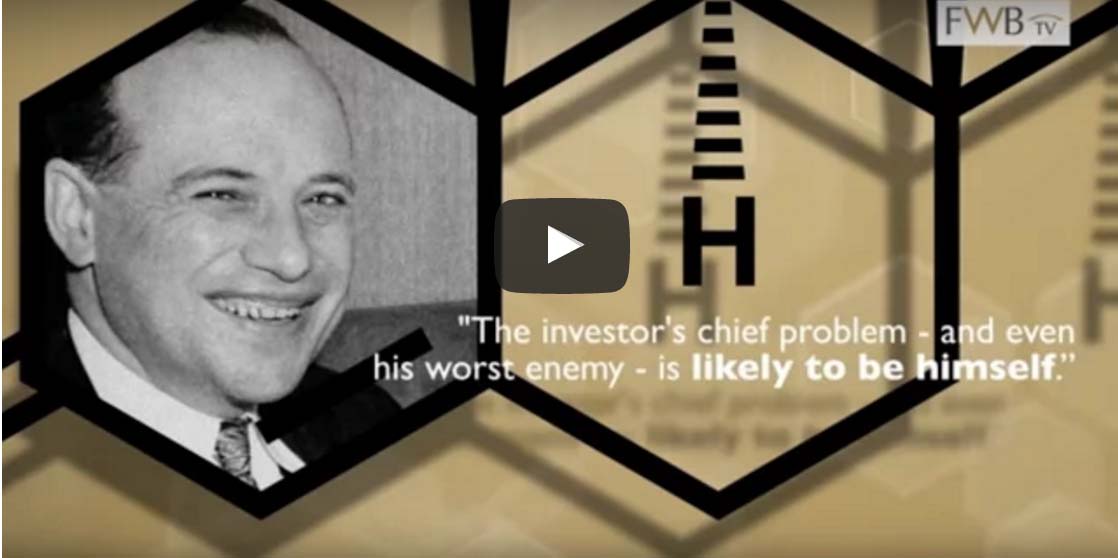
If you’re an investor, there’s a good chance the real enemy is the face you see every morning while shaving (or applying makeup!). The pithy quote in the screen shot is of course from legendary value investor Benjamin Graham.
The main point of this 4-minute video is that successful investing is about controlling what you can. You can’t control what the market does, but you can control what you do in response. In our experience, a person’s returns depend less on whether they pick great investments than on whether they can manage their emotions.
One of the experts in the video describes the physiology of stress that investors suffer during — well, times like the past few weeks! In the heat of volatility, particularly the downward variety, our emotions can get the better of us. There’s a reference to a Cambridge University study of 142 students, all male, who were invited to play a game about trading stocks. They found that the more testosterone they found in the subjects, the greater the risks they took on. Such surges of chemicals and emotion can actually affect your perception of the future, and seldom for the better!
Implications for actively managed funds
Since the Evidence-based Investor Videos largely sing the praises of passive or index investing, you might not be too surprised by a statement that this research may have some implications for investors who use actively managed funds. One source asserts that the investment industry is a stress competitive arena and many fund managers tend to be young males. The decisions they make under pressure and stress may cause them to be overconfident about the stock bets they place on your behalf.
The video concludes that investors may benefit by doing business with a rational, use unemotional advisor.
In addition, SensibleInvesting.TV has put up part 7 of the How to Win the Loser’s Game series of videos. While indexing is a relatively simple way to invest, there are still important questions index investor need to ask. Crucially, they need to ensure they are invested in a diverse range of assets that reflects their attitude to risk. They might also want to “tilt” their portfolios to particular risk factors — small-cap or value stocks, for example. While more volatile, these have been shown to deliver higher returns over the long term.


 Posted By
 The latest FWB TV video has been posted, entitled You Need an Advisor Not A Salesman.