In one of my books I’ve argued that young people should adopt the slogan “Freedom, Not Stuff” as a way to remind themselves that financial independence beats accumulating possessions via debt.
Now a survey being released by Credit Canada Debt Solutions and Capital One Canada has released a survey saying Canadians think financial security beats milestones like buying a home or a car. The two organizations are celebrating ten years of building financial literacy through Credit Education Week, which runs this week (Nov 7 to 11th).
The survey of 600 in four major regions of Canada asked consumers to share insights into their financial wins. While there’s a perception that Canadians hold the goal of home ownership above all else, the survey found that in reality, they rank milestones like buying a home (12 per cent) or car (8 per cent) as less important financial wins than feeling financially secure in their daily lives (25 per cent).
“There is so much to learn from the positive, everyday financial experiences of our friends and family,” says Brent Reynolds, Managing Vice President of Capital One Canada. “Milestone moments like a new home or car may garner more ‘likes’, but it’s the experiences not easily shared in 140 characters that are most impactful – like how we took charge of our finances or recovered from a financial stumble.”
Locked-in Retirement Accounts (LIRAs) differ from RRSPs in that you usually can’t “unlock” the funds in them before age 55.
I guess the annual RRSP season is just around the corner, based on some of my most recent writing assignments. Earlier in the week, for MoneySense.ca, I made the case for semi-retirees in their Sixties (like me!) for starting the process of withdrawing money from RRSPs early. Click on the headline Retirement Tax Tips. The Hub summary ran here under the headline The case for Early RRSP withdrawals.
As TriDelta Financial wealth advisor Matthew Ardrey told me for the FP article, you’re going to see a lot more about LIRAs in the coming years. Whether you’re leaving a classic Defined Benefit pension plan or a more market-tied Defined Contribution pension plan, the job market these days is in such flux that a lot of people are going to have to start learning about what happens when you leave an employer pension plan earlier than you might once have envisaged.
LIRAs will multiply as Boomers reach Findependence
It’s hard to believe, but the Financial Independence Hub (aka FindependenceHub.com) is now two years old, a veritable toddler!
We launched the evening of Nov. 3, 2014, several months after I declared my Findependence Day on May 20, 2014.
This is post number 802, which means we have more than exceeded our original goal of providing fresh content every day (Sundays excepted). While I try to write one or two blogs a week myself, this wouldn’t have been possible without the many guest contributors who have lent their time, energy and names to the project.
Thanks also to the early supporters of the Hub: you know who they are from the banner ads that provide a little operating cash and a lot of moral support.
Thanks too to the many individuals who registered on the site and subscribed to our daily news email. There is no charge for this service (that’s why we need some banners to defray costs): all that’s needed is to supply a valid email address.
Fram Oil Filters: “Pay me now or pay me later.” (YouTube.com)
My latest MoneySense Retired Money column was published earlier today: click on the headline Retirement Tax Tips for full version.
As I say at the end of the column, after decades of the RRSP contribution habit, I admit it goes against the grain to start decumulating. And even more so, it’s counterintuitive to pay taxes on investment funds before you HAVE to.
However, to paraphrase the famous Fram Oil Filters TV commercial, you can pay me now or you can pay me more later — much more later. (For the famous 1972 “Pay me now or pay me later” Fram Filter ad, click on this YouTube link.)
Since tax is one of the biggest, if not THE biggest expense in retirement, I’d rather pay a little tax now prematurely than a lot of tax later.
Live on early RRSP withdrawals and defer CPP benefits
Emeritus’s Doug Dammer
So what has this got to do with RRSPs and taxes? As the column points out in detail, citing Emeritus Retirement Solutions’ Doug Dahmer, at some point those great tax refunds from decades of RRSP contributions eventually come back to haunt you. Usually that’s when you turn 71 and are forced to start making annual, and taxable, withdrawals from Registered Retirement Income Funds or RRIFs. (you can opt instead to annuitize or to cash out and pay a ton of tax upfront).
In practice, most will choose to take RRIF withdrawals starting at the end of the year you turn 71, but if you also have a good employer pension, the usual government pensions and other income sources, there’s a good chance some of those withdrawals will be at or near the top marginal tax rate, which these days ranges from 46% to more than 50%, depending on your income and the province in which you reside. And as the MoneySense column mentions, if you’re in the OAS clawback zone, you may have to add a further 15% to the government’s haul.
But if you’re semi-retired and “basking” in a relatively low tax bracket in your Sixties, you may be able to start withdrawing RRSP funds earlier than necessary, which may make sense if it’s only being taxed at 20 or 30%. Plus, as Dahmer suggests, by living on some of this relatively low taxed early RRSP funds you can defer the receipt of Canada Pension Plan (CPP) benefits and possibly Old Age Security benefits to as late as 70.
Every year you can defer taking CPP by living instead on early RRSP withdrawals, the CPP benefit will be 8.4% higher. Dahmer poses the rhetorical question whether your RRSP can generate an annual return of 8.4%. These days you certainly can’t generate that return with fixed-income and after all, we’re talking about people who by now should have a good percentage (perhaps 50%) in fixed-income. You may or may not get 8.4% from stocks but if you do, you’re also subjecting your portfolio to possible capital losses.
Jon Chevreau on Peter Armstrong’s On the Money: CBC.ca
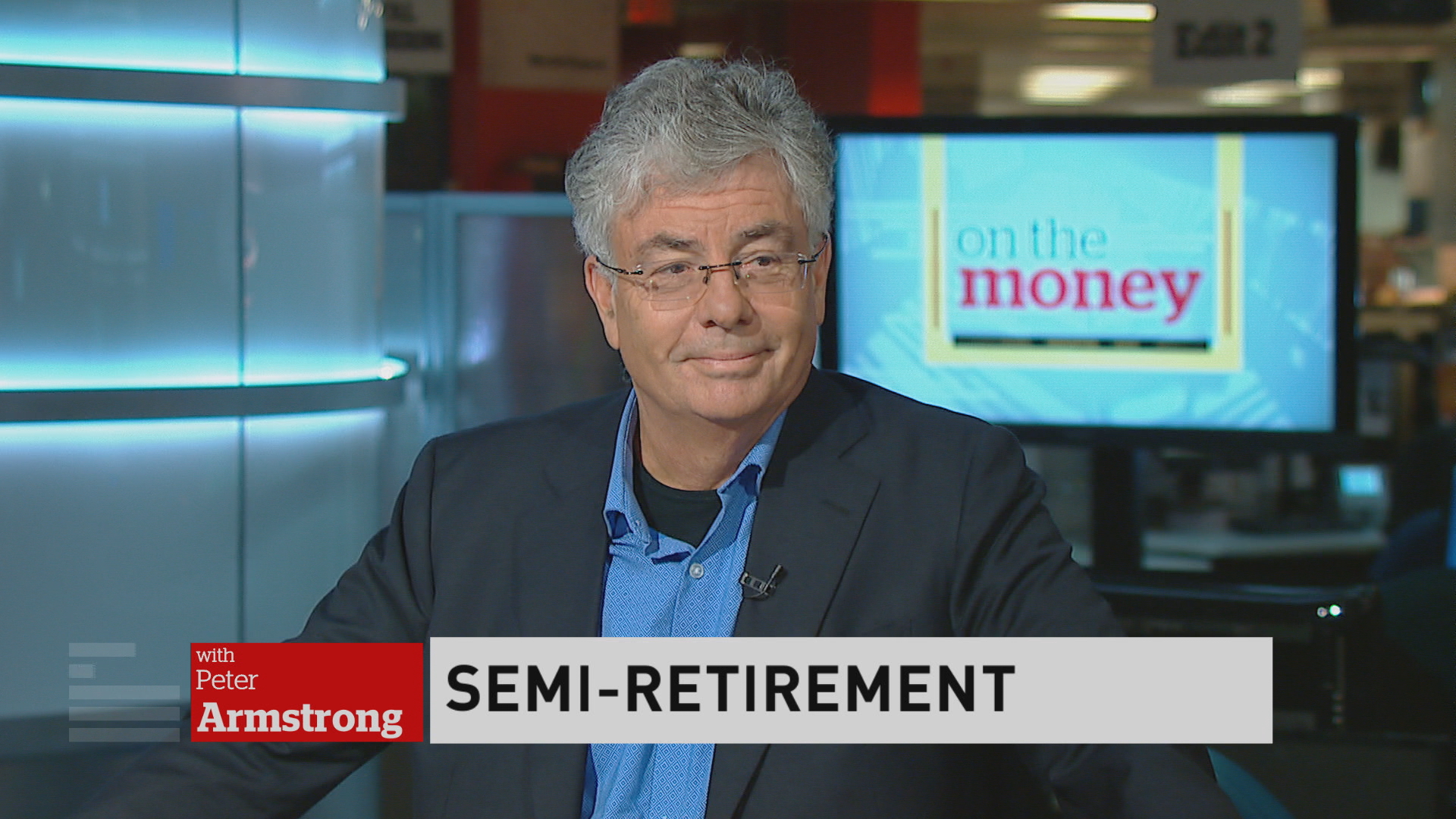
My recent blogs on Semi-Retirement seem to have struck a chord. After I wrote this online piece for MoneySense.ca: Semi-Retirement is the Future (and a version here on the Hub, under the headline The Next Boomer Wave: Semi-Retirement), I was interviewed by Peter Armstrong at CBC TV’s On the Money Show.
The context of the CBC’s Tips for Boomers segment was in part my new book Victory Lap Retirement, written with Mike Drak, who describes it as a “retirement book about NOT retiring.” The first of several excerpts ran in the Financial Post on Monday.
CBC’s Peter Armstrong (Twitter.com)
After the CBC segment aired, Peter published his own blog covering similar territory, which you can find under the headline You’re Never Going to Retire — and Here’s Why. He picked up on my statement that the Millennials are going to live a long time and therefore will have an 80-year investment time horizon. I mentioned that a few weeks ago, when I gave a talk to T.E. Wealth in Ottawa about financial advice for Millennials.
Long-lived Millennials need to be mostly in stocks


 Posted By