Hub Blogs contains fresh contributions written by Financial Independence Hub staff or contributors that have not appeared elsewhere first, or have been modified or customized for the Hub by the original blogger. In contrast, Top Blogs shows links to the best external financial blogs around the world.
In 2021, the Canadian ETF market once again showed its ability to innovate as the first jurisdiction to allow crypto-currency ETFs.
This reaffirms one of the core benefits of ETFs, as access to vehicles for harder-to-trade asset classes, where — just like gold and other commodities — ETFs have brought cryptocurrencies to the mainstream by providing efficient trading over the exchange.
We’ve now seen the listing of over 30 tickers across providers, with over $5 billion in assets.1 Starting in February 2021, and quickly followed by further products, Purpose Bitcoin ETF (ticker: BTCC) captured global attention and earned outsized trading volumes. For investors who can stomach the volatility, crypto-currencies via an ETF have provided another portfolio tool, with the benefit of low correlation to traditional asset classes.
A small crypto allocation can have meaningful impact on returns
Crypto-currencies provide quite a ride, from the sell-off in the summer, to the rapid rise in the fall, and now a further correction late in the year, they have experienced volatility of around 70% standard deviation since market entry, showing that a small allocation can still have a meaningful impact to portfolio returns.
Another ETF trend where we are seeing volatility right now is within innovation stocks. After a gangbuster run for innovation in 2020, many of these stocks reversed course, moving into correction territory by the end of 2021. This is due to several factors: the market rotated into value and out of growth, rising interest rates and yields added pressure on growth stocks’ future cash flows, and inflation fears pushed investors towards more defensive industries. Continue Reading…
By Duane Ledgister, vice president, Connor Clark & Lunn Private Capital
Special to the Financial Independence Hub
Inflation has moved to its highest level in decades, with higher prices resulting from strong economic growth led by pent-up demand for goods and record levels of government spending.
At the same time, strong demand is leading to supply shortages. When we look at the components of inflation, we see recent price increases are largest in industries hurt the most during the pandemic, such as energy. These industries are cyclical and are pulling inflation readings higher as prices recover after a period of decline.
Higher prices in the short term are expected to be tempered as supply adjusts and demand returns to more normal levels, and while policy actions such as higher spending and larger debt levels have increased short-term inflation, the same forces are deflationary long-term. This is because more money goes to paying down debt as opposed to future investment. The caveat is that higher debt levels encourage policymakers to allow inflation to move higher than it has been in recent cycles. Accordingly, inflation will be higher but not at the disruptive levels we saw in the 70s and 80s.
Impact of inflation on your investment allocation
Now is a good time to consider its effect on different asset classes that make up a portfolio. Real diversification is much more involved today than you would have been told before.
Stocks can generally do well in a period of moderate inflation, whereas fixed income is hurt the most. Alternative asset classes — which most investors have little exposure to, and should begin evaluating — also have some natural protection from inflation.
Equities
Moderate inflation is a double-edged sword for stocks: increasing corporate cash flows while decreasing the real value of investment returns. Companies with high valuations tend to underperform as their valuations are based on future earnings growth long into the future. In a period of higher inflation, these future earnings are now worth less today. Companies with lower valuations, called value stocks, do better in a period of above-average inflation. Strategically it makes sense to hold both growth and value styles within your equity allocation.
Fixed Income
The bond allocation of a portfolio is the one that is hardest hit by inflation, because most bond coupon payments do not increase with inflation, and bond yields tend to rise when inflation is moving higher. The result is both a temporary decline in the price of bonds and lower long-term real return. The negative effects of rising inflation and yields can be managed by holding short-term bonds and higher coupon bonds. The former is less sensitive to changes in inflation and yields. This protects capital when inflation is rising. The latter have more income to offset price declines.
Having a view of the economic backdrop and managing a bond portfolio’s sensitivity to changes in yields and inflation is important to delivering risk-adjusted returns, particularly true when inflation is on the rise.
Alternatives
This is where real diversification can pay off. The alternative asset classes in a portfolio are attractive since they generate strong levels of income relative to traditional equities and bonds. They also tend to be the least sensitive to risks in the broader economy, including inflation. Private market investments (real estate, infrastructure, and private loans) should have natural inflation stabilizers. For real estate, rental income tends to rise with inflation and infrastructure contracts may have ongoing inflation adjustments. Finally, private loans income rises as yields and inflation move higher. Continue Reading…
It’s scary times for everyone, investors included. As this site focuses on Financial Independence, I’ll try in this blog to direct readers to some useful sources of financial advice.
We’ll start with MoneySense, since in my role as Investing Editor at Large, I’m on top of much of the investing content there.
First, I’d point to Allan Small’s article that appeared over the weekend: The Meaning of market swings and why you should care. Allan recaps current trends in rising inflation and rising interest rates, noting that geopolitical uncertainties can create buying opportunities on certain stocks:
“The key is to make sure your portfolio is diversified. It’s the best — and cheapest — strategy to protect your portfolio in any environment. Balance it with different sectors of the economy.”
Second, Dale Robert’s weekly market wrap for MoneySense always has plenty of good insights into up-to-the-minute market action. His February 27th instalment of Making Sense of the Markets is particularly instructive. Hub readers will be familiar with Dale’s own site, Cutthecrapinvesting, as we regularly republish Dale’s blogs here on the Hub (with his kind permission, of course!).
“Even a few weeks ago it was easy to predict what would help investors make their portfolios more battle-hardened. Gold and energy certainly rose to the unfortunate occasion.”
Ever since Covid hit, Dale has been furnishing sound investment ideas, often ahead of the rest of the financial blogosphere. For example, he was one of the earliest to sound the alarm that Covid would be a serious problem for investors. He was also early in recommending energy plays like Eric Nuttall’s Nine Point Energy Fund (NNRG) and inflation-fighting recommendations like the Purpose Real Assets ETF (PRA.) That’s one reason why we included Dale as a panelist in MoneySense’s yearly ETF All-Stars feature: the 2022 edition will be out this spring, albeit under the direction of a new writer, Bryan Borzykowski.
No one ever made a dime panicking
How am I responding to the financial aspect of this crisis? Well, as Mad Money’s Jim Cramer often reminds readers in such times, “No one ever made a dime panicking.” Just yesterday, The Successful Investor publisher Patrick McKeough reminded Hub readers that short-term investment decisions all too often sabotage long term returns.
Patrick has been hugely consistent over the years with the following three-fold guidelines, which are as relevant during this Ukraine crisis as in they are in sunnier times:
1.) Invest mainly in well-established, dividend-paying companies;
2.) Spread your money out across most if not all of the five main economic sectors (Manufacturing & Industry; Resources & Commodities; Consumer; Finance; and Utilities);
3.) Downplay or avoid stocks in the broker/media limelight.
In his Inner Circle Advice bulletin issued after Tuesday’s market rout, McKeough titled one section “Putin goes for broke” while urging investors to stay the course if they adhere to the three points above:”In the past third of a century, Russia has gone from dictatorship to fledgling democracy and back to dictatorship. If his Ukraine venture goes awry, it could be the end of the Putin era and the start of a new try at western-style government for Russia.
“Meanwhile, we advise sticking with your portfolio if your investments are in tune with our Successful Investor directives. Now, though, is a good time to re-emphasize that recent IPOs tend to be a poor investment choice, on average. But that’s especially so in a market situation like this one, in which volatility is likely to be above average for some time.”
Some other newsletters to which I subscribe recapped historical market action in advance and during prior outbreaks of war and invasions; generally they found that investors who “bought the invasion” eventually did well.
On the other hand, in an article in the Globe & Mail this Monday, veteran commentator Gordon Pape suggested it wouldn’t hurt to raise cash where you have significant capital gains: while they’re still gains. You can find the article, albeit paywalled, by clicking on this highlighted headline: Investors should take these steps to protect their portfolios from the Russia-Ukraine conflict. Pape also warned, as have many pundits, that if Russia does get away with its Ukraine invasion, it may embolden China to make a similar move on Taiwan. Continue Reading…
Tick-tock, tick-tock. The March 1 deadline for RRSP contributions that can be claimed against your 2021 income tax return is tomorrow. If you’re among the thousands of Canadians who haven’t put money into their RRSP this year, you still have time to take advantage of this government-sponsored, tax-deferred retirement savings plan.
Whether you’re a last-minute RRSP contributor or one who invests towards retirement regularly, it’s important to take a strategic and disciplined approach to how you fund and invest in your RRSP. Here are some pointers to consider in 2022 and beyond.
Thinking of borrowing? Think about your strategy
With interest rates still staying low by historical standards, it may seem like a good idea to borrow money to invest in an RRSP. It can be if you proceed with a well-considered strategy. As a starting point make sure you have a plan for repaying the loan as quickly as possible while committing to your investment for the long-term. It’s also important to choose investments most likely to yield a return that’s higher than the interest rate on your loan.
Consider tapping into your TFSA
Instead of borrowing, you may want to consider transferring some money from your TFSA into your RRSP. This allows you to get the tax deferral from your RRSP contribution without triggering tax on the money you’re taking out of your TFSA. At the same time, TFSA rules allow you to re-contribute the following year the amount you withdrew. Just as you would if you were borrowing, make sure you have a plan for repaying your TFSA.
Don’t miss out on employer matching
Take full advantage of company-sponsored programs that match RRSP contributions. In addition to the regular contributions deducted from your pay, ask your employer to direct any bonuses coming your way straight to your RRSP. At some companies, it’s standard practice to pay bonuses in February as a way to help employees maximize RRSP matching benefits. Accept the help and put that hard-earned bonus towards your retirement.
Mind the investments in your RRSP
When it comes to investments, don’t just set it and forget it. Keep an eye on the investments inside your RRSP and review your asset allocation regularly with your financial advisor to make sure it continues to align with your goals and risk profile. Continue Reading…
It’s no secret that yields on fixed income investments have been in a prolonged slump for decades, challenging both individual investors to meet their income needs and institutional investors like pension funds and insurance companies to deliver on their obligations to retirees.
While some investors have moved further out the fixed income risk spectrum in pursuit of higher yields, others are diversifying their income sources by adding to their investments in shares of dividend-paying companies.
Dividends are playing catch-up
Despite recovering economic conditions, dividend-paying stocks lagged the overall market in 2021. Given continued uncertainties directly and indirectly related to the COVID-19 pandemic, dividend growth in general reflected some conservatism. Many factors influencing earnings growth in 2021 were sector-specific. Some industries continued to deal with subdued demand compared to pre-pandemic levels, while in other cases, regulators prohibited dividend increases at the onset of the pandemic.
Lately, however, dividend payers’ shares have performed well for several reasons:
Despite rising inflation, supply-chain pressures and labour shortages, corporate fundamentals have generally remained supportive as revenues, earnings and profit margins have continued to perform well.
Valuations for many dividend stocks are firmly anchored to those fundamentals, insulating them somewhat from market concerns over valuations in a higher-rate environment.
In addition to many companies initiating, restoring or raising their dividend payouts, the share prices of many dividend-paying stocks benefited from market momentum in a “best of both worlds” environment.
Market sentiment has shifted in response to signals from both the U.S. Federal Reserve and the Bank of Canada indicating a faster pace of interest rate increases in combination with quantitative tightening.
Dividends likely to grow
The average earnings per share growth for the Canadian S&P/TSX Composite and the U.S. S&P 500 Indices spiked last year. Dividend increases were broad-based throughout the year. Barring any major economic setbacks, we expect continued steady dividend growth from companies across many sectors. Average cash as a percentage of total assets held by constituents of the S&P/TSX Composite Index is at levels not seen in more than 20 years: another positive development for dividend growth.
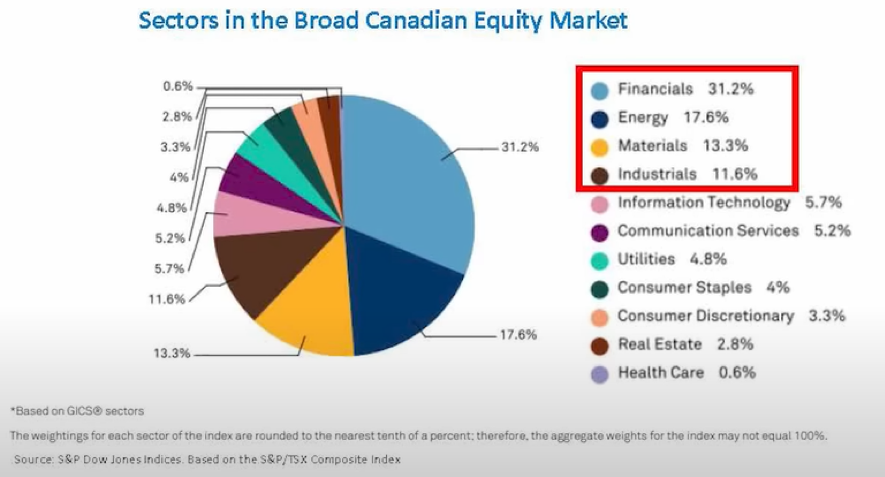
In Canada, we are finding certain sectors particularly attractive:
Financials: Banks are an example of dividend growth held back by regulators from the pandemic’s onset. In 2021, even though earnings grew, dividends were temporarily constrained; however, this restriction was lifted last November. Most recently, we have seen the Canadian banks increase dividends between 10% and 25%, but we believe there could be room for further increases. Banks retain excess capital, and at the very least, we believe the group will resume their annual pattern of increases from this point. In our view, Canadian banks are on very solid footing and offer some of the most attractive valuations.
Commodity-related: Commodity prices are high as economic activity resumes from pandemic lows, which is positive for the energy and materials sectors, and by extension, industrials. We have seen a remarkable recovery in oil prices since the precipitous drop in the spring of 2020 when the global economy shut down in response to the spread of COVID-19. At that time, a number of energy stocks had their dividends cut as the depth and duration of the economic downturn were unknown.
Since then, the oil and gas sector has staged a dramatic comeback, with higher prices boosting cash flows. Along with the recovery of prices, we also have seen a significant pick-up in dividends. Companies are employing various dividend strategies. Some prefer methodical increases to the base dividend level at a rate sustainable under a range of commodity price scenarios; others are considering variable dividends or periodic special dividend payments on top of the base dividend level. We believe boards and management teams are exercising a certain degree of caution to avoid being vulnerable if oil or gas prices experience a sharp decline in the future.
Real estate: In certain property categories (primarily retail), real estate investment trusts (REITs) had to absorb higher vacancies and deferred rent payments from tenants as stores were temporarily closed due to pandemic restrictions. These stresses often manifested as flat cash distribution profiles or, in some cases, temporary reductions in distributions. Although it’s too early to be certain of a return to historical norms across all property classes, we are seeing encouraging signs in rents and occupancy, and we note some REITs are again raising distributions.
Utilities and telecoms have maintained their dividends throughout the pandemic and we expect their dividend growth trajectories will be in line with historical experience.
Risks and opportunities
Consistent and growing dividends are characteristic of higher-quality, established companies that by definition tend to sit comparatively lower on the equity risk spectrum. It’s important to remember that like any stock, they are subject to equity market levels of volatility; but stable to growing dividends can reduce part of that risk as investors continue to receive income distributions even in a volatile market. In a rising market environment, investors could benefit both from the dividend yield and a higher stock price. Continue Reading…