Hub Blogs contains fresh contributions written by Financial Independence Hub staff or contributors that have not appeared elsewhere first, or have been modified or customized for the Hub by the original blogger. In contrast, Top Blogs shows links to the best external financial blogs around the world.
One day as I was perusing the world wide web, I came across a posting about DRIP investments, which ran in the new blog by PWL Capital’s Justin Bender.
What caught my eye had nothing to do with DRIP investments but more about a comment made at the end of article that really got me thinking. It said:
“…Investors should be focusing their attention to more important investment decisions that are likely to have a bigger impact on overall success (such as savings rate, expenses, risk, fees, taxes, and behaviour)…”
Make no mistake, these are important factors in developing your investment ideology or strategy. However, these elements just get you into the game of investing; on their own they are not going to guarantee you will be successful. Continue Reading…
Click above link for the full article. I’ve reproduced the ten headings below, after which I make a few additional observations, based on my own transition in 2014 from employment (21 consecutive years of it.)
The bottom line is this is what Findependence (Financial Independence) is all about, and the raison d’être of this website. In fact, the cover of the US edition of my book on Financial Independence is very similar to the illustration to the left, except that the calendar date circled is Findependence Day.
As I note below, there may also be good reasons NOT to quit your job in 2015 but instead in 2016 or later. I wrote the original Findependence Day in 2008 but the day didn’t actually arrive until 2014, so you could say it was six years in the making. Sometimes, big life events need to be planned out that far ahead.
In any case, here are the ten reasons for quitting sooner than later: Continue Reading…
Ah, life was so simple when all we had were Defined Benefit pension plans! I sometimes envy my late father, who only had to invest in GICs (Guaranteed Investment Certificates) to supplement his inflation-indexed Ontario Teachers pension. Just like a salary, that guaranteed pension flowed in like clockwork, including a healthy survivor’s benefit after my father predeceased my mother.
Unfortunately, such pensions do not pass to the next generation and it’s becoming harder to find employers that offer new employees DB plans: even if you’re fortunate enough to be in one, you may be subjected to pressures to switch to a Defined Contribution Plan, putting stock-market risk squarely on the pensioner’s shoulders instead of the employer’s.
Decumulation Issues similar with RRSPs and RRIFs
Since RRSPs behave quite similarly to DC pensions, the issues are almost the same, both on the wealth accumulation side as well as what we call the Decumulation side. (Here at the Hub, we have sections devoted to blogs on either topic).
Unlike DB plans, members of DC plans need some employer-supplied education so as to optimize both the wealth accumulation as well as the ultimate decumulation that is the ultimate raison d’être of any pension. Por says an OECD study found most employer communications programs about DC pensions were rather ineffective in improving the behaviour of the plan members when it came to investing decisions. The average score of such programs was only 10 out of a maximum 100. (a range of 50-60 is considered effective).
Anyone near retirement and without significant income from old-fashioned DB plans well knows the stress of seeing RRSP or RRIF values fluctuate with financial markets. As Por notes, one reason for the disappointing DC scores is this:
Plan members are expected to make complex decisions about an uncertain future … Members are expected to make the same or even more difficult decisions as chief investment officers (CIOs) of large pension funds.
His fifth point is also instructive:
Educators fail to recognize the inherent challenge of overcoming limitations imposed by human nature, such as people’s hard-wired biases and heuristics.
Most DC plans do a good job educating members in the Accumulation years. Por says default options can guide more than 80% of members to a well-diversified efficient portfolio at low costs. But it all breaks down just when the money is needed at retirement:
Unfortunately, much of this support disappears at the decumulation decision— the very point where complexity explodes. Yet 60 cents of every retirement dollar are paid by returns earned after retirement as the direct result of decumulation decisions.
Por delves into behavioural economics, noting that one reason retirees shy away from annuities is that they “discount” the value of the tradeoff involved in converting capital to long-term secure income stream that should last 20 or 30 years.
While Por’s focus is DC plans, remember that the decumulation issues are also quite relevant for those planning for the transition from RRSPs to Registered Retirement Income Funds (RRIFs). But with 9 million Canadians set to retire in the next 15 or 20 years, he’s optimistic that employers and financial institutions will rise to the Decumulation challenge:
Canadian society will produce 1,500 retirees every working day for the next 20 years, and financial institutions have an overriding interest in serving them. As these institutions vie for asset decumulation, competition will result in better financial products and more effective education efforts.
Since I expect robo-advisers will make great strides in 2015, it’s perhaps fitting that the first full week of the new year kicked off with an announcement that Vancouver-based WealthBar is rolling out it service across the rest of Canada.
WealthBar, which describes itself as the country’s “only full service online adviser,” issued a press release Monday advising that it has registered with each provincial regulator across Canada. The company uses low-cost ETF portfolios to deliver online personal financial planning.
Human advice alongside the “robo” advisor
And while it does use the inevitable term “robo-adviser” in the release, it hastens to clarify that the service also includes “access to a real live financial adviser for less than half the cost of most mutual funds.” This “personal financial adviser” will answer specific questions about investing and insurance and provide help with financial plans.
“We’d like to help all Canadians understand how to save money effectively and efficiently,” says Tea Nicola, CEO and co-founder of WealthBar (and daughter of well-known Vancouver financial planner John Nicola). “It’s about knowing how and when you will reach your goals as well as getting the right advice to make the best decisions whenever personal circumstances change.”
Ms. Nicola says WealthBar’s financial planning tool is free to use for everyone. Currently, anyone who signs up also gets a free planning session with a human financial advisor. “We understand that human touch is still important for good financial planning so we made the advisor a key part of the WealthBar experience right from the beginning.”
For more, see www.wealthbar.com. And for more background on roboadvisers in general enter the term here at the Hub’s search engine on the top right of the main page. (While the release spells it as “roboadvisor” we at the Hub are sticking with MoneySense’s use of the e in adviser and so robo-adviser).
Over the holiday break I’ve been reading about Russia and its president, Vladimir Putin, who came to power at the turn of the millennium. As one of the three books flagged below points out, Russia is the only power that has the capacity to destroy the United States in a nuclear strike. Those who assumed the west “won” the Cold War when the Soviet Union collapsed in 1991 should keep reading. From Ukraine to the War in Syria and the battles over gas pipelines and the plummeting price of oil, Russia is very much in the news as we enter 2015. It’s a fascinating story in itself but investors will find it of particular relevance.
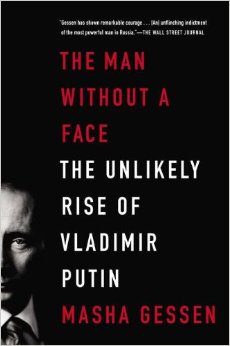
The Man Without a Face
Before his surprise appointment by Boris Yeltsin, little was known about the former KGB (now FSB) operative, which is why Masha Gessen titled her 2012 book about him The Man Without a Face. Subtitled The Unlikely Rise of Vladimir Putin, the gutsy Moscow-based veteran journalist pulls no punches about the true nature of Putin’s Russia.
She traces Putin’s formative years in a chapter entitled “Autobiography of a Thug.” Continue Reading…


 Posted By