Hub Blogs

Hub Blogs contains fresh contributions written by Financial Independence Hub staff or contributors that have not appeared elsewhere first, or have been modified or customized for the Hub by the original blogger. In contrast, Top Blogs shows links to the best external financial blogs around the world.

Financially Surviving a High-Net-Worth Divorce

Unsplash

By Devin Partida

Special to Financial Independence Hub

Navigating a divorce can be stressful, especially if you have considerable financial assets. While legal separations can be nasty, they don’t have to be.

Discover what counts as a high-net-worth divorce, along with some tips to help you survive it with most of your financials intact.

What is a High-Net-Worth Divorce?

Traditionally, high-net-worth divorces are considered a split of US$1 million dollars between parties. Considering the increased property values and inflation in recent years, a high-net-worth divorce now involves several million dollars worth of financial assets. If you have assets amounting to this sum, you’re looking at a high-net-worth divorce in your hands.

What makes High-Net-Worth Divorces complicated?

Divorce in the U.S. is still prevalent, with estimates that 50% of first marriages will most likely end in divorce. That’s a lot of legal proceedings and assets to divide. Parties with fewer assets to divide often have more uncomplicated legal matters to resolve.

Divorce proceedings get more complex since you have millions of dollars worth of assets to take care of. Many factors come into play, like assets and liabilities acquired before and after the marriage, businesses owned by either or both spouses and investment or pension plans.

Tips on how to Safeguard your Interests during and after a High-Net-Worth Divorce

Wealthy couples typically have a lower divorce risk, but there may come a time when one or both parties decide to call it quits. Although high-net-worth divorces typically involve top-caliber lawyers and advisors, it’s still essential to research what to expect during legal proceedings. Doing so will help you prepare better for the process and safeguard your financials.

Get Expert Legal and Financial Advice

Divorce can be a physically, mentally and emotionally draining process. It’s also time-consuming if you have no idea how to proceed. Getting expert legal and financial advice can save you time and money, especially if you hire lawyers who have your interests in mind.

Hiring an expert mediator is one of the most underrated ways to ensure smooth divorce proceedings. Divorce mediation involves protecting both parties and safeguarding their interests from a neutral standpoint: each side gets what is rightfully theirs, no more and no less.

Know which Assets to Protect

Distinguishing between marital and separate assets is critical to protecting your financials in a divorce. You must ensure you know the value of your assets like properties, businesses, investments and so on. Catalog them depending on their classification so you know which assets to protect from division.

Here’s what you need to know about the difference between marital and separate assets. Continue Reading…

MoneySense Retired Money: Should GICs be the bedrock of Canadian retirement portfolios?

My latest MoneySense Retired Money column, just published, looks at the role Guaranteed Investment Certificates (GICs) should play in the retirement portfolios of Canadians. You can find the full column by going to MoneySense.ca and clicking on the highlighted headline: Are GICs a no-brainer for retirees? 

(If link doesn’t work try this: the latest Retired Money column.)

Now that you can find GICs paying 5% or so (1-year GICs at least), there is an argument they could be the bedrock of the fixed-income portfolios, especially now that the world is embroiled in two major conflicts: Ukraine and Israel/Gaza. Should this embolden China to invade Taiwan, you’re starting to see more talk about a more global conflict, up to an including the much-feared World War 3.

Of course, trying to time the market — especially in relation to catastrophes like global war and armageddon — generally proves to be a mug’s game, so we certainly maintain just as much exposure to the equity side of our portfolios.

I don’t think retirees need to apologize for sheltering between 40 and 60% of their portfolios in such safe guaranteed vehicles. Certainly, my wife and I are glad that the lion’s share of our fixed-income investments have been in GICs rather than money-losing bond ETFs: the latter, and Asset Allocation ETFs with heavy bond exposure, were as most are aware, badly hit in 2022. But not GICs; thanks to a prescient financial advisor we have long used (he used to be quoted but now he’s semi-retired chooses to be anonymous), we had in recent years been sheltering that portion of our RRSPs and TFSAs in laddered 2-year GICs. Since rates have soared in 2023, we have gradually been reinvesting our GICs into 5-year GICs, albeit still laddered.

The MoneySense column describes a recent survey by the site about “Bad Money advice,” which touched in part on GICs. Almost 900 readers were polled about what financial trends they had “bought into” at some point. The list included AI, crypto, meme stocks, side hustles, tech and Magnificent 7 stocks and GICs. Perhaps it speaks well of our readers that the single most-cited response was the 49% who said “none of the above.” The next most cited was the 16% who cited a “heavier allocation to GICs.” You can read the full overview here but I did find a couple of other findings to be worthy of note for the retirees and would-be retirees who read this column: Not surprisingly, tech stocks (FANG, MAMAA. etc. were the first runnerup to GICs, receiving 13.24% of the responses. Not far behind were the 10.55% who plumped for crypto and NFTs (Non-fungible tokens). AI was cited by 3.7%: less than I might have predicted; and meme stocks were only 2.81%.

As I said to executive editor Lisa Hannam in her insightful article on the 50 worst pieces of financial advice, GICs are at the opposite end of the spectrum from such dubious investments as meme stocks and crypto. (I’d put Tech stocks and A.I. in the middle).

GICs won’t grow Wealth for younger investors, aren’t tax-efficient in non-registered accounts

The GIC column passes on the thoughts of several influential financial advisors. One is Allan Small, a Toronto-based advisor who occasionally writes MoneySense’s popular weekly Making Sense of the Markets column. He is among GIC skeptics. He told me his problem with GIC is that they “don’t grow wealth. They can act as a parking lot for money for some people but over time there have been very few years in which people have made money with GICs, factoring in inflation and taxation.” Continue Reading…

2024 Canadian Retirement Income Guide: 10 potential sources of income

By Ted Rechtshaffen, CFP

Special to Financial Independence Hub

Over the years, we have received thousands of questions from clients related to a wide range of financial and planning issues.  Without doubt, the highest volume of questions relate to how to manage the transitions from working to retirement.

To help address many of these questions, we have put together the 2024 Canadian Retirement Income Guide.  This can be found on the link here: Canadian Retirement Income Guide – TriDelta Private Wealth.

The Guide highlights ten different sources of retirement income.  Some range from the very common, Canada Pension Plan, to those that may only apply to some – life insurance, corporations, or home equity. The Guide is free and doesn’t require any input to get it (such as name or email.)

Perhaps the most common question is whether to take CPP at age 60 or 65 or even 70.  The thoughts around a potential answer are discussed in the Guide as well as providing a link to a CPP calculator (CPP Calculator – TriDelta Private Wealth) and guidance on how to work with Service Canada.  Similar discussions and links relate to Old Age Security (OAS), ranging from taking it at 65 to age 70, and also factors that might help you to avoid any clawbacks.

Other factors that need to be considered include minimizing taxes, not just for one year, but over the entire post-work period.  One of the reasons for looking at every possible source of retirement income is that this can be the key to planning out the lowest tax retirement.

Some strategies discussed that could lower taxes could include:

  • Delaying OAS and CPP to age 70, but drawing down RRSPs between retirement and age 70 – if you are healthy. The lower income drawdown of RRSPs will result in lower taxes, while helping to maximize government pensions and potentially maintaining full OAS payments.
  • Using a balance of non-registered assets or a home equity line of credit, to keep taxable RRIF income a little lower. Continue Reading…

4 Financial Scams all Senior Citizens should know about

As senior citizens get closer to retirement, scammers see them as financial prey. Learn about different financial scams so you can protect your money.

Image courtesy Logical Position/Summit Art Creations

By Dan Coconate

Special to Financial Independence Hub

Approaching retirement is an exciting time for senior citizens. You’re about to experience the golden years of your life and have worked hard to save up a nest egg to enjoy this relaxing time.

Unfortunately, many scammers know that you probably have that nest egg, and they want to drain it. Scammers are growing increasingly creative in how they target people. All senior citizens should know about the following four financial scams so they can see through this creative criminal behavior.

Loved-One Impersonation

While some technology has changed the world for the better, some has fallen into the hands of criminals. Scammers can now use various voice-changing and phone-cloning technology to impersonate the people we know and love. They often pretend to be a loved one who is in a sudden difficult situation, such as a grandchild in need of bail money or a friend stuck on an overseas trip.

Before you try to help your loved one, verify who and where they are through another communication channel. For example, contact your grandchild’s parents to check where the family is or hang up and call your friend on the number saved in your phone.

Dating-Service Swindle

The retirement years open up free time for seniors, which is a boon when you’re looking for a special someone to date. However, many scammers know that senior citizens may not be as tech-savvy when it comes to the personals. They create fake profiles on dating websites and try to foster a connection with the senior. Before the relationship can develop in-person, they mention financial trouble or ask for money.

The best way to avoid scams while looking for love is to meet prospective dates in person after getting to know them either through email or phone/video conversations. Arrange to meet in a public place that you’re familiar with. But above all, don’t share financial information or lend/give money.

Job-Interview Scam

Everyone should have a chance to love what they do. As you get ready to retire from one career, you may consider transitioning to a job you love instead of a job you need. Unfortunately, scammers can create fake job posts and even hold fake interviews so they can offer you a job. Once you accept, they request your financial information so they can supposedly start your human resources paperwork. Continue Reading…

Defined Benefit pensions likely to see improved financial health of their plans

By Jared Mickall, Mercer Canada

Special to Financial Independence Hub

Canadians have faced cost pressures in many facets of their daily lives, including housing costs, food and gas prices, and insurance premiums to name a few. At the same time, Canadians may be thinking about how inflation and volatile interest rates may have impacted their retirement savings over Q4.

Canadians that participate in defined benefit (DB) pension plans are likely to have seen the financial health of their DB pension plans weaken in Q4, but show an overall improvement over the whole of 2023. DB pension plans that used fixed income leverage may have experienced stable or improved solvency ratios over the quarter.

The Mercer Pension Health Pulse (MPHP) is a measure that tracks the median solvency ratio of the defined benefit (DB) pension plans in Mercer’s pension database. At December 31, 2023 the MPHP closed out the year at 116%, which is a decline over the quarter from 125% as at September 30, 2023, but an improvement from 113% at the beginning of the year. The solvency ratio is one measure of the financial health of a pension plan.

In the final quarter, plans saw positive asset returns, but these returns were not enough to offset an increase in DB liabilities due to a decline in bond yields. While we saw a decline in the financial health of DB pension plans over Q4, it improved over the whole of 2023. In addition, compared to the beginning of year, there are more DB pension plans with solvency ratios above 100%.

Canadian inflation and interest rates

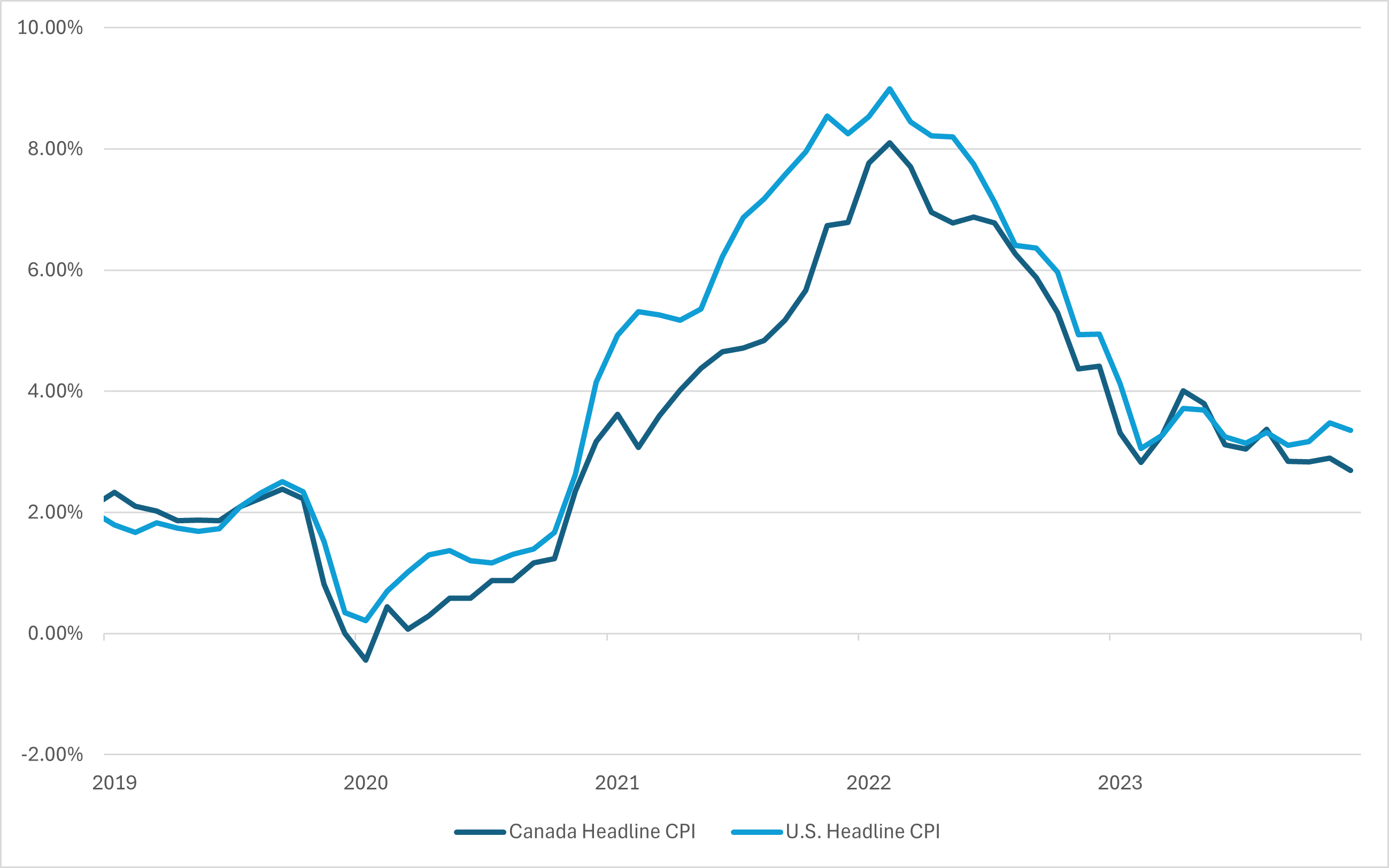
Canadian inflation came down over 2023 and is approaching the upper end of the Bank of Canada’s inflation-control target of 3%. General views are that inflation will continue to decline in 2024 and reach the policy target of 2% in 2025. In 2023 the Bank of Canada increased the overnight rate to 5.00% from 4.25%, which was a continuation of increases that commenced in 2022, to mitigate inflation and to balance against the risk of a recession.

However, DB pension plan benefits are accumulated and paid over periods that are significantly longer than the overnight rate. Interest rates on Canadian bonds with longer terms were volatile throughout the year and finished at lower levels than at the start of the year. It’s unclear whether the interest rates that apply to DB pension plans will stabilize in 2024, and if so, at what level. As such, interest rates continue to pose a significant risk for many DB pension plans. Continue Reading…