Reviews

We review books that deal with everything from financial independence topics to politics, and anything in between. We may sometimes stray into films and music if there is a “Findependence” angle.

Retired Money: How to beat the banks at their own game

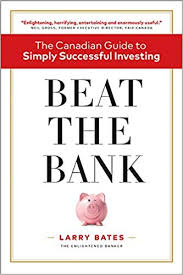
My latest MoneySense column reviews the new book by ex banker Larry Bates, titled Beat the Bank. As the headline suggests, it’s all about how to beat the banks at their own game, which ironically can mean owning the big bank stocks themselves! The full column can be retrieved by clicking on the highlighted text here:  Tips for DIY investors on beating the Big Five banks.

The formal launch date for the book is this Thursday: September 13, 2018. I first met Bates over lunch in March as his manuscript was nearing completion, where he expounded on what he called the “two Bay Streets.” Old Bay Street and its secrets are the focus of chapters 4 and 5, and New Bay Street is chapter 6.

Old Bay Street is not the investor’s friend

Most experienced investors will have encountered Old Bay Street at some point. This is the traditional investment industry: the commission-based mutual fund and brokerage industry, insurance company reps, investment “specialists” in the bank branches and various salespeople who call themselves “advisors.”

New Bay Street = Discount Brokerage, ETFs & fee-for-service planners

The New Bay Street includes providers of low-cost index funds or Exchange-traded Funds (ETFs) or online robo-advisers that automate the purchase and rebalancing of ETFs along with setting asset allocation.

At 62, Bates is well into his own “Victory Lap,” leaving employment for self-employment. Actually, his New Bay Street model isn’t all that new, as it describes models similar to what I myself described back in 1998 in my own financial book, Findependence Day. My version consists of buying ETFs at a discount brokerage and using a fee-for-service financial planner. The same year, similar principles were also described in Stop Buying Mutual Funds!, by Mark Heinzl, now a Globe & Mail stock market columnist.

Dinosaur banks have the lowest T-REX scores

Bates has fashioned something he calls T-REX scores  This is an acronym for Total Return Efficiency Index Score. A T-REX score of 100% would be paying absolutely no fees at all, no matter how long your time horizon.

Mutual funds with 2% annual fees would have T-REX scores of 54% over 20 years and true fees of 46%, but the longer you hold, the worse the performance; thus, over 40 years the T-REX would be 41% and the true fee 59%. Fees of 3% inflict even more damage. This is the basis for his statement that long-term customers of Old Bay Street lose half their money to fees. You can find more at his website at www.larrybates.ca.

The pure DIY model of buying individual stocks or bonds at a discount broker yields the highest scores: a T-REX of 96 to 99%. (Remember, the higher the better, with 100 being perfect).

Continue Reading…

Retired Money: How to avoid pre-retirement financial stress syndrome

My latest MoneySense Retired Money column looks at how near-retirees can avoid what author Patrick McKeough calls “pre-retirement financial stress syndrome.”

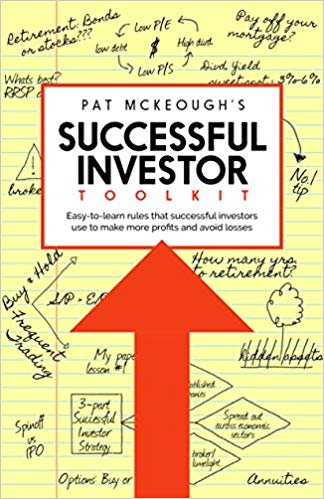
That’s a syndrome he identifies in his new book, Pat McKeough’s Successful Investor Toolkit. McKeough is a regular contributor here at the Hub and you can find the full MoneySense review of his book by clicking on the highlighted text: Investing tips for retired Canadians.

The book is a distillation of McKeough’s long investment career, honed first at The Investment Reporter, and in recent years his own firm, The Successful Investor, and its stable of newsletters. As a member of his Inner Circle and TSI Network, I have long been a proponent of his common-sense approach to investing. He is remarkably consistent in his insistence that investors of any age rely mostly on a conservative portfolio of quality dividend-paying stocks spread among the five major economic sectors (Manufacturing & Industry, Resources, Finance, Utilities and Consumer). And, he never fails to remind you, steer clear of stocks in the crosshairs of what he calls the “broker/media limelight.”

His newsletters are focused variously on Canadian stocks and U.S. and international stocks, and in recent years he has increased his coverage of ETFs.

A cure for PRFSS: Work longer or refine your spending

So what is“pre-retirement financial stress syndrome,” or PRFSS? PRFSS strikes when mature investors realize they may not have enough savings to generate the stream of retirement income they’d been counting on. While some investors are searching for one last desperate “hail Mary” gamble, McKeough advises the opposite: aiming for safer investments.

And while it may not be what some may want to hear, he suggests those suffering from PRFSS adopt one or both of these two solutions: work longer and/or refine your spending. He challenges them to “turn frugality into a game.”

With his focus on stocks, it’s no surprise that McKeough is not keen on bonds, even for retirees and those on the cusp of it. Continue Reading…

FP: A look at three retirement income planning software packages

My latest Financial Post column looks at a few retirement income planning software packages that help would-be retirees and semi-retirees plan how to start drawing down from various income sources: Click on the highlighted text to retrieve the full article: How you draw down your retirement savings could save you thousands: this program proves it.

There may be as many as 26 distinct sources of income a retired couple may encounter, estimates Ian Moyer, a 40-year veteran of the financial industry and creator of the Cascades program described in the article.

When he started to plan for his own decumulation adventure, five years ago, he felt there was very little planning software out there that was both comprehensive and easy to use. So, he hired a computer programmer and created his own package, now called Cascades.

While the main focus of the FP article is on Cascades, (available to financial advisors for $1,000 a year; do it yourself investors can negotiate a price directly), the article also references a couple of other programs we have looked at previously here on the Hub: Doug Dahmer’s Retirement Navigator and BetterMoneyChoices.com, the latter currently nearing the end of beta testing.

Dahmer has been writing guest blogs on decumulation here at the Hub almost since this site’s founding in 2014. See for example his most recent one, or the similar articles flagged at the bottom: Top 10 Rules for Successful Retirement Income Planning.

Dahmer says he’s pleased that others are waking up to the need for tax planning in the drawdown years: “Cascades provides a very good, easy-to-use introduction to these concepts.”

Planning for peaks and valleys in spending

Retirement Navigator’s Doug Dahmer

However, Dahmer would like an approach that doesn’t assume yearly spending remains relatively static: his Better Money Choices(available on line for $108 a year) allows for the “peaks and valleys” of spending as retirees pass through their Go-go to their slow-go and finally their “no-go” years.  Most retirees have to plan for sporadic large purchases like renovations or replacement of roofs or furnaces, plus of course vacations with widely varying price tags. Each spending peak represents a tax challenge, while the valleys are where the tax planning opportunities exist. Dahmer likens Better Money Choices to a gym monthly membership and Retirement Navigator to a personal trainer.

Personally, I found going through both firm’s programs a fascinating exercise, very much like putting together a jig saw puzzle. For me, Better Money Choices helps you visualize the final picture you’re trying to assemble, showing how much money you’ll need and when you’ll need it. Cascades provides vivid yearly snapshots of your year-by-year progress in putting the pieces together.

Retired Money: How to be financially, physically and emotionally fit for Retirement

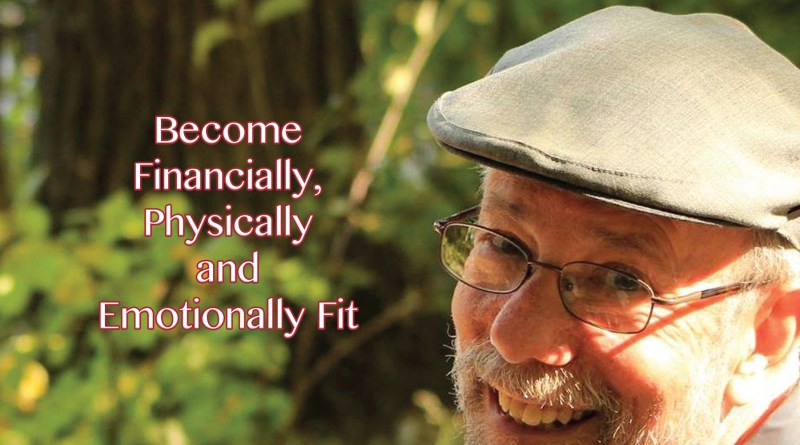
My latest MoneySense Retired Money column, which has just been published, looks at a self-published book by the semi-retired (at age 64) Howard Pell. His book is titled Retire Fit, Fit & Fit. Click on the highlighted headline to retrieve the full MoneySense column: Retirement fitness involves mind and body, as well as money.

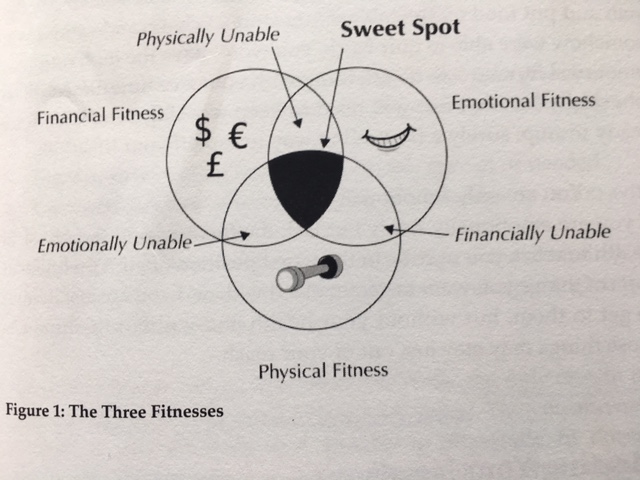
So what does the Fit, Fit & Fit mean? It’s in the headline of this blog as well as the adjacent photo taken from the book cover, which is the book’s subtitle. So it’s referring to being all three of financially fit, physically fit and emotionally fit for Retirement.

There are plenty of books about financial fitness so Pell pays only lip service to that aspect: what he brings to the table is insights on how to integrate finances with physical and emotional fitness. (To some extent, so does the book I co-authored with Mike Drak: Victory Lap Retirement)

Pell, who is based in Waterloo, Ont., does add a few newish terms to the semi-retirement lexicon.  He dubs the lifestyle “voluntary unemployment” but like many at this stage, finds the word “retired” inadequate. He tosses out several alternatives but the best one is his suggestion to simply adopt the Spanish word for “retired,” which is Jubilado (for males) or Jubilada (for females.”) He would use the term to signify anyone who is financially, physically and emotionally fit.

I can certainly relate to his observation of the semi-retired life that  “The big difference is that now all my deadlines and commitments are self-imposed.” Of course, as the old quip goes about driven self-employed business people: “My boss is a slavedriver.”

Pell also went personally through the “glide path” to semi-retirement described in other Retired Money columns and here at the Hub, via working a three-day week for his then employer during the last two years of his time there. This is a good way to test out your financial fitness while also clearing time for more physical fitness and — perhaps the toughest challenge — preparing for emotional fitness for retirement (I’m speaking for myself here.)

Finding the sweet spot

A Venn diagram on page 7 of Pell’s book (shown adjacent) illustrates that the sweet spot is the intersection where financial, emotional and physical fitness all converge.

If they don’t, and you became financially fit by selling out either your physical and/or your emotional health, the retirement your finances make possible may be a very limited and unsatisfying one.

It’s also possible to be only physically fit or only emotionally fit but lack the financial resources for retirement. The need to keep working to pay the bills will be frustrating, especially if all your peers have retired.

Continue Reading…

Retired Money: Reflections on turning 65 and transitioning into Retirement

Well, I’m officially “old” if you go by the federal Government’s eligibility date for receiving Old Age Security (OAS) benefits. The traditional retirement age has long been age 65, a milestone I reached on April 6th. As I have previously written, I had a hockey tournament to play that weekend so the party my wife and I host every 5 years or so was postponed to late May, by which time we calculated my first OAS cheque should have been deposited into our joint account. (There appears to be roughly a six-week gap between turning 65 and the first payment, even if you set up the process a year ago: Ottawa invites you to start the OAS process rolling when you turn 65. See the “Related Articles” links at the bottom of this blog for some articles on this.)

In any case, my latest MoneySense Retired Money column goes into my (mixed) feelings about reaching this milestone. You can retrieve the full column by clicking on the highlighted headline: I’ve just turned 65: Here’s how I’m transitioning into Retirement.

Regular readers of this site or my books will know I see Retirement as a gradual process rather than a one-time sudden event more likely to generate what Mike Drak and I call “Sudden Retirement Syndrome.” My contraction for Financial Independence (Findependence, coined in the title of my financial novel, Findependence Day) is not meant to be synonymous with full-stop Retirement. Shortly after I left my last full-time journalism job four years ago (almost to the day!), I was happy to co-author a book with Mike and go with his chosen title, Victory Lap Retirement.

Four years into my “Victory Lap”

So I’ve been on my Victory Lap for four years now. That doesn’t mean 65 isn’t a significant milestone: as it tacks on another (albeit modest) stream of income, it means I can slow down a bit, if it’s possible to slow down when you’re running a website like this with daily content.

I described in an earlier piece in the FP how I am still working “some semblance” of a 40-hour week, although a good third of that time consists of errands or activities like Yoga or going to the gym, all the subject of the Younger Next Year 2018 Facebook group that a group of us launched late in 2017. Younger Next Year is a New York Times bestselling book that has been around for years but didn’t come to my attention until late in 2017 when regular Hub contributor Doug Dahmer gave me a copy.

The Hub’s subsequent review in the last post of the year led to the creation of the Facebook group, with the lead taken by Vicki Peuckert Cook, who is based in Rochester, but who I hope to meet this weekend for the infamous OAS party at our home in Toronto. For more on the genesis of the group, read member Fritz Gilbert’s blog republished on the Hub late in March: Do you want to be younger in 2018 than in 2017?

The group has already attracted more than 450 members on both sides of the border, including the co-author of the book, Chris Crowley, and his coauthor on Thinner This Year, Jennifer Sacheck.

Certainly the 6-day a week regime recommended in Younger Next Year is more doable if you’re retired or semi-retired/Findependent. Most of the Facebook group appears to be in that category, although there are a few dedicated younger folk still juggling full-time careers with raising a family and doing what they can on the exercise/nutrition front.

Continue Reading…