We review books that deal with everything from financial independence topics to politics, and anything in between. We may sometimes stray into films and music if there is a “Findependence” angle.
The sixth annual MoneySense survey of Canada’s one line brokerages (aka discount brokers) is now available. Written this year by me with Glenn LaCoste, CEO of Oakville, Ont.-based Surviscor Inc., you can find the full piece by clicking on the highlighted headline: Canada’s Best Online Brokers 2018.
Qtrade Investor once again narrowly edged out Questrade as the top firm overall:
Best Overall:
Qtrade Investor – 22 pts
Questrade – 21 pts
iTRADE – 14 pts
BMO InvestorLine – 14 pts
12 firms were included, ranging from the many bank-owned discount brokerages to the still-independent Questrade. The report also looks at various categories, including Mobile, ETFs, Design & User Experience, and Fees & Service.
As you go through the separate categories you’ll see both firms often place in the top three spots: five for Qtrade and four for Questrade this time around. Qtrade was first in two categories, second in another two, and third in one; while Questrade was first in one category, second in two categories and third in one.
Methodology
The survey methodology is based on MoneySense-specific categories based on Surviscor’s latest mobile and online reviews. Continue Reading…
When you’re young, you feel like nothing can stop you. You’re in charge of your own destiny.
Things might look different in hindsight, but don’t worry about that now. The most important thing you can do right now is set in motion a plan to achieve financial independence as soon as possible. With the means to do what you want, when you want, you’ll open doors you never even knew existed.
Before you begin in earnest, make sure you have the right digital tools and apps in your corner. These user-friendly resources all have their place in a coherent, comprehensive financial independence plan, provided you use them properly and consistently.
Perhaps you’re using a few already.
Digital Budgeting Tools: All Your Money in One Place
This list of the “best simple and free budgeting tools” doesn’t get to actual digital solutions until the third entry, when it calls out the trusty old Excel spreadsheet.
If you’re in the market for something a bit more robust and hands-off than a wall of spreadsheet cells, consider later entries like Mint or PearBudget (which, to be fair, began life as an Excel tool).
These aren’t professional-grade tools by any means, but they’re nevertheless robust enough to accommodate basic household budgeting and ensure that you spend well less than you earn. Remember to download mobile versions and link your bank accounts for automated cash flow tracking.
Automated Savings Apps: Ditch the Reminders
Tired of remembering (or forgetting) to make regular savings deposits? Take the uncertainty out of the process with automated savings apps that quietly transfer small sums to your savings accounts without any input on your end.
Tools like Digit exist wholly for this purpose. More robust online banking solutions like Chime Bank typically have built-in automated savings features that round up every debit transaction to the nearest dollar and sock away the difference
Educational Videos: DIY, But for Money
Are you a DIYer at heart? You can learn a lot from high-quality investing and financial education videos. After all, there’s no need to pay for entry-level information and strategic advice when you’ve got a YouTube account to your name. If you need help or want to learn more about specific topics, you can always go straight to the source with questions.
Lightweight Accounting Platforms for Entrepreneurs Continue Reading…
So you need your own website? Whether you’re a small business, a budding webpreneur or just someone with a message to share, a website is a great way to reach your audience.
Nevertheless, many people are put off starting a website for fear of the costs and expertise involved. What they don’t know is that there are loads of amazing tools and platforms out there that can help them to design an effective website at an affordable price.
Here are some of the best tools and platforms for making a website:
Duda
Duda is a responsive website builder. Choose from a range of ready-made templates then use the drag and drop editor to create the look and the layout you want. You can integrate your site with the likes of PayPal, OpenTable and Disqus. And there are some great website personalisation features, allowing you to adapt your site for different customers.
WordPress
WordPress is a favourite amongst rookie and professional web designers for a reason. It’s great for everything from a basic blog to a fully-fledged e-commerce site. It’s really easy to use. And this is one platform where the cost of a website needn’t be a worry. Free packages cover all of the basics. And if you’re looking for more templates, greater customisation or full control over how your website looks and behaves, there are very reasonably priced upgrades you can sign up for. Continue Reading…
I hate New Year’s Resolutions, and I can’t remember the last time I made one.
Why make them, if you’re most likely going to break them? That doesn’t make sense to me. Call me cynical, but that’s just not the way I think about challenging myself to improve.
Don’t get me wrong. I love thinking about how I can move life from Good To Great,and I enjoy having goals. I think often about both my long- and short-term goals, and where my life is going. I do it informally, by constantly watching for opportunities to create improvements in my life and developing personal challenges. I push myself to achieve the goals I set for myself (like writing this blog). Do you?
Make the pursuit of challenges an ongoing habit in your life. It’s a way of Living Life At The Limits, and it keeps life interesting. Most of you know that I’m a bit of a fitness nut, and I’m always on the lookout for opportunities to challenge myself. I grab onto interesting things as they cross my path. It’s why I swam in the cold waters of London on an early November morning. It’s something that keeps me young.
It works for me.
Try it … It just may work for you.
Today, I’ll give you your chance …
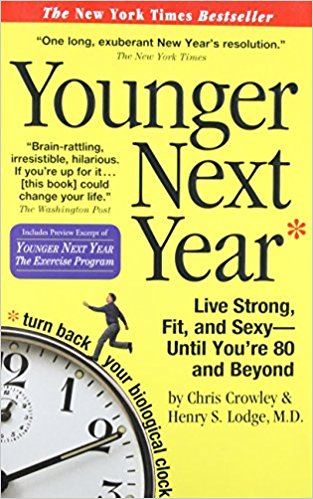
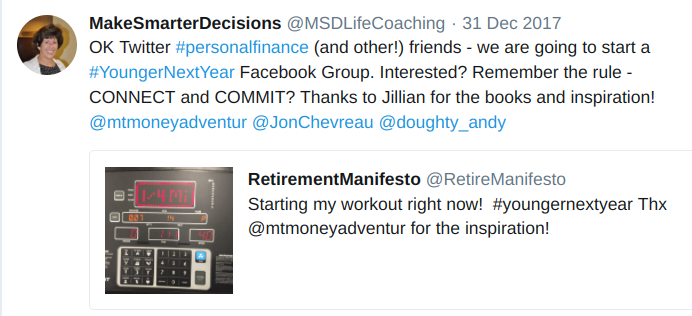
A Bunch Of Folks Decide To Get Younger Together
Something exciting happened at the beginning of this year, and it generated this post you’re now reading (originally posted early in January). A new Community/Movement/Revolution was launched, and it’s rapidly taking shape. It’s only a few months old but it’s starting to run. And it’s starting to run …
… Fast.
Do You Want To Be Younger?
This development is a legitimate way to make you Younger In 2018 Than In 2017, if you’re willing to commit to doing a bit of work. A bunch of folks are joining in and this thing is gaining momentum. The fact that it’s (original) timing falls in line with New Year’s resolutions is irrelevant, in my book (tho, in fairness, it’s a good time to launch the challenge, as many folks are thinking about trying to get into shape for the New Year).
This movement is a great opportunity and I’m convinced that it can, indeed, help in your quest to Achieve A Great Retirement (my byline). It’s a group of friends with similar interests urging each other on to mutual success (on both sides of the US/Canada border).
If you’re interested, check it out. You don’t have to commit today. Just explore and see if it’s something that interests you. I’ll show you below, but in case you’re impatient and just want to head over there now here’s the link, but please don’t go there yet 🙂
The group’s open to all, and readers are especially encouraged to participate.
If you lack what finance professor and author Moshe Milevky calls a “real” pension (i.e. an employer-sponsored Defined Benefit plan), then you’re a likely candidate for annuitization or at least partial annuitization of your RRSP and/or RRIF.
My latest MoneySense Retired Money column revisits Fred Vettese’s excellent new book, Retirement Income for Life, and in particular his third “enhancement” suggestion for maximizing retirement income. We formally reviewed Vettese’s book in the MoneySense column before that, and commented on it further here at the Hub.
You can find the new piece drilling down on the partial annuitization enhancement by clicking on the highlighted headline: RRIF or Annuity? How about Both.
One of the main sources in the piece is fee-only planner Rona Birenbaum (pictured above with Fred Vettese), who has some useful videos on YouTube about annuities, including an interview with Vettese about the partial annuitization strategy described in the new MoneySense column. See Is it time for annuities?
Expect an annuity wave from retiring boomers without DB pensions
Certainly you’re going to hear a lot more about annuities as the baby boomers move seriously from Wealth accumulation mode to de-accumulation, aka “decumulation.” Coincidentally both Vettese and I are 1953 babies with April birthdays. In an interview with Fred, he told me he bought some annuities a year ago and that he believes that those who plan to retire at age 65 (and who lack a traditional employer-sponsored Defined Benefit pension) should consider at least partly annualizing at 65, to the tune of roughly 30% of the value of their nest egg (typically in an RRSP or RRIF). That means registered annuities.
Certainly, in light of the 10% “correction” in stocks that occurred in the last few weeks, the possibility of a more severe stock market retrenchment has to be upper most in the minds of soon-to-retire baby boomers. I note in his recent G&M column, Ian McGugan (in his early 60s) confessed he was slowly starting to take some profits from stocks and move them to safer fixed-income investments like GICs. See The Market’s gone mad: Here’s how to protect yourself. See also Graham Bodel’s article earlier this week: Response to an investor who frets the market is going to crash.
Annuities are one way to hedge against market risk, since you’re in effect transferring some of the market risk inherent in an RRSP or a RRIF to the shoulders of the insurance company offering the annuity. That’s one reason in the YouTube video above, Vettese talks about partly annuitizing as soon as you retire, whether that be age 65, or sooner or later than that traditional retirement date.
Financial advisors may not agree with all of Vettese’s five “enhancements.”
The earlier column reviewing the book mentioned that not many of Vettese’s “enhancements” to retirement income may be endorsed by the average commission-compensated financial advisor. Even so, as the Royal Bank argued earlier this year here at the Hub, annuities can help fund a full lifestyle in retirement. It observed that 62% of Canadians aged 55 to 75 are worried they’ll outlive their retirement savings but only 10% use or plan to use an annuity to ensure they’ll have a viable lifestyle in retirement.
Regular Hub contributor Robb Engen — a fee-only financial planner who also runs the Boomer & Echo website — wrote recently (on both sites) that annuities are one way retirees or would-be retirees without traditional DB pensions can Create their own personal pension in retirement.
As I note in the MoneySense column, while I’m certainly approaching the age when partial annuitization may make sense, I’ll probably wait a year or two. But in preparation for that possibility, as well as for the column, I asked Birenbaum to prepare three quotes for a $100,000 registered annuity, starting at ages 65, 70 and 75. As you might expect, the longer you wait to begin receiving payments, the higher the payout, but it’s not such a massive rise that you could rule out early payments if you really needed them to live on.
The mechanics of buying an annuity
And should you be ready to take the step, it’s not all that complicated. In the above case, you would liquidate $100,000 worth of investments in your RRSP so the cash is available to transfer, then complete an annuity purchase application and fill out and submit a T2033 RRSP transfer form. That form is sent to your RRSP administrator, and they transfer the cash to the insurance company without triggering tax. Once all these preliminary steps have been taken, payments begin the month following the annuity purchase.
Oh, and one last step, Birenbaum adds: Start relaxing!