Once you achieve Financial Independence, you may choose to leave salaried employment but with decades of vibrant life ahead, it’s too soon to do nothing. The new stage of life between traditional employment and Full Retirement we call Victory Lap, or Victory Lap Retirement (also the title of a new book to be published in August 2016. You can pre-order now at VictoryLapRetirement.com). You may choose to start a business, go back to school or launch an Encore Act or Legacy Career. Perhaps you become a free agent, consultant, freelance writer or to change careers and re-enter the corporate world or government.
Nothing has worked more effectively for the financial industry to justify asset accumulation or AUM (Assets Under Management) than the theoretical underpinnings of the 4% “rule” or “guideline.”
There are innumerable articles on how individuals will require one million dollars or more for retirement based on this dubious principle.
Certainly it is crucial to save but to focus on any particular threshold misses the point that what counts in retirement is a regular, dependable stream of income for a lifetime.
There are two factors in retirement to balance: lifestyle and longevity. Any 4% or otherwise rule is irrelevant if longevity is uncertain. Most people want to maintain a certain quality of life in retirement as well as living healthy.
Here is a hypothetical question: would you take Social Security if it were offered as a lump sum or continue to collect it monthly for the rest of your life (with the bonus of inflation adjusted payouts)? Continue Reading…
Pension incomes are not created equal. They come in all shapes and sizes. They are as varied as the people who have accumulated them and who seek to use them.
In this seemingly infinite variety, in this mathematical complexity, there is a common thread as far as advisors are concerned: delivering clients the most after-tax income possible.
CPP, OAS, Defined Benefit Pension, Dividend Income, Interest Income, RRIFs, Part Time Employment Income, Corporate Dividends, TFSAs: These are just a few of the various sources of income individuals may have access to when they exit the workforce. Upon retirement, decisions about what, when, and how much income to draw upon, move to the forefront.
Tax is key to coordinating multiple income streams
Coordination here is key as each of these sources of income is subject to different tax rates, different tax deferrals and different estate taxes. Tax is key, in other words.
Recent or prospective retirees need more than a competent advisor at this stage. Understanding the tax rates, tax deferral rates and the implications regarding OAS and Income Splitting is one thing. But accounting for these sources of income and the complicated ways in which they interact requires an algorithm.
The specialized software, Cascades, cascadesfs.com, performs these calculations, giving users informed withdrawal strategies. Designed by financial advisors in partnership with software developers, Cascades uses actual tax rates, not average tax rates, projecting for the duration of retirement, including longevity risk.
Because numbers require context to be meaningful, let us consider prospective retirees Bill and Anne Smith.
Case Study: a Couple in their late 60s
Retirement Plan: Bill and Ann are 68 and 67 currently. They have been retired for a few years but still have RRSPs and a LIRA and want to know if they should start using them for income or defer payments until age 71.
Income Sources: Both have CPP and OAS. Anne has a defined benefit pension from having worked as a teacher.
Investments: Bill has a healthy RRSP and Anne has a modest RRSP and a LIRA. They have maxed out their TFSAs and each have about $100,000 additionally in individual non-registered accounts.
Total: 12 different income sources and investment accounts to manage for retirement income
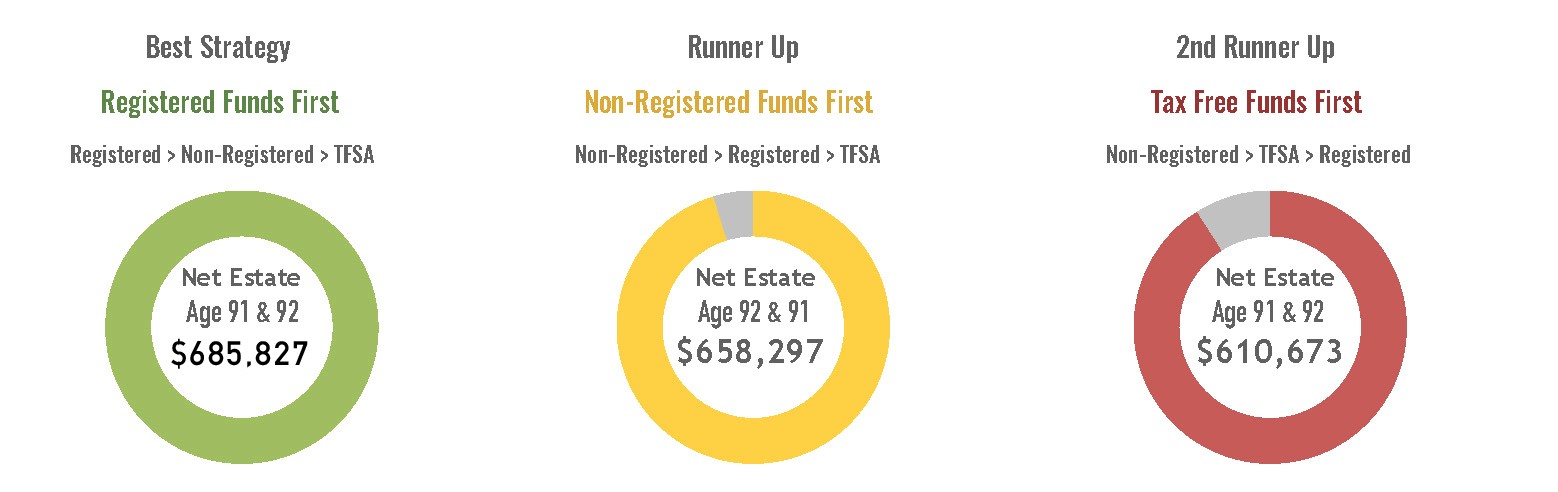
Cascades provides direction in the following way. Users — whether they be Anne and Bill themselves, or their advisors — fill in a detailed online questionnaire, submit their responses and in under ten seconds they have a report. This report (an excerpt is shown at the top of this blog) automatically gives three potential strategies and shows which one works best. For Anne and Bill, drawing down and re-investing their registered accounts first is expected to save them over $75,000 in their estate compared to a complete deferral of their registered money.
As far as Bob and Linda Sanderson are concerned, on the other hand, a Cascades report advises them to do just the opposite and ultimately predicts a savings of $125,000. Here’s how:
Quite different withdrawal recommendations for this younger couple
Bob and Linda are both 55 and currently working. They plan to retire in 10 years. They have a rental property they maintain that they plan to sell in 15 years and want to know how to plan for the long-term.
Income Sources: Both will receive CPP and OAS. Bob will receive a small defined benefit pension. Both will earn rental income until sale of the property. Both will receive corporate dividends until age 80 from a holding company.
Investments: Both have large RRSPs, nearly capped TFSAs, and a small amount of non-registered savings. Additionally, Linda has a small LIRA.
Total: 18 different income sources and investment accounts to manage for retirement income.
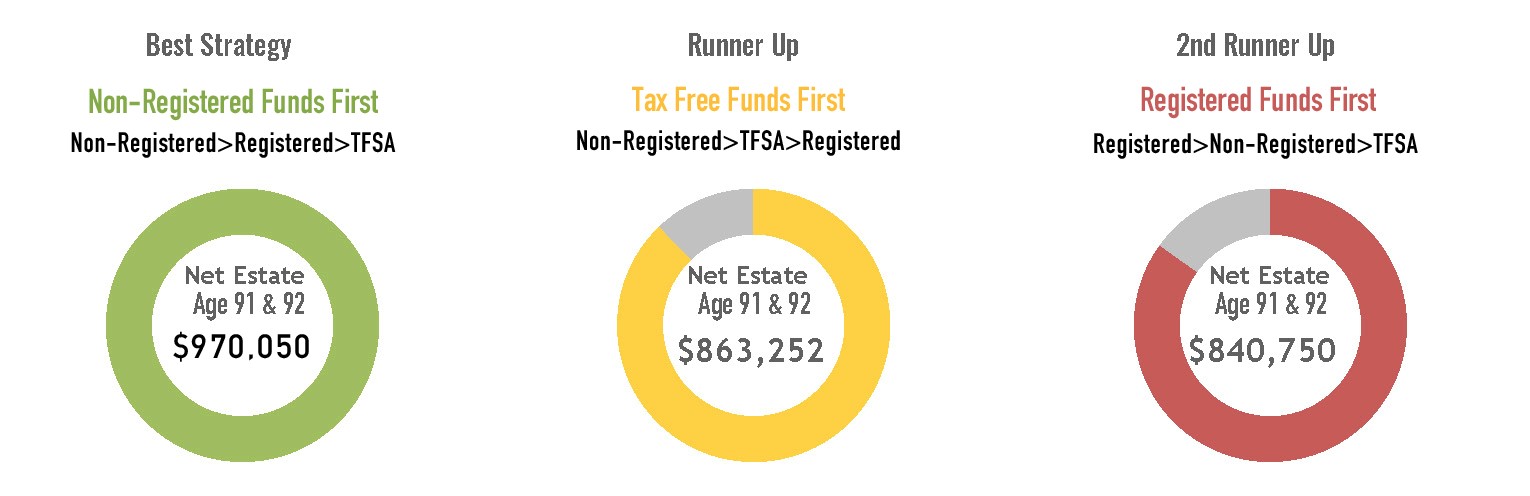
Cascades proposes three withdrawal strategies and highlights the best plan. Using all of their non-registered savings before rolling over registered investments will save Bob and Linda over $125,000 in their estate compared to an early drawdown of their registered money. Cascades software is designed to help users do their due diligence on the matter of retirement planning. The results are specifically tailored to the retirement in question and they are reliable, informed and rigorously defined as they are by Canada’s vast and varied tax laws.
.
Ian Moyer is the founder of Ian C. Moyer Insurance Agency Inc. and Cascades Financial Solutions Inc.
Billy and Akaisha take in the view from their hostel in Zacatecas, Mexico
By Akaisha Kaderli
Special to the Financial Independence Hub
We understand that not everyone likes to travel. No doubt it can be challenging, but there are significant benefits if you choose to enliven your routine with a little excursion.
Traveling makes you smarter
From the beginning of choosing a location, packing your suitcases and figuring out the logistics of who will water your plants or sit with your pet, traveling takes you out of your routine. Anything new and different like this that engages your brain causes new neurological pathways to grow.
Learning a new language, taking a cooking or painting class while on your trip and meeting new people all place you in unique situations, and your brain strengthens.
Traveling is healthy for you!
Traveling makes you strong
For some people, all these new patterns outside the everyday routine can be perceived as a hassle. Yes, and that’s good! We learn flexibility, creativity and self-reliance. Those are great attributes to have and they are useful to daily living.
Flexibility of mind, finding new solutions to new challenges and our sense of who we are and how we cope all get stronger.
Traveling helps you become an interesting story teller
When things don’t go according to plan, those seemingly challenging circumstances make for the best stories!
If everything goes perfectly on your trip or vacation, and people ask “How did you enjoy yourselves? How was your trip?” then all you can say is “Great!” Continue Reading…
My latest MoneySense Retired Money column looks at a financial planning software platform called Viviplan. You can find the full article by clicking on the highlighted text: What I learned by putting Viviplan to the test.
Viviplan is the third retirement planning package I’ve tested this year, perhaps — as the MoneySense article reveals — the topic is getting all too real for me now that my wife, Ruth, has told her employer she plans to retire when she turns 65 next summer. I’m a year older and have been somewhere between self-employed and semi-retired for most of my 60s.
All these packages deserve consideration and work in more or less similar fashion. To do the job justice, you need to have handy — or at least summary information — such documents as your latest tax returns, brokerage statements, Service Canada CPP and/or OAS projections, as well as having a good grasp of your regular and occasional monthly expenses.
Having most recently performed this exercise with Viviplan — and as one of the users we interviewed for MoneySense relates — it can be a bit scary to see in black and white just how expensive daily living can be. The package won’t let you forget any tiny expense, from pet food to boarding your pet when you’re on vacation (or arranging to hire a neighbour’s teenager, which is what we do if we go away and must leave our cat behind.)
Viviplan calls itself a Robo Planner
Viviplan — which has been dubbed “Canada’s Robo Planner” — is the brainchild of financial planner Rona Birenbaum. Birenbaum also runs a separate fee-for-service financial planning firm called Caring for Clients. I have consulted her for various pieces in the past, particularly about annuities.
Indeed, when I was putting Viviplan through its paces, one of the big questions I had was whether there was a need for us to partly annuitize, seeing as Ruth has no employer-provided Defined Benefit pension at all (just a hefty RRSP), and I have only two modest DB pensions that are not inflation-indexed.
Viviplan’s Morgan Ulmer
Our main question was whether to make up for this lack of employer pensions by at least partially annuitizing, or what Moshe Milevsky and Alexandra McQueen call in the title of their book Pensionize Your Nest Egg. Another author, Fred Vettese in Retirement Income for Life, was in a similar situation when he reached 65 (the same month as I did) and had suggested annuitizing 30% of his nest egg at 65 and doing another 30% at age 75 (assuming CPP at 70). Our question for Viviplan was whether this would make sense for us too, or just for Ruth.
We went back and forth with Calgary-based certified financial planner and product manager Morgan Ulmer (pictured to the right). As she relates in the MoneySense piece, “it’s certainly not necessary,” since at today’s interest rates, Viviplan told her that for us a pure GIC portfolio could get us to where we want to go, with the virtue of more financial flexibility and higher final estate value. Like the other programs, Viviplan recommends delaying CPP till 70 and OAS too if possible.
Annuitize? No wrong decisions and no rush
Partial annuitization for Ruth along the lines of what Vettese suggests would result in a slightly lower estate for our daughter. “With annuities, you are making a choice between legacy and flexibility versus security and longevity protection,” Ulmer said in the plan’s written recommendations, “There are no wrong decisions here, and there is also no rush.” Continue Reading…
As some investors near retirement, their advisors recommend switching to bonds and other fixed-income investments for their retirement investments instead of holding stocks or ETFs.
To some extent, this is an understandable retirement investing strategy, since bonds can provide steady income and a guarantee to repay their principal at maturity.
Bonds will lower the long-term returns that are key to successful retirement investing
Unfortunately, using bonds for retirement may not be the best strategy. Bond prices will likely fall over the next few years because interest rates are likely to rise. Bond prices and interest rates are inversely linked. When interest rates go up, bond prices go down, when interest rates go down, bond prices for up.
Bonds have been in a period of rising prices (a bull market) more or less since 1981. That year, long-term interest rates reached an historic turning point when long-term U.S. Treasury bond yields peaked near 15%. Ever since, interest rates have gone through wide fluctuations, but they have essentially headed downward.
Today, interest rates just don’t have that much further to fall. But under certain conditions, interest rates could go substantially higher. Remember, as mentioned, when interest rates go up, bond prices drop.
Even so, brokers continue to sell bonds to their clients. That’s partly because most of today’s brokers had not yet entered the investment business when the bull market in bonds began in 1980. All they know is that bonds do tend to reduce the volatility of your portfolio, since they tend to rise when stock prices fall. Of course, bonds also generate more commission fees and income for the broker, compared to stocks, especially if you buy them via bond funds and other investment products.
That’s why we continue to recommend that you invest only a small part of your portfolio—if any—in bonds and fixed-income investments. Instead, you should aim for a diversified portfolio of well-established companies with long histories of dividends, or ETFs that hold these stocks. We recommend a number of stocks and ETFs appropriate for retirement investing in our Canadian Wealth Advisornewsletter.
We recommend this retirement investing strategy because equities are bound to be more profitable than bonds for retirement over long periods. That’s because equity returns are related to business profits, while returns on fixed-return investments are related to business interest costs.
Bonds and other fixed-return investments can add stability
Returns on your stocks are sure to be more volatile than what you earn on fixed-return investments (that includes short-term bonds). That’s because returns on stocks are related to the part of gross profit that’s left over after a company pays its interest costs. Continue Reading…


 Posted By



 Posted By

 Posted By