Victory Lap

Once you achieve Financial Independence, you may choose to leave salaried employment but with decades of vibrant life ahead, it’s too soon to do nothing. The new stage of life between traditional employment and Full Retirement we call Victory Lap, or Victory Lap Retirement (also the title of a new book to be published in August 2016. You can pre-order now at VictoryLapRetirement.com). You may choose to start a business, go back to school or launch an Encore Act or Legacy Career. Perhaps you become a free agent, consultant, freelance writer or to change careers and re-enter the corporate world or government.

Retired Money: How to boost Retirement Income with Fred Vettese’s 5 enhancements

 Once they move from the wealth accumulation phase to “decumulation” retirees and near-retirees start to focus on how to boost Retirement Income.

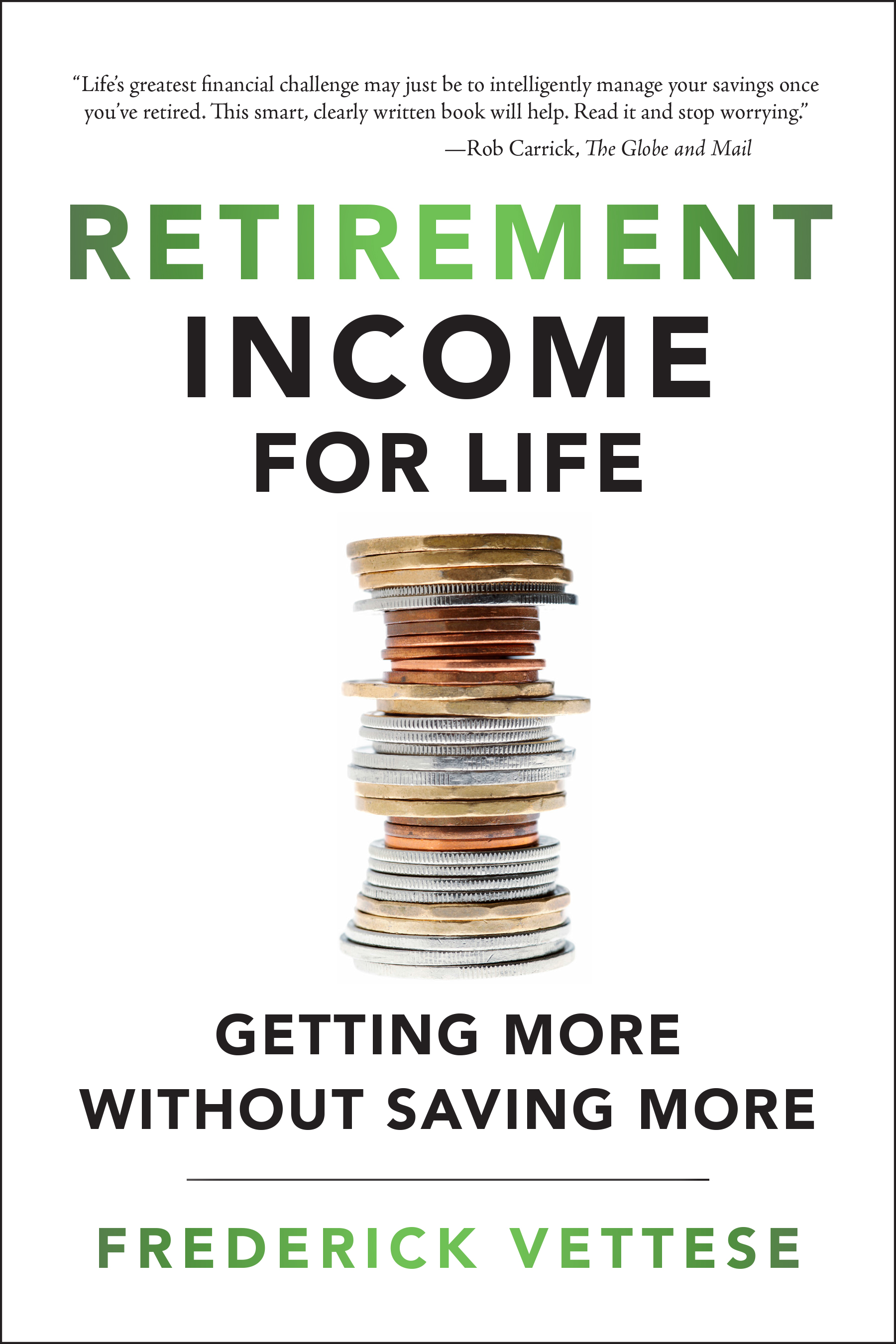
The latest instalment of my MoneySense Retired Money column looks at five “enhancements” to do this, all contained in Fred Vettese’s about-to-be-published book, Retirement Income for Life, subtitled Getting More Without Saving More. You can find the full column by clicking on this highlighted headline: A Guide to Having Retirement Income for Life.

You’ll be seeing various reviews of this book as it becomes available online late in February and likely in bookstores by early March. I predict it will be a bestseller since it taps the huge market of baby boomers turning 65 (1,100 every day!): including author Fred Vettese and even Yours Truly in a few months time.

That’s because a lot of people need help in generating a pension-like income from savings, typically RRSPs, group RRSPs and Defined Contribution plans, TFSAs, non-registered investments and the like. In other words, anybody who doesn’t enjoy a guaranteed-for-life Defined Benefit pension plan, of the type that are still common in the public sector but becoming rare in the private sector.

The core of the book are the five “enhancements” Vettese has identified that help to ensure that those seeking to pensionize their nest eggs (to paraphrase the title of Moshe Milevsky’s book that covers some of this ground) don’t outlive their money. Vettese says many of these concepts are current in the academic literature but have been slow to migrate to the mainstream, in part because few of these “enhancements” will be welcomed by the typical commission-compensated financial advisor. That in itself will make this book controversial.

Each of these “enhancements” get a whole chapter but in a nutshell they are:

1.) Enhancement 1: Reducing Fees

By moving from high-fee mutual funds or similar vehicles to low-cost ETFs (exchange-traded funds), Vettese explains how investment fees can be cut from 1.5 to 3% to as little as 0.5% a year, all of which goes directly to boosting retirement income flows. One of his takeaways is that “Tangible evidence of added value from active management is hard to find.”

2.)  Enhancement 2: Deferring CPP Pension

We’ve covered the topic of deferring CPP to age 70 frequently in various articles, some of which can be found here on the Hub’s search engine. Even so, very few Canadians opt to wait till age 70 to collect the Canada Pension Plan. Because CPP is a valuable inflation-indexed guaranteed for life instrument — in effect, an annuity that you can never outlive — Vettese argues for deferral, although he (like me) is fine with taking Old Age Security as soon as it’s available at age 65. He argues that for someone who contributed to CPP until age 65, they can boost their CPP income by almost 50% by waiting till 70 to collect.  “You are essentially transferring some of your investment risk and longevity risk back to the government, and you are doing so at zero cost.” Continue Reading…

How to enjoy a healthy retirement (literally!)

By Rachel Jackson

Special to the Financial Independence Hub

Whether it’s junk  food, drugs, alcohol, cigarettes or simply laziness there are many things that can lead to an unhealthy life. Not being health conscious can have dire consequences and you can easily walk yourself into an early grave if you don’t take care of your body. But it doesn’t have to be that way. With these tips to live by, you can stay healthy well into your retirement years.

1.) Keep fit

No matter what your age, you should be exercising regularly and doing your best to stay fit. While you don’t need to become a marathon runner or boxing expert, try to exercise for at least 30 minutes every day to maintain a healthy body and mind. Don’t believe that you have to tone it down when you reach a certain age either: your body will keep up with what you offer it. If you don’t start running until the age of 50 then you might have some problems but someone who regularly runs well into their fifties will be able to keep it up. Exercise helps to strengthen your heart, keep your body working and mobile and release endorphins to ease stress and improve mood.

2.) Eat healthily

There’s nothing wrong with a treat now and then but you need to stick to well-balanced meals and healthy snacks for the most part if you want to live for a long time. Eating the wrong diet, can result in  obesity, diabetes, digestive problems, heart problems and high cholesterol. And that’s only the start. Eat well: remember that when you put good stuff in, you will get bad stuff out.

3.) Laugh often

One of the best ways to extend your life is to enjoy it. Failing to spend time with friends and family, to entertain yourself, to have fun and laugh daily can be almost as harmful to your health as smoking or drinking. If you enjoy yourself, you exercise your heart muscles, ease stress and tension and keep a positive mind. If you don’t, you increase your risk of depression, illness, and complications associated with stress such as heart attacks.  Continue Reading…

Why Saving alone isn’t the best way to Financial Independence

By Elizabeth Lee

Special to the Financial Independence Hub

You’ve been told your entire life that you’ll never be able to accomplish anything unless you have a padded savings account: that every penny you can possibly set aside should be set aside, and you should absolutely never touch it.

You may even have been told that this is the only way you’ll become financially independent. You’ve been told wrong.

Saving is crucially important, but it’s important for entirely different reasons. You shouldn’t go out and spend your nest egg indiscriminately, but spending some of it might help you create a better and stronger independent (“findependent”) future. It all depends on how you strategize.

Why Saving is important

If you’re spending all your money as it comes in, what happens when you run into an expense you didn’t know was coming? Your car breaks down, you need to travel for a destination wedding, you find out you’re going to be a parent a little earlier than you’d originally planned, or you need to go to urgent care for a pesky sinus infection. How are you going to pay for it?

You had no idea that it was coming, and you didn’t budget for any of those things, because you didn’t know they were coming. If you don’t have savings, you might be set so far off track that you need to borrow to pay the bills. Without a savings account, you’re never truly protected from the financial variables life might throw your way.

Why Saving alone won’t make you Financially Independent

You need to spend money to live. Having a pile of money that isn’t doing anything for you won’t unlock a brighter future. Even in a high-yield savings account, the interest won’t amount to much. Financial independence means increasing your income, rather than just having an emergency stash to fall back on when something unexpected happens.

The idea of having savings is not to touch them unless you absolutely need to. The more savings you have, the more protected you are. But they aren’t helping you grow. Financial independence comes through growth, and it’s achieving that goal that will set you up for a smooth ride into your future. Continue Reading…

Canadians think they need $756,000 to retire; failure to plan means most will fall short

My latest Financial Post column looks at a CIBC survey released Thursday that finds on average individual Canadians believe they’ll need $756,000 in order to retire.

Of course, most fall woefully short because they haven’t even crafted a financial plan to get there. And you know the old sayings, “Failing to plan is planning to fail,” or “If you don’t know where you’re going you’ll probably end up somewhere else.”

You can find the full column by clicking on the highlighted headline: The magic number for Retirement Savings is $756,000, according to poll of Canadians.

Considering that on average Canadians hope to retire by age 63, the fact that almost one in five haven’t even begun to even think about retirement suggests a bit of a disconnect. And women are consistently more behind in their retirement planning preparations than men. That’s a problem, considering that women have longer life expectancies and their money will therefore have to last longer.

Depending on aspirations, the “Number” can range from Zero to $2 million

\While the CIBC study looks at individuals rather than couples, the column quotes regular Hub guest blogger Marie Engen, who described three levels of retirement — basic, average and deluxe — in this 2016 blog: How much do you REALLY need to retire?  (The original blog ran on the Boomer & Echo site late in 2015.) Some with modest needs can save nothing and subsist on the $38,000 senior couples can get from CPP and OAS. Continue Reading…

Do you need two million dollars to retire?

By Billy and Akaisha Kaderli

Special to the Financial Independence Hub

We like to keep informed about the topic of retirement from the perspective of money managers and those in the financial fields.

You might have read some of these articles also; you know, the ones that say North Americans have not saved enough to retire.

Many of these pieces proclaim that you must save enough in your investments to throw off 80% of your current annual salary so you can afford a comfortable life away from a job. Lots of them will say that you need US$2 million in investments and woe to the person who thinks they can do it on less.

Approximately 10% of the households in the US have a net worth of one million dollars or more. What are the other 90% supposed to do? Not retire? What kind of common sense does this make?  Expecting the regular “Joe” to meet this $2 million dollar mark is not realistic.

As you know, we have almost three decades of financial independence behind us. And while everyone’s idea of a perfect lifestyle sans paycheck is different, we can tell you that for these almost-30-years, we have kept our annual spending around $30,000 or less per year.

The secret: Living within your means

In all of our years of retirement and travel we cannot recall one retiree who regrets their decision to retire. In fact, most have told us that they wished they had done it sooner.

The Society of Actuaries (SOA) recently conducted 62 in-depth interviews of retired individuals across both the U.S. and Canada. These people were not wealthy and had done little to no financial planning. But the vast majority of them shared that they had adapted to their situation and live within their means. Meaning, they have adjusted their spending to the amount of money they have coming in every month.

So basically, it’s really that simple and this is why we say if you want to know about retirement, go to the source.

It doesn’t have to be complicated

In our books and in our articles about finance, we say over and over that there are four categories of highest spending in any household. We personally have made adjustments in all four of these categories, and have therefore reaped the benefits of having done so.

The financial guys and gals will have you tap dance all over the place with investment products, and a certain financial goal you must achieve. They will press upon you the seriousness of this decision to leave your job for a couple of decades of jobless living. We say it doesn’t really have to be that complicated, but it’s very important to pay attention to these four categories.

Listen up Continue Reading…