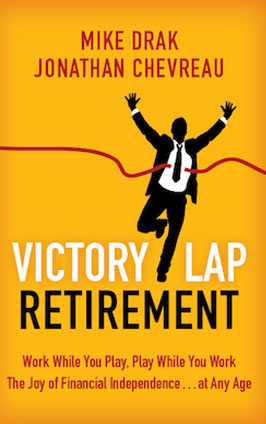
Once you achieve Financial Independence, you may choose to leave salaried employment but with decades of vibrant life ahead, it’s too soon to do nothing. The new stage of life between traditional employment and Full Retirement we call Victory Lap, or Victory Lap Retirement (also the title of a new book to be published in August 2016. You can pre-order now at VictoryLapRetirement.com). You may choose to start a business, go back to school or launch an Encore Act or Legacy Career. Perhaps you become a free agent, consultant, freelance writer or to change careers and re-enter the corporate world or government.
Last year, the Hub reviewed a classic (i.e. not recent) book called Flow, written by a University of Chicago professor, Mihaly Czikszentmihalyi. This time, we’re going to take a look at the same author’s followup book, Creativity, which bears the subtitle Flow and the Psychology of Discovery and Invention.
It’s a fascinating read for anyone who has fancied themselves an “artiste” or musician, but were never able to extract a living from their creativity. But of course, one bonus of achieving financial independence is that it’s never too late to cultivate one’s creativity. One of the author’s concluding points is that we should strive in various ways to boost our creativity, whether or not it leads to the world’s recognition of our talents. The concluding words are these:
“… what really matters, in the last account, is not whether your name has been attached to a recognized discovery, but whether you have lived a full and creative life.”
Much depends on what “domain” one chooses: there is a chapter on the domain of words: for writers, poets, novelists and those who are “vendors of words,” to use an expression often used by the British journalist and author Malcolm MuggeridgeContinue Reading…
One of the chief concerns regarding senior citizens, especially those who live alone or in assisted living facilities, is boredom. Experts in senior care know that when a person is bored or feels unstimulated this can escalate to depression, which is already another concern among the senior population.
While the lack of activity could be due to a physical ailment that prevents the person from doing things they loved to do — such as walking, running, or other highly physical activities — in many cases it’s simply that a little nudge and some positive guidance is needed. A caregiver can be instrumental in this role and encourage their client to be more active, mentally or physically.
If you work with or know a senior citizen who needs to be challenged, adding a hobby to their daily routine can make a world of difference in their mood and ultimately their overall health. These are just a few hobbies that are fun, challenging, and can help lift mood and energy levels.
Art
Art is one of the easiest hobbies to introduce because it comes in so many forms. From painting with watercolors to adult coloring books, art brings a sense of freedom and independence as there is no right or wrong way to do it; art is subjective.
The piece is based on a recent Seniors’ Luncheon hosted by the Toronto church I attend and as you will read, I was struck by how the experiences of these seniors — who ranged in age from 82 to 100 — reinforced the theme of my recently released co-authored book, Victory Lap Retirement.
In short, every senior at the table believed in continuing to work in some fashion even in their looming old age. Including 100-year-old Meta, pictured. While I changed the names of the other seniors in the article, Meta is a real name and used there and here with her permission.
Here’s the thing. Until she suffered a hip injury earlier this year, Meta was still working one or two half-days a week at a nearby printing firm. And at her 100th birthday celebration earlier this month, this continued work connection meant several of the people celebrating with her were from work, as well as the church, neighbours and various other circles.
And now that the din over her 100th birthday milestone has subsided, Meta told me last week that she wanted to return to work one day a week, because she misses her co-workers and she likes to get out of the house (she lives in the top floor of a house overlooking Lake Ontario, and has been there since the 1960s. The last thing she would want would be to move to an institution catering to seniors.)
The danger of retiring “too soon”
As for the senior men I chatted with that day, one regretted having voluntarily retired “too soon” at the tender age of 58: Kevin (not his real name) said he did so because he had a good teacher’s pension but when his wife passed away soon after, found himself with too much time on his hands.
“We’re on a bit of a crusade to change the way our society thinks about retirement.” — Jonathan Chevreau & Mike Drak
Mike Drak and Jonathan Chevreau, co-authors ofVictory Lap Retirement(published, October 2016) are not the first to head out on this crusade. Apart from the material on the larger subject of aging and longevity, in my library I must have at least 19 books, in addition to the stacks of reports, studies and new models on the subject of Retirement.
Over the twenty years in the career services industry, where I worked directly with business executives in their later life transitions – leaving the corporate crow’s nest, as I call it, I can appreciate where Mike and Jonathan are coming from in their take on this. I have produced three retirement programs since 2001, and in the process suffered from metaphor madness, developing novel ways of reframing the concept of retirement and our later life journey.
However, this Drak & Chevreau volume is a welcomed new addition to this crusade. The book, by way of its novelty, weaves the conversation from the threads of a concept called Findependence, as the cornerstone of aVictory Lap Retirement. So here we go. Rather than a traditional book review, here in this blog post, I present views of the authors as shared through interview questions with them in late October.
Authors Interview
Mark’s Q: Your co-authored book, early on, takes a shot across the bow at the “financial media & financial services industries” in the way they persist to push “Retirement” as if it were some final destination. (There seems little shift between the 1970’s London Life’s Freedom 55, to Prudential’s 2016 Race for Retirement campaigns for example.) What one new key message should marketers take from reading Victory Lap that could become a differentiator in their marketing?
Mike: The industry is using the same commercials that they used 40 years ago. The only difference is that they are now in color. The world of retirement has changed significantly over the years and most people cannot afford nor do they want to live the lifestyle portrayed in their commercials.
Banks assume more money equals better retirement, which is wrong thinking. Banks are good with the investment piece but they need to become more involved with the lifestyle piece. How can you ever know if you have enough if you do not have a firm handle on what type of retirement lifestyle you want in retirement and what that lifestyle will cost?
Mark’s Q: At one point in Chapter 3, you make the point that: “Compounding the problem is the lack of financial education our children receive in school.” You also say in Chapter 4 that the importance of financial independence is a prerequisite to the new stage of life you call “Victory Lap Retirement.” Let’s play here. What do you think about an opportunity for you to design/deliver a “Findependence” course relatable to high school teenagers that didn’t use the word Retirement? What then would the main message sound like to them?
My latest MoneySense Retired Money column on TFSAs is now online. You can read the whole thing by clicking on this highlighted link: How retirees can use TFSAs to save on tax.
I’m a huge fan of The Tax-free Savings Account or TFSA both for young people and for seniors, and everyone between.
It’s the single most powerful investment tax shelter available to Canadian investors. (For any American readers, the TFSA is roughly the equivalent of Roth IRAs).
So if you’re a member of the much-touted “Millennial” generation, you should move heaven or earth to maximize the annual $5,500 contribution as soon as you turn 18 – even if you have to solicit a “matching” contribution from your parents.
If you’ve not yet opened up a TFSA, as of 2017 the cumulative TFSA room built up since the plan’s debut in 2009 will be $52,000. As I say in the column, for millennials the combination of the newly expanded Canada Pension Plan and a TFSA maximized from age 18 on means that by the time they are old enough to read the Retired Money column, they will be well positioned for retirement.
While late for Boomers, TFSAs can still be a boon in retirement
But as this particular MoneySense column has been dubbed “Retired Money,” the focus is on what the TFSA can do for near-retirees and seniors already retired. When it first came out in 2009, we aging baby boomers lamented the fact the TFSA hadn’t been available when we we were just starting out.