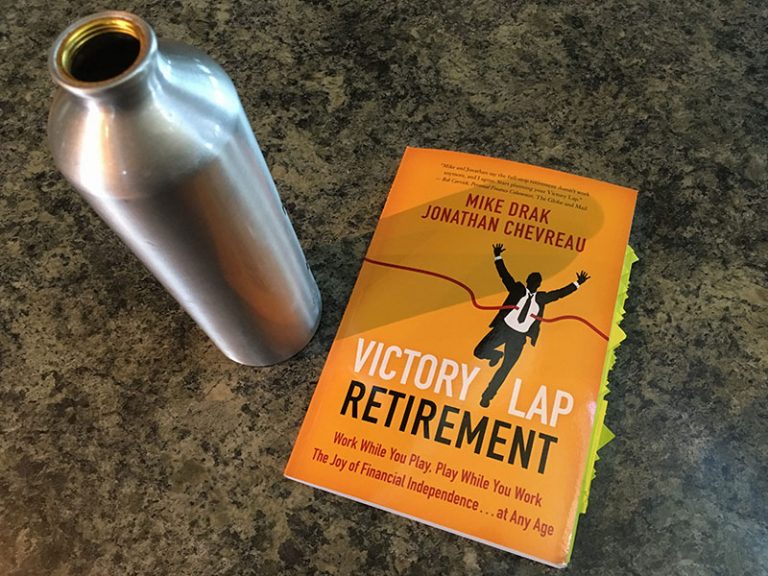
Once you achieve Financial Independence, you may choose to leave salaried employment but with decades of vibrant life ahead, it’s too soon to do nothing. The new stage of life between traditional employment and Full Retirement we call Victory Lap, or Victory Lap Retirement (also the title of a new book to be published in August 2016. You can pre-order now at VictoryLapRetirement.com). You may choose to start a business, go back to school or launch an Encore Act or Legacy Career. Perhaps you become a free agent, consultant, freelance writer or to change careers and re-enter the corporate world or government.
Small business owners typically spend their days juggling a huge variety of tasks, whether they have a team around to help them or not. From managing accounts and serving customers to handling marketing and sales and developing new products or services, there are many priorities which compete for attention. As a result, it can be tough for entrepreneurs to find the time and the energy to think about their future, particularly when it comes to retirement savings.
However, that doesn’t mean that it should keep being put off until later. If you own your own business, it’s important that you don’t end up at retirement age without enough savings to see you through. If you need to take care of your future, read on for some steps you can follow today to tackle retirement planning.
Know Your Goals
When it comes to retirement for small business owners, one of the first things entrepreneurs should think about is their long-term goals. Whether you want to retire in ultimate style one day or just want a basic amount of cashflow to see out your days with a simple life, it’s important to be clear on what your exact goals are for the future.
Apart from working out how much money you will need to retire in the manner you wish, you should also have goals about when you want to retire, and how you want to go about doing so. For example, would you prefer to sell your business, hand it down to a family member, friend, or colleague, or simply close it up when you’re ready to retire? Or perhaps you would prefer to sell just your share of the business to a business partner? Your goals for the future will determine how you prepare for your retirement, so you need to know them well in advance.
Converting your RRSP to a RRIF is clearly the best of three alternatives at age 71 and there are four ways to make sure you get the maximum benefit from the RRIF (Registered Retirement Income Fund).
If you have one or more RRSPs (registered retirement savings plans), you’ll have to wind them up at the end of the year in which you turn 71. We think converting your RRSP to a RRIF (registered retirement income fund) is the best option for most investors.
You have three main retirement investing options:
• You can cash in your RRSP and withdraw the funds in a lump sum. In most cases, this is a poor retirement investing option, since you’ll be taxed on the entire amount in that year as ordinary income.
• You can purchase an annuity.
• Proceed with the RRSP to RRIF conversion
RRIFs are the best retirement investing option for most investors
“Playing” at Dublin’s oldest pub (photo J. Chevreau)
As I write an early draft of this blog, I am in Dublin, Ireland, at the midpoint of the second week of a two-week holiday. Readers may recognize this blog’s headline as the subtitle of the new book I’ve recently published, Victory Lap Retirement. It was written with ex-banker Mike Drak, whose blogs have been regularly posted or republished here at the Hub.
I believe it was our editor, Karen Milner, who came up with this inspiring subtitle but whoever first articulated it, we all agreed on it once it came up. I often think of it when I’m working and really playing, or vice versa.
“Working” CIFFA executives at FIATA 2016 World Congress in Dublin this week.
For example, right now I’m working on writing this blog while officially “Playing” at being on holiday. The ostensible reason for the trip was to tack on a week’s vacation to a business trip my wife took to attend the FIATA 2016 World Congress in Dublin. That’s Ruth on the extreme right of the photo, along with colleagues and a spouse at a reception at Dublin’s Trinity College.
Such “Work” came at the end of a solid week of being a tourist elsewhere in Ireland, with the couple with whom we’ve been travelling.
I suggested to them in jest that the job of being a “tourist” would be a tough one if it meant 49 weeks a year, eight hours a day of “touristing,” however much it might seem to be a dream job. Come the end of any week of touring historical sites, art galleries and such – much of it on one’s feet, either walking or standing – you’d greet the arrival of the weekend and the cessation of tourism for a few days with some relief! (If you happen to be a Facebook friend, you can see about 40 photos of the trip under Ireland, here.)
It’s all relative really: if you were a writer for a Tourist guide book like Lonely Planet, you’d no doubt regard tourism as “work.”
“Time is more valuable than money. You can get more money, but you cannot get more time.” – Jim Rohn
It wasn’t until I began working on Victory Lap Retirement that it came to me that time, not money, was now my most important asset. The relationship between time and money had changed for me over the years.
When I worked in the corporate world, I willingly traded my time for money and I would use that money to provide security for my family. My efforts were focused on working hard and getting a promotion in order to get a bigger salary. I was willing to invest more and more of my time in order to make that happen because that was the way the game was played.
But when I was finally able to achieve “Findependence,” trading my time for money no longer felt like a fair exchange, Other things became more important and something inside started pushing me to become the real me. The only problem was that after all those years in the corporate world I had forgotten who I was, but thankfully I was able to figure that one out eventually.
This change in thinking probably had something to do with visiting my mother in the nursing home and realizing that in finally getting to my own Victory lap I had essentially used up two thirds of my allotted time. Let’s just say that I’m very concerned with how I invest the time I have left.
Expiry dates and Best Before dates
Everyone is born with an expiry date; the problem is that date is kept hidden from us, and when it happens, it just happens. But everyone also has a best-before date, a date up to which you are still physically able to do most things you enjoy: studies have shown this period can be influenced to a large extent by a person’s lifestyle.
When I think about the word “retirement,” and my definition for retirement is admittedly very narrow, I tend to think about that period that lies after a person’s best-before date up to their expiry date. This is the period where a person is no longer capable of being independent, and are dependent on others for care and support for their remaining years.
My main focus in my own Victory Lap is to make good investments of my time to create an optimal lifestyle with the goal of pushing back as far as possible my own best before date.
The video was a real eye opener for me. After watching it, I began to really appreciate the value of my remaining time. I promised myself I would take the appropriate corrective actions, but habit change is never easy and it is a work in progress for me. Please be assured that I will talk more on this important subject in future posts.
It takes ten years to become an overnight success
One day at a yard sale, I bought some old poker chips with the intent of using them to help track the time invested in pursuit of some of my goals. I came up with this idea after reading the book “Outliers” by Malcolm Gladwell and his chapter on the 10,000 hour rule, which is the hours of practice required to achieve mastery in anything.
A key component of my Victory Lap is the job I created for myself (my reason for getting out of bed in the morning) and creating the VLR community. To succeed, I need to improve my writing, blogging and public speaking skills. I also need to get healthy again so I will have the energy to get it all done. I have committed to investing 10,000 hours on this project, which equates to 1,000 hours per year over a 10-year period.
Those poker chips I bought? I counted out 520 chips, which represent the number of weeks covering a 10-year period and keep them in a glass jar in my home office. Each Sunday night after reviewing what I accomplished with my time that week I throw that week’s chip away and replace it with another one from the jar.
Watching that jar of chips shrink over time makes me focus on the important things in my life. It creates awareness especially as I carry the current week’s chip around in my pocket. When I hold it, it reminds me to focus on doing what I need to do in order to make things happen. Sometimes I might write something on the chip to serve as a theme for the week. It helps me to focus on what’s important and to forget about the rest.
The most important decision that you make each day is how you are going to invest your time. If you can’t see a reasonable return from your time investment don’t make the investment period.
Mike Drak is an author, blogger and speaker based in Toronto. He can be reached at michael.drak@yahoo.ca. Victory Lap Retirement, co-authored with Hub CFO Jonathan Chevreau, is now available for is now available for orders online. It’s also available now as a Kindle e-book, and on Kobo. The paperback edition will be available in bookstores in the second week of October. This blog is reprinted from Mike’s site with permission.
Or you can scroll down below for a lightly edited transcript of the proceedings.
But first, here’s an overview written by Doug Hoyes, co-founder of insolvency trustees Hoyes Michalos:
Doug Hoyes
Doug Hoyes:
Today’s podcast is the first ever podcast interview with Jonathan Chevreau and Mike Drak together, talking about their new book Victory Lap Retirement. This is so exclusive an interview that the book won’t even be officially released until October 10, 2016 but it is available for pre-order at amazon.ca, and the Kindle version is available now.
Mike Drak created the concept of a Victory Lap as an alternative to retirement, and teamed up with Jonathan to write their new book.
So what is a Victory Lap?
You will have to read the book for a full description, but as Jonathan and Mike and I discussed the concept of retirement has changed significantly. Our grandparents and parents had a good chance of working at the same company until aged 65, and then retiring with a full pension before dying at age 70.
Today almost no-one works at the same company for their entire working life, and most employers no longer offer full pensions, so the old fashioned view of retirement at age 65 with a full pension is no longer reality for most workers.
Instead, we are working longer, and living longer.
The essence of Victory Lap Retirement is to leave corporate employment, which usually entails working for someone else, and enter a new and different phase of your life.
Mike and Jonathan wrote Victory Lap Retirement to show readers how to transition from a high stress work environment to a low stress sustainable lifestyle to enjoy a happier, healthier life. For many, that may involve turning a hobby or passion into income during your “retirement” years, or working part time to “stay involved.”
Debt and Retirement
Debt is a prominent subject in Victory Lap Retirement, including this quote:
…make breaking free from the chains of debt your first priority. Not only will debt limit your financial freedom severely, it will suck the life right out of you.
As we discussed, debt and retirement don’t mix. When you retire your income decreases, so it’s likely you won’t be able to afford payments on a mortgage or other debt in retirement. Get out of debt long before retirement.
Unfortunately that’s not always possible, which is why seniors are the fastest growing age group of people filing bankruptcy and consumer proposals. Older debtors, aged 50 and older, now account for 30% of all insolvency filings, up from 27% two years ago, and that number keeps growing.
Senior debtors, people aged 60 and over, have the highest amount of unsecured debt of any age group when they go bankrupt, almost $70,000. A growing percentage of them even resort to payday loans to stay afloat.
If you’ve got debt, retirement is very difficult. If you have trouble making your debt payments while you are working, it may be impossible to keep up when you retire and your income drops, which is why we all agree that eliminating debt is essential long before retirement.
In addition to eliminating debt, Mike and Jonathan suggest you ask yourself “what do I like to do?” and start planning your Victory Lap now.
For more, listen to the podcast or read the transcript.