Posted By
  We’ve reviewed several books about Longevity over the nearly two years the Hub has been running, the most recent one being Mark Venning’s review of The 100-Year Life. (See Superlongevity: The 100-Year Life in a Blue Zone).
I mentioned this book in my talk Thursday to T.E. Wealth, in the context of the prospect of an 80-year investment time horizon for Millennials. (Implication of that: 100% stocks!)
But until now, for obvious reasons, we have held off on the “farther out” topic of immortality.
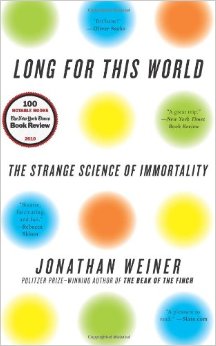
Even so, there is a growing literature on the topic of what I might term “ultra-longevity.” One in this camp is Long for This World: The Strange Science of Immortality.
Published in 2010 by science writing teacher Jonathan Weiner, the book focuses on a real believer in the possibility of human immortality: one Aubrey David Nicholas Jasper de Grey, who he quotes thus: “When you start talking’ about five-hundred year humans, or one-thousan’-year humans, most members of the general public get a li’l bit nervous.”
Indeed, and Weiner himself seems skeptical, despite providing such a platform to Aubrey de Grey. As the back-cover blurb states, “Could we live forever? And if we could — would we want to?”


 Posted By
 Posted By