Once you achieve Financial Independence, you may choose to leave salaried employment but with decades of vibrant life ahead, it’s too soon to do nothing. The new stage of life between traditional employment and Full Retirement we call Victory Lap, or Victory Lap Retirement (also the title of a new book to be published in August 2016. You can pre-order now at VictoryLapRetirement.com). You may choose to start a business, go back to school or launch an Encore Act or Legacy Career. Perhaps you become a free agent, consultant, freelance writer or to change careers and re-enter the corporate world or government.
View of San Miguel from top of the Rosewood Hotel (Photo J. Chevreau)
Last week, my wife Ruth and I enjoyed a week’s vacation in San Miguel de Allende, which is located in central (and landlocked) Mexico. We’d been to Mexico several times over the years but never this particular community, which is not handy to a major airport.
It was also our first trip to Latin America in about five years, since we had been taking our February breaks in Florida in more recent years.
Ironically, San Miguel was prominently featured in the old magazine I published around the year 2000: The Wealthy Boomer. At the time, I remember being impressed by the fact the cost of living for semi-retired American and Canadian baby boomers was roughly half what it was in our home countries. This theme was also applied to various Asia locations in a Hub blog last year featuring the book Planet Boomer. See also my post, titled 5 Asian locations where retirement is more affordable than North America.
Trading high taxes for crime?
Back during the days of the tax-and-spend Jean Chretien Liberals, I found the Mexican expatriate fantasy quite compelling, so much so that I listened to Spanish instructional tapes on my long commutes to the National Post’s bunker then located in Don Mills. But the fantasy of becoming a tax exile/early retiree faded once the Conservative Party achieved power and seemed to offer at least the hope of more reasonable levels of taxation (the Tax-free Savings Account being a major positive example.)
Meanwhile, the unremitting press over drug-cartel-related crime in Mexico reached a crescendo in the last few years so we stopped visiting for a spell. Continue Reading…
Over the years I’ve summarized many financial strategies for your successful retirement. Today I delve into shaping key “lifestyle” factors for your retirement happiness.
Definition of lifestyle is a very individual combination of activities. There is no one-size-fits-all scenario.
For example, try to diminish your work life gradually, say over two to five years. A series of short sabbaticals is another way to sample your new lifestyle.
Your retirement road map is a very personalized and unique process. Where there is a spouse, both should be involved in the planning.
Developing 5-year road maps within the money comfort works for many,
such as activities for age “60 to 64,” “65 to 69” and so on.
Are you a retailer who uses eBay as a virtual storefront to move a lot of products? Or, are you merely an occasional seller? Or, do you use Kijiji and Craiglist to empty out your basement, storage locker or Aunt Mildred’s apartment after she moved to a nursing home? Perhaps you rent out your house, apartment or cottage using FlipKey and Airbnb?
Do you do graphic design using sites like Fiverr? Or, do you have a website or a YouTube channel that makes you tens of thousands of dollars in advertising revenue? Do you drive for Uber?
Making money on the internet is easier than ever. And there are millions of sellers. CRA knows this. So, starting with returns filed in 2014 for individuals and 2015 for corporations, Canadians have to report internet sites used by them for income earned from the Internet. This will allow the tax man to check the information that the taxpayer reports with websites advertising products and services and to audit internet vendors who do not report their web based revenues. Continue Reading…
With millions of Baby Boomers poised to leave the workforce within the next decade, many of us want to find ways to contribute from our vast wells of experience and knowledge. We want more freedom of expression in our lives instead of continuing what might be a lukewarm commitment to a full-time job.
Yet there are those like Andrew Yarrow, vice president and director of Public Agenda, who’ve characterized retiring early as “profoundly selfish and unpatriotic.” However, we believe he is missing the mark completely, falling into painting a doom-and-gloom scenario instead of banking on the monumental range of creativity our age group has shown. After all, it was our generation who invented the life-changing personal computer and gave us rock and roll. We expect that we are quite capable of coming up with solutions to any difficult issues we may face in the future.
The Goldilocks scenario
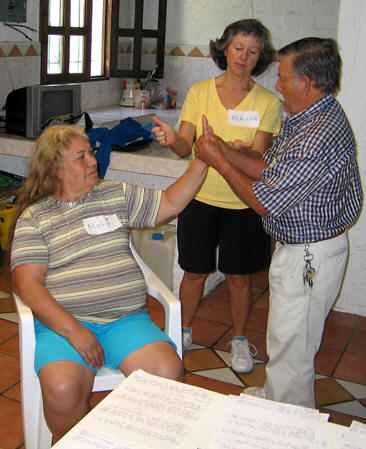
Akaisha teaching Thai massage in Mexico
Finding a satisfying middle ground between what Marc Freedman, the founder of Civic Ventures, calls “the fallacy of 30 years of R&R” and our significant need to find meaning through imparting our collective wisdom, the sheer numbers of 60-somethings are having an effect on how people actually live during retirement. Some would say they’re creating a new stage of life by choosing an encore career.
If you find yourself in this position of wanting to retire without giving up entirely on being active, there are more options for you now than ever before in history. You may want to seek out opportunities for heartfelt jobs, artistic pursuits, spiritual quests, volunteer vacations, or job adventures abroad such as the Peace Corps.
Websites now abound with information on how to help adults in the second half of life set a course, connect with peers, and find pathways to significant service.
Groups like Experience Corps work to solve serious social problems here in the U.S. You can even use Craigslist to help you get involved in your community and find flexible jobs or volunteer opportunities. Boomers simply won’t go quietly into the good night.
Nor should they.
Work or volunteer?
It’s the American Way to be original and productive, and our generation illustrates both of these qualities. Yet if you fear that America isn’t ready to deal with older workers, take heart — there is growing evidence to the contrary.
Websites like Retired Brains, Senior Job Resource, and AARP‘s Best Employers Program Honorees all provide information for those who are 50+ and want to work full or part time. And due to simple demographics, these positions are only going to become more plentiful.
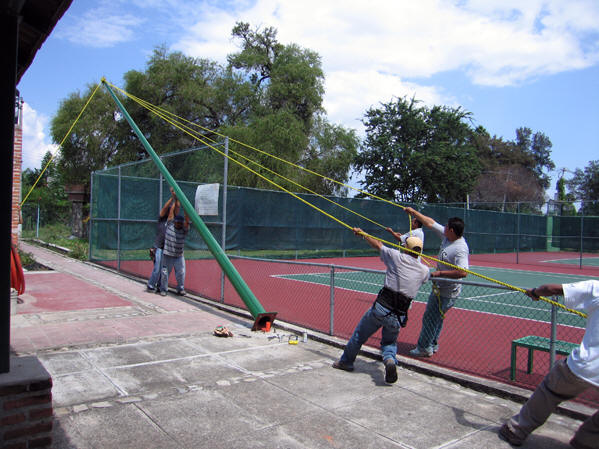
Billy built these tennis courts in Mexico
Looking at complete retirement can seem overwhelming to some. The idea of having no structure to their days — and the possible loss of ongoing relationships with patients or clients — can be a large detraction. The notion of forfeiting the intellectual and social stimulation of interacting with colleagues may seem like a kink in the perfect lifestyle away from work.
For these people, mentoring at SCORE, helping at Learning for Life, or volunteering time at your local hospice, food banks, or community colleges can also bring rewards beyond expectation. Money is not the only measure of wealth in a society.
The aim, we believe, is to activate the freedom to choose how to live your life no matter what stage you find yourself in — rather than letting someone else dictate your future ambitions. Once you’ve reached financial independence, you can easily move into a more rewarding position or challenge of your choice.
How you contribute to others in your retirement, and how you spend your time and your money is up to you and only you. Have confidence in yourself, know the value of your talents and endeavors, and build up your self-worth. After all, you’ve earned it.
It is from here that you will make all the difference in your world and in the world around you.
This is what we have done, and our personal lives have expanded significantly because of it.
About the Authors
Billy and Akaisha Kaderli are recognized retirement experts and internationally published authors on topics of finance and world travel. With the wealth of information they share on their popular website RetireEarlyLifestyle.com, they have been helping people achieve their own retirement dreams since 1991. They wrote the popular books, The Adventurer’s Guide to Early Retirement and Your Retirement Dream IS Possible available on their website or on Amazon.com
As readers may know, Hub blogger Michael Drak and I have just finished co-authoring a book about life after Financial Independence. It’s titled Victory Lap Retirement, and describes a new post-corporate lifestyle that combines work and play, much like the illustration to the left.
The book has just gone through its second editing pass. Next we’ll be sending out pre-release PDFs to media and influencers, looking for testimonials: if you’re interested please let me know at jonathan@findependencehub.com or Michael at michael.drak@yahoo.ca.
The finished product should be in book stores and available online by mid-summer.
Half-hour interview will be at Abundant Retirement telesummit


 Posted By
 Posted By