Victory Lap

Once you achieve Financial Independence, you may choose to leave salaried employment but with decades of vibrant life ahead, it’s too soon to do nothing. The new stage of life between traditional employment and Full Retirement we call Victory Lap, or Victory Lap Retirement (also the title of a new book to be published in August 2016. You can pre-order now at VictoryLapRetirement.com). You may choose to start a business, go back to school or launch an Encore Act or Legacy Career. Perhaps you become a free agent, consultant, freelance writer or to change careers and re-enter the corporate world or government.

Weekly Wrap: Semi-retirement, Mini-Retirements, RVing & Variants

SAMSUNG CSCThe current issue of MoneySense features my Financial Independence column, with the current instalment being an update on the “semi-retired” first year of my personal Findependence: What semi-retirement is really like.

Do a search on semi-retirement and/or financial independence and you’ll find plenty more articles on this theme. For instance, in February, the Afford Anything blog ran a piece titled Mini-Retirements, Semi-Retirement, Early Retirement — What’s the Most Awesome Lifestyle? There are some interesting variants in the piece, such as “Perpetual Semi-Retirement.”

Back in April, The Toronto Star and other media ran stories like this one: Semi-retirement the new normal in Canada: Survey. The Hub also weighed in on the survey, noting that 15% plan never to fully retire, but many will embrace Semi-Retirement.

Way back, the Get Rich Slowly blog ran this reader story about Making the Move to Semi-Retirement. Note the reference to the classic book about Financial Independence, Your Money or Your Life, which is all about the tradeoffs between time/life energy and money. Recommended reading for anyone interested in Findependence!

The RV has replaced the rocking chair
51PY175FY8L._SY300_
Amazon.com

Continue Reading…

Some Early Stage Encore Career Observations and Recommendations


A metal toggle switch with plate reading Change and Same, flipped into the Same position, illustrating the decision to work toward changing or improving your situation in lifeBy Michael Drak

Special to the Financial Independence Hub

I started my own encore career back in February 2015;  here are some of the things you might want to consider when planning your own encore career:

Should you tell your boss you plan to leave and start an Encore Career?

Bosses can start to act a little funny after you tell them you plan to leave the company at some point in the future. For some reason they believe that you are no longer fully committed to your job and that your performance will start to slide as you focus on getting ready for your new career.

This can cause some friction, so it’s best to make sure you have the bulk of your encore job preparation completed prior to dropping the bomb, just in case. In my own situation within three months of having declared I was planning to leave I was pleasantly surprised to receive a buy-out from the company. Was it a coincidence? Who knows, but I’d rather receive a payout versus a gold watch any day, plus it provided me with some liquidity until my new business starts generating a profit.

Do as much advanced preparation as you can prior to leaving your job

My original plan was to tell everyone that I was leaving in two years and during that time learn to run a blog and start working on my retirement book. Getting bought out accelerated things. In hindsight, it might have been better to have started the book and other projects prior to making the announcement.

 Have a safety net in place so you can sleep at night Continue Reading…

An Aging Workforce is a Competitive Advantage

pinpoint__dsc1211_opt_367_x_326
Lisa Taylor

By Lisa Taylor, Challenge Factory

Special to the Financial Independence Hub

The dramatic impact of longevity on organizations was predicted decades ago. Indeed, in 1961, President John F. Kennedy put a formal structure in place to ensure that Congress would be attentive to the opportunities and challenges increased life expectancy presented to existing programs and policies. Since science had added years to our lives, Kennedy’s vision was to ensure added life to our years.

Longer life expectancy implies longer workspan

One corollary: increased life expectancy means longer work-life too. Continue Reading…

The Ageless Generation

Jane Fonda at the Jane Fonda Hand And Foot Print Ceremony as part of the 2013 TCM Classic Film Festival, TCL Chinese Theater, Hollywood, CA 04-27-13
Jane Fonda in 2013

Are the Baby Boomers part of the Ageless Generation?

Many of us seem to act as if that were the case but there’s little doubt most of us feel younger than we appear. To me, the poster child for this ageless generation is Jane Fonda, whose famous workout videos appear to have held her in good stead in her personal twilight career.

(Technically, since she was born in 1937, Jane Fonda is not a post-war baby boomer but her spirit certainly seems to epitomize the zeitgeist of the generation that came soon after her).

If you get Netflix check out the recently released series Grace & Frankie, where  Fonda plays a 70-year old recent divorcee: even though she herself is actually 77! Equally vibrant are her aging costars: Lilly Tomlin, Martin Sheen and Sam Waterston (best known as the prosecutor on Law & Order). Tomlin is 75 and the two male co-stars are 74.

Medical advances will transform the global economy

41X0rgzpqKL._SY344_BO1,204,203,200_
Amazon.com

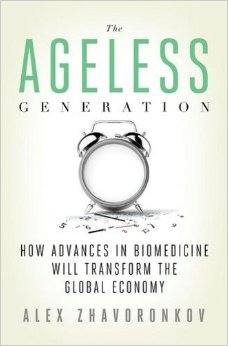
The Ageless Generation also happens to be the title of a recent (2013) book by Dr. Alex Zhavornonkov, director of the Biogerontology Research Foundation and founder of the International Aging Research Portfolio. It’s one of about a dozen books I read in recent months in preparation for a talk on Longevity that I gave on Monday to the National Elder Planning Issues Conference in Niagara Falls.

The book’s subtitle summarizes the gist of it: How advances in biomedicine will transform the global economy. Since the focus is on the United States, it will come as no surprise that  Zhavornonkov believes breakthroughs in extending Longevity can only make a shaky Social Security and Medicare system that much more fragile in the United States, and by extension their equivalent programs in other advanced nations.

Pressure on Social Security & Medicare

Continue Reading…

We may be saving enough, yet still not be ready for retirement

pinpoint__dsc1211_opt_367_x_326
Lisa Taylor

By Lisa Taylor, Challenge Factory

Special to the Financial Independence Hub

Recently, Malcolm Hamilton’s C.D. Howe Institute paper, Do Canadians Save Too Little?, challenged the prevailing view that Canadians are not financially prepared for retirement. His Financial Post column summarized the key findings of his paper and highlighted that many of the assumptions made about retirement are not accurate. Canadians are saving and the determination of how much saving is enough is dependent on many non-financial factors. [See also the Hub’s blog on this: JC]

Indeed, the question of “retirement readiness” is more complicated than calculations predicting financial security.

Meaning of “Retirement” has changed

Retirement has changed. Every formal definition of the verb “to retire” focuses on retreat, withdrawal and conclusion. The original meaning of the word included a complete withdrawal from work, a focus on rest or seclusion, a retreat from battle or the time to go to bed. We retire equipment when it is taken out of service. We retire a bond by taking it out of circulation. Continue Reading…