As Didi says in the novel (Findependence Day), “There’s no point climbing the Tower of Wealth when you’re still mired in the basement of debt.” If you owe credit-card debt still charging an usurous 20% per annum, forget about building wealth: focus on eliminating that debt. And once done, focus on paying off your mortgage. As Theo says in the novel, “The foundation of financial independence is a paid-for house.”
By Kevin Flanagan, Senior Fixed Income Strategist, WisdomTree
Special to the Financial Independence Hub
The last few months have certainly given the money and bond markets a lot of divergent news headlines to digest. Not surprisingly, the focus has been on negative rates abroad, geopolitical events and, a bit more recently, some better-than-expected employment news juxtaposed with a softer-than-expected GDP report. That begs the question: What about inflation? Isn’t that a key ingredient in the bond market mix?
Without a doubt, U.S. inflation data has taken a backseat for fixed income investors, and for good reason; there just haven’t been any fresh developments lately. Certainly, the conversation has shifted from a year ago, when deflation concerns were permeating market psychology. But the latest figures don’t elicit concerns that price pressures will be rearing their ugly head anytime soon, or at least that’s what the collective thinking is in the fixed income markets.
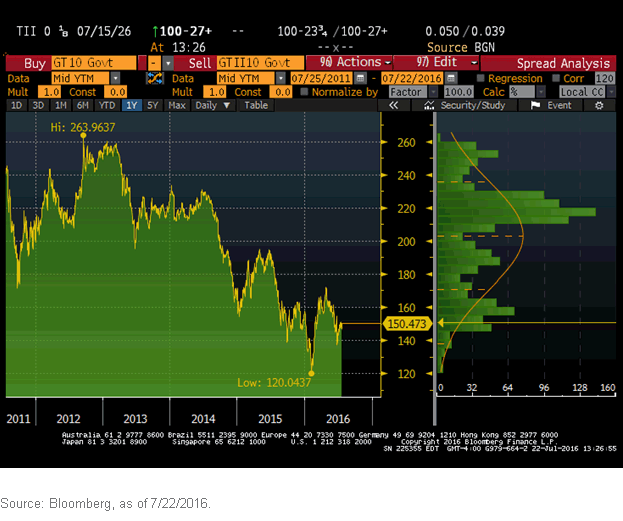
Breakeven inflation rate
So, what does the inflation backdrop look like? According to the widely followed Consumer Price Index (CPI), the year-over-year inflation rate came in at +1.0% in June (Note 1)—very little changed from the readings posted over the last four months, but definitely higher than the +0.1% for the same month in 2015. The core gauge, which excludes food and energy, rose at a +2.3% annual clip and has been residing in a range last seen in 2012. There continues to be a large dichotomy between core goods (-0.6%) and core services (+3.2%) .(Note 2)
The cost of life insurance increases as you get older. It is also more expensive for people with less than perfect health. Even if you are in perfect health today, you could become ill tomorrow or your fitness level could drop, especially if you live a sedentary life. People generally become less active when they get older. Insurance companies are now launching new incentives to help keep Canadians fit and healthy longer.
Manulife, one of Canada’s top insurance companies, is introducing an innovative new product called the Vitality Program. This product rewards policyholders for maintaining a high level of health and fitness and Goodlife Fitness is going to help with reduced membership fees.
“You make choices every day. With Manulife Vitality, you get rewarded for the healthy ones.”
This is the first time such a program has ever been offered. The Vitality Program combines the benefits of life insurance with two great features:
• The opportunity to save money on your life insurance premiums
• The opportunity to earn valuable rewards for improving your health
Or you can scroll down below for a lightly edited transcript of the proceedings.
But first, here’s an overview written by Doug Hoyes, co-founder of insolvency trustees Hoyes Michalos:
Doug Hoyes
Doug Hoyes:
Today’s podcast is the first ever podcast interview with Jonathan Chevreau and Mike Drak together, talking about their new book Victory Lap Retirement. This is so exclusive an interview that the book won’t even be officially released until October 10, 2016 but it is available for pre-order at amazon.ca, and the Kindle version is available now.
Mike Drak created the concept of a Victory Lap as an alternative to retirement, and teamed up with Jonathan to write their new book.
So what is a Victory Lap?
You will have to read the book for a full description, but as Jonathan and Mike and I discussed the concept of retirement has changed significantly. Our grandparents and parents had a good chance of working at the same company until aged 65, and then retiring with a full pension before dying at age 70.
Today almost no-one works at the same company for their entire working life, and most employers no longer offer full pensions, so the old fashioned view of retirement at age 65 with a full pension is no longer reality for most workers.
Instead, we are working longer, and living longer.
The essence of Victory Lap Retirement is to leave corporate employment, which usually entails working for someone else, and enter a new and different phase of your life.
Mike and Jonathan wrote Victory Lap Retirement to show readers how to transition from a high stress work environment to a low stress sustainable lifestyle to enjoy a happier, healthier life. For many, that may involve turning a hobby or passion into income during your “retirement” years, or working part time to “stay involved.”
Debt and Retirement
Debt is a prominent subject in Victory Lap Retirement, including this quote:
…make breaking free from the chains of debt your first priority. Not only will debt limit your financial freedom severely, it will suck the life right out of you.
As we discussed, debt and retirement don’t mix. When you retire your income decreases, so it’s likely you won’t be able to afford payments on a mortgage or other debt in retirement. Get out of debt long before retirement.
Unfortunately that’s not always possible, which is why seniors are the fastest growing age group of people filing bankruptcy and consumer proposals. Older debtors, aged 50 and older, now account for 30% of all insolvency filings, up from 27% two years ago, and that number keeps growing.
Senior debtors, people aged 60 and over, have the highest amount of unsecured debt of any age group when they go bankrupt, almost $70,000. A growing percentage of them even resort to payday loans to stay afloat.
If you’ve got debt, retirement is very difficult. If you have trouble making your debt payments while you are working, it may be impossible to keep up when you retire and your income drops, which is why we all agree that eliminating debt is essential long before retirement.
In addition to eliminating debt, Mike and Jonathan suggest you ask yourself “what do I like to do?” and start planning your Victory Lap now.
For more, listen to the podcast or read the transcript.
Credit cards, much like any financial product, seem to create anxiety for many. With so many rumours surrounding credit cards, we decided to turn to top influencers in the community for help on busting these myths and sharing the facts.
Here are your top 5 credit card myths busted once and for all:
Myth #1: Having a credit card means you are financially irresponsible
Credit cards are a great way for you to start building credit and earn rewards from everyday purchases. If you’re spending wisely and are paying off your balance each month, credit card debt won’t be an issue.
Myth #2: Getting a credit card will hurt your credit score
The exact opposite is actually true here. The best way to establish credit is to start by getting a credit card. By paying off your debt in full each month, there’s nowhere but up for your credit score. Be wary of credit utilization though. A high utilization ratio will affect your credit score negatively.
Congratulations – Your credit score has just gone up!
I would love to say it increased just because you are reading this article but in reality it is because Equifax has implemented a change in its algorithm (the computer scoring system that banks use to predict the chances of you paying on time).
These changes have had a huge impact on the report and 80 per cent of Canadians have seen a jump in their personal credit score. So if you were declined for financing previously, you might want to try again.
Here are some of the main changes that have been made:
Mortgage Payments now affect your credit score
As of June, your mortgage payment history now affects your credit score. If you are like most Canadians and paying your mortgage is top priority, then this will be one of the main reasons why your score has jumped.
Lines of Credit report different than your Credit Card
Before the recent changes, a high balance (any balance over half of the limit) on a line of credit or a credit card would lower your score the same amount. Now, a high balance on your line of credit will not hurt your score as much as if you have a high balance on a credit card. Continue Reading…


 Posted By
 By Kevin Flanagan, Senior Fixed Income Strategist, WisdomTree

 Posted By