As Didi says in the novel (Findependence Day), “There’s no point climbing the Tower of Wealth when you’re still mired in the basement of debt.” If you owe credit-card debt still charging an usurous 20% per annum, forget about building wealth: focus on eliminating that debt. And once done, focus on paying off your mortgage. As Theo says in the novel, “The foundation of financial independence is a paid-for house.”
For people with bad credit, the experience of buying a home can be quite difficult and daunting. It’s a tricky time that necessitates careful planning and preparation.
However, despite the difficulties that low credit scores may present, there are several tips and strategies you can employ to help you navigate the home-buying process. This article highlights some of these innovative strategies.
How to Buy a Home with Less than Stellar Credit
Here are some pointers to help you buy a home even if you have bad credit:
Consider Special Programs
There are numerous loan programs that do not require a high credit score or a down payment if you are a first-time homebuyer or have a low income. Some options [in the United States] to consider include USDA loans, VA loans, and the Fannie Mae HomeReady and Freddie Mac HomeOne and Home Possible loan programs.
Look for the Best Deal
Different mortgage brokers offer various rates of interest, so shop around to find the best deal. According to studies, trying to compare multiple rate quotes could save you a substantial amount of money in the long run.
Look into Down Payment Assistance
If you’re concerned about saving for a down payment, there are more than 2,500 down payment support programs available across the country for which you could be eligible. However, you need to avoid major financial changes. Taking on new debt or making a large purchase can lower your credit score, so avoid doing so while applying for a mortgage.
Things you should know about the Homebuying Process
Before you start looking for a house, you should educate yourself on the ins and outs of house purchases. Here’s a rundown of some key points to keep in mind:
Recognize why you want to Buy a House
Buying a house is a significant investment that shouldn’t be taken lightly. If you don’t know why you would like to buy a house, you may come to regret your decision later on.
Check your Credit Score
Your credit score will help you in evaluating your payment plans; lenders use it to set loan pricing and determine if you can repay your mortgage. The more favorable your credit history, the better your chances of obtaining financing at the best terms and rates. Continue Reading…
Central banks across the globe are likely to continue with their attempts to tame inflation by hiking interest rates, crushing the hope that markets will return to normality any time soon.
With the unemployment rate at a historically low level, inflation remains a top concern for the Bank of Canada (BoC) and the Federal Reserve (Fed), who are also dealing with looming risk of a recession and uncertainty regarding the impacts of the recent bank turbulence. The BoC and the Fed appear to be ahead of global peers in their attempt to slowdown inflation – raising the question around whether we have seen the peak in rates in North America.
The rapid tightening cycles by policy makers are reinforcing the appeal of owning high-
quality ultra-short bond, and money market ETFs. A series of recent rate hikes by the Bank of Canada and the Federal Reserve gave a boost to yields for these products, making the saying “cash is king” true to a certain extent, as investors who are worried about higher inflation and slowing growth prefer investing in these cash alternatives to ride out the market volatility. In today’s market, you can earn an attractive yield while taking less risk – earning while you wait for volatility to subside.
Yield curve[1], are we in love with the shape of you?
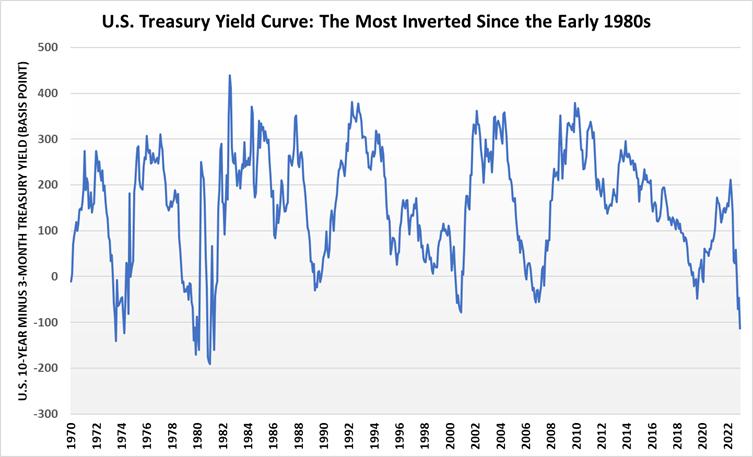
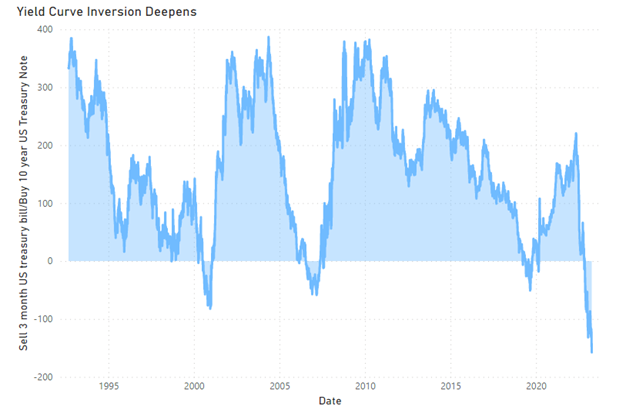
Normally, the yield curve is upward sloping, meaning longer-term bonds yield more than shorter-term bonds as investors often demand higher yields for locking their money up for a longer period. However, at present, the shape of the yield curve is inverted, which means shorter-term securities are yielding more than longer-term ones. This inversion is largely owing to the Central Bank’s quest to reduce inflation by hiking the interest rates.
Due to historically low interest rates in the last few years, investors were compelled to take more duration[2] risk by adding exposure to longer-term bonds and higher credit risk[3] by investing in lower credit quality segments such as high-yield or emerging markets bonds. However, due to the current yield curve inversion, the tables have turned now, offering a unique opportunity for fixed-income investors looking to earn higher yields.
Source: Bloomberg USYC3M10 Index (Sell 3 Month US T-bill & Buy 10 Year US Bond Yield Spread) Sep 1992 to April 2023
Why stash cash in money market & ultra-short-term bond ETFs?
The front-end of the yield curve (0-1yr) offers an attractive asymmetry and opportunity to capture yield between 4-5% + with limited duration and credit risk. This allows investors to earn the highest yields we’ve seen in more than a decade on fixed income and build a more stable high-quality fixed-income portfolio by adding exposure to ultra-short investment grade bonds and money market securities. Based on the current interest-rate volatility, hugging the front-end of the curve seems a more prudent and consistent way to preserve capital in a fixed-income allocation. BMO ETFs offers solutions such as BMO Money Market Fund ETF Series (ZMMK), BMO Ultra Short-Term Bond ETF (ZST) and BMO Ultra Short-Term US Bond ETF (ZUS), which are a great way to get exposure to the front end of the curve.
These money market & ultra short-term bond ETFs invest in high credit-quality instruments that provide a great degree of safety and capital preservation. Firstly, by investing in securities that mature in less than one year, the duration risk is minimal, which results in lower interest rate sensitivity in your portfolio. Secondly, these ETFs offer high liquidity[4] due to the nature of their underlying securities, which means they can be bought and sold easily with minimal market impact. Continue Reading…
From setting specific financial goals for success to having someone hold you accountable, here are 18 answers to the question, “What are your best tips for how to stay motivated and disciplined in the pursuit of financial independence?”
Stay Disciplined and Goal-Oriented
Tie Your Goals to a Tangible Item
Stay Educated
Equate Money to Your Time
Celebrate Small Wins Along the Way
Develop an Action Plan
Create a Budget
Invest in Yourself
Develop a Strong “Why”
Have Fun With It
Set Specific Financial Goals for Success
Balance Spending Now and Saving for the Future
Start Tracking Your Progress
Focus On the Big Picture
Be Present
Build a Support System
Set Yourself Micro-Goals Along the Way
Find a Financial Accountability Buddy
Stay Disciplined and Goal-Oriented
Staying motivated and disciplined while pursuing financial independence requires commitment. One approach to remaining committed is to practice goal-setting, breaking down big goals into smaller goals that are based on achievable objectives. For example, if you want to save $1,000 in 3 months, break your bigger goal of saving money into a series of monthly phases, setting benchmarks each month as you inch closer to achieving your end goal. This helps with momentum and development while moving towards your desired result. — Michael Alexis, CEO, swag.org
Tie Your Goals to a Tangible Item
One often overlooked way to accomplish this is to tie your goals to a tangible item, such as a savings jar or bank account. Visualize yourself with it when planning out what you need to do today and watch as your small contributions add up.
Having this visual representation can be just the thing you need on days when you feel unmotivated and looking for an excuse not to save money. Taking ownership of your financial goals is the first step towards realizing those dreams – that’s what staying disciplined will help you achieve! — Tasia Duske, CEO, Museum Hack
Stay Educated
Continually educating yourself about personal finance is crucial in staying motivated and disciplined as you pursue financial independence. Of course, this starts with knowing how to budget and set boundaries for yourself.
As you strive toward financial independence, it’s important that you know where your money is going and identify areas where you can cut back on spending. There are a variety of ways that you can budget your money, so explore those options and find a way that works for you.
If you are one who likes to invest, stay up to date on current market trends so you don’t take any enormous risks that could cost you a lot of money. As you continue to stay informed and educated about personal finance, you will make informed decisions and avoid costly mistakes, which will ultimately help you achieve your goals. — Bill Lyons, CEO, Griffin Funding
Equate Money to your Time
Whether you make minimum wage or $100 an hour, we all trade time for money. Spending less money is one way to achieve greater financial independence. But when you’re struggling to cut expenses, one way to stay motivated is to understand how much time your money costs you.
For example, if you’re toying with the idea of a $50 purchase, think of how much of your time it would take to make back that $50. How far would that put you behind? Would you be willing to spend that time getting that item?
Thinking about money in terms of minutes/hours of your life can help you exercise some restraint on impulse buys or unnecessary purchases. If you feel like it would be a waste of time, it’s probably a waste of money, too. — Alli Hill, Founder and Director, Fleurish Freelance
Celebrate Small Wins along the way
Achieving financial independence can be a long and difficult journey, and it’s easy to become discouraged if you only look at the result. You can keep your motivation and momentum going by celebrating minor victories along the way.
Set attainable short-term goals, such as paying off a credit card or increasing your monthly savings by a certain amount. When you achieve these objectives, take the time to recognize your accomplishments and reward yourself.
As a reward for sticking with it, give yourself a small treat or indulge in a favorite activity. This will help you in maintaining your motivation and discipline, as well as making the journey to financial independence more enjoyable. –– Johannes Larsson, Founder and CEO, JohannesLarsson.com
Develop an Action Plan
It is important to develop a plan with realistic goals. Start by setting short-term goals that are achievable, such as saving a certain percentage of each paycheck or paying off the debt within a certain timeframe.
Then, set longer-term goals for retirement savings or other goals related to financial independence. Having a plan will help keep you motivated and on track to achieving your financial goals. — Martin Seeley, CEO, Mattress Next DayContinue Reading…
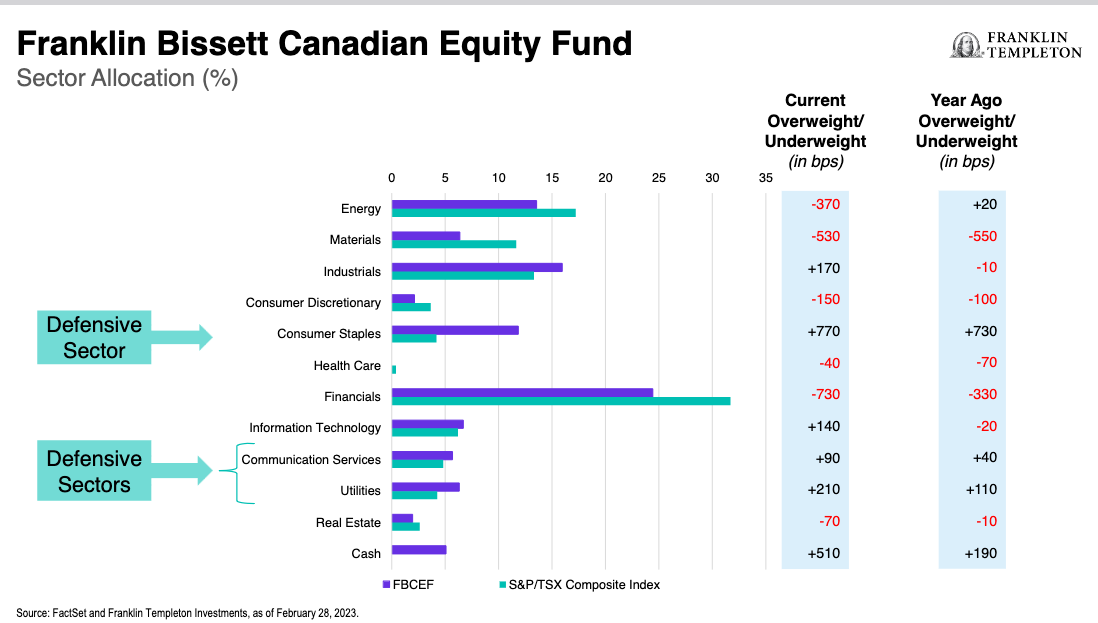
Despite a looming recession acknowledged by most of the financial industry, Franklin Templeton Canada is relatively upbeat about the prospects for both Canadian stocks and fixed income over the short- to medium-term. In a Toronto event on Wednesday aimed at financial advisors and the press, GareyJ. Aitken, MBA, CFA — Calgary-based Chief Investment Officer for Franklin Bissett Investment Management — described how he has been positioning his Franklin Bissett Canadian Equity Fund somewhat defensively. (There was also a webinar version of the event.)
As you can see from the above breakdown of the fund, Aitken is way overweight defensive sectors like Consumer Staples relative to the index: the S&P/TSX composite. In Canada, consumer staples amounts to the major grocery stores like Loblaw and Metro: there’s little along the lines of such American staples giants as Proctor & Gamble or Colgate Palmolive. Aitken said his fund has owned Saputo Inc. since its IPO in the late 90s, and has long owned Alimentation Couche-Tard Inc.
The fund has been overweight consumer staples for more than a year: as the chart shows, he was overweight this defensive sector by a whopping 730 basis points a year ago and this year is even more overweight by 770 bps. He is also overweight the other big defensive sector, Utilities, by 210 bps, compared to overweight by 110 bps a year ago. The third major defensive sector globally is Health Care, but the Canadian stock market has only minimal exposure to that sector.
Aitken has moved from a small underweight position in industrials a year ago to a modest overweight in 2023 of 170 bps. And he is slightly overweight Information Technology by 140 bps, compared to a small underweight of 20 bps a year ago.
Underweight Energy, Financials & Materials
On the flip side, the fund has been and continues to be underweight in the three big sectors for which the Canadian stock market is famous: Energy, Financials & Materials. Financials (chiefly the big Canadian banks) were underweight 330 bps a year ago and Aitken has moved that to an even bigger 730 bps underweight this year. In Materials he has stayed largely pat, with a 530 underweighting today compared to a 550 bps underweighting a year ago.
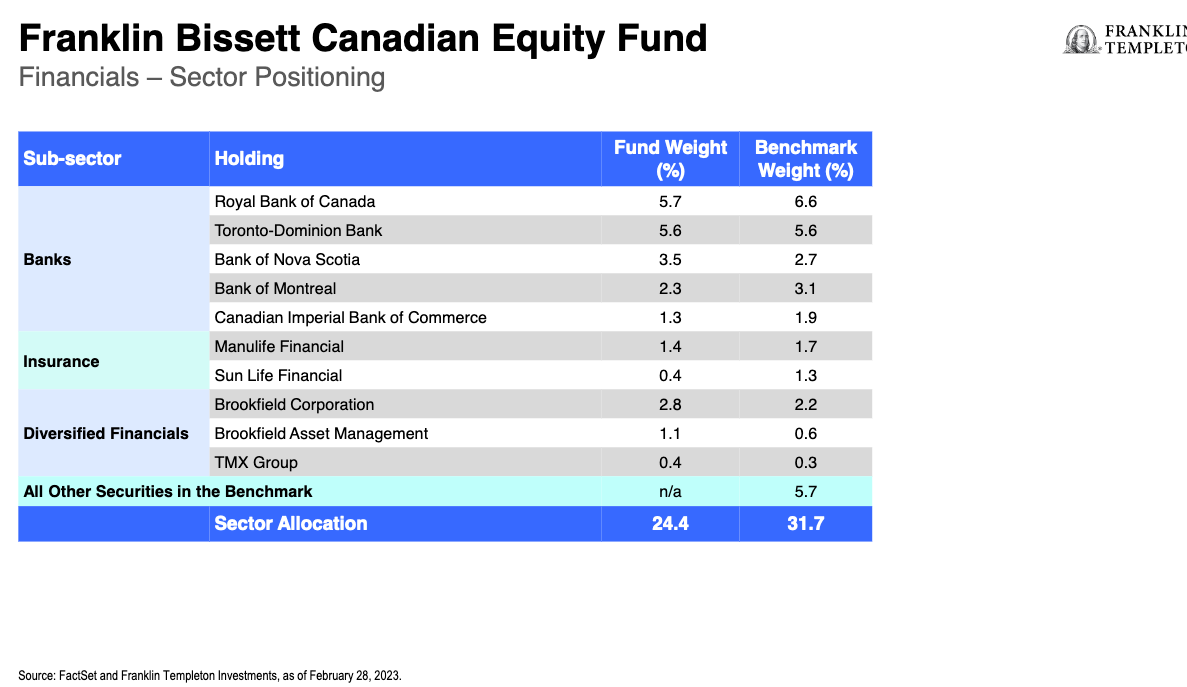
The chart below shows the fund’s holding in Canadian financials. You can see that among the big Canadian banks, the fund is over the index weighting only for the Bank of Nova Scotia, and is slightly overweight Brookfield Corp. and Brookfield Asset Management:
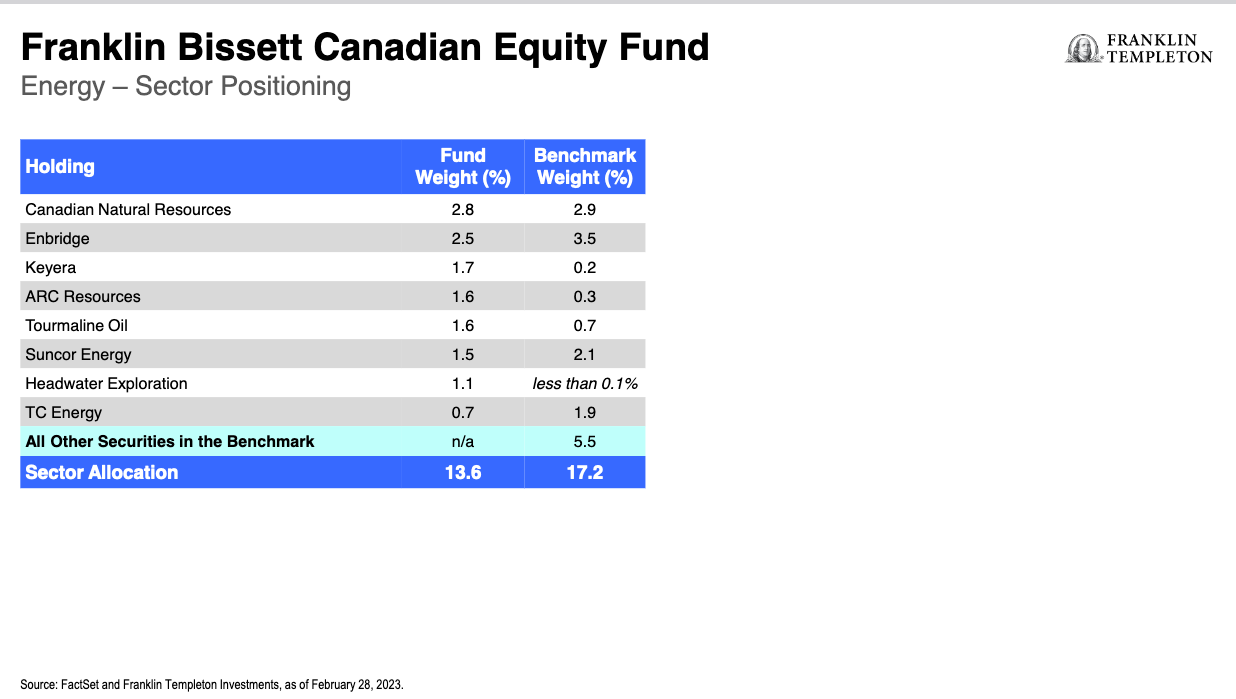
However, Aitken has moved Energy (Canadian oil & gas stocks, pipelines etc.) from a small 20 bps overweight position last year to a 370 bps underweighting in 2023. The chart below shows the major Energy holdings relative to the index, with overweights in certain less well-known names:
Aitken remains slightly underweight Consumer Discretionary stocks, moving from a 100 bps underweight last year to 150 bps underweight currently. Real estate is almost flat: from a slight 10 bps underweighting a year ago to a small 70 bps underweight today. Continue Reading…
By Winnie Jiang, Vice President, Portfolio Manager, BMO ETFs
(Sponsor Content)
Little about the current economic cycle has conformed to historical norms. With divergence in employment data and leading economic indicators, recent data released sent mixed signals that left investors perplexed about the near-term economic outlook.
On one hand, the job market remains overwhelmingly strong, with ISM (Institute for Supply Management) Services bouncing back from extreme lows in December and retail sales also rebounding. The re-opening of the Chinese economy will likely provide a breather on global supply chain issues while boosting demand. Consumer credit remains well retained as default rates stay low with no warning signs of near-term upticks.
On the other hand, yield curve inversions, a precedent of most recessions, continue to worsen. 3-month U.S. Treasury yields are pushed above 10-year yields by the widest margin since the early 1980s. ISM Manufacturing PMI (purchasing managers’ index) and housing data also point to a gloomy outlook. Corporate sentiment and capital expenditure showed little signs of recovery, and housing permits have rolled back to pre-pandemic levels after surging strongly during Covid.
Source: Bloomberg, January 31st, 2023
The Outlook
While robust job markets and consumer data keep inflation well above the Fed’s long-term target, recent CPI (Consumer Price Index) announcements indicate things are steadily, albeit slowly, moving towards the right direction. The inversion of the yield curve caps the magnitude of further rate increases that could be absorbed by the economy before it slips into a recession.


 Posted By


 Posted By