As Didi says in the novel (Findependence Day), “There’s no point climbing the Tower of Wealth when you’re still mired in the basement of debt.” If you owe credit-card debt still charging an usurous 20% per annum, forget about building wealth: focus on eliminating that debt. And once done, focus on paying off your mortgage. As Theo says in the novel, “The foundation of financial independence is a paid-for house.”
Retirement! For many of us, it’s an event so far in the future that it almost seems unreal. Taking active steps to plan and invest for the “golden years” feels unnecessary.
Yet as anyone who’s lived through their 30s and 40s can share, those decades go by quickly. And if you want to retire early, the worst thing you can do is wait to start saving or unintentionally sabotage your portfolio.
Long story short, if you want to retire early (and wealthy), you’ll want to start now. But what does “start” mean when it comes to saving for retirement?
The answer is surprisingly complex. The good news is that learning how to build your nest egg won’t consume all of your free time. With attention and discipline, you can retire early: so let’s get started.
1.) Visualize your future and figure out what that costs
You wouldn’t renovate your kitchen without choosing a style and establishing a budget. Think of building your nest egg the same way: you need a goal and a plan to get there. Sure, you know you want to retire early. But what does retirement look like for you once you’re there? Do you want to travel? Live in your hometown? Play bridge? Take piano lessons? Visualizing your retirement home base and how you’ll spend your free time will help you set your savings goal.
Envisioning a loose plan for what you want your post-work life to look like is a great start. But you’ll also need to take into account inflation and investment returns, among other factors. AARP’s retirement calculator can help you understand where you’ll need to be financially in order to achieve your goal. It will also help you prioritize the actions you’ll want to take now so you can actually get there later.
2.) Pay off debt and reapply the payments
Debt is a normal part of life for most Americans. Buying a home or paying for college often requires taking out a loan, and so does starting a business. Borrowing responsibly in these areas can help you get ahead financially, but other kinds of debt, like high-interest credit card payments, can hinder your retirement savings efforts.
First, if you have education debt and think the scholar-”ship” has sailed, think again. There are actually scholarships that pay off education debt for borrowers who have already graduated. And if you have excellent credit, you can also look into refinancing your student loans.
If you have credit-card debt, personal loans, or other high-interest payments, prioritize paying off those balances in full. If the payments were manageable for your budget, repurpose those payments into building your nest egg instead. Bonus: once you’ve paid those debts, your credit score will probably rise. And that helps you qualify for lower rates when refinancing or taking out a new fixed or adjustable-rate mortgage.
3.) Get sneaky with microsavings so you can live life along the way
Small dollars add up fast. That’s great news for people who want to enjoy life and save for retirement at the same time. If you’re aggressive with microsavings, you’ll have an easier time affording life’s little niceties and still be able to save for retirement at the same time. Continue Reading…
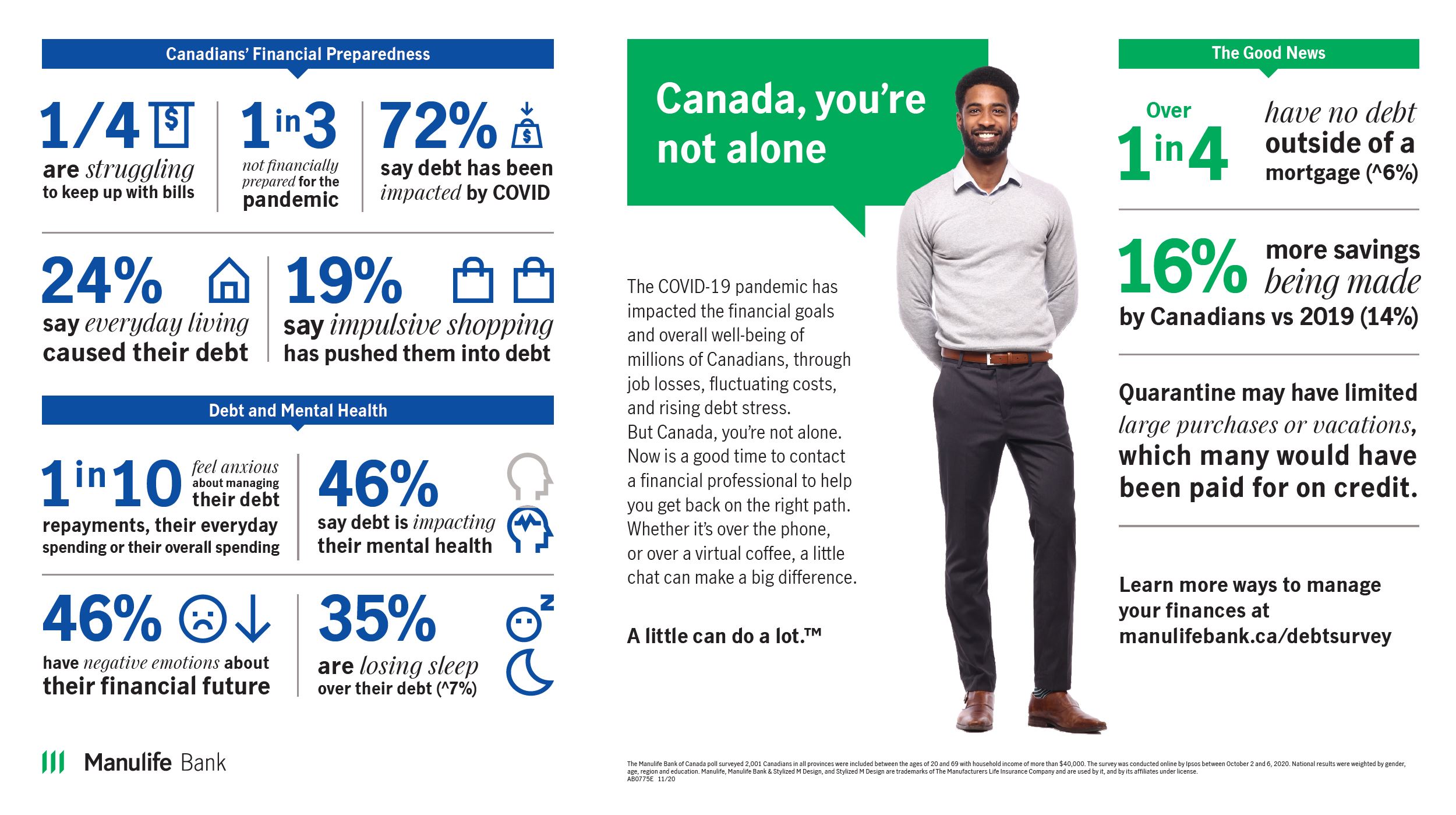
A third of Canadians were financially unprepared for the pandemic, and more than 75% think Covid-19 has impacted their mental health, according to a Manulife Debt Survey released late Tuesday. Young people are particularly concerned that their hopes for home ownership are slipping out of reach: two thirds of Canadians served who do not own a home worry about saving for one.
A whopping 36% said they worry significantly about saving for a home, while 28% are concerned about supporting their children through post-secondary education (28%) and 28% about saving for retirement.
On average, Canadians have been allocating nearly half their income to essentials like food and housing since COVID-19 began, with 58% of homeowners and 54% of renters worry about making payments.
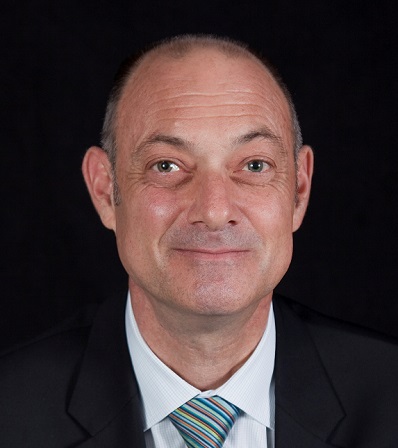
Manulife Bank CEO Rick Lunny
“Debt can negatively impact mental health and leave Canadians feeling like their financial goals are unachievable. The pandemic has made that even more pronounced,” said Rick Lunny, President and CEO, Manulife Bank. “It’s so important to have financial flexibility, especially when one looks at purchasing a home – it’s easy to feel stressed. Financial conversations are essential to identify opportunities, what matters most and help you stay on track, no matter the financial environment.”
A financially unprepared population
The survey found 35% admit they were financially unprepared for the pandemic. 74% believe their financial situation has been impacted as a result of the pandemic and 69% of them say the impact has been overall negative: 42% worry that it may take them over a year to recover to pre-COVID-19 levels.
One in four are struggling to keep up with their bills, with one in six laid off due to COVID-19: an equal number say they would have been laid off had it not been for the wage subsidy provided by Ottawa.
Some have flourished
The survey reveals a sharp disparity in how the pandemic has impacted us, with some flourishing as others have been devastated. Manulife views this as evidence of a K-shaped recovery narrative. On the one hand, while Canadian on average, appear to be saving more compared to a year ago (16% of after-tax income, on avg. vs. 14% in Fall 2019), 24% have been saving absolutely no after-tax income compared to the same period last year. Within the indebted population there has been a significant increase in the proportion of those who say everyday living is the cause of their debt: 24%. This suggests more Canadians who are in debt are struggling to make ends meet, even if fewer Canadians (27% debt-free vs. 21% on Fall 2019) are now in debt overall compared to a year ago.
There are numerous life insurance mistakes Canadians are making, and who qualifies better to talk about these mistakes than life insurance experts? We asked numerous life insurance experts to weigh in on the top life insurance mistakes they have seen throughout their careers.
You can find a summary of their replies in the above chart, with more detailed explanations following in their segments (% shows how often a particular mistake has been mentioned).
The top three mistakes are:
1.) Putting off your life insurance purchase until it is too late, or not getting life insurance at all (especially in your younger years).
2.) Not doing a needs analysis and not understanding all possible risks resulting from being underinsured.
3.) Not leveraging the benefits of a permanent life insurance policy due to its higher cost, though there are numerous benefits to this product in the long run.
Tony Bosch, Development Hub Financial
Tony Bosch – Executive Vice President Broker Development Hub Financial
“Life insurance is a key component in most financial and estate plans”
Three key mistakes people make when purchasing life insurance:
Not doing a needs analysis: The first step in any life insurance purchase should be to do a proper needs analysis. People often fail to look at the big picture when buying life insurance. The calculation of how much insurance you need should be more detailed than just having your mortgage paid off or replacing a certain multiple of your income. In determining your life insurance needs it is necessary to determine what amount is actually necessary to “allow your family to maintain their standard of living and pay off outstanding debt”under “less than ideal circumstances,” factoring in that the grieving process and the time to recover emotionally may take several months or even years. Life insurance should provide “financial confidence.” allowing a family time to adapt and adjust to life without a loved one.
Product selection: Life insurance, unlike most forms of insurance, can come in a variety of payment options from low cost term insurance to permanent policies that can build substantial tax sheltered cash values and can help solve estate planning needs and/or serve as an alternative investment. The problem arises when the product selection overrides the need. Clients with a limited budget may be attracted by product features causing them to choose a permanent product with a lower face amount than is required. A family with three kids may like the idea of a shiny sports car but may need a mini van. It is critical to first define the amount of protection required and then choose the product or combination of products that meet this need within a given budget.
Choosing a solution based on price and/or convenience rather than contract guarantees and flexibility: A simple example may be purchasing loan or mortgage insurance through a lending institution. Although this may seem like an easy and convenient solution, it may require additional underwriting at the time of claim, which could result in a claim being denied. A basic renewable and convertible term plan underwritten by an insurance company may take a little more time to set up, but in most instances provides a better and more flexible policy that can adapt to your changing needs.
Life insurance is a key component in most financial and estate plans. Working with an experienced and trusted independent advisor will help make sure you and your family get the life insurance you require with the flexibility to adjust to your changing needs.
Michael Liem, Canada Protection Plan
Michael Liem – Canada Protection Plan Regional Vice President
“Don’t put it off until it is too late.”
Putting it off until it is too late: Even though Canada Protection Plan can help get life insurance for people with medical or lifestyle issues, I think it is always best to get insurance when you don’t need it and when you are healthy. It’s not how much you can afford, but rather how healthy you are that gets you the best insurance options.
Not telling anyone about your life policy: People get a life insurance policy but when they pass away, some beneficiaries don’t even know about it. I always suggest that advisors should acquire contact information for the beneficiaries and where possible, introduce themselves because these beneficiaries will most likely be contacting the advisor to make a claim.
Regularly reviewing a client’s policy: So many advisors provide the initial policy but never review them. People’s lives are constantly changing and they may need to adjust or add more coverage. If an advisor never contacts their client, then they should not be surprised when the client switches their business to another advisor.
Lawrence Geller, L.I. Geller Insurance Agencies
Lawrence Geller – President of L.I. Geller Insurance Agencies
“Everyone has asked to either renew the existing policy or buy a new policy.”
Of the many people who have assured me over the years that they only needed life insurance for a maximum of 10 years, every one has asked to either renew the existing policy or buy a new policy to replace the one that was renewing. Even then, most have deluded themselves by thinking that they would not need the coverage when the term of the contract ended, and almost all have wanted coverage at the end of the term.
Not a single client who bought a guaranteed paid up whole life policy has ever told me that they made the wrong choice of coverage, although many have told me that they wished that they had purchased a larger amount of life insurance.
Daniel Audet – Vice President Assumption Life
Daniel Audet, Assumption Life
“Don’t gamble on being uninsured.”
The top life insurance mistake, from a consumer’s perspective, has to be the choice to gamble on being uninsured (or underinsured).
LIMRA reported a year ago in 2019 that 32 per cent of Canadian households do not have any life insurance coverage, while 56 per cent of Canadian households do not have any individual life coverage. Everyone would agree that there are more pleasant things to consider and address than the risk of dying prematurely, and that may be the reason why so many Canadians are shying away from a proper assessment. More likely, the observation comes from a knowledge gap of the risk and associated loss. Many Canadians would not necessarily consider themselves as gamblers, meanwhile the chosen approach of not buying insurance (or not buying enough) is very similar to that of a gambler’s behavior. The gambler “invests” a little wager with a small probability of a large payoff. In comparison the non-insured “saves” paying a small premium hoping he/she wouldn’t die with a significant financial burden. Both types of gamblers have small amounts involved when compared to what is at stake, and the odds of the event, while relatively small, can have a significant impact. They are just at both ends of the spectrum: the casino gambler hoping for the big win, and the life gambler neglecting to consider the major financial loss.
Turning a blind eye to the needs of paying final expenses, replacing income, paying off the mortgage, or paying the estate bills, and choosing not to be insured (or underinsured) is essentially just like gambling the financial state of the loved ones left behind. Several Canadians, when asked why they do not own life insurance, have stated they could not afford it (27 per cent) or that they had other financial priorities (25 per cent). Continue Reading…
Earlier this year, the Hub ran a blog by Franklin Templeton Canada entitled A cure for the headaches of Fixed Income investing, written by Ahmed Farooq, Vice President of ETF Business Development for the company. Franklin Templeton is a sponsor of the Hub. Today’s blog is a question-and-answer session between Ahmed’s colleague, Jon Durst, Vice President, ETF Business Development, that picks up where we left off.
Jon Chevreau, Q1: Do you believe active management makes more sense in the fixed-income space versus the equity space? Perhaps it makes sense in both?
Jon Durst, Franklin Templeton’s Vice President, ETF Business Development
Jon Durst: There are merits to active management in both equities and fixed income; however, I feel recently, it has been a heavy skew towards active fixed income in this current market environment, and for many reasons. Early in March 2020, we saw a 50bps cut in interest rates by the Fed in the US: it was the first unscheduled rate cut since 2008 and the biggest cut since the financial crisis. There also appears to be a strong consensus on the street that rates will be “low for longer” going forward. If you own a passive fixed income strategy, the goal is to minimize tracking error to the index and what it cannot do is to adjust or try to anticipate any type of market events, like interest rate changes or changing company fundamentals.
This can certainly be a worrisome event for most advisors if they buy their own bonds directly or passive fixed income products covering different sectors/regions, as they have to scramble and figure out if they should continue with the same fixed income allocations in their portfolio, as the onus of making any changes to their portfolio will be on them.
Active managers with years of experience can focus solely on their investment mandates and can adjust to different types of market events, such as shape of the pandemic recovery or the consequences of the Democrats winning the 2020 US elections.
Outsourcing in this market environment and buying active fixed income exposures that align with your client’s outcomes will hopefully provide a calming effect that is certainly needed. Not to mention, active fixed income ETFs in particular are now often priced very similarly to passive indexed products, which is even more important in this low rate environment to help maximize clients cash flow.
Jon Chevreau, Q2: For income-oriented retirees, do you generally see more opportunity in corporate or government bonds?
Jon Durst: I do see more opportunity in corporates debt, as the yields are higher, they also tend to be less sensitive to interest rate movement, but the risk level and volatility do tend to slightly go up.
A passive aggregate bond strategy that encompasses both corporate and government debt in Canada yields around 2.55%, a pure passive Canadian government bond strategy at 2.11%, and a passive Canadian corporate strategy around 2.77%. On the other hand, for example, an active Canadian corporate strategy FLCI – Franklin Liberty Canadian Investment Grade Corporate ETF, yields 3.12%. An active manager can select certain bonds over others, perhaps looking for higher coupons and/or YTMs, or overweighting certain sectors that will benefit from the pandemic trade or the Biden Presidency.
Jon Chevreau, CFO of Financial Independence Hub
Jon Chevreau, Q3: How much exposure should Canadian investors have in US and international bonds and through what vehicle? On that note, what is your stance on currency hedging?
Jon Durst: We do need to think outside of Canada; even from a fixed income perspective, Canada’s total debt in comparison to the world is about 3-4%. Also, there is no tax incentive to buying solely Canadian debt, unlike the Canadian Dividend Tax credit provided on distributions from Canadian equities. There are many fixed income opportunities to take a look at – a solution based option via a Canadian Core Plus strategy is one – where you would still keep 70-75% in Canadian bonds and have an active manager select the 25-30% in the US and/or globally. You could also consider a more broad-based global aggregate option, having the portfolio manager look for opportunities from a global stand-point, which offers the PM a lot of flexibility to diversify geographically and from a currency perspective. Yields in different countries can vary significantly which can create a lot of opportunity for higher yields and capital appreciation, not to mention diversification benefits.
In terms of buying a pure-based exposure – in other words, buying direct US, EAFE or EM debt, either by purchasing individual bonds or a managed product — I find most advisors are still tippy toeing into pure US, EAFE or EM debt spaces: most still maintain a home country bias and the complexity of selection, weighting, and trading these exposures is difficult, to say the least. Those that see the value in investing outside of Canadian debt usually outsource this complexity by using active fixed income strategies that provide access to the US/Global exposure, in addition to Canadian bonds.
I am for 90-100% in currency hedging fixed income exposures. With interest rates and yields being at historical lows, another level of worry should not be placed on how the global currencies are going to perform relative to the CAD$, especially in fixed income, which is supposedly the conservative component of a client’s portfolio. In my opinion, currencies should be hedged out as much as possible in fixed income.
Jon Chevreau, Q4: Your blog back in February compared bond funds to GICs. Do you see a role for both and in what proportion?
Jon Durst: In this environment, it can get even trickier: do you really want to lock into GICs for a certain period of time at a certain rate? Or want to be nimble and have liquidity? It’s a question on how to balance stable income that is locked in (currently at historically low rates) and/or including a short term bond strategy that can yield a little more in this environment and provide liquidity in the event of a requirement. I am beginning to see a fair number of advisors who have started to allocate to short term bonds funds as client GICs mature. Usually cash, GICs and short-term bond funds make up about 5-10% of a clients portfolio, but GIC investors are being compensated very little, so short term bond funds are being used for those with a higher need for income, and cash now being used for those with a 100% capital preservation requirement (not taking inflation into the equation). GICs appear to be losing some steam.
Today’s long-term bonds pay such low interest rates that it makes no sense to own them. There is virtually no upside, and rising interest rates loom on the downside. Warren Buffett called this “return-free risk.” He was right. Here I explain the problem and address objections.
As I write this, 10-year Canadian government bonds pay 0.623% interest. If you invest $10,000, you’ll get a total of only $623 in interest over the decade, and then you’ll get your $10,000 back. This is crazy. Even if inflation stays at just 2%, you’ll lose $1237 in purchasing power.
Even worse are 30-year Canadian government bonds that pay 1.224% as I write this [late in October 2020.] Your $10,000 would get a total of $3672 in interest over 3 decades. This is a pitiful amount of interest over a full generation. At 2% inflation, you’ll lose $1738 in purchasing power. Even a portfolio that only beats inflation by 2% per year would gain $8113 in purchasing power over 30 years.
All investments have risk, but there has to be some potential upside to justify the risk. Where is the upside for long-term bonds? The only upside comes if we have sustained deflation. It’s crazy to risk so much just in case the prices of goods and services drop steadily for the next decade or three.
Some investors mistakenly think they can always sell bonds and collect accrued interest. That’s not how it works. With a 30-year bond, the government is promising to pay you the tiny interest payments and give you back your principal after 3 decades. If you want out, you have to sell your bond to someone else who will accept these terms. You don’t get accrued interest; you get whatever another investor is willing to pay. Counting on selling a bond is hoping for a greater fool to bail you out. If future investors demand higher interest rates on their bonds, your bond will sell at a significant capital loss.
If the interest rate on 30-year bonds goes up over time, that’s actually bad for current bond owners, because they have to live with their lower rate instead of receiving the new rate. If 30-year bond interest rates go up by 1%, you immediately lose 30 years of 1% interest; you can’t just sell to avoid the loss because other investors wouldn’t happily take these losses for you.
Let’s go through some objections to this argument against owning today’s long-term bonds:
1.) Stocks are risky
It’s true that stocks are risky, but I’m not suggesting that investors replace long-term bonds with stocks. Short-term bonds and high-interest saving accounts are safer alternatives. A decision to avoid long-term bonds doesn’t have to include a change in your asset allocation between stocks and bonds. For anyone willing to look beyond Canada’s big banks, it’s not hard to find high-interest savings accounts paying at least 1.5% and offering CDIC protection on deposits. If long-term bond interest rates ever return to historical norms, it’s easy to move cash from a savings account back into bonds. So, you don’t have to live with a measly 1.5% forever.
2.) Investors need to diversify
The benefit from diversifying comes from owning assets with similar expected returns that aren’t fully correlated. However, the expected returns of today’s bonds are dismal. We don’t really own bonds for diversification these days. The real reason we own bonds is to blunt the risk of stocks. It doesn’t make sense to try to reduce portfolio risk by buying risky long-term bonds. Flushing away part of your portfolio with long-term bonds isn’t a reasonable form of diversification. Short-term bonds and high-interest savings accounts do a fine job of reducing portfolio volatility without adding significant interest rate risk.
3.) Long-Term bonds have higher interest rates than short-term bonds
Historically, long-term bonds rates usually have been higher than short-term rates. Today, however, high-interest savings accounts pay more interest than long-term government bonds. But that’s not the only consideration. Interest rates will change over the next 30 years. If you own short-term bonds, your returns will change too. However, if you buy 30-year bonds, your interest rate won’t change for three decades. If interest rates rise, new short-term bond rates will be higher than your old 30-year rate. Continue Reading…


 Posted By
 Posted By