Decumulate & Downsize

Most of your investing life you and your adviser (if you have one) are focused on wealth accumulation. But, we tend to forget, eventually the whole idea of this long process of delayed gratification is to actually spend this money! That’s decumulation as opposed to wealth accumulation. This stage may also involve downsizing from larger homes to smaller ones or condos, moving to the country or otherwise simplifying your life and jettisoning possessions that may tie you down.

Retired Money: Getting real about Retirement planning with Viviplan

My latest MoneySense Retired Money column looks at a financial planning software platform called Viviplan. You can find the full article by clicking on the highlighted text:  What I learned by putting Viviplan to the test.

Viviplan is the third retirement planning package I’ve tested this year, perhaps — as the MoneySense article reveals — the topic is getting all too real for me now that my wife, Ruth, has told her employer she plans to retire when she turns 65 next summer. I’m a year older and have been somewhere between self-employed and semi-retired for most of my 60s.

Previously we have looked at a couple of packages created by Emeritus Financial Strategy‘s Doug Dahmer — who is a frequent contributor to the Hub — as well as Ian Moyer’s Cascades, which you can read about in an earlier column by me here. Dahmer offers a choice of two packages: Retirement Navigator and BetterMoney Choices.com.

All these packages deserve consideration and work in more or less similar fashion. To do the job justice, you need to have handy — or at least summary information — such documents as your latest tax returns, brokerage statements, Service Canada CPP and/or OAS projections, as well as having a good grasp of your regular and occasional monthly expenses.

Having most recently performed this exercise with Viviplan — and as one of the users we interviewed for MoneySense relates — it can be a bit scary to see in black and white just how expensive daily living can be. The package won’t let you forget any tiny expense, from pet food to boarding your pet when you’re on vacation (or arranging to hire a neighbour’s teenager, which is what we do if we go away and must leave our cat behind.)

Viviplan calls itself a Robo Planner

Viviplan — which has been dubbed “Canada’s Robo Planner” — is the brainchild of financial planner Rona Birenbaum. Birenbaum also runs a separate fee-for-service financial planning firm called Caring for Clients. I have consulted her for various pieces in the past, particularly about annuities.

Indeed, when I was putting Viviplan through its paces, one of the big questions I had was whether there was a need for us to partly annuitize, seeing as Ruth has no employer-provided Defined Benefit pension at all (just a hefty RRSP), and I have only two modest DB pensions that are not inflation-indexed.

Viviplan’s Morgan Ulmer

Our main question was whether to make up for this lack of employer pensions by at least partially annuitizing, or what Moshe Milevsky and Alexandra McQueen call in the title of their book Pensionize Your Nest Egg. Another author, Fred Vettese in Retirement Income for Life, was in a similar situation when he reached 65 (the same month as I did) and had suggested annuitizing 30% of his nest egg at 65 and doing another 30% at age 75 (assuming CPP at 70). Our question for Viviplan was whether this would make sense for us too, or just for Ruth.

We went back and forth with Calgary-based certified financial planner and product manager Morgan Ulmer (pictured to the right). As she relates in the MoneySense piece, “it’s certainly not necessary,” since at today’s interest rates, Viviplan told her that for us a pure GIC portfolio could get us to where we want to go, with the virtue of more financial flexibility and higher final estate value. Like the other programs, Viviplan recommends delaying CPP till 70 and OAS too if possible.

Annuitize? No wrong decisions and no rush

Partial annuitization for Ruth along the lines of what Vettese suggests would result in a slightly lower estate for our daughter. “With annuities, you are making a choice between legacy and flexibility versus security and longevity protection,” Ulmer said in the plan’s written recommendations, “There are no wrong decisions here, and there is also no rush.” Continue Reading…

Using bonds for retirement will hurt your retirement income

Senior couple trying to figure out tax declaration

As some investors near retirement, their advisors recommend switching to bonds and other fixed-income investments for their retirement investments instead of holding stocks or ETFs.

To some extent, this is an understandable retirement investing strategy, since bonds can provide steady income and a guarantee to repay their principal at maturity.

Bonds will lower the long-term returns that are key to successful retirement investing

Unfortunately, using bonds for retirement may not be the best strategy. Bond prices will likely fall over the next few years because interest rates are likely to rise. Bond prices and interest rates are inversely linked. When interest rates go up, bond prices go down, when interest rates go down, bond prices for up.

Bonds have been in a period of rising prices (a bull market) more or less since 1981. That year, long-term interest rates reached an historic turning point when long-term U.S. Treasury bond yields peaked near 15%. Ever since, interest rates have gone through wide fluctuations, but they have essentially headed downward.

Today, interest rates just don’t have that much further to fall. But under certain conditions, interest rates could go substantially higher. Remember, as mentioned, when interest rates go up, bond prices drop.

Even so, brokers continue to sell bonds to their clients. That’s partly because most of today’s brokers had not yet entered the investment business when the bull market in bonds began in 1980. All they know is that bonds do tend to reduce the volatility of your portfolio, since they tend to rise when stock prices fall. Of course, bonds also generate more commission fees and income for the broker, compared to stocks, especially if you buy them via bond funds and other investment products.

That’s why we continue to recommend that you invest only a small part of your portfolio—if any—in bonds and fixed-income investments. Instead, you should aim for a diversified portfolio of well-established companies with long histories of dividends, or ETFs that hold these stocks. We recommend a number of stocks and ETFs appropriate for retirement investing in our Canadian Wealth Advisornewsletter.

We recommend this retirement investing strategy because equities are bound to be more profitable than bonds for retirement over long periods. That’s because equity returns are related to business profits, while returns on fixed-return investments are related to business interest costs.

Bonds and other fixed-return investments can add stability

Returns on your stocks are sure to be more volatile than what you earn on fixed-return investments (that includes short-term bonds). That’s because returns on stocks are related to the part of gross profit that’s left over after a company pays its interest costs. Continue Reading…

Money never sleeps, even when you’re retired

By Billy Kaderli

Special to the Financial Independence Hub

Just because you retire, your money doesn’t have to.

In the words of Gordon Gecko from the 1987 movie Wall Street, “money never sleeps.” And your money definitely won’t once you leave your job.

Many people are shocked to learn that since we left the conventional work force almost thirty years ago our net worth has actually increased, significantly out-pacing inflation and spending. Reading financial articles about what if retirees run out of money, I get the impression that the authors do not understand that once retired, your money can – and should – continue to work for you.

Working smart, not hard

Once you clock out or walk out of the office for the last time, that doesn’t mean your investments are frozen at that point. The stock market is still functioning and now your “job” is to become your own personal financial manager. Actually, you should have been doing this all along, but if not, start now.

You need to get control of your expenses by tracking your spending daily, as well as annually. This is so easy — only taking minutes a day — and this will open your eyes as to where your money is going. Not only that, but it will give you great confidence to manage your financial future. Every business tracks expenses and you need to do the same. You are the Chief Financial Officer of your retirement.

Income is important, but …

Many people structure their investments for income knowing they need $3,000 or more per month to cover their lifestyle. Which is fine, but inflation will be eating away at those numbers and most likely taxes will do the same. Over time your expenses will rise and your purchasing power will drop. You need protection to cover the increases.

Stocks provide that protection and there is an added bonus; when you sell, capital gains are taxed at a lower rate than ordinary income. Therefore, tilting your investments for growth as compared to income will help protect yourself against future inflation. Plus, it will minimize your tax liability.

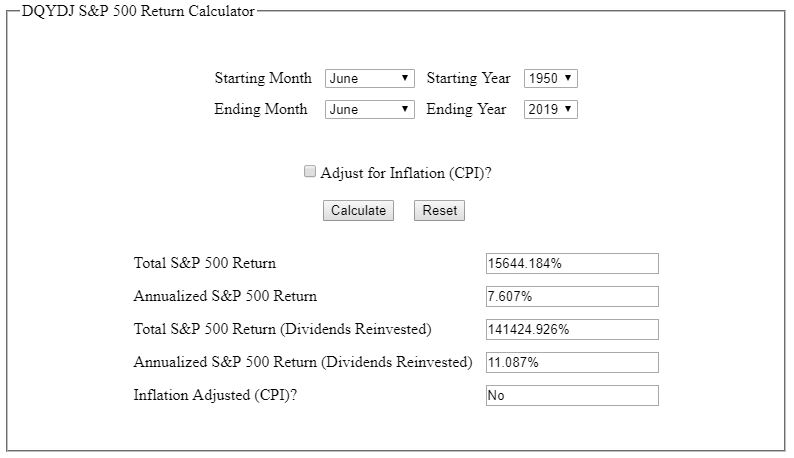
The day we retired the S&P 500 index closed at 312.49. Today, this equates to a better than 10% annual return including dividends.

That’s pretty good for sitting on the beach working on my tan.

Making 10% on our portfolio annually while spending less than 4% of our net worth has allowed our finances to grow out-pacing inflation, while we continue to run around the globe searching for unique and unusual places.

The key is to start as young as you can with as much as you can and let the markets work in your favor. Time is the greatest asset with investing and younger people can utilize this to their advantage.

But what if you’re fifty?
Continue Reading…

The financial benefits of carrying Life Insurance

Photo credit: Pixabay.com

By Gloria Martinez

Special to the Financial Independence Hub

For some, life insurance may feel like an unnecessary expense. It can range from a few to many hundreds of dollars each month — it’s something you hope you don’t need, and when you’re faced with other expenses, it’s natural to want to trim it from your budget.

However, life insurance can provide a host of financial benefits besides the death benefit, which is certainly an important element of any life insurance policy.

In fact, a 2017 Insurance Barometer Study by the nonprofit organization LIMRA and Life Happens found that 85 per cent of people carry life insurance to cover burial and funeral expenses. Those expenses can range between $7,000 and $10,000, and few people are prepared to incur such a large expense unexpectedly.

Don’t discount importance of the Death Benefit

 Even if you’re close to retirement or retired, keeping life insurance is a valuable asset. If you’re still paying off a mortgage that you’ve refinanced or you purchased your home later in life, consider purchasing a life insurance policy to cover the remaining mortgage should you pass away. A life insurance policy will also cover you or your spouse against lost pensions. If you have a large estate on which you’ll incur estate taxes after your death, you can purchase a life insurance policy that will cover the cost of those taxes.

What’s more, you’ll also protect yourself and your family with a good insurance plan that covers your children’s college expenses and pays off other debts besides the mortgage, such as medical expenses, other loans, or credit cards.

You can benefit from Life Insurance while still living

You can use your life insurance as more than just a death benefit, depending on the type you carry. Continue Reading…

G&M: 3 programs to chart your Retirement income & spending

The Globe & Mail newspaper has just published a column by me describing our family’s experience with three Canadian retirement planning programs available to consumers. You can find the full article by clicking on the highlighted headline here: Three online programs to help plan out your finances in Retirement.

These programs vary in price from $85 to more than $800 but just a single insight from any one of them will likely recap the modest fees. I found all three (or four actually) quite useful, seeing as I have already turned 65 and my wife Ruth will follow suit next summer, at which point she too will abandon full-time employment for the kind of semi-retirement or financial independence that this website focuses on.

Some of the planning packages are designed for financial advisors to work with their clients but all can be obtained by individual consumers. They are all strong on the financial side and the first step with any of them is to enter data into your personal computer (PC or Mac, or any device via the cloud). You’ll need your brokerage statements, pension benefits statements if any, tax returns and a good grip on your monthly expenses, which means credit-card and bank statements, and maybe charitable contributions and any other regular expenses not gathered by the foregoing.

Just as important, you need to have at least a rough picture of what your future golden years will be spent doing once you’re no longer tethered to full-time employment.

Decumulation can be more challenging that Wealth Accumulation

All these programs are good at projecting your future retirement income and taxes, factoring in the many moving parts of CPP payments, OAS clawbacks and the other minutae that make the “Decumulation” phase of retirement planning perhaps even more challenging than what the long Wealth accumulation process was.  As Retirement Navigator creator Doug Dahmer (a regular contributor to the Hub) often says, tax is perhaps the single biggest expense in Retirement.

There’s an art to deciding which income sources to drawn down upon first (registered, TFSAs, non-registered), or to deciding whether to defer corporate or government pensions till 70, while drawing on savings in the meantime.

But it’s not just about money: these programs help you identify how you’ll navigate the three major phases of retirement: the early “go-go” years where you may indulge in expensive travel and other hobbies; the “slow-go” years where you pull in your oars a bit and stick closer to home; and finally the “no-go” years where one or both members of a couple start to confront their mortality and deal with rising healthcare costs and perhaps a shift into a retirement or assisted living facility.

Here’s the capsule summary of the strengths and weaknesses of each. The highlighted text in Red will take you to the respective websites: Continue Reading…