Most of your investing life you and your adviser (if you have one) are focused on wealth accumulation. But, we tend to forget, eventually the whole idea of this long process of delayed gratification is to actually spend this money! That’s decumulation as opposed to wealth accumulation. This stage may also involve downsizing from larger homes to smaller ones or condos, moving to the country or otherwise simplifying your life and jettisoning possessions that may tie you down.
We like to keep informed about the topic of retirement from the perspective of money managers and those in the financial fields.
You might have read some of these articles also; you know, the ones that say North Americans have not saved enough to retire.
Many of these pieces proclaim that you must save enough in your investments to throw off 80% of your current annual salary so you can afford a comfortable life away from a job. Lots of them will say that you need US$2 million in investments and woe to the person who thinks they can do it on less.
Approximately 10% of the households in the US have a net worth of one million dollars or more. What are the other 90% supposed to do? Not retire? What kind of common sense does this make? Expecting the regular “Joe” to meet this $2 million dollar mark is not realistic.
As you know, we have almost three decades of financial independence behind us. And while everyone’s idea of a perfect lifestyle sans paycheck is different, we can tell you that for these almost-30-years, we have kept our annual spending around $30,000 or less per year.
The secret: Living within your means
In all of our years of retirement and travel we cannot recall one retiree who regrets their decision to retire. In fact, most have told us that they wished they had done it sooner.
The Society of Actuaries (SOA) recently conducted 62 in-depth interviews of retired individuals across both the U.S. and Canada. These people were not wealthy and had done little to no financial planning. But the vast majority of them shared that they had adapted to their situation and live within their means. Meaning, they have adjusted their spending to the amount of money they have coming in every month.
So basically, it’s really that simple and this is why we say if you want to know about retirement, go to the source.
It doesn’t have to be complicated
In our books and in our articles about finance, we say over and over that there are four categories of highest spending in any household. We personally have made adjustments in all four of these categories, and have therefore reaped the benefits of having done so.
The financial guys and gals will have you tap dance all over the place with investment products, and a certain financial goal you must achieve. They will press upon you the seriousness of this decision to leave your job for a couple of decades of jobless living. We say it doesn’t really have to be that complicated, but it’s very important to pay attention to these four categories.
Doug Dahmer, CEO and founder of www.RetirementNavigator.ca has been a regular guest contributor to the Hub since its inception in November 2014. His focus is on Canada Pension Plan optimization, avoidance of retirement tax traps, and the creation of drawdown strategies during the decumulation side of financial planning. Some of these ideas have been used (with proper attribution) in various columns I’ve written in other media outlets, generally summarized here at the Hub.
However, Dahmer has been noticeably quiet lately. This blog explains why.
As the headline says and the adjacent image suggests, Doug is about to turn financial planning on its head. How? By democratizing access to financial planning, in the same way that Robo-Advisors democratized investing. This disruption of the planning industry is built upon a new planning platform called Better Money Choices.
Asked what motivated him to launch this venture Dahmer said more than 70% of Canadians say their greatest worries in life are centred around their financial futures. “Yet at the same time it is estimated that fewer than 15% of Canadians have a formal financial plan in place.”
As he talked to clients about this disconnect — why they resisted the idea of financial planning as an Rx to their financial stress — he discovered most people have no idea what true financial planning looks like.
Doug Dahmer, creator of BetterMoneyChoices.com
“The financial services industry has twisted the planning process into a tedious, time-consuming, onerous task that’s heavily biased toward the sale of financial products. What they hated most about planning, is that, more often than not, the conclusion to the process was always the same: spend less, save more, work longer, work harder. These recommendations were made while providing little in the way of understanding of the specific rewards these sacrifices would deliver.”
In short, Planning did not relieve their level of stress, it actually increased it!
Money doesn’t buy stuff, it buys choices
True planning was never meant to promote the sale of financial products. It’s supposed to be a process that allows you to explore the lifestyle choices you are thinking about, so you can discover their future financial implications before you need to commit to them. “Armed with this insight, you can then decide whether you’re willing to make the necessary sacrifices to bring them to fruition.”
Your most valuable asset isn’t money. It’s Time — and how you choose to spend it
Dahmer’s financial planning philosophy is based on the belief our lives are defined by the choices we make: the more good choices we make, the better our lives will be. His new site, BetterMoneyChoices.com, lets people quickly, easily and securely explore their lifestyle choices so they can better determine what outcomes they should focus on.
Everyone’s personal resources – time, money, energy, relationships and talents – are limited in some way. That forces each of us to make choices to accept less of one thing in order to obtain more of the things that are most important to us. However, seldom is “more money” what we are seeking.
It’s time the financial planning sector evolved with the times
Dahmer says technology has given us many low cost/no-cost, self-serve tools that make almost all aspects of our lives easier, but not yet financial planning. “My mission is to change this. By putting the focus on how you want to live your life instead of how much money you can accumulate, and making it easy for you to determine which set of choices will bring you closer to what you value most, the technology behind the Better Money Choices process will revolutionize planning.”
His goal is to make it a quick, easy and engaging process to determine the trajectory our lives are tracking. “I want to convert the misnomers that planning is an event that translates into an exact science to the reality that planning is an ongoing, never ending process of making a set of best guesses – projecting those best guesses into the future – then re-engaging with life to learn more.”
Such a process requires frequently returning to our ever-living planning platform to check our progress and improve upon our guesses. “Once people understand what true planning looks like and the huge benefits that can accrue by adopting this approach for directing them to better choices, their disdain for planning will finally disappear and they will rely on their planning tools with the same natural inclination they reach for their google maps when it comes time to choose how best to arrive at their desired destination.”
Exact pricing has yet to be determined, but Dahmer’s goal is to have a monthly subscription that is comparable to Netflix or Spotify.
Beta Testing
Dahmer is currently running a beta test to get user feedback, prior to it being released publicly (currently scheduled for April 1st, 2018, coincidentally a week before I myself turn 65).
Doug has asked me to participate as one of the early beta testers and I have agreed to do so. In the past week, I have been “playing” with the software with our own personal data and I can tell you already it’s an eye opener. Over the next few weeks on the Hub, I’ll report back to you on my experiences with the software and the impact this novel approach to planning has had on my own plans for the second half of my life.
After all, I’m hardly unique in turning 65 this year: some 1,100 other Canadians now do so each day. (Incidentally, I’ll be collecting my first Old Age Security cheque late in May but, as per the guidance of Doug and his new software, I’ve elected to wait until age 70 to collect the Canada Pension Plan. This too has been reported in my columns in the country’s two major daily newspapers or MoneySense.ca )
If you’d like to be one of the first to know when the site officially launches, you can sign up at www.BetterMoneyChoices.com.
Retirement investing advice is a subject we’re asked about all the time. And it’s one that we deal with on a practical day-to-day basis with our Successful Investor Wealth Management clients.
If you want to pay less tax on dividends while you’re still working, investing in an RRSP (Registered Retirement Savings Plan) is the way to go. That’s because dividends you receive in an RRSP grow tax free.
Is an RRSP the best savings plan for retirement?
RRSPs are a great way for investors to cut their tax bills and make more money from their retirement investing.
RRSPs are a form of tax-deferred savings plan. RRSP contributions are tax deductible, and the investments grow tax-free. (Note that you can currently contribute up to 18% of your earned income from the previous year. March 1 is the last day you can contribute to an RRSP and deduct your contribution from your previous year’s income.)
When you later begin withdrawing the funds from your RRSP, they are taxed as ordinary income.
A Registered Retirement Income Fund (RRIF) is a great long-term investing strategy for retirement
Converting your RRSP to an RRIF is clearly one of the best of three alternatives at age 71. Continue Reading…
Vanguard Investments Canada Inc. has announced the listing of three new low-cost Asset Allocation ETFs that give investors one-stop shopping to the firm’s globally diversified strategies. They began trading on the TSX today (February 1, 2018.)
Both investors and advisors are asking for “simple yet sophisticated single-ticket investment solutions that provide well-diversified global equity and bond exposure within a low-cost ETF structure,” says Atul Tiwari, managing director for Vanguard Canada. The new ETFs offer investors three different risk profiles and regular rebalancing.
In effect, each ETF is a fund of funds although Vanguard describes them as having an “ETF of ETFs structure.” Each holds seven existing core Vanguard index ETFs (which I list in the postscript below). Each new ETF of ETFs has a management Fee of 0.22%. Vanguard says that when one of its ETFs invests in underlying Vanguard funds, “there shall be no duplication of management fees.” Spokesman Matthew Gierasimczuk said “There are no duplicate fees beyond the 0.22 management fee, other than a basis point or two for operating expense and the trading fee for buying or selling the ETF.”
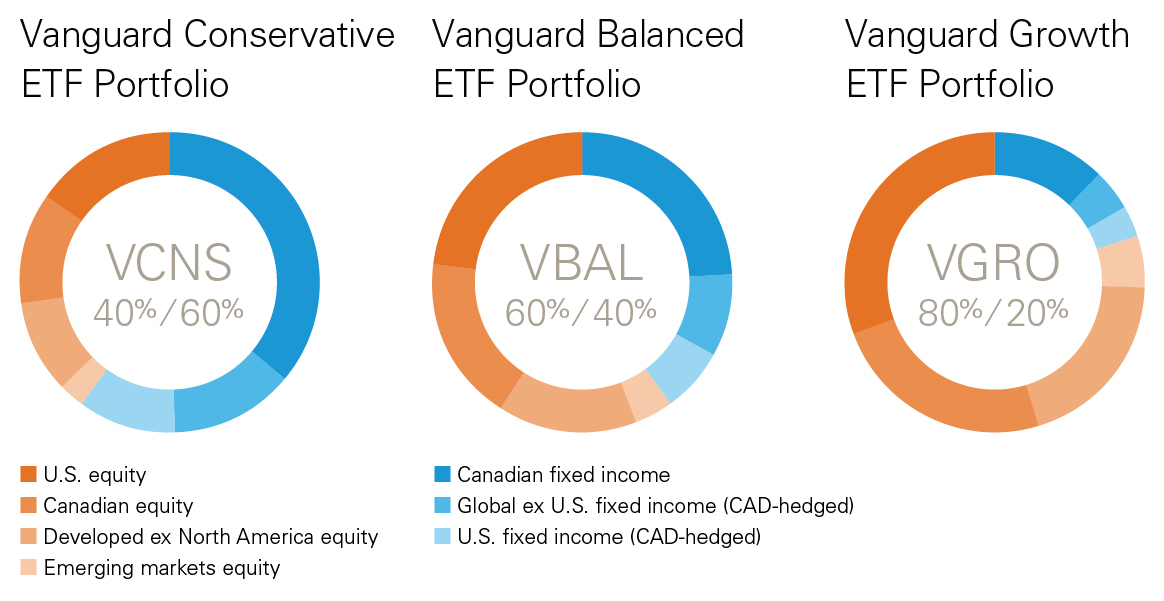
The three asset allocation ETFs cover the normal range from Conservative to Balanced to Growth, as reflected in the product names. Equity weights range from 40% for the Conservative offering, to 60% for the Balanced and 80% for the Growth.
Here are the 3 ETFs and their ticker symbols on the TSX:
Vanguard Conservative ETF Portfolio (VCNS) seeks to provide a combination of income and moderate long-term capital growth by investing in equity and fixed income securities with a strategic allocation of 40% equities and 60% fixed income.
Vanguard Balanced ETF Portfolio (VBAL) will provide long-term capital growth with a moderate level of income split 60% equities to 40% fixed income.
Vanguard Growth ETF Portfolio (VGRO) provides long-term capital growth by investing in equity and fixed income securities with 80% equities and 20% fixed income.
In a press release, Vanguard Canada head of product Tim Huver said the ETFs offer “a simplified and scalable solution for financial advisors, and a one-stop globally-diversified and transparent option for investors … Investors can rely on Vanguard’s global investment experts to continuously assess their portfolio’s exposure and rebalance it back to its intended risk level.”
With the three new ETFs, Vanguard Canada now offers 36 ETFs, with C$14 billion in assets under management. Vanguard Investments Canada Inc. is a wholly owned indirect subsidiary of The Vanguard Group, Inc.
The reason why retirement planning is so difficult is because the one variable we need to know – how long we have to live – is impossible to predict. Sure, we have mortality tables and family history to help guide us, but statistically speaking, half the population will outlive their median life expectancy.
That makes longevity risk – the risk of running out of money before you die – a very real threat to your retirement. And yet many Canadians ignore this threat by not saving enough during their working years; retiring before they’re financially ready, taking Canada Pension Plan benefits too early, withdrawing too much from their RRSPs, and so on.
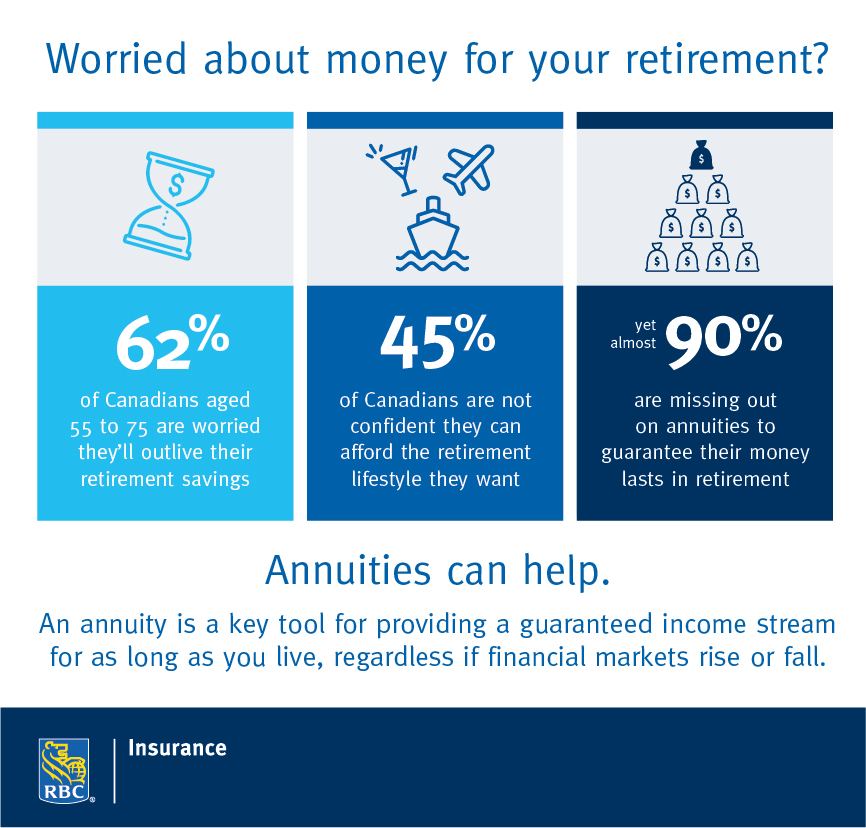
Nearly half of Canadians are worried they won’t have enough money to live a full lifestyle in retirement, according to a recent survey by RBC Insurance. They interviewed 1,000 Canadians aged 55 to 75 about their retirement readiness and came out with some interesting findings.
The retirees, or soon-to-be-retirees seem to want it all, according to the poll, yet many will lack the savings to do so:
80 per cent want to live at home for as long as they can
72 per cent said it’s important to own a car.
68 per cent said it’s important for them to be able to travel at least once a year
53 per cent want to go out for lunch or dinner a few times a week
Having enough money to support their desired lifestyle is a real concern, highlighted by the fact that 62 per cent of those surveyed are worried about outliving their retirement savings.
The one retirement income tool that didn’t appear on the radar was an annuity. Just 12 per cent said they are using or plan to use one in retirement.
How Annuities Can Help In Retirement
An annuity provides a predictable income stream for life – much like how a defined benefit pension, CPP, and OAS pays benefits for as long as you live. Nothing protects you from longevity risk quite like a guaranteed lifetime income.
It’s puzzling why more Canadians don’t choose to turn even a portion of their savings into an annuity – to pensionize their nest egg, to borrow a phrase coined by financial authors Moshe Milevsky and Alexandra Macqueen.
Lack of knowledge around annuities definitely plays a role. While nine in 10 Canadians polled by RBC know they don’t need to invest their entire retirement savings into an annuity, just 28 per cent know that an annuity doesn’t have to be managed once it has been purchased. Continue Reading…


 Posted By
  By Billy and Akaisha Kaderli
 Posted By

 Posted By
 Posted By