Decumulate & Downsize

Most of your investing life you and your adviser (if you have one) are focused on wealth accumulation. But, we tend to forget, eventually the whole idea of this long process of delayed gratification is to actually spend this money! That’s decumulation as opposed to wealth accumulation. This stage may also involve downsizing from larger homes to smaller ones or condos, moving to the country or otherwise simplifying your life and jettisoning possessions that may tie you down.

Top Canadian Dividend ETFs

By Mark Seed, myownadvisor

Special to the Financial Independence Hub

What makes a great Exchange Traded Fund (ETF)?

What makes a great Canadian dividend Exchange Traded Fund? 

What are the top Canadian dividend ETFs to own?

You’ve come to the right site and the right post.

Top Canadian Dividend ETFs – what is an ETF?

An ETF (Exchange Traded Fund) is a diverse collection of assets (like a mutual fund) that trades on an exchange (like a stock does).

This makes an ETF a marketable security. It has trading capability. Since you and buy and sell ETFs on an exchange during the day, prices can change throughout the day as they are bought and sold.

ETFs typically have lower fees than mutual funds (although not always), which can make them an attractive alternative to mutual funds.

Based on my personal experiences approaching 20 years as a serious DIY investor, ETFs are easy to buy using a discount brokerage and offer a low-cost way to own dozens if not hundreds of stocks to diversify your portfolio.

Although you don’t need to buy equity ETFs, it is my belief that you’re FAR better off owning more equities than bonds over long investing periods.

The reason for this is rather simple: if you want predictable returns you’re going to have to live with lower, long-term returns that offer this predictability. If you want higher, long-term returns, you’re going to have to live with the short-term volatility that comes with higher-risk equities.

Simply put: learn to live with stocks for wealh-building.

If you’re just starting out your investing journey, you can learn more about ETFs here.

What goes into a good ETF? What should you consider?

Before we get into my favourite Canadian dividend ETFs, here are some elements that make up a solid ETF:

1. Style – ETFs can track an index, follow an industry sector, be rules-based like some smart-beta funds are, or be much more. For the most part, I prefer either plain-vanilla, broad market equity indexed ETFs or dividend ETFs when I share my favourites with readers or other investors. This is because the former provides market-like returns less skimpy money management fees. Dividend ETFs can provide income; tangible money you and I can use as we please while offering some long-term growth. I avoid other types/styles of ETFs based on futures, hedges or swap agreements. By and large those products tend to make the company offering those funds rich, not you.

2. Fees – Hopefully by now you know high money management fees kill portfolio values over time. When it comes to fund fees in particular, my bias is, I try to keep the management expense ratio (MER) (the fee paid to the fund’s manager, as well as taxes and other costs) low for as long as possible. That means I wouldn’t consider owning any ETF over an MER of about 0.50% – including any Canadian dividend ETF. You should also be considering investing in products with fees that are lower than that.

Further Reading: Learn about MERs, TERs and more about ETF fees here.

3. Tracking error – In short, tracking error is the difference between the performance of the fund (the ETF) and its benchmark (what it tracks). I would advise you to look at the fund’s prospectus before you buy it and strive to own ETFs with low tracking errors.

4. Diversification – Along the same lines ‘Style,’ you should be very mindful of the assets within an ETF before you buy it. ETFs are not created equal.

For a quick example, I’ve been a huge fan of Canadian broad market ETFs like XIU, XIC, ZCN, VCN, along with others over the years.

I like XIU in particular.

XIU holds the largest 60 stocks in Canada. XIU however has nowhere near the number of holdings that VCN has (214 at the time of this post) yet XIU has delivered stellar long-term returns better than most. Just because of the limited fund holdings, is XIU really an inferior product to VCN for our Canadian market?  Hardly.

Based on my personal experiences, diversification can be a great ally as a risk mitigation tactic against stock picking but that doesn’t mean it’s bulletproof. Indexed ETFs hold all the studs and duds in fact. Typically the larger the ETF equity holdings are, the better the chance you’ll own all the stock duds and studs as well. More stock holdings does not automatically equate to better returns.

5. Tax efficiency – If you never intend to max out your TFSAs, RRSPs, kids’ RESPs, or other registered accounts then this is a non-issue for you.

For some investors however, who invest outside registered accounts (such as the aforementioned RRSPs, RRIFs, TFSAs, RESPs, LIRAs) like I do, then you need to consider the tax efficiency of your ETFs.

Be wary of ETFs that have lots of turnover by the fund manager (through buying and selling securities) – those funds are likely to result in more costs to you.

In taxable accounts, I would advise you to look at the fund’s prospectus before you buy it and strive to own ETFs that are as tax efficient as possible.

Further Reading: How to invest for tax efficiency investing in taxable accounts.

6. History – While past performance is never indicative of future results unfortunately history is all we have since nobody can predict the financial future with any accuracy.

I think owning funds that have an established history of > 3 years or more is generally smart.

While new ETF entrants are fine, ETF tactics can change by the company that runs the fund at will – so buyer beware of any ETF niche products. This is yet another reason I believe sticking to plain vanilla funds or dividend ETFs that are easy to understand; something you can explain to a 10-year-old. Simplicity when it comes to investing is usually more value to you as the long-term investor.

What are my Top Canadian Dividend ETFs? Continue Reading…

What Tawcan is doing to cope with this Bear Market

By Bob Lai, Tawcan

Special to the Financial Independence Hub

Unless you’ve been living under a rock, you probably have heard that the stock market is crashing. Year-to-date, the S&P 500 is down by 23.55% and the NASDAQ is down by 32.76%, and the Russell 2000 is down by 27.4%. The TSX YTD performance of -10.51% actually doesn’t seem too bad when we compare it to its US counterparts.

S&P 500 YTD performance_1

NASDAQ YTD performance_1

I’ll be frank. It’s tough to be an investor right now. Every day your portfolio value is probably down compared to the day before and when you check your net worth at the beginning of each month (if you check that often), it is shrinking fast like an ice cream cone inside a kid’s mouth.When the market is crashing and you’re losing your hard-earned money on paper, it can get really tough for investors. Some investors are probably losing sleep because of the beet-red stock market and want to sell everything and hide cash under their mattresses.Back in February 2020, when there were a lot of uncertainties and fear over the COVID-19 pandemic, the market tanked too. But as the uncertainties and fear cleared away, the market recovered and went for an amazing run.I’d say the current situation is entirely different than what we saw in Q1 2020. The key driver of the stock market crash is the high inflation rate.

Battling high inflation rate

Because interest rates were very low throughout 2020 and 2021, as pandemic restrictions started to lift and pent-up consumer demands for travel, cars, electronics, food, fuel, etc increased, this caused the inflation rate to rise quickly. The Russian invasion of Ukraine caused the price of oil and some commodities to soar further, which drove the CPI even higher.

Inflation rose 8.6% in May in the US, the highest since 1981 – more than four decades!. Here in Canada, we saw an inflation rate of around 6.7% in the same period. This is causing a lot of fear and angst. Both the Federal Reserve and the Bank of Canada are hiking interest rates quickly in an attempt to try to tame the high inflation rate.

Are we going to see the inflation rate start to go down quickly? Or are we’re now battling hyperinflation?

I don’t believe we’ll see hyperinflation like post-WWI in Germany and I think there’s no appetite to see inflation rates in the teens like in the early 80s. The central banks will simply not allow that to happen under their watch. But I have my doubts that the inflation rate will start to go down quickly.

I believe interest rates are still way too low and both the Fed and the BoC should be raising interest rates more aggressively (the Fed did hike interest rates by the biggest amount (0.75%) since 1994 recently). Can we agree that the central banks were too slow in reacting to the pandemic recovery and the pent-up consumer demands? Interest rates probably should have gone up last year but didn’t because there were still a lot of pandemic-related uncertainties.

One thing to keep in mind is that the Fed and the BoC are being very careful about hiking interest rates too quickly. Since many people purchased properties during the past couple of years in a heightened housing price period, some of them do not have additional cash each month to pay for higher mortgage interests. If the Fed and the BoC start to raise interest rates too quickly, this can cause people to default on their mortgages, creating a housing crash, similar to what we saw in the US during the financial crisis. (Apparently nearly 1 in 4 Canadian homeowners ay they’d have to sell their home if interest rates rise more, according to a survey)

Interest rates also impact the unemployment rate. As interest rates rise, companies may decide to freeze hires and lay off people to reduce operational costs and company debt levels. As people lose their jobs, they won’t spend as much money buying things and may have issues paying off mortgages and consumer debt. High unemployment rates also hurt the country’s GDP.

As you can see, interest rates can create a lot of cascade effects and this is why monetary policy can be a very interesting topic.

So what’s my guess when it comes to the high inflation rate? My guess is that the high inflation rate will peak and flatten out later in 2022 or early 2023 before it starts to trend down to the inflation target rates in late 2023.

That’s just a pure guess on my part. As we all know, it is nearly impossible to predict the future.

How do interest rates affect the stock market?  

Well, as interest rates go up, the yield for new bonds also goes up. Since bonds are safer than stocks, once bond yields reach a certain rate, bonds become more attractive to some investors and money starts to shift from the stock market to bonds. As people sell their stocks and buy more bonds, this puts pressure on the stock market (remember, stock prices are determined by demand and supply).

Furthermore, rising interest rates mean it is increasingly expensive for businesses to take out loans. So rising interest rates typically have a negative impact on companies that require a lot of new capital to grow. Tech companies usually are considered in this bucket, hence we’re seeing the likes of Amazon, Google, Tesla, Apple, and other major tech companies’ stock prices dropping like stones in the water.

Warren Buffett has repeatedly compared interest rates to gravity, as they represent the risk-free rate of return available to investors. This in turn affects the relative value of other assets. Since high interest rates make borrowing money more expensive, leveraged bets are therefore discouraged.

“The most important item over time in valuation is obviously interest rates,” Buffett said last year. “If interest rates are destined to be at low levels. … It makes any stream of earnings from investments worth more money. The bogey is always what government bonds yield.” Continue Reading…

Case Study: Am I going to be okay when I retire?

Photo by LinkedIn Sales Navigator from Pexels

By Ian Moyer

(Sponsor Content)

Pamela is a 63-year-old widow residing in Ontario, Canada with two adult children who live on their own. Pamela worked for more than 30 years as a Payroll Manager and was able to pay off her mortgage with the life insurance inheritance she received from her husband’s passing and put her savings towards retirement.

She is preparing to retire in two years and has increasing concerns about the amount she has saved for retirement.

Pamela earns $76,000 a year. Now age 63, she has saved:

  • $306,000 in a Registered Retirement Savings Plan (RRSP), contributing $5000 annually until retirement
  • $36,000 in A Tax-Free Savings Account (TFSA), contributing $1000 annually, which doubles as an emergency fund.
  • At age 65 Pamela plans on selling her cottage and adding $400,000 to her retirement funds.

Using Cascades Financial Solutions retirement income planning software, we help Pamela determine if she can retire at the age of 65 and sustain her lifestyle and accommodate traveling.

Pamela will decide to retire at the age of 65 if the after-tax income will meet her needs. With retirement fast approaching, she has three main questions:

  1. Do I have enough to retire? Pamala assumes she will need approximately 50% of her income to travel for five years.
  2. What are other income sources I can rely on? Pamela is concerned about the sustainability of her RRSP, TFSA and sale of the cottage alone.
  3. How do I deal with taxes? Pamela is unsure about the amount of taxes she will need to set aside.

Answering Pamela’s first question: “Do I have enough to retire?” The answer is YES! Based on her needs.

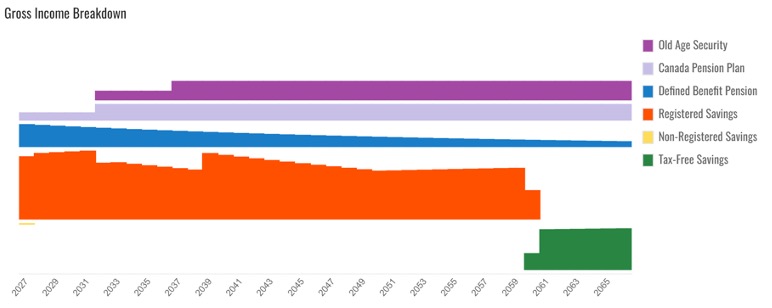
Using Cascades Financial Solutions, we’ve run a retirement income withdrawal plan resulting in three different ways to produce an after-tax annual retirement income of $45,703 for Pamela:

We’ve selected an asset allocation as moderate in the software: Moderate: 60% Fixed Income, 40% Equity,  5% rate of return and 2% inflation. All income and savings are reported in “today’s dollars” by Cascades.

Strategy Descriptions

Registered Funds First: This strategy involves creating retirement income from registered funds first, reducing the risk of leaving highly taxable investment accounts to an estate. The second priority is given to taxable non-registered accounts, leaving Tax Free Savings Accounts (TFSAs) last.

Non-Registered Funds First: This strategy involves creating retirement income from non-registered funds first, deferring the income taxes payable on registered investments. The second priority is given to registered investments, leaving Tax Free Savings Accounts (TFSAs) last.

Tax Free Funds First: This strategy involves creating retirement income from non-registered funds first and postpones the use of registered funds as long as possible. The second priority is given to Tax Free Savings Accounts (TFSAs), leaving registered funds last.

Determining a Winning Strategy: With all other factors being equal, the winning strategy provides a client longevity and the highest estate value, net of taxes and fees, at life expectancy. The differences in the net estate value represents the income tax savings of the winning strategy.  

Answering Pamela’s second question: “What are other income sources I can rely on?” There are two main programs that provide retirement income for most Canadians: the CPP or Quebec Pension Plan (QPP), and OAS.  The maximum CPP / QPP Pension you could receive starting at age 65 is $1,203.75 monthly ($14,445 annually) for 2021.[1]

Continue Reading…

New Equity-linked GICs offer equity twist on humble GIC

By Rachel Megitt, Vice President,

Term Investments & Savings, RBC

(Sponsor Content)

If you’re looking to grow your money, the future looks a lot different than it did even a few months ago, given the current volatility in the markets and intensifying inflation.

We often hear the adage “big risk equals big reward,” but what if you want the reward but aren’t comfortable taking the risk? This is where a new twist on a traditional investment is proving to be a powerful option: equity-linked GICs (Guaranteed Investment Certificates).

In the summer of 2021, we shook up our product line-up and added two new equity-linked GICs that also represented RBC firsts and proudly shared the news, including in a Findependence blog.

New GICs with an equity twist

Within the first six months, we saw client enthusiasm about these two new “GICs with an equity twist” surge well beyond our expectations. Our clients have been clamouring for these GIC options and we believe this reflects the overall desire of Canadian investors to tap into what equity-linked GICs provide: the appealing combination of a guarantee for their initial investment, plus the higher return potential that comes with an equity investment.

While we knew we had created two truly compelling and competitive GICs, we never imagined how strongly these new GICs would resonate across the country. The buzz surrounding these equity-linked options is helping reshape investment conversations in Canada. These GICs offer investors who are reluctant to buy individual equities the opportunity to step into the world of equity investing at both a pace and level of risk they are comfortable with. Continue Reading…

An income strategy for new retirees: HDIF

By David Kitai,  Harvest ETFs

(Sponsor Content)

One third of recently retired Canadians surveyed by RBC insurance said they retired sooner than they planned because of the COVID-19 pandemic. That same survey found that retirees, especially new retirees, are increasingly concerned about affording their retirement.

More than 78% of survey respondents said they were concerned about the impact of inflation on their savings. 47% said they were concerned about a lack of guaranteed income and 48% said they worry about outliving their savings.

All three of these concerns come down to income. New Canadian retirees, many of whom retired early due to COVID, are worried that they don’t have a stable source of income that can overcome the rapidly rising cost of living and last for their whole lifespans.

One income asset class can help with those worries.

Inflation worries come after years of low-yielding bonds

The income concerns discovered by the survey should come as no surprise. For the better part of a decade income yields from fixed income investments have been at or near historic lows. Retirees used to live on the income these investments provided but yields at sub 2% levels have been unsustainable.

More recently, rates have begun to rise as central banks attempt to reign in inflation. However, with inflation in spring of 2022 hitting levels above 6%, those rising bond yields are still paying negative real income.

That trend is reflected in the fact that 78% of survey respondents said they were concerned about inflation. Many traditional income sources seem incapable of matching what inflation has done to ordinary retirees’ balance sheets.

Many income sources, but not all.

Equity Income ETFs for retirees

An equity income ETF takes a portfolio of equities — stocks — and uses a combination of dividends and a covered call strategy to generate consistent monthly cashflows for unitholders. This results in an ETF with a target annual yield that can be as high as 8.5%, paid in the form of a monthly cash distribution. These assets can still participate in market growth opportunity, like an ordinary equity ETF, albeit with some growth opportunities limited due to the covered call strategy. The end result is a product paying consistent income with exposure to market growth opportunities. Continue Reading…