Most of your investing life you and your adviser (if you have one) are focused on wealth accumulation. But, we tend to forget, eventually the whole idea of this long process of delayed gratification is to actually spend this money! That’s decumulation as opposed to wealth accumulation. This stage may also involve downsizing from larger homes to smaller ones or condos, moving to the country or otherwise simplifying your life and jettisoning possessions that may tie you down.
This guest blog is excerpted from Moshe Milevsky’s recently published book, How to Build a Modern Tontine
By Prof. Moshe A. Milevsky, Ph.D.
Special to the Financial Independence Hub
I have been asked about the difference between a tontine – be it modern or medieval – and a conventional life annuity, purchased from a regulated life insurance company. Both might appear to perform similar tasks at first glance, but the differences are subtle and important and get to the essence of the distinction between longevity insurance versus longevity (or survivorship) credits.
One aspect of the life annuity story is the financial benefit of risk pooling, and the other is the insurance benefit and comfort from having a guaranteed income that you can’t outlive. Allow me to elaborate with a statement that some readers might find shocking. If you are 75 years old with $100,000 in your RRIF and would like to guarantee a fixed annual income for the rest of your life, there is absolutely no need to purchase a life annuity from an insurance company to achieve that goal. There are other options.
This might sound like something odd for a long-term annuity advocate to say. But the fact is that a non-insurance financial advisor can design a lovely portfolio of zero-coupon strip bonds that will do the job. That collection of bonds will generate $4,000 per year for the rest of your life, even if you reach the grand old age of 115. Ok, financial advisors need to eat too, so they may not do it for $100,000, but I’m sure that a lump sum of $1,000,000 will pique their interest and in exchange you will get $40,000 per year.
Moreover, with these strips, if you don’t make it all the way to the astonishing age of 115, they will continue to send those $4,000 (or $40K) to your spouse, children or favourite charity until the date you would have reached 115, if you had been alive. This collection of strips would be completely liquid, tradeable and fully reversable, although subject to the vagaries of bond market rates. For this I have assumed a conservative, safe and constant 2.5% discount rate across the entire yield curve, which isn’t entirely unreasonable in today’s increasing environment.
Stated technically, the present value of the $4,000 annual payments, for the 40 years between your current age 75 and your maximum age 115, is exactly equal to $100,000 when discounted at 2.5%. Yes, those numbers and ages were deliberately selected so my numerical example rhymes with the infamous 4% rule of retirement planning but has absolutely nothing to do with it.
Now, I’m sure you must now be thinking (or even yelling) “Moshe, but what if you live beyond age 115, eh? You will run out of money!”
Touché. Let’s unpack that common knee-jerk reaction to non-insurance solutions for a moment. To start with, the probability of reaching age 115 is ridiculously and unquantifiably low. If you do happen to be the one in a 100 million (or perhaps billion) that reaches age 115, I suspect you will have other things on your murky mind. Personally and post-covid, there is a very long list of hazards that worries me more than hitting 115.
Nobody really “runs out of money” in this century
Second and more importantly, nobody really “runs out of money” in retirement in the 21st century. That is plain utter fear-mongering nonsense. With CPP, OAS/GIS, the elderly will continue to receive some income for as long as they live even if they have completely emptied every piggy bank on their personal balance sheet. In fact, with tax-based means-testing you might get more benefits if you actually do empty your bank accounts.
Ok, so back to my prior claim and the supporting numbers, if you want a guaranteed (liquid, reversable, bequeathable) income for the rest of your life, you can exchange your $100,000 for a bunch of strip bonds and voila, you have created a sort of pension plan. My point here is that the primary objective isn’t a guaranteed lifetime of income: which anyone can create with a simple discount brokerage account and a DIY instruction manual. Continue Reading…
As we update our list of the Best Canadian Dividend Stocks for 2022, we continue to focus on four key areas:
Dividend Yield
Dividend Growth Consistency
Earnings Per Share
Overall Company Revenues
As we head into Q3, Canadian dividend stocks have continued to reward our confidence in them. While high-flying tech stocks have gotten slaughtered (and then recovered a little bit), and European stocks continue to see their growth evaporate, Canadian oligopolies continue to churn out dependable dividend growth. With Canadian forward P/E now at 12 – well below their historical average of 14 – there is no better place to be in terms of equity exposure if you prize caution and dividend yield.
While they have suffered drawdowns at times due to market-wide momentum, they have held up quite well, and earnings reports have supported the long-term viability of their dividends.
While many companies around the world are seeing their bottom lines chewed up by increasing costs, our top Canadian dividend stocks continue to show the pricing power that made us so confident in recommending them in the first place.
As a longtime dividend investor (I’ve had a Canadian dividend investing portfolio for over 15 years now, since I started the Smith Manoeuvre) I’ve learned that while current dividend yield is a beautiful thing, it’s the long-term dividend growth and earnings per share (EPS) that will really drive your overall portfolio returns.
My personal selection for the top dividend stocks for long-term investments are available below.
Our Top 10 Canadian Dividend Growth Stocks (September 2022)
Here’s a look at our top 10 long-term Canadian dividend stocks in order of their dividend increase streak.
For my full 32-stock list of Canadian dividend earners that I’m buying today – as well as the 74-stock list of US Dividend all stars that I recommend – check out the platform that I personally use to do my dividend stock research.
Note: Data on this article updates periodically. If you are looking for real time data and guidance, read our recommendation below.
More Up to Date Canadian Dividend Stocks Data
The easiest way to keep up to date with the best dividend stock picks, is by signing up with Dividend Stock Rock. DSR is not just a weekly newsletter with stock picks. It’s a program that will help you manage your portfolio and improve results using unique and sophisticated tools.
The person behind DSR is Mike, the most prominent and active dividend stock blogger in Canada and is a certified financial planner since 2003.
You can first read our detailed DSR review, or sign up now by clicking the button below. Our readers are eligible for an exclusive 33% off discount using code MDJ33.
Visit DSR & Get Exclusive Discount
2022 Canadian Dividend Update
The war in Ukraine has shaken markets around the world, and with the word “recession” appearing every two paragraphs in most financial publications, people have pulled money out of markets to some degree. (Although perhaps not as much as the initial “meltdown skeptics” initially anticipated.)
This has resulted in some stocks seeing their valuations get beat up despite actually increasing both their revenues and operating profits. You can see from the chart below for example that Canadian banks stocks just continue to print free cash flow and increase dividends at a safe (but lucrative) rate.
Given their very attractive current valuations, you’d have to expect a recession to crater their earnings by 20%+ for this to make sense – and I just don’t see that happening.
Bank
Dividend Increase
EPS
2017 Dividend
2021 Dividend
2022 Dividend
Payout Ratio
BMO.TO
25.47%
53.28%
$0.88
$1.06
$1.33
36.56%
NA.TO
22.54%
57.29%
$0.56
$0.71
$0.87
31.37%
TD.TO
12.66%
20.06%
$0.55
$0.79
$0.89
40.86%
RY.TO
11.11%
41.39%
$0.83
$1.08
$1.20
39.02%
BNS.TO
11.11%
45.30%
$0.76
$0.90
$1.00
46.54%
CM.TO
10.27%
69.38%
$1.27
$1.46
$1.61
41.81%
With payout ratios like the ones above, combined with those really solid Earnings Per Share numbers – we remain strong in our belief that there are no better options for investors who want stable long-term growth combined with free cash flow.
With inflation fears now dominating the media news cycle, we see more than ever that companies with solid balance sheets and oligopoly-driven moat stocks are the smart long-term play. Companies that can pass along those inflation-fuelled rise in costs have historically outperformed during inflation cycles.
Frankly, I think all of this talk about inflation might be a bit overdone, and that it’s likely to come down to the 3-3.5% range next year. At that rate, it’s really only a mild concern in the grand scheme of things. I’d be much more worried if this was deflation we were talking about!
Our list of top Canadian inflation stocks explains exactly which companies we believe are best positioned in order to pass along the inevitable price increases and increased costs that will come along in 2022.
Of course we remain committed to our long-term strategy of balancing EPS with a company’s ability to grow its dividend, in order to allocate our personal dividend nest egg.
Afterall, the only thing better than a high dividend yield today, is a much larger (and increasing) one tomorrow!
Check out our in-depth Dividend Stocks Rock Review for a deeper dive on just why we trust the service so much, and more details on our exclusive promo offer code.
My Top Canadian Dividend Stock Recommendations
Sorted in order of dividend streak:
Fortis (FTS.TO) – 48 Years of Dividend Growth
3.67% Dividend Yield
6.68% 5 Year Revenue Growth
6.10% 5 Year Dividend Growth
79.85% Payout Ratio
22.06 P/E
Investment Thesis:
Fortis aggressively invested over the past few years resulting in strong and solid growth from its core business. You can expect FTS’s revenues to continue to grow as it continues to expand. Strong from its Canadian based businesses, the company has generated sustainable cash flows leading to four decades of dividend payments.
The company has a five-year capital investment plan of approximately $19.6 billion for the period 2021 through 2025. Only 33% of its CAPEX plan will be financed through debt. Nearly two-thirds will come from cash from operations. Chances are most of its acquisitions will happen in the US.
We also like the FTS goal of increasing its exposure to renewable energy from 2% of its assets in 2019 to 7% in 2035. The FTS yield isn’t impressive at around 3.70%, but there is a price to pay for such a high-quality dividend grower.
Dividend Growth Perspective:
Management increased its dividend 6% in 2019 and 2020 and has declared that it expects to increase dividends by 6% annually until 2025. We like it when companies show motivation for growth (through acquisitions) and reward shareholders at the same time!
After all, Fortis is among those rare Canadian companies who can claim it has increased its dividend for 48 consecutive years. Fortis is a great example of a “sleep well at night” stock.
Enbridge (ENB.TO) – 26 Years of Dividend Increases
6.38% Dividend Yield
6.37% 5 Year Revenue Growth
9.52% 5 Year Dividend Growth
117.23% Payout Ratio
22.30 P/E
Investment Thesis:
ENB’s customers enter 20-25-year transportation contracts. It is already well positioned to benefit from the renewed profits of the Canadian Oil Sands (as its Mainline covers 70% of Canada’s pipeline network).
As production grows, the need for ENB’s pipelines remains strong.
After the merger with Spectra, about a third of its business model will come from natural gas transportation. Enbridge has a handful of projects on the table or in development. It must deal with regulators notably for their Line 3 and Line 5 projects. Both projects are slowly but surely developing.
The cancellation of the Keystone XL pipeline (TC Energy) secures more business for ENB for its liquid pipelines. ENB has now a “greener” focus with their investments in renewable energy. The stock offers a yield over 6% which makes it a strong candidate for any retirement portfolio.
Dividend Growth Perspective:
The company has been paying dividends for the past 65 years and has 26 consecutive years with an increase. While it’s probable dividend growth won’t be as generous as compared to the past three years (10%/year), the current generous yield makes up for it. Management aims at distributing 65% of its distributable cash flow, leaving enough room for CAPEX.
Look for their latest quarterly presentation for their payout ratio calculation. Management expects distributable cash flow growth of 5-7%. Therefore, you can expect a similar dividend growth rate. We have used more conservative numbers in our DDM calculation.
Canadian National Railway (CNR.TO) – 26 Years of Dividend Increases
1.90% Dividend Yield
3.76% 5 Year Revenue Growth
10.40% 5 Year Dividend Growth
35.57% Payout Ratio
21.17 P/E
Investment Thesis:
Canadian National has been known for being the “best-in-class” for operating ratios for many years. CNR has continuously worked on improving its margins. The company also owns unmatched quality railroads assets.
CNR has a very strong economic moat as railways are virtually impossible to replicate. Therefore, you can count on increasing cash flows each year. Plus, there isn’t any more efficient way to transport commodities than by train. The good thing about CNR is that you can always wait for a down cycle to pick up some shares. There’s always a good occasion around the corner when we look at railroads as attractive investments.
Finally, the cancellation of the Keystone XL pipeline has driven more oil transportation toward railroads. CNR has benefitted from this tailwind.
In 2021 CNR entered a bidding war against CP to buy the Kansas City Southern Railroad. When the deal fell through for CNR, and the company announced a renewed focus on efficiency, long-term investors were rewarded handsomely as the stock shot up in value.
Dividend Growth Perspective:
CNR has successfully increased its dividend yearly since 1996. The management team makes sure to use a good part of its cash flow to maintain and improve railways, all while rewarding shareholders with generous dividend payments.
CNR shows impressive dividend records with very low payout ratios. While the business could face headwinds from time to time, its dividend payment will not be affected. Shareholders can expect more high-single-digit dividend increases.
Telus (T.TO) – 18 Years of Dividend Increases
4.58% Dividend Yield
5.76% 5 Year Revenue Growth
6.68% 5 Year Dividend Growth
103.38% Payout Ratio
22.10 P/E
Investment Thesis:
Telus has grown its revenues, earnings, and dividend payouts on a very consistent basis. It is very strong in the wireless industry and is now attacking other growth vectors such as the internet and television services.
The company has the best customer service in the wireless industry as defined by their low churn rate. It uses its core business to cross-sell its wireline services. Telus is particularly strong in Western Canada, but has the recent Rogers turmoil to increase market share throughout the country.
Telus is well-positioned to surf the 5G technology tailwind. This Canadian telecom stalwart looks at original (and profitable) ways to diversify its business. Telus Health, Telus Agriculture and Telus International (artificial intelligence) (TIXT.TO) are small, but emerging divisions that should lead to more growth going forward.
Dividend Growth Perspective:
This Canadian Aristocrat is by far the industry’s best long-term dividend-payer (as opposed to short-term yield). Telus has a high cash payout ratio as it puts more cash into investments and capital expenditures.
Capital expenditures are always taking away significant amounts of cash due to their massive investment in broadband infrastructure and network enhancement. Such investments are crucial in this business.
Telus fills the cash flow gap with financing for now. At the same time, Telus keeps increasing its dividend twice a year showing strong confidence from management.
Emera (EMA.TO) – 15 Years of Dividend Increases
4.31% Dividend Yield
6.15% 5 Year Revenue Growth
5.24% 5 Year Dividend Growth
128.82% Payout Ratio
29.42 P/E
Investment Thesis:
Emera is a very interesting utility with a solid core business established on both sides of the border. EMA now shows $32 billion in assets and will generate annual revenues of about $6 billion. It is well established in Nova Scotia, Florida, and four Caribbean countries.
This utility is counting on several “green projects” consisting of both hydroelectric and solar plants. Between 2021 and 2023 management expects to invest $7.4 to $8.6B in new projects to drive additional growth. These investments decrease the risk of future regulations affecting its business as the world is slowly moving toward greener energy.
Most of its CAPEX plan will be deployed in Florida where Emera is already well established. In general, Florida offers a highly constructive regulatory environment. In other words, EMA shouldn’t have any problems raising rates. This is another “sleep well at night” investment.
Dividend Growth Perspective:
Emera has been increasing its dividend payments each year for over a decade. With the purchase of TECO energy management intends to continue that tradition. The company forecasts a 4-5% dividend growth rate through 2022, while targeting a payout ratio of 70-75%.
At a 4%+ dividend yield, this is a keeper for several years. Don’t get fooled by the high payout ratio, as the adjusted earnings show a payout ratio around 80% including the recent dividend growth. This is the type of company that fits perfectly in a retirement portfolio.
It’s a trade-off. I hold a concentrated portfolio of Canadian stocks. What I give up in greater diversification, I gain in the business strength and potential for the companies that I own to not fail. They have wide moats or exist in an oligopoly situation. For the majority of the Canadian component of my RRSP account I own 7 companies in the banking, telco and pipeline space. I like to call it the Canadian wide moat portfolio.
(updated August 24, 2022) Like many Canadian investors I discovered over the years that my Canadian stocks that pay very generous dividends were beating the performance of the market. You’ll find that market-beating event demonstrated by the Beat The TSX Portfolio. Eventually, I moved to the stock portfolio approach.
Over longer periods you’ll see that BTSX beat the TSX 60 by 2% annually or more. And as always, past performance does not guarantee future returns.
For the bulk of my Canadian contingent I hold 7 stocks.
Canadian banking
Royal Bank of Canada, Toronto-Dominion Bank and Scotiabank.
Telco space
Bell Canada and Telus.
Pipelines
Canada’s two big pipelines are Enbridge and TC Energy (formerly TransCanada Pipelines).
For the U.S. component there is a basket of U.S. stocks. Here’s an update of our U.S. stock portfolio. That portfolio continues to provide impressive market-beating performance.
Here’s the Canadian wide moat 7 from 2014 vs the TSX Composite, to the end of July 2022. I slightly overweight to the telcos and banks. The portfolio for demonstration purposes is rebalanced every year. When reinvesting I usually throw money at the most beaten-up stock. That would be a reinvestment strategy that seeks value and greater income, the general approach of the Beat The TSX Portfolio.
2021 was a very good year for the wide moat portfolio. It beat the TSX, but did underperform the Beat The TSX Portfolio model and Vanguard’s High Dividend ETF (VDY). The outperformance of the Wide Moat 7, over the market, is accelerating in 2022.
In 2022 the Canadian Wide Moat 7 is up 1.14%. The TSX Composite is down 5.56%. For the record, the Vanguard High Dividend (VDY) is up 2% in 2022 to the end of July.
Charts courtesy of Portfolio Visualizer
Annualized returns and volatility
The Canadian Wide Moat 7 has delivered greater total returns and with less volatility and less drawdowns in corrections. The market beat is somewhat consistent with the Beat The TSX Portfolio beat of over 2% per year.
And of course the portfolio dividend income is more than impressive. I did not create portfolio exclusively based on the generous and growing income, but it is a wonderful by-product. The following is based on a hypothetical $10,000 portfolio start amount. The starting yield is above 4%, growing towards a 10% yield (on cost) based on the 2014 start date.
In the above, the dividends are reinvested. For example, the Telus dividend is reinvested in Telus. While I will take a total return approach for retirement funding, the generous portfolio income contribution will add a dimension that will help reduce the sequence-of-returns risk. I am in the semi-retirement stage.
Performance update to the end of May 2022
In this chart I begin with the inception date of the Vanguard High Yield VDY, 2013. We see the Canadian Wide Moat 7 vs VDY and the TSX Composite – XIC.
The Wide Moat stocks have outpeformed for the full period, but that is thanks mostly to better returns out of the gate. The outperformance is also aided by lesser drawdowns in market corrections. We see that both the Wide Moat approach and VDY have beat the market, with ease.
Wide Moats with an energy kick
I also hold Canadian energy stocks in the mix. That energy allocation is near 10%. Here’s what it looks like over the last year with that energy kicker. The following table looks at from January of 2021 to the end of July 2022. Continue Reading…
Millennials — the generation born between 1981 and 1997 — are beginning to enter their 40s. With the passing of that milestone comes a new consideration: retirement.
Canadians are living longer and longer, retirement at or around age 65 may need to last 30+ years. Millennials in their 30s and early 40s are ideally placed to plan for their eventual retirement. In those typically peak working years, millennials can take major strides towards a stable financial future and the achievement of their retirement goals. Preparing for retirement, though, is more than just putting a magic number away in a bank account. There are myriad factors a millennial should consider as they begin to plan for retirement. Below are five of those factors.
1.) Understanding RRSPs and RRIFs
Registered Retirement Savings Plan (RRSP) accounts are a key tool Canadians can use to save for retirement. Their mechanism is simple: contributions to these accounts within the annual limit are tax-deductible. Income earned by investments held in the RRSP is also tax exempt, provided that income stays in the account. RRSPs give you an annual tax incentive to save for your retirement.
Millennials considering their retirement should look at how RRSPs can give them a tax benefit for saving now, while also planning for how the eventual transition to RRIFs will change their financial realities.
2.) How the Canada Pension Plan factors into retirement
Canadians between the ages of 60 and 70 who worked in Canada and contributed to the Canada Pension Plan (CPP) can elect to activate their CPP benefits. Those benefits will be paid as monthly income based on how much you earned and contributed during your working years, as well as the age you chose to begin receiving benefits.
The longer you wait before turning 70, the higher your CPP benefits will be, though that appreciation doesn’t go beyond age 70. Millennials planning for retirement at any age could consider how they’ll finance their lifestyles while maximizing their CPP benefits at age 70. It’s notable that even the highest levels of CPP benefits pay less than $2,000 per month in 2022. That won’t be enough for many Canadians to live on, and millennials considering retirement may want to think about other sources of income.
3.) Equity Income ETFs
One of the issues that retirees have struggled with over the past decade has been the extremely low yields of traditional fixed income products like bonds. In 2022 those rates rose somewhat, but only following record inflation eating away at the ‘real yields’ of an income investment.
Many equity income ETFs pay annualized yields higher than most fixed income and higher than the rate of inflation. These ETFs hold portfolios of equities — stocks — but pay distributions generated through a combination of dividends and other strategies. Harvest equity income ETFs use an active and flexible covered call option writing strategy to help generate their monthly cash distributions.
These ETFs still participate in some of the market growth opportunity a portfolio of stocks would, while also delivering consistent monthly cash flow for unitholders. The income they pay can help retirees finance their lifestyle goals and help millennials as they prepare themselves to retire.
4.) Tax efficiency of retirement income
Tax is a crucial consideration for any younger person thinking about retirement. Aside from the tax issues surrounding RRSPs and RRIFs, any income-paying investments held in non-registered accounts, or any income withdrawn from a registered account, will be subject to tax. Dividend payments and interest payments from fixed-income investments are taxed as income. Continue Reading…
I often recommend deferring CPP until age 70 to secure more lifetime income in retirement. It’s also possible to defer OAS to age 70 for a smaller, but still meaningful, increase in guaranteed income.
While the goal is to design a more secure retirement, there can be a psychological hurdle for retirees to overcome. That hurdle has to do with withdrawing (often significant) dollars from existing savings to fill the income gap while you wait for your government benefits to kick in.
Indeed, the idea is still to meet your desired spending needs in retirement – a key objective, especially to new retirees.
This leads to what I call the retirement risk zone: The period of time between retirement and the uptake of delayed government benefits. Sometimes there’s even a delay between retirement and the uptake of a defined benefit pension.
Retirement Risk Zone
The challenge for retirees is that even though a retirement plan that has them drawing heavily from existing RRSPs, non-registered savings, and potentially even their TFSAs, works out nicely on paper, it can be extremely difficult to start spending down their assets.
That makes sense, because one of the biggest fears that retirees face is the prospect of outliving their savings. And, even though delaying CPP and OAS helps mitigate that concern, spending down actual dollars in the bank still seems counterintuitive.
Consider an example of a recently divorced woman I’ll call Leslie, who earns a good salary of $120,000 per year and spends modestly at about $62,000 per year after taxes (including her mortgage payments). She wants to retire in nine years, at age 55.
Leslie left a 20-year career in the public sector to work for a financial services company. She chose to stay in her defined benefit pension plan, which will pay her $24,000 per year starting at age 65. The new job has a defined contribution plan to which she contributes 2.5% of her salary and her employer matches that amount.
Leslie then maxes out her personal RRSP and her TFSA. She owns her home and pays an extra $5,000 per month towards her mortgage with the goal of paying it off three years after she retires.
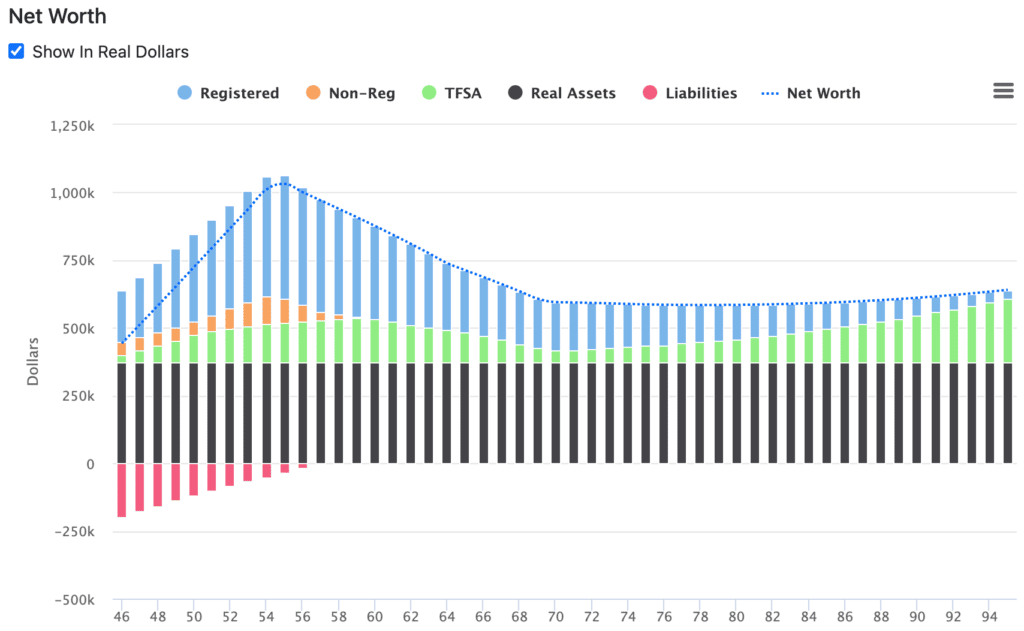
Because of her impressive ability to save, Leslie will be able to reach her goal of retiring at 55. But she’ll then enter the “retirement risk zone” from age 55 to 65, while she waits for her defined benefit pension to kick in, and still be in that zone from 65 to 70 while she waits to apply for her CPP and OAS benefits.
The result is a rapid reduction in her assets and net worth from age 55 to 70:
Leslie starts drawing immediately from her RRSP at age 56, at a rate of about 7.5% of the balance. She turns the defined contribution plan into a LIRA and then a LIF, and starts drawing the required minimum amount. Finally, she tops up her spending from the non-registered savings that she built up in her final working years.
When the non-registered savings have been exhausted at age 60, Leslie turns to her TFSA to replace that income. She’ll take that balance down from $216,000 to about $70,000 by age 70. Continue Reading…


 Posted By







 Posted By